

Acrylic Display Glossary: 68 Buyer Terms Defined
Sixty-eight terms buyers, designers and factories use for custom acrylic displays and packaging, each defined in one plain sentence.
Need this made?Custom acrylic product lines →
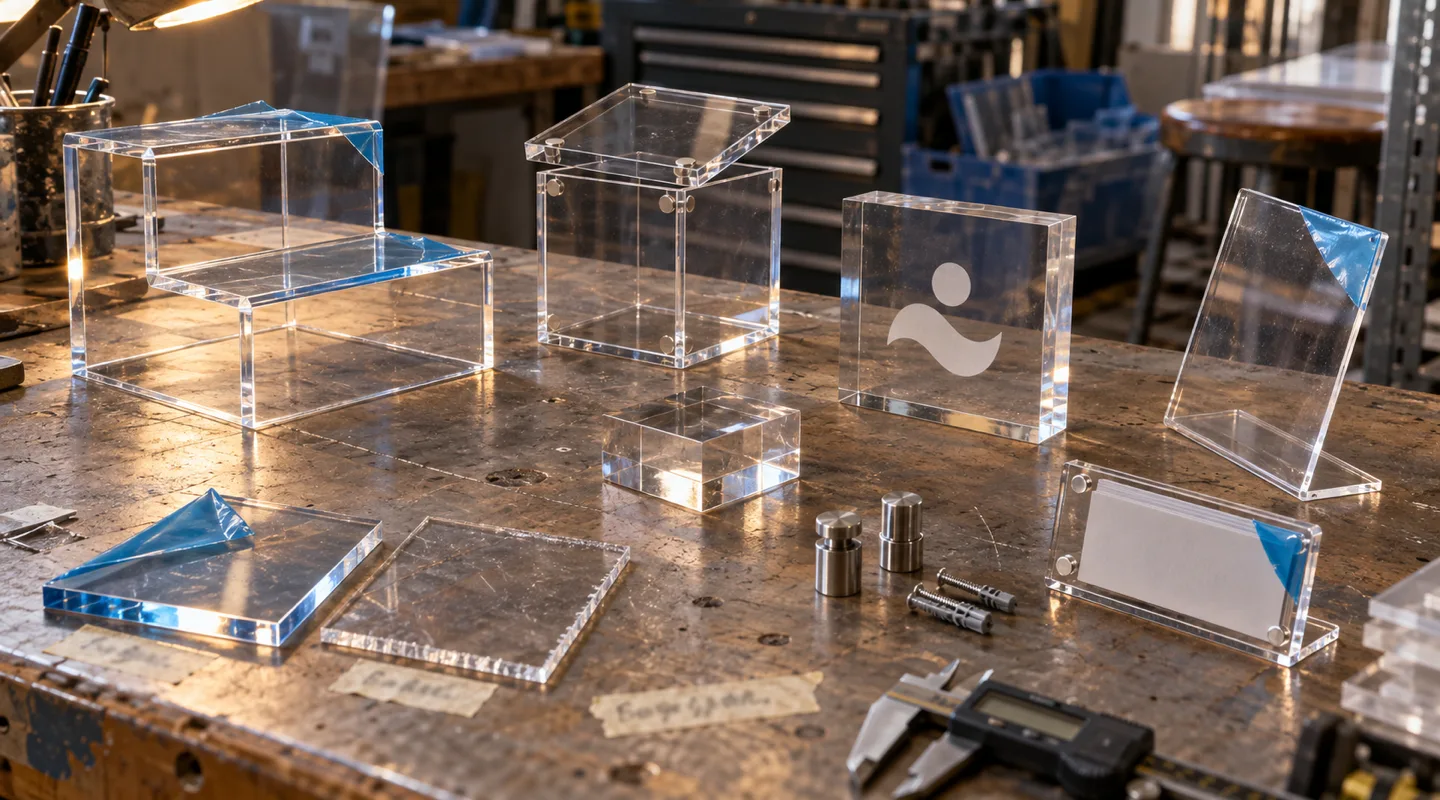
Use it to write an RFQ the factory reads the same way you do.
Key Takeaways
- Cast and extruded acrylic are both PMMA; cast sheet machines and polishes more cleanly, while extruded sheet holds thickness more tightly.
- Edge finish is named per edge on the drawing: diamond-polished, flame-polished or cut edge. Wetop's standard working tolerance is ±0.2 mm unless the approved drawing states otherwise.
- MOQ is counted per design: 100 pieces. Changing only names, numbers or dates keeps one design; a new shape, size, color or print method is a new design.
- Top loaders, penny sleeves and card savers are mass-produced in PVC or polypropylene and are not what Wetop builds; Wetop makes premium thick acrylic card holders and display cases.
- FOB Shenzhen prices stop at the vessel in China; DDP prices include delivery and import duties to your door. Name the term on every quote you compare.
On this page
How to use this acrylic display glossary
This acrylic display glossary defines 68 terms buyers, designers and factories use when they specify custom acrylic displays, cases, boxes and packaging. Each entry opens with a one-sentence definition and links to the Wetop page that covers the topic in depth. Terms are grouped by stage: material, cutting and finishing, decoration, construction, display formats, card storage, inspection, and ordering.
A shared vocabulary saves a revision round. When an RFQ says “polished edges” and the factory reads “flame-polished” while the buyer meant “diamond-polished”, the first sample comes back wrong. Writing the exact term on the drawing, and checking it against the Wetop acrylic standard, keeps the quote, the sample and the production run aligned.
Material terms
Acrylic material terms describe the sheet before any cutting: what polymer it is, how it was made, and which trade name or finish it carries. The sheet decides clarity, thickness accuracy and how well edges polish, so these words belong in the first line of any specification.
Acrylic (PMMA)
Acrylic is the common name for polymethyl methacrylate (PMMA), a clear, rigid thermoplastic used as a lighter, more impact-resistant alternative to glass.1 Wetop fabricates acrylic from sheet bought from sheet makers; it does not cast sheet itself.
Cast acrylic
Cast acrylic is PMMA sheet made by curing liquid monomer between glass plates, which gives better edge polish, cleaner laser engraving and better machining than extruded sheet. Its thickness band is wider: under ISO 7823-1 a 3 mm cast sheet may measure 2.3–3.7 mm. See cast vs extruded acrylic.
Extruded acrylic
Extruded acrylic is PMMA sheet pushed through a fixed die, which holds thickness more tightly (roughly ±5% above 3 mm) but polishes and engraves less cleanly than cast sheet. It suits parts that slot or stack on thickness.
Plexiglass, Lucite and Perspex
Plexiglass, Lucite and Perspex are brand names that became everyday words for acrylic sheet; all three describe PMMA. The plexiglass vs acrylic terminology guide explains where each name came from.
PETG
PETG is a copolyester sheet that bends cold and resists impact better than acrylic but scratches more easily and polishes poorly at the edge. The cast acrylic vs PETG and polycarbonate guide compares them for displays.
Polycarbonate
Polycarbonate is a very impact-resistant clear plastic used for security glazing; it is tougher than acrylic but softer on the surface, yellows more readily and does not polish to the same edge clarity.
Frosted acrylic
Frosted acrylic is sheet with a matte, light-diffusing surface that hides fingerprints and softens what sits behind it. See clear vs frosted vs colored acrylic.
Mirrored acrylic
Mirrored acrylic is sheet with a reflective metallized backing, used for risers, shoe displays and jewelry bases; thin mirror sheet can bow under warm lights, so large panels need thicker stock.
UV-filtering acrylic
UV-filtering acrylic is a sheet grade with additives that block much of the ultraviolet light that fades signatures, inks and printed card art. See UV-filtering acrylic for trading cards.
Pantone matching
Pantone matching is making colored sheet or print to a named Pantone reference, judged against the physical chip on the approved sample under the display lighting. See Pantone color matching for acrylic.
Cutting and edge-finishing terms
Cutting and finishing terms describe how a part is shaped and what its edges look like. Edge finish is the most visible quality signal on a clear acrylic display, so name it per edge on the drawing rather than writing “polished” once for the whole part.
Laser cutting
Laser cutting is shaping acrylic with a focused CO2 beam that vaporizes material along a programmed path, leaving a smooth, glossy cut edge on most flat profiles. See acrylic laser cutting.
CNC machining
CNC machining is cutting acrylic with a computer-controlled rotating bit, used for thick stock, pockets, countersunk holes and edges that will be diamond-polished. See CNC machining and CNC vs laser cutting.
Kerf
Kerf is the width of material a laser beam or cutting bit removes; on acrylic laser cuts it runs roughly 0.18 mm on thin sheet to 0.32 mm at 20 mm, and the cutting program offsets for it.
Tolerance
Tolerance is the allowed difference between a dimension on the drawing and the finished part. Wetop’s standard working tolerance is ±0.2 mm unless the approved drawing states otherwise, with ±0.1 mm on fit-critical 2D features after drawing review; see the tolerance table.
Diamond polishing
Diamond polishing is finishing an acrylic edge with a diamond-tipped cutter that shaves it flat and bright, giving a crisp, square, glass-like edge. See diamond vs flame polishing.
Flame polishing
Flame polishing is passing a controlled flame over a cut edge to melt the surface smooth and glossy; it is fast and suits curved edges but can leave slight rounding and stress near the edge.
Cut edge (unpolished)
A cut edge is an edge left as it comes off the laser or CNC with no polishing step, used where the edge is hidden or the drawing calls for it.
Heat bending
Heat bending is warming a straight line across a sheet and folding it to an angle, the method behind sign holders, brochure holders and one-piece risers. See heat bending and thermoforming.
Thermoforming
Thermoforming is heating a whole sheet until soft and forming it over a mold to make domes, curves and trays that cannot be bent along a single line.
Crazing
Crazing is a network of fine surface cracks in acrylic caused by stress combined with solvents, alcohol-based cleaners or repeated heat; it is why acrylic is wiped with mild detergent and never put in a dishwasher. See how to clean acrylic displays.
Printing and decoration terms
Decoration terms describe how a logo, artwork or text gets onto or into the acrylic. The method sets the look, the durability and whether a new design counts toward a separate minimum, so name it on the RFQ.
UV printing
UV printing is inkjet printing directly on acrylic with inks cured instantly by ultraviolet light, which prints full color and photos with no screens or plates. See UV printing on acrylic.
White ink layer (underbase)
A white ink layer is an opaque white print laid under or over the color on clear acrylic so the color reads solid instead of see-through.
Reverse printing
Reverse printing is printing artwork mirrored on the back face of clear acrylic so it is viewed through the sheet, which protects the print and gives depth.
Silk-screen printing
Silk-screen printing is pushing ink through a mesh stencil, one screen per color; it suits solid spot colors on larger runs and lasts well outdoors. See box printing methods.
Laser engraving
Laser engraving is marking acrylic with a laser that frosts the surface, leaving a permanent white-looking mark with no ink. See logo block engraving vs UV printing.
Hot stamping
Hot stamping is pressing a heated die through metallic or colored foil to transfer a crisp foil mark onto acrylic, often gold or silver on boxes and awards.
Embedded logo (sealed inside)
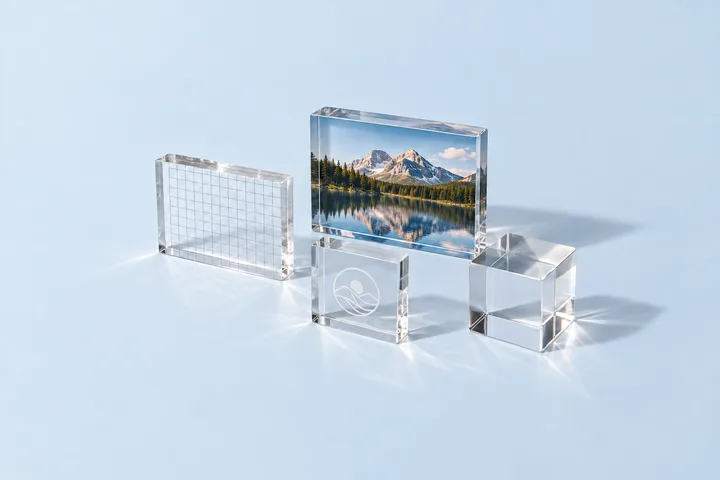
An embedded logo is a flat printed logo laminated between two clear acrylic layers so it appears to float inside the block. Wetop seals flat printed inserts and logo layers; it does not cast real objects, coins or banknotes inside acrylic. See acrylic logo blocks.
Variable text
Variable text is the part of an otherwise identical design that changes piece to piece, such as names, numbers, years, dates, locations or titles; it does not create a new design for the 100-piece minimum.
Construction and assembly terms
Construction terms describe how flat parts become a finished box, case or stand. Joints, closures and hardware decide strength, appearance and how the product ships, so they belong on the drawing next to the dimensions.
Solvent bonding
Solvent bonding is joining acrylic parts with a solvent that softens both faces so they fuse into one joint, giving clear, near-invisible seams. See box joinery and seam quality.
Mitered joint
A mitered joint is a corner where both edges are cut at 45 degrees and bonded, so no panel edge shows on the outside; it is the premium corner on display cases.
Butt joint (90-degree joint)
A butt joint is a corner where one panel’s edge is bonded flat against the face of the other, the simplest and most common acrylic box corner.
Magnetic lid
A magnetic lid is a lid held shut by small magnets set into the lid and the box walls, so it lifts off without hinges. See box lid closure types.
Standoff
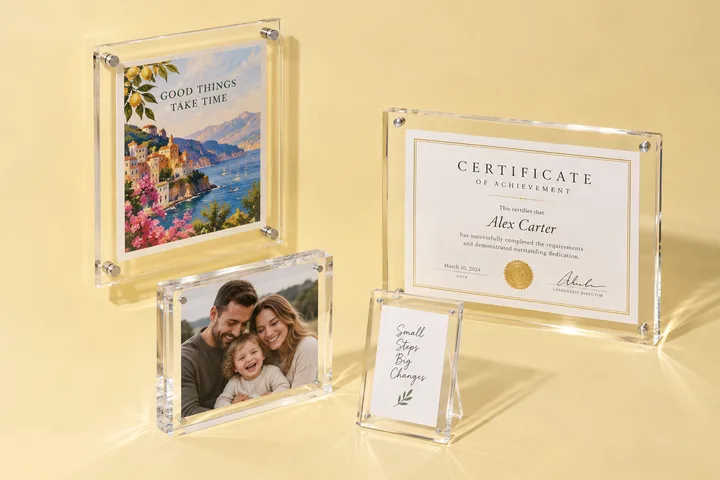
A standoff is a metal pin or barrel that holds an acrylic panel away from a wall, typically 15–25 mm, through drilled holes. See acrylic poster frames.
Sandwich frame
A sandwich frame is two acrylic panels clamped together with the print, certificate or puzzle held flat between them, with no glue on the artwork.
Insert
An insert is a removable printed card, foam piece or velvet-lined tray that fits inside an acrylic holder, box or tray; in sign holders and tray bottoms it lets the graphic change without a new part. See box insert options.
Protective film
Protective film is the peel-off plastic film on new acrylic sheet that guards both faces from scratches through cutting, packing and transit, removed by the end user. See protective film for shipping displays.
Display format terms
Display format terms name the type of fixture. Using the format word buyers and retailers already use makes the brief faster to quote and the finished unit easier to place in the store.
Countertop display
A countertop display is a small freestanding stand that holds products or literature on a retail counter near the register. See countertop display stands.
Riser
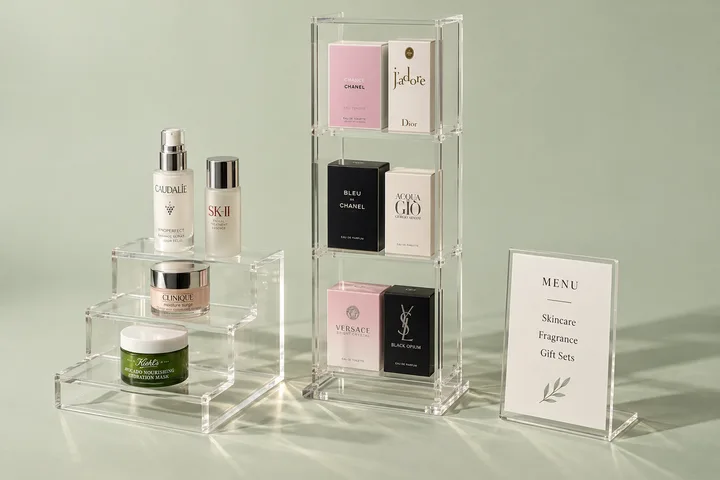
A riser is a step or block that lifts products a few centimeters above a counter or shelf, often in two or three tiers, so each item is visible. See acrylic risers.
Plinth
A plinth is a solid block or box base that a single object sits on to set it apart; in acrylic it is usually a solid display block or a five-sided box. See acrylic display blocks.
Pedestal
A pedestal is a tall freestanding column that brings one object up to eye level on the floor, often with a clear cover. See acrylic display pedestals.
Glorifier
A glorifier is a small raised base, often lit or branded, that spotlights a single hero product such as a fragrance bottle on a beauty counter. See cosmetics and perfume displays.
Shadow box
A shadow box is a deep, wall-hung or freestanding frame with space between the front panel and the back for three-dimensional items such as jerseys, medals or signed memorabilia. See acrylic shadow boxes.
Display case (cover on base)
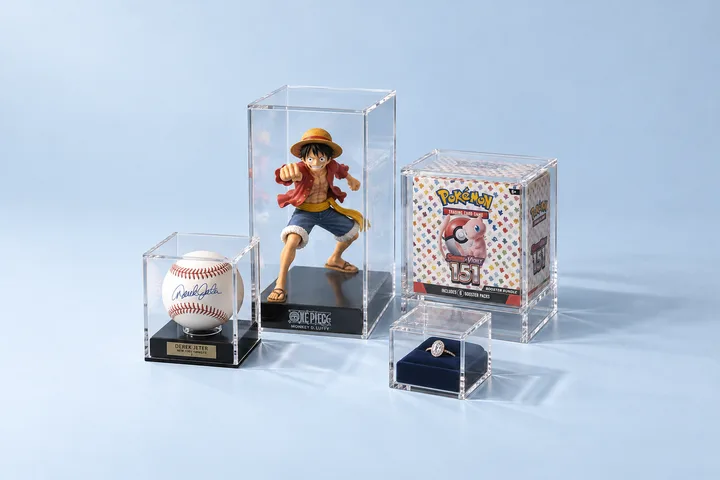
A display case is an enclosed acrylic box, often a clear cover on a separate base, that protects an object from dust and handling while keeping it fully visible. See acrylic display cases.
Sign holder
A sign holder is a frame of bent or bonded acrylic that holds a printed sign or menu, the most common being the slant-back L-shape and the T-style double-sided stand. See acrylic sign holders and the sign holder size chart.
Shelf talker
A shelf talker is a small sign that clips to or sits on a retail shelf edge to call out a product, price or promotion. See acrylic shelf talkers.
Header card
A header card is the printed panel at the top of a display that carries the brand name or campaign, often swappable so the stand outlives one promotion. See interchangeable display graphics.
Slatwall
Slatwall is a wall panel with horizontal grooves that accept hooks, shelves and holders, so acrylic fixtures can be moved without drilling.
POP display
A POP (point-of-purchase) display is any fixture placed where the shopper decides to buy, from counter units to floor stands. See POP and POS displays.
Trading card storage terms
Card storage terms are where buyers most often mix up products. The table and definitions below separate the thin, mass-produced card supplies from the thick acrylic holders and display cases a fabricator builds.
| Term | What it is | Does Wetop make it? |
|---|---|---|
| Penny sleeve | Thin soft sleeve | No (mass-produced in polypropylene) |
| Top loader | Thin rigid sleeve, open at one end | No (mass-produced in PVC) |
| Card saver | Semi-rigid holder used for grading submissions | No |
| Graded slab | Sealed holder from a grading company | No; Wetop makes stands and cases for slabs |
| Magnetic card holder | Thick acrylic plates closed by magnets | Yes, from 100 pieces per design |
Penny sleeve
A penny sleeve is a thin, soft plastic sleeve that a single card slides into for basic scratch protection, usually before it goes into a top loader.
Top loader
A top loader is a thin, rigid PVC sleeve open at one end, about 3 × 4 inches for standard cards, rated by the card thickness it holds in points. See top loader sizes.
Card saver
A card saver is a semi-rigid, flexible plastic holder that collectors use mainly to send raw cards to a grading company.
Graded slab
A graded slab is the sealed, tamper-evident holder a grading company such as PSA, BGS, SGC or CGC puts a card in after grading, with a label above the card. Wetop makes stands, multi-slot blocks and cases sized to slabs, not the slabs themselves; see PSA slab dimensions and graded card display cases.
Magnetic card holder (one-touch)
A magnetic card holder is two thick, polished acrylic plates with a recess for the card, closed by magnets, often with a logo or printed backing and an optional UV-filtering sheet. This premium thick acrylic holder is the card product Wetop builds, from 100 pieces per design. See card display cases.
Quality and inspection terms
Inspection terms define how a factory proves an order matches what you approved. Wetop accepts every order against the approved drawing for dimensions and the approved physical sample for finish and fit, as set out in the Wetop acrylic standard.
Approved sample
An approved sample is the paid pre-production sample the buyer signs off in writing, which becomes the acceptance reference for finish, print appearance and fit. An acrylic sample normally costs USD 200–500 per design and is never credited to production. See the sample approval checklist.
First article inspection (FAI)
First article inspection is measuring the first production piece against every dimension on the drawing before the full run continues. See the first article inspection checklist.
100% inspection
100% inspection means every finished piece, not a sample, is checked against the approved drawing and sample before packing; Wetop has inspected every product leaving the factory this way since 2018.
AQL (acceptable quality limit)
AQL is the worst average process quality a sampling plan is designed to keep accepting, set per defect class; it is not a percentage of your order allowed to be defective.2 The common convention is 0 for critical, 2.5 for major and 4.0 for minor defects. See the sampling and AQL table.
Pre-shipment inspection (PSI)
A pre-shipment inspection is a check of finished, packed goods before the balance is paid and the shipment leaves, usually when production is complete and at least 80% packed. See pre-shipment inspection for acrylic orders.
Show face
A show face is any surface the end customer sees in use; defects on show faces are classed as major, while the same mark on a hidden face is minor.
ISTA 3A
ISTA 3A is an International Safe Transit Association test procedure that simulates parcel-delivery handling on a packed carton; Wetop signs it off where it is stated in the quote. See how acrylic orders are packed.
Ordering, pricing and shipping terms
Ordering terms set what a quote covers and who carries cost and risk at each step. Two quotes that look different are often the same price under different trade terms, so compare them on the same terms.
MOQ per design
MOQ per design is the minimum order quantity counted for each distinct design; Wetop’s standard is 100 pieces per design, with paid samples separate from that minimum. A matched set of display blocks or risers in several heights ordered together counts as one design.
Reference price
A reference price is a published price for one named specification at a stated quantity, given so buyers can budget; any other specification is quoted from the buyer’s drawing. All of Wetop’s are in the published reference prices table.
FOB (Free On Board)
FOB is an Incoterms rule under which the seller delivers the goods on board the vessel at the named port, after which cost and risk pass to the buyer; Wetop quotes FOB Shenzhen by default.3 See FOB vs DDP.
DDP (Delivered Duty Paid)
DDP is an Incoterms rule under which the seller delivers to the buyer’s named place with import duties and taxes paid, so the buyer receives the goods with no customs bill.4
EXW and CIF
EXW (Ex Works) means the buyer collects from the factory and carries every cost after that, while CIF (Cost, Insurance and Freight) means the seller pays sea freight and insurance to the destination port; Wetop also quotes both.
Blind drop shipping
Blind drop shipping is shipping a production order straight to a reseller’s client in plain cartons, with no Wetop branding or invoice in the box and the reseller’s own packing list and labels. See blind drop shipping for custom acrylic.
Lead time
Lead time is the time from an approved sample or order to finished goods; for standard Wetop acrylic orders it is 3–5 days for a sample and 15–20 days for production, before transit. See production lead times.
Tooling fee
A tooling fee is a one-time charge for a mold, jig or die needed to make a part; most acrylic products need none, and when a complex part does, the fee is stated in the written quote. See CNC acrylic vs molded parts.
Footnotes
-
Poly(methyl methacrylate) — Wikipedia — overview of PMMA’s chemistry, trade names (Plexiglas, Lucite, Perspex) and use as a lighter, shatter-resistant alternative to glass, supporting the acrylic definition. ↩
-
ANSI/ASQ Z1.4 & Z1.9 sampling standards — American Society for Quality — the publisher’s page for the Z1.4 attribute sampling standard that defines AQL-based sampling plans, inspection levels and accept/reject numbers. ↩
-
Incoterms 2020 — International Chamber of Commerce — the ICC’s official page for the eleven Incoterms rules, including where cost and risk transfer under FOB. ↩
-
Know Your Incoterms — US International Trade Administration — US government explainer of buyer and seller obligations under each Incoterm, including DDP and EXW. ↩
Frequently Asked Questions
What is the difference between a riser, a plinth and a pedestal?
A riser lifts products a few centimeters on a counter or shelf, often in tiers. A plinth is a solid block or box base that one object sits on. A pedestal is a tall, freestanding column that brings an object to eye level on the floor. All three are built to your drawing from 100 pieces per design.
What does MOQ per design mean for custom acrylic?
The 100-piece minimum applies to each design. Changing only variable text such as names, numbers, years or locations keeps one design, so the minimum is the sum of all personalized pieces. A different shape, size, artwork layout, color or print method is a separate design with its own 100-piece minimum.
What is AQL in acrylic inspection?
AQL (acceptable quality limit) is the worst average process quality a sampling plan is designed to keep accepting; it is not a defect allowance for your order. Wetop inspects 100% of finished pieces and layers ANSI/ASQ Z1.4 sampling on top for larger lots, with the common 0 / 2.5 / 4.0 levels for critical, major and minor defects.
Can I order top loaders or penny sleeves from Wetop?
No. Standard top loaders, penny sleeves, card savers and slab sleeves are mass-produced in PVC or polypropylene, and that is not what we build. Wetop makes premium thick acrylic card holders with magnetic or screw-down closures, plus acrylic stands and cases for graded slabs, from 100 pieces per design.
Explore Custom Acrylic Products
Browse product categories to compare formats, materials, and customization options before choosing the closest fit for your project.