

RFQ Template for a Custom Acrylic Quote: 9 Fields
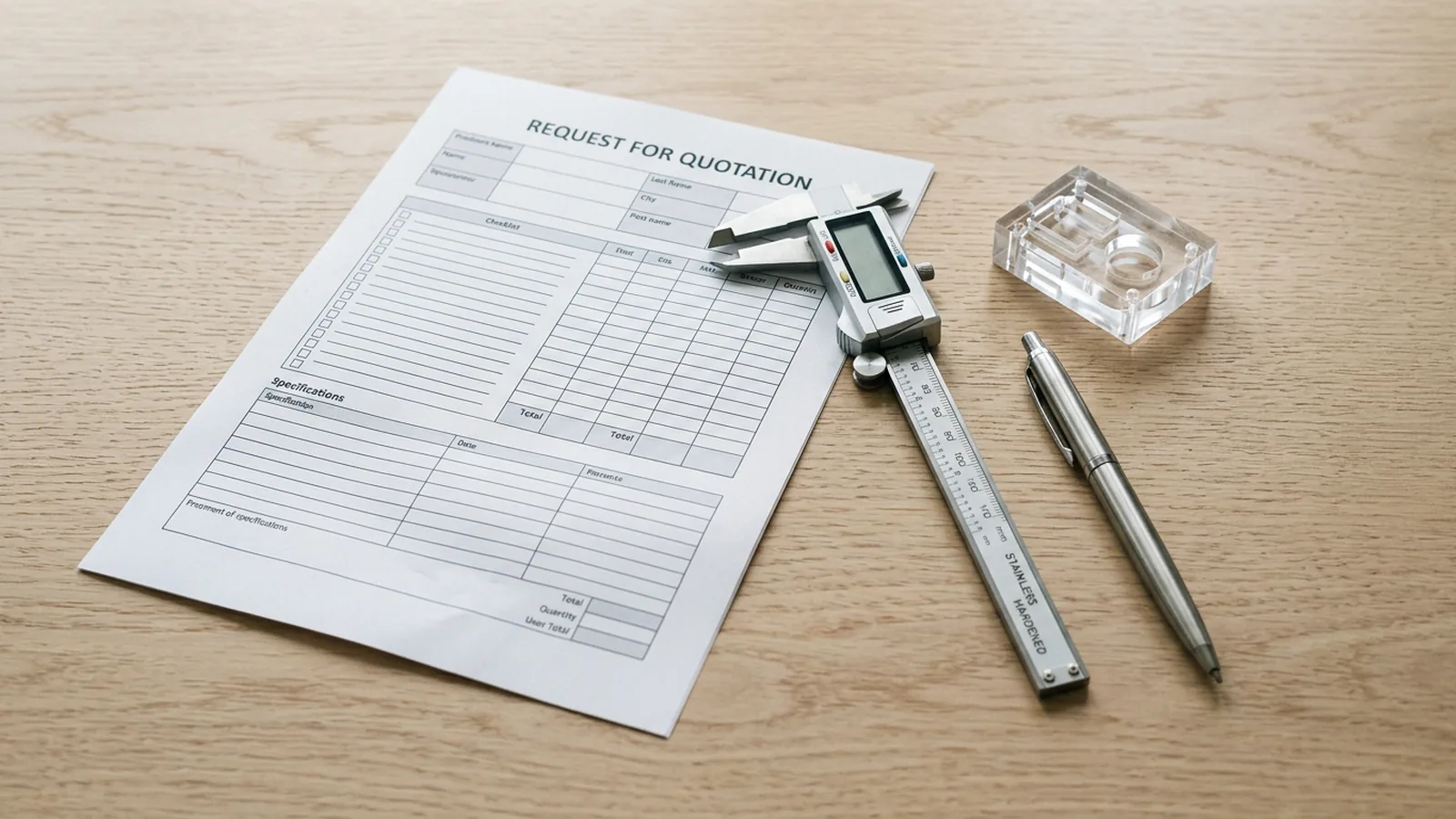
A complete custom acrylic quote request gets an accurate number in hours; a vague one starts days of back-and-forth and may still produce an unusable price.
Need this made?Custom acrylic fabrication services →
Key Takeaways
- 9 out of 10 RFQs I receive are missing at least one field that forces a follow-up — dimensions and material grade are skipped most often.
- A complete acrylic RFQ has 9 fields: dimensions + tolerances, thickness, material type/grade, quantity tiers, finish, assembly requirements, application/use-case, packaging, and delivery terms.
- Attaching a technical drawing (DXF, PDF, or dimensioned sketch) reduces quote turnaround time by roughly half — but you can start without one: reference photos, overall dimensions, and the product the piece must hold are enough for a first quote.
- Write quantities as sets and state parts per set — 500 'pieces' of a five-part display can mean 500 displays or 100 — then add tiers (e.g., 500 / 1,000 / 2,000) to get price-break data without sending three separate emails.
- For food-contact applications, specify FDA 21 CFR 177.1010 compliance in the material field — if you don't ask, your fabricator may not check.
On this page
- RFQ Template for a Custom Acrylic Quote: 9 Fields
- Field 1 — Overall Dimensions and Tolerances
- Field 2 — Acrylic Thickness
- Field 3 — Material Type and Grade
- Field 4 — Quantity (With Tiers)
- Field 5 — Surface Finish
- Field 6 — Assembly Requirements
- Field 7 — Application and Use-Case
- Field 8 — Packaging Requirements
- Field 9 — Delivery Terms
- The Complete Acrylic RFQ Template
- When a Drawing Is Required vs. Optional
- Common RFQ Mistakes That Cost Buyers Time and Money
- What Happens After You Send Your RFQ
RFQ Template for a Custom Acrylic Quote: 9 Fields
A custom acrylic quote needs nine fields: finished dimensions with tolerances, thickness per part, material type and grade, quantity as sets with tiers, surface finish, assembly method, application, packaging, and delivery terms. Send all nine with a drawing or reference photos and a factory can return a line-item price in one round instead of several.
The template works with any fabricator. For the processes Wetop prices against it, including laser and CNC cutting, polishing, bending, printing and assembly, see custom acrylic fabrication. A German industrial OEM used this structure for 300 CNC acrylic instrument bases across two SKUs; its compliance annex cleared the buyer’s audit on the first pass and production ran 18 days.
Miss a field and the fabricator either guesses, which produces a number you can’t trust, or asks, which costs time. I lose roughly half an hour every week asking buyers for information they forgot to include. For buyers in the US or Europe, each clarification round trip is about a full day because of time zones, so three missing fields can stretch a one-hour costing job across most of a week.
Once the quote is accepted, use the buyer’s sample-approval checklist to define the dimensions, appearance, function, packing, and signed record that control the bulk run.
Field 1 — Overall Dimensions and Tolerances
State the finished-part dimensions (length, width, height) in millimeters or inches and the tolerance you need. Our standard working tolerance is ±0.2 mm; fit-critical 2D features can be held to ±0.1 mm after drawing review, and bent or thermoformed features are looser and agreed on the drawing. The working tolerance standard and the acrylic machining tolerance guide show how to mark those features.
Dimensions are the field I see missing most often. “A countertop display for lipstick” says almost nothing about material volume, cut time or waste, all of which set the price. If the design is not final, give a range: “approximately 200mm × 150mm × 80mm, ±20mm on all sides.” A range supports a directional budget estimate; a bare description does not.
Tolerance the interface, not the object. A display shelf can vary a millimeter unnoticed; a slot that must grip your 8.5mm product cannot. Mark the fit-critical dimensions, because those are the ones cut and inspected to tolerance, and over-specifying the rest adds cost for no benefit. For fit-critical slots, the most reliable input is the product itself: send one unit so the slot can be measured and fit-checked on the sample. Published product dimensions and real molded products often disagree.
Field 2 — Acrylic Thickness
Specify the thickness in millimeters for every distinct panel. Walls, base and lid may each differ, so list them separately. Standard stock runs from 1.5mm to 25mm; common B2B specifications are 3mm, 5mm, and 8mm, which cover roughly 80% of display and packaging projects.
If you are unsure, state the load (what the part holds) and the unsupported span (how far it bridges between supports); those two inputs are enough to work back to a thickness. The acrylic thickness guide covers the full decision.
Sheet stock itself varies: manufacturers publish per-gauge thickness tolerance tables,1 so a nominal 3mm sheet can measure slightly thinner or thicker while still in spec. That is one more reason fit-critical grooves and slots get confirmed on a physical sample.
Field 3 — Material Type and Grade
Acrylic is not a single material. Specify cast or extruded PMMA (the process affects clarity, polishability and cost), the color or finish (clear, frosted/matte, colored, mirrored, anti-static), and any compliance requirement for the end use.
The compliance field is where I see the most dangerous omissions. A buyer in the foodservice industry once sent us an RFQ for serving trays with no material compliance note. We quoted standard clear cast acrylic. Three revisions later — after they confirmed the trays would contact food — we switched to FDA 21 CFR 177.1010 compliant PMMA2. The switch added cost and a sourcing delay that could have been avoided entirely if the application had been noted upfront. For electronics or EU-market products, RoHS and REACH may be mandatory; state them in the material field, not in a follow-up email.
Field 4 — Quantity (With Tiers)
State the quantity you intend to order, then add one or two tiers above it. “Please quote 500, 1,000, and 2,000 units” gives price-break data in one response instead of three emails over three days.
Before the number, fix the unit. Write quantities as sets and state how many parts make one set: “500 sets; one set = 1 base + 1 back panel + 3 shelves (5 acrylic parts).” “500 pieces” of a five-part display is ambiguous by a factor of five: the factory reads parts, because parts are what get cut, polished and packed; the buyer means finished displays. This is the most common correction I make on a first-time acrylic RFQ.
Our production MOQ is 100 pieces per design. If your planned quantity is below 100, the path is a paid sample rather than a sub-MOQ batch; the custom display stands procurement guide shows the cost math at 100 pieces and up. Acrylic parts are CNC- and laser-cut, not injection molded, so price breaks come from spreading setup, fixtures, assembly templates and sheet nesting over more units. Flag runs above 500 pieces, because pricing can shift meaningfully. Standard production is 15–20 days; very large orders get a schedule stated at quote stage.
Field 5 — Surface Finish
Specify the finish on every exposed edge and surface:
| Finish | Method | When to Use |
|---|---|---|
| High-gloss polished | Diamond or flame polishing | Visible edges on display cases, awards, premium packaging |
| Matte / frosted | Surface treatment or frosted sheet | Diffused panels, privacy screens, premium cosmetics trays |
| As-cut (no polish) | Laser or CNC only | Internal or hidden edges — saves cost where not visible |
| Printed surface | UV printing, silk-screen, hot stamping | Branded panels, colored graphics, logo application |
| Engraved | Laser engraving | Serialized parts, branded awards, decorative detail |
If every surface gets the same finish, say so; if panels differ (polished faces, as-cut internal edges), call it out per component. “Standard finish” means different things to different fabricators. Our edge finish standard defines what “polished” means on a Wetop quote.
Color belongs in the same field, and it has one number worth memorizing: a custom Pantone match is a one-time $200–300 cost per color; the Pantone matching acrylic guide explains the routes. A Pantone code such as “PMS 2935 C” is a target we can mix, match, and be judged against,3 while “blue, like our logo” guarantees a swatch round trip. Standard sheet colors (clear, black, white, frosted, mirrored, common tints) carry no matching fee. If a standard color is acceptable, “standard black is fine” is as useful as a code.
Have These 5 Fields Ready? Get a Quote Now
Field 6 — Assembly Requirements
If the product uses more than one acrylic part, describe how they join: solvent bonding (permanent, nearly invisible joint), mechanical fasteners (screws, standoffs), snap-fit, magnetic closure, or flat-pack for assembly at destination.
Assembly affects price and lead time. Solvent bonding and multi-part assembly add fixture time, cure time and inspection steps, while a flat-pack kit is faster to produce and cheaper to ship. If you are price-sensitive, ask for flat-pack and assembled options in the same quote to compare.
Field 7 — Application and Use-Case
State what the product is for and where it will live. “Countertop retail display for a cosmetics brand” tells a fabricator far more than “acrylic display box.” The application decides material grade (food contact, display, electronics), edge-finish priority, structural thickness and any compliance flags.
I ask about application on every RFQ that leaves it out, because answers like “it’s for food service” or “it sits near a UV lamp array” change the spec. It is a technical input to the quote, not background.
Field 8 — Packaging Requirements
Specify how the finished product is packed: individual poly bags, foam insert trays, bulk cartons, master cartons with inner boxes, or custom-branded retail packaging. For display cases and award blocks, protective packing is not optional; the question is what level you need and whether its cost is visible on the quote.
If the product is resold to consumers, say so. Retail-ready packaging (individual boxes, hang tags, branded poly bags) adds cost and lead time that bulk cartons do not, and it is quoted as its own line. We ship all orders by default in protective foam-lined cartons that meet standard freight durability requirements; our packing standard describes the default export packing.
Field 9 — Delivery Terms
State your preferred shipping term using Incoterms 2020.4 The three most common for US buyers sourcing from China:
- FOB Shenzhen — we load goods at our port. You arrange and pay for ocean freight, insurance, and import clearance. You control the freight cost.
- CIF [destination port] — we cover cost, insurance, and freight to your destination port. You pay import clearance and inland freight from port to warehouse.
- DDP [destination address] — we cover everything including import duties to your door. Simplest for you, highest unit cost.
Our default term for sea freight is FOB Shenzhen. For a DDP or CIF comparison in the same response, add it to the RFQ and use the FOB vs DDP acrylic-order guide to list the same named place, mode and landed-cost lines; compare FCA for air freight or a container handed to the carrier before vessel loading.
The Complete Acrylic RFQ Template
Copy this table into your next quote request. Every field marked “Required” will be asked for if missing.
| Field | Example Input | Required? | Why It Matters |
|---|---|---|---|
| Overall dimensions (L × W × H) | 200mm × 150mm × 80mm | Required | Sets material volume and cut time |
| Thickness (per component) | Walls: 5mm, Base: 8mm, Lid: 3mm | Required | Affects material cost and fabrication method |
| Material type | Clear cast acrylic PMMA | Required | Determines sourcing, polishability, price |
| Compliance requirement | FDA 21 CFR 177.1010 / RoHS / None | Situational | Missed compliance = rework or recall |
| Color / finish type | Clear, frosted, colored (Pantone ref), mirrored | Required | Drives material sourcing |
| Quantity tiers | 500 / 1,000 / 2,000 sets (state parts per set) | Required | Enables price-break comparison and kills the sets-vs-pieces ambiguity |
| Surface finish | Diamond-polished edges, matte top panel | Required | Affects per-piece time significantly |
| Assembly | Solvent-bonded, or flat-pack | Required | Changes production steps and lead time |
| Application / use-case | Countertop cosmetics display, retail environment | Required | Informs spec decisions beyond the drawing |
| Packaging | Individual poly bag in master carton | Required | Affects ship weight and unit cost |
| Delivery term | FOB Shenzhen | Required | Makes the price comparable across suppliers |
| Target delivery date | 8 weeks from order | Helpful | Allows lead time vs. capacity check upfront |
| Technical drawing | DXF, PDF, or dimensioned sketch attached | Required for complex shapes | Eliminates most clarification emails |
When a Drawing Is Required vs. Optional
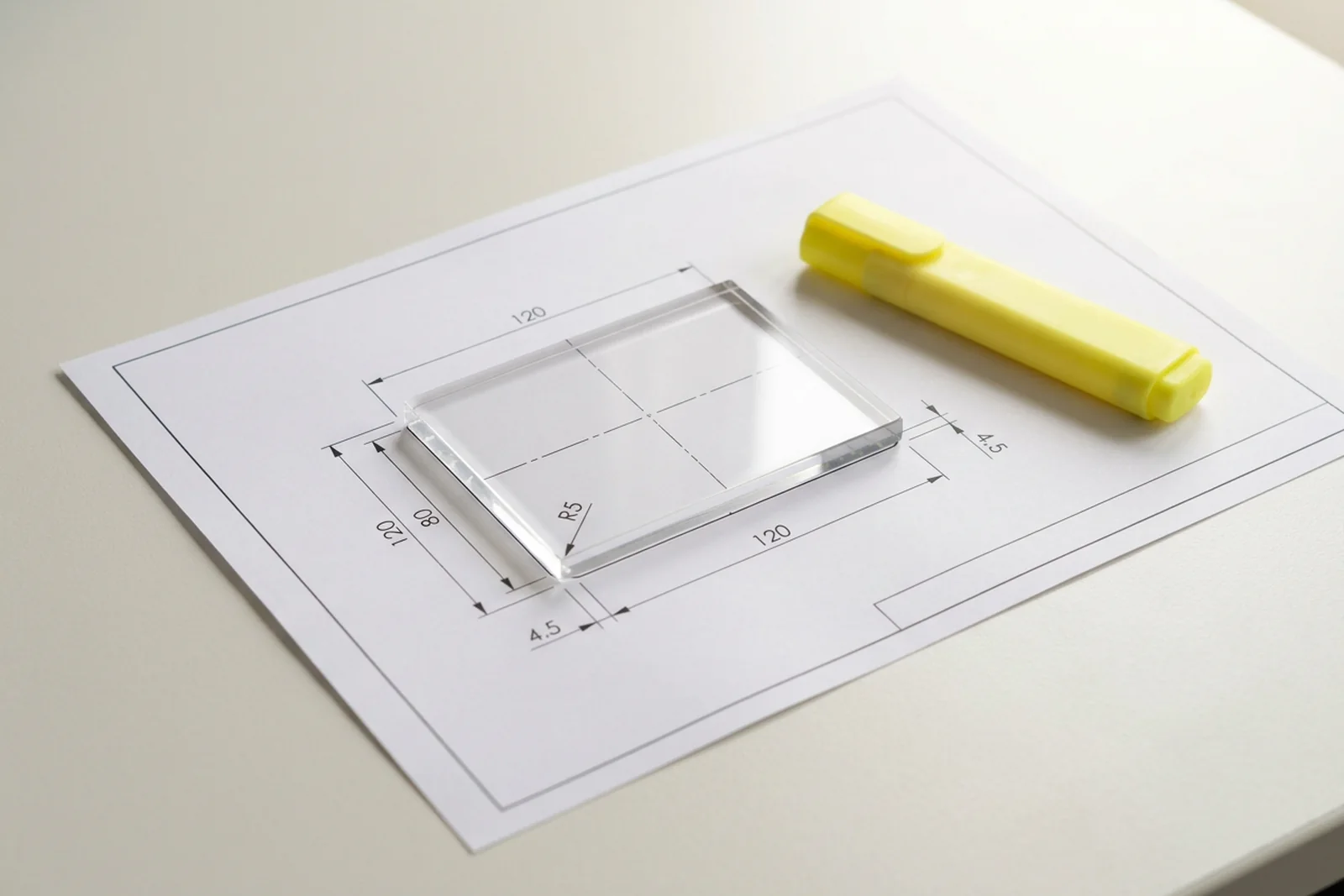
A written specification is enough for simple flat-cut parts: a single-panel sign holder, a flat shelf insert, a rectangular tray with no bends. Anything with joins, bends, cutouts, sliding mechanisms or multiple fitted parts needs a drawing before production. Quoting a multi-part assembly without one is guessing, and an accepted guess becomes a production problem.
You don’t need a CAD file. A clearly photographed hand sketch with labeled dimensions is enough to start a quote on most projects. A DXF or DWG from your design team is better because it feeds straight into CNC and laser cutting; a dimensioned PDF is a solid middle ground. What doesn’t work: a product photo with no measurements, “similar to what we ordered last time,” or a verbal description of a curved or angled shape.
With no drawing at all, there is still a path to a real quote. Send reference photos of something close to what you want, overall dimensions, and the product the piece must hold; that is enough for a costed spec and a first price, because most custom acrylic products are variations on geometry a fabricator has built many times. Buyers have opened with a competitor’s product photo, a phone snapshot of a sketch on graph paper, and once a photo of a display mocked up in cardboard — all three became production orders. What the no-drawing path never skips is the approval gate: the references become a dimensioned production drawing that you correct and approve, and that drawing plus a physical sample (3–5 days) become the standard the 15–20 day production run is inspected against. A buyer who starts with nothing but photos is typically holding an approved sample about ten days after the first email. Artwork and logo files still come from you. The same fields apply to the products quoted most often, such as acrylic display cases and acrylic display stands.
Common RFQ Mistakes That Cost Buyers Time and Money
Since 2020, I’ve catalogued the same five mistakes appearing on new inquiries across every industry we serve.
1. Omitting material grade and assuming the fabricator will default correctly. Standard clear cast acrylic is the default. If your application needs UV-resistant, anti-static, food-contact-compliant or colored acrylic, the fabricator cannot assume it. The cost of the wrong assumption is a re-order.
2. Sending a single quantity with no tiers. Pricing at 200 units versus 1,000 units can differ by 30–50% per piece due to setup amortization. Sending three quantities in one email costs seconds; getting three quotes separately costs days.
3. Describing finish as “shiny” or “clear.” “Diamond-polished edges, matte frosted face panel, as-cut internal edges” is a specification. “Shiny” produces a clarifying question.
4. Not stating the application. I’ve quoted what I thought was a display case and found out after approval it was meant for food service. Application drives material compliance — state it first, not as an afterthought.
5. Requesting DDP pricing without an address or HS code. A DDP quote needs a destination address and an estimated HS code for import duties. Without them, the DDP number is a guess, often low, and the buyer later sees a higher customs bill and assumes the supplier changed the price.
What Happens After You Send Your RFQ
When we receive a complete RFQ at inquiry@wetopacrylic.com, we respond within 24 hours. The response includes a line-item quote with material, fabrication and packaging broken out, lead time confirmation (3–5 days for samples, 15–20 days for production), and any spec alternatives that would save cost or time. Payment is a 30% deposit before production, with the balance before shipment. Insist on a line-item quote from any supplier: it shows what polishing, printing and packaging each cost, so you can negotiate specific lines instead of one opaque number.
For procurement teams following ISM sourcing practice5 (competitive bidding, supplier qualification, total cost of ownership), a complete RFQ is what makes quotes comparable, because incomplete RFQs let each fabricator fill the gaps differently. For a multi-SKU example, see the 50-store retail acrylic display rollout case study. To check the supplier on the other end of your RFQ, including capacity, certifications and founding year, start at our about page.
Footnotes
-
Thickness tolerance of ACRYLITE extruded acrylic sheet — ACRYLITE knowledge base — a sheet manufacturer’s own documentation of per-gauge thickness tolerance and why thickness variation affects joints and fit, the reason fit-critical features get sample-confirmed rather than assumed from the nominal number. ↩
-
FDA 21 CFR 177.1010 — Acrylic and modified acrylic plastics for food contact (eCFR) — the US federal regulation defining which acrylic formulations are cleared for direct food contact. Specify compliance in any RFQ for serving trays, food-display cases, or products contacting edible items. ↩
-
Pantone Color Systems — Explained — Pantone’s overview of the Pantone Matching System, the standardized color language that makes a code like “PMS 2935 C” an exact, verifiable target across buyer and factory. ↩
-
Incoterms 2020 — International Chamber of Commerce — the standard set of international trade terms defining which party bears responsibility for freight, insurance, and customs at each stage of shipment. Use the exact Incoterm abbreviation (FOB, CIF, DDP) in your RFQ to ensure quotes are comparable across suppliers. ↩
-
Institute for Supply Management (ISM) — the leading professional association for supply chain and procurement, publishing standards and best practices for RFQ processes, supplier evaluation, and sourcing strategy. ISM’s sourcing frameworks emphasize complete specifications as the foundation of competitive bidding. ↩
Frequently Asked Questions
What information should I include in an acrylic quote request?
Nine fields: dimensions and tolerances, thickness per part, material grade, quantity tiers stated as sets, finish, assembly, application, packaging, and delivery terms. Add a drawing or reference photos and mark which dimensions are fit-critical. A German OEM used this structure for 300 CNC instrument bases across two SKUs, pairing the drawings with compliance documents, packing and delivery terms.
Do I need a technical drawing to request a quote?
Not for a first directional quote: reference photos, overall dimensions and the product the part must hold are enough to start. Any bends, joints, cutouts or fit-critical features must be transferred to an approved production drawing before sampling and bulk release.
How do I specify acrylic material grade in an RFQ?
State cast or extruded PMMA, the color or finish, and the specific documentation your buyer or jurisdiction requires, such as FDA 21 CFR 177.1010 for food contact or REACH and RoHS declarations for the EU. Ask for documents tied to the production material; a generic compliance claim is not enough.
What delivery terms should I use when quoting from a Chinese manufacturer?
Ask for FOB Shenzhen first, then request CIF or DDP beside it if you need port or door delivery. Name the destination and the Incoterms 2020 rule so every supplier's quotation covers the same scope.
How long does it take to get a quote back from an acrylic manufacturer?
Wetop responds within 24 hours to a complete nine-field RFQ. Missing dimensions, quantity, finish, or destination each add a clarification round, and across US, European and China time zones a round usually costs about a day.
Can I use this RFQ template for a custom acrylic quote?
Yes. Fill the nine fields, attach the drawing or reference images you have, identify fit-critical dimensions and required documents, and request a paid sample. The sample normally costs USD 200–500 depending on complexity and is billed separately, never credited to production.
Have specs ready? Send us your RFQ.
Use the RFQ checklist above as your template. Send it with dimensions, quantity, material, and delivery date; paid sample fees are billed separately and are not credited to production.