Countertop jewelry cases
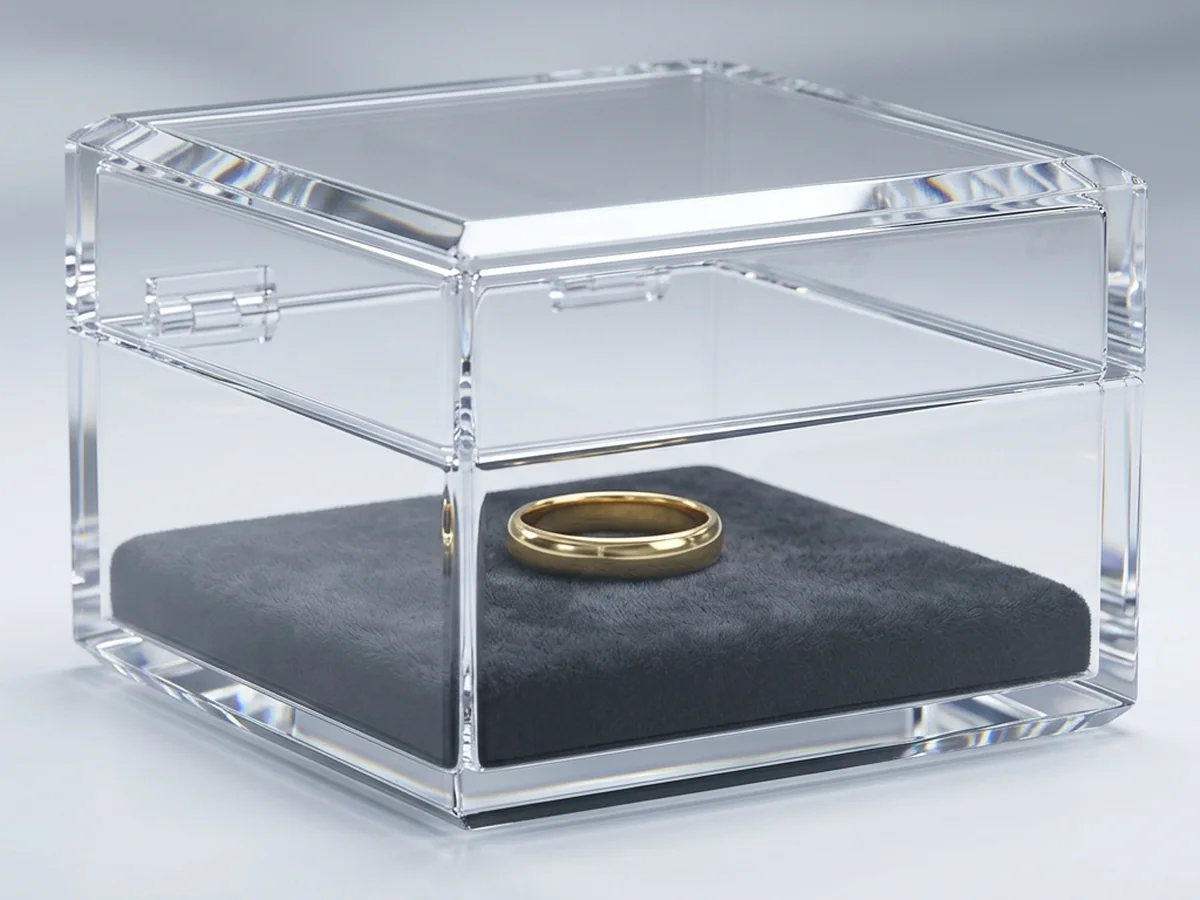
Enclosed cases that keep pieces protected and fully visible — security without hiding what you sell. Lockable versions for high-value lines.
150 × 100 × 100 mm case: from $6–12 at 500 pcs
We manufacture custom acrylic jewelry display cases, watch cases, risers, velvet-lined trays and pedestal blocks for jewelers, watch retailers and luxury boutiques, from 100 pieces per design.
ISO 9001 · Manufacturing since 2008 · 2,000+ custom projects · Quote reply within 24 hours
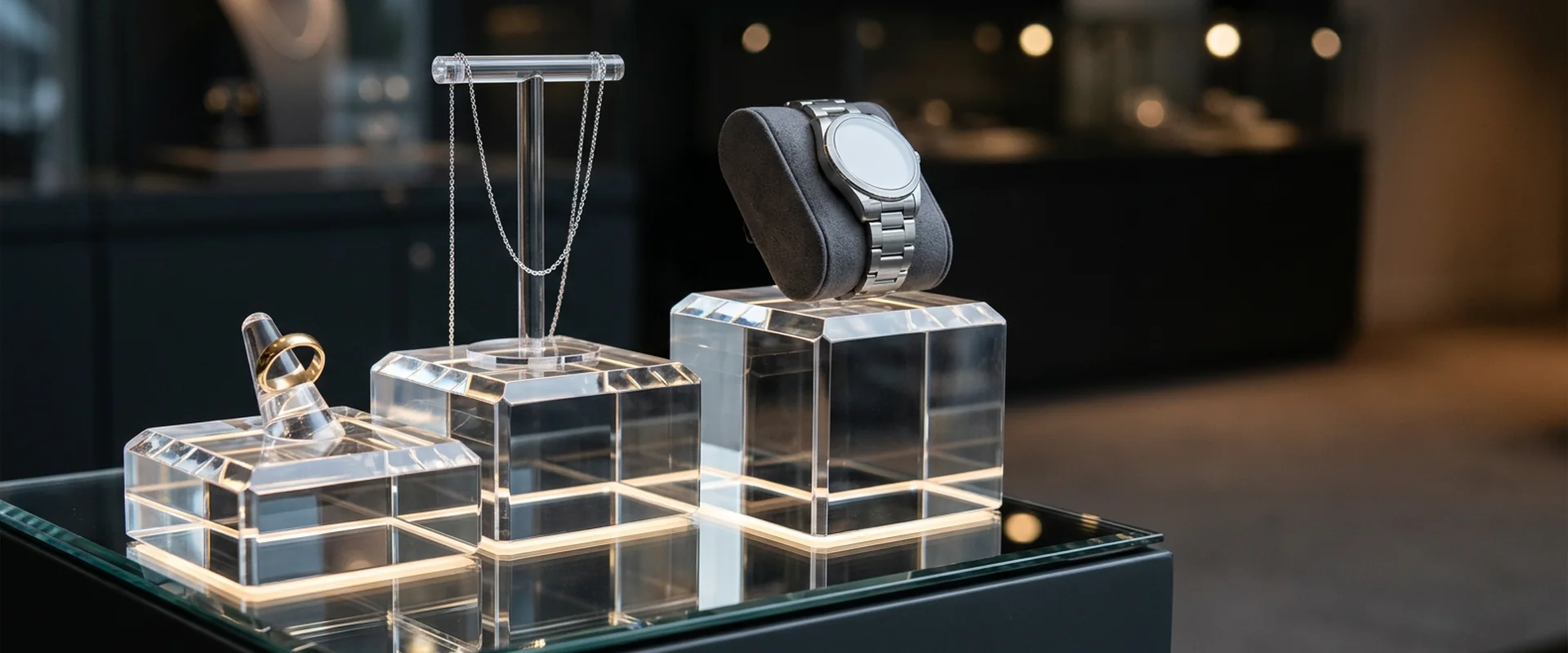
Jewelry display is a system: a case protects, a riser elevates, a tray presents, and a drawer organizer keeps inventory where staff can find it.
Enclosed cases that keep pieces protected and fully visible — security without hiding what you sell. Lockable versions for high-value lines.
150 × 100 × 100 mm case: from $6–12 at 500 pcs
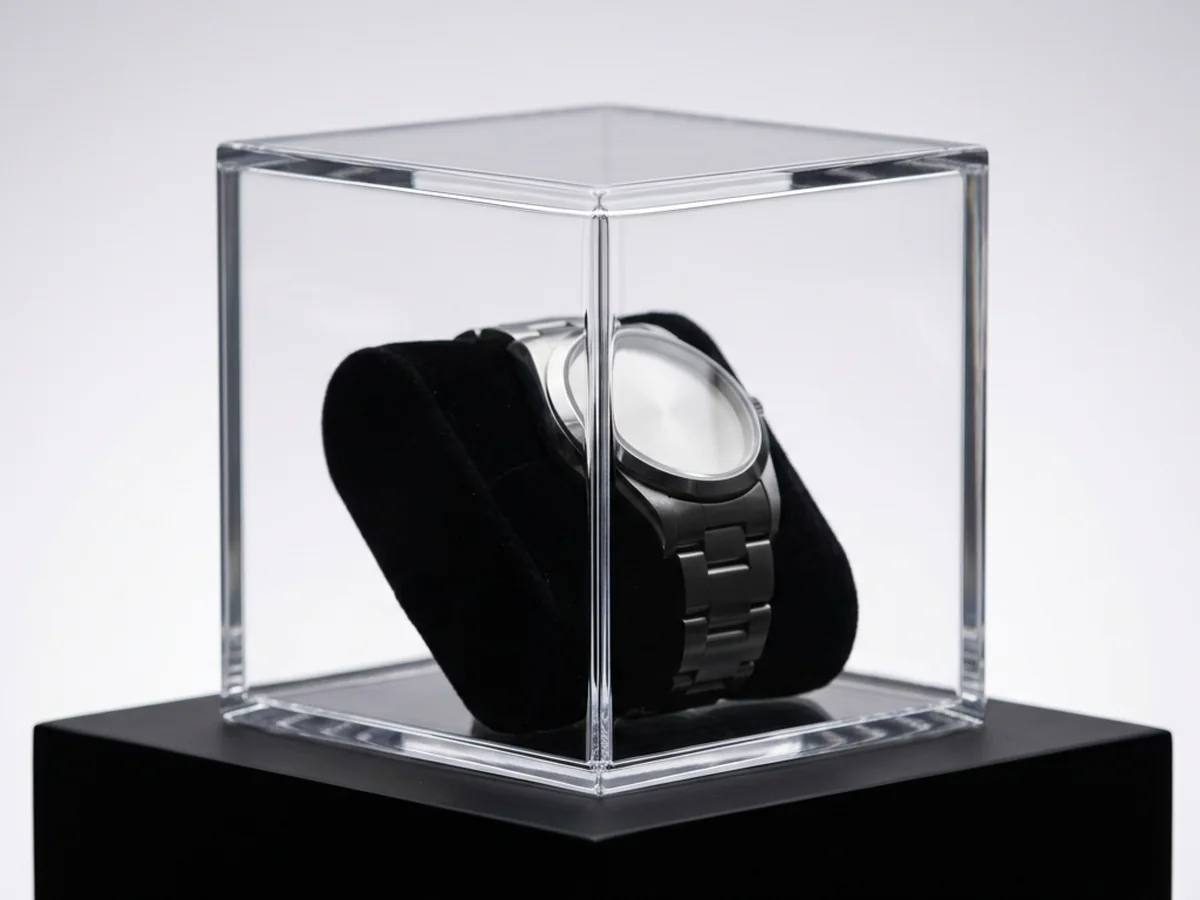
Mitered cases with cushion inserts, sized to each watch line — a case too large makes the watch look small.
UV-filtering case, 300 × 200 × 250 mm: from $15–30 at 200 pcs
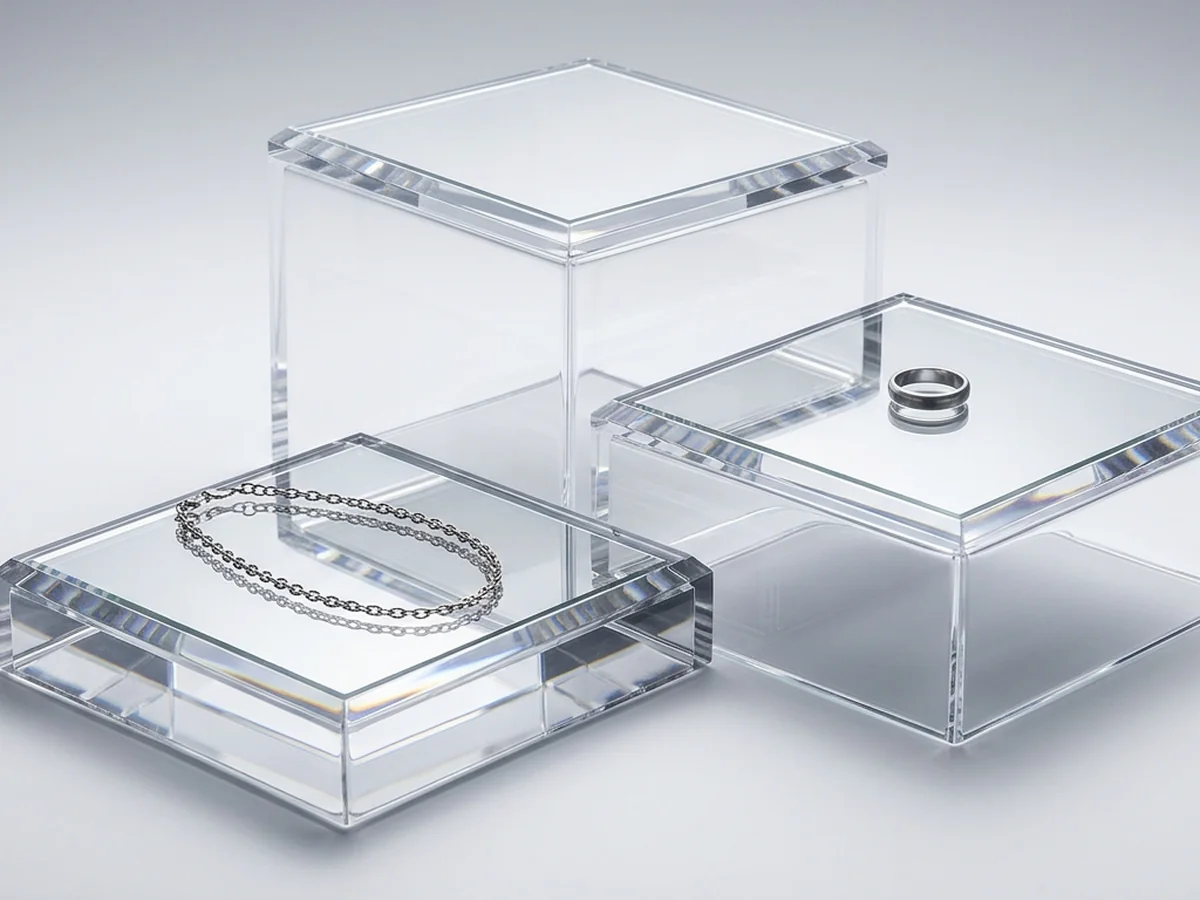
Staggered heights with mirrored tops turn a flat counter into a stepped collection display.
Two-tier countertop stand: $28 each at 100 pcs
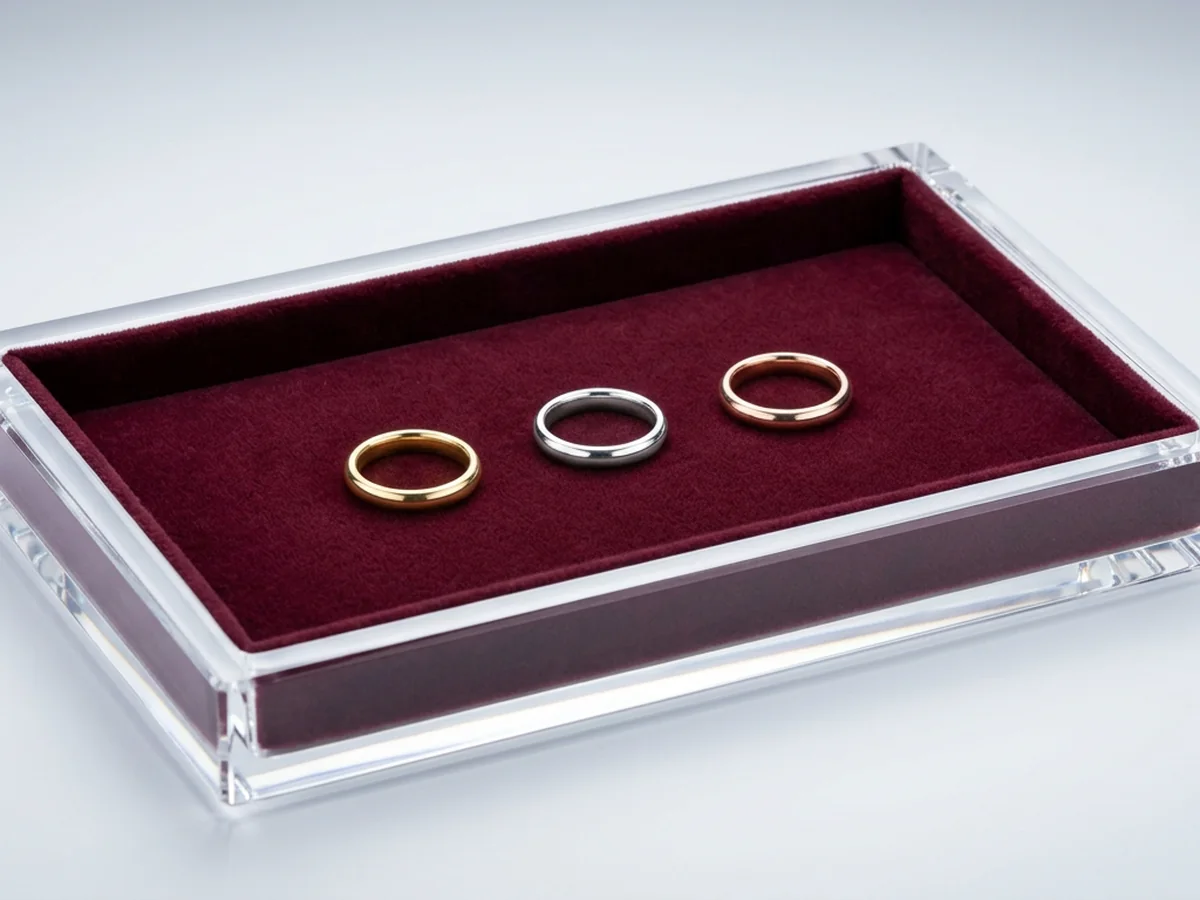
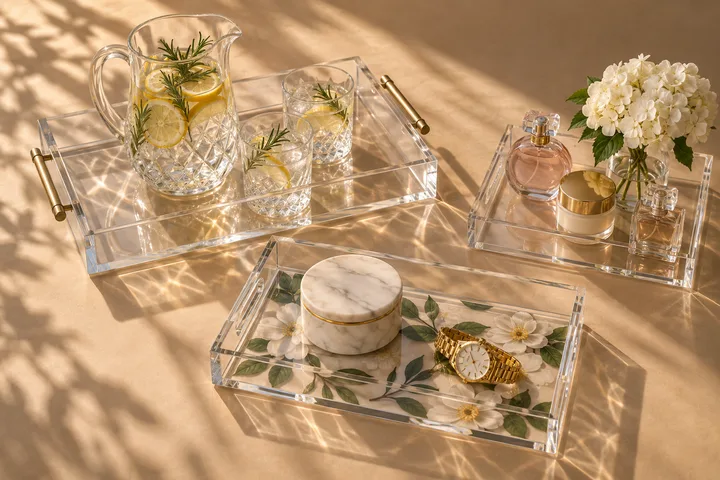
Staff pull a curated tray for the customer, then slide it back into the showcase — rings, bracelets, and earrings by row.
10 × 7 in vanity tray: $10 each at 100 pcs
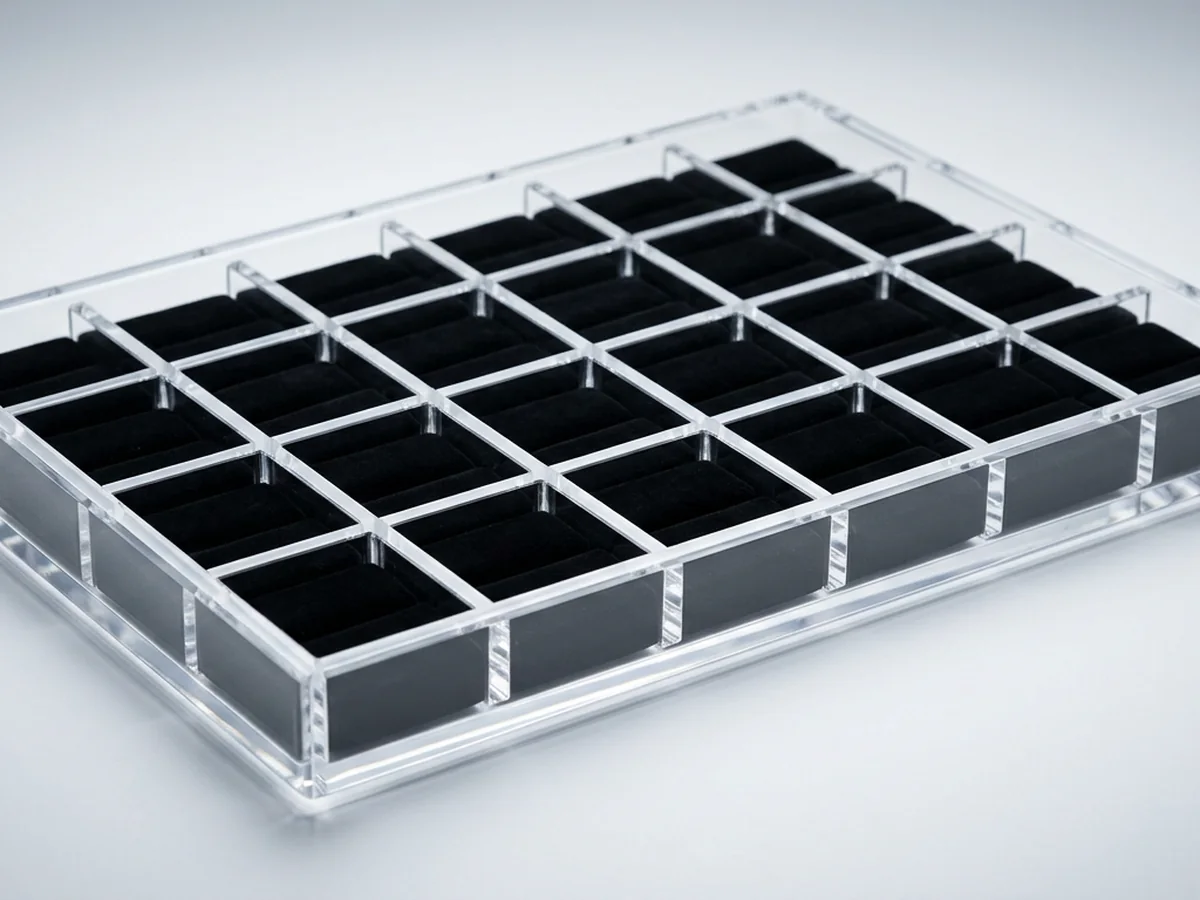
Compartment inserts that turn showcase drawers into an inventory system staff can read at a glance.
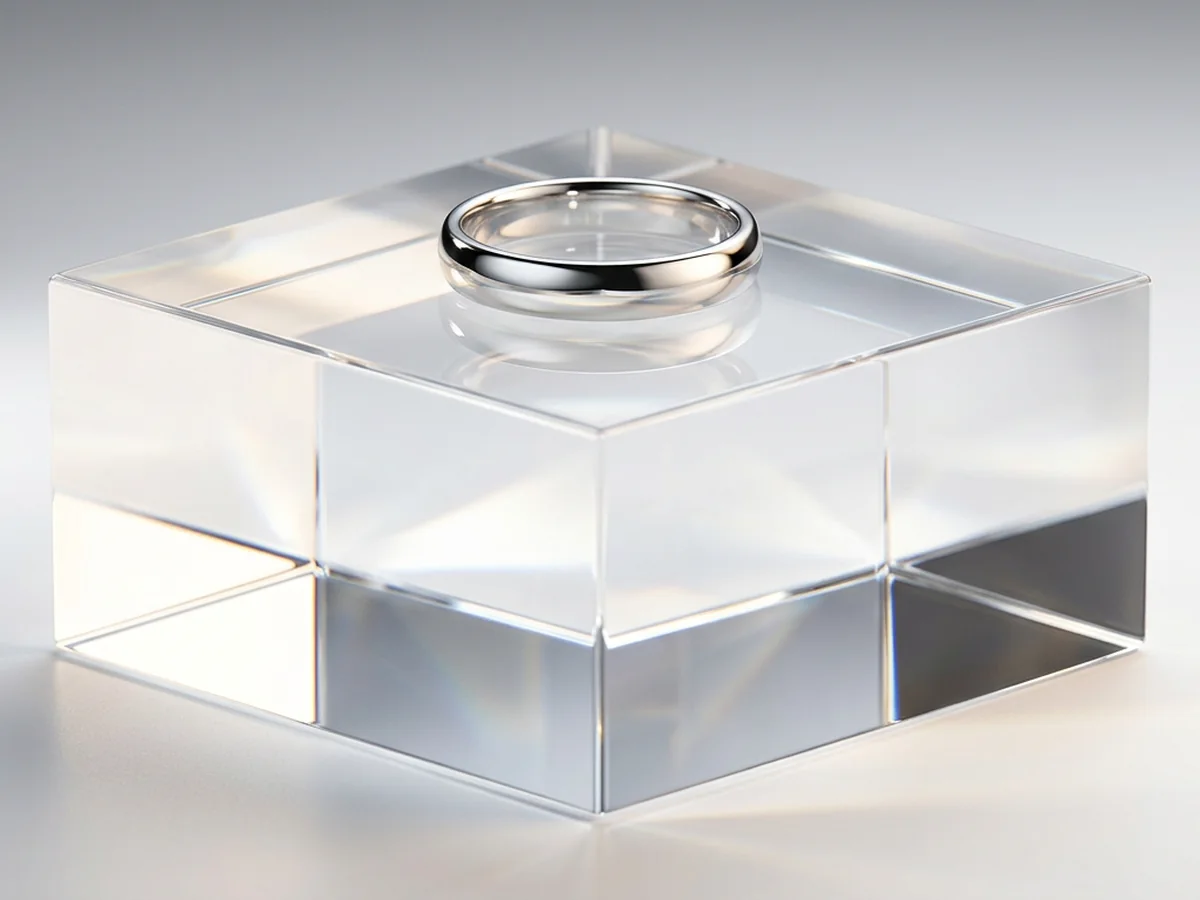
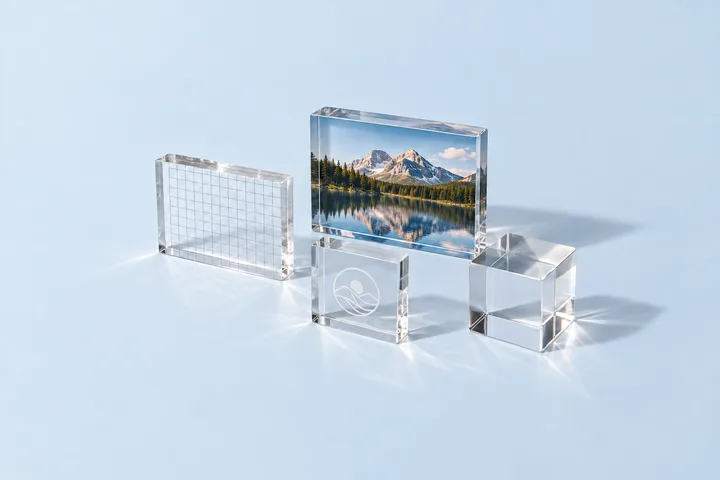
Graduated clear acrylic display blocks polished on all faces that catch and refract light, placing a hero piece where the spotlight hits.
80 × 80 × 50 mm display block: $12 each at 100 pcs
Buying in volume? We don't stock or sell wholesale — every design is made to your specification from 100 pieces, and the unit price steps down as the run grows. Prices are published FOB Shenzhen references for the named specification; your quote follows your drawing.
Displays by product: Ring displaysNecklace displaysEarring displaysBracelet displays
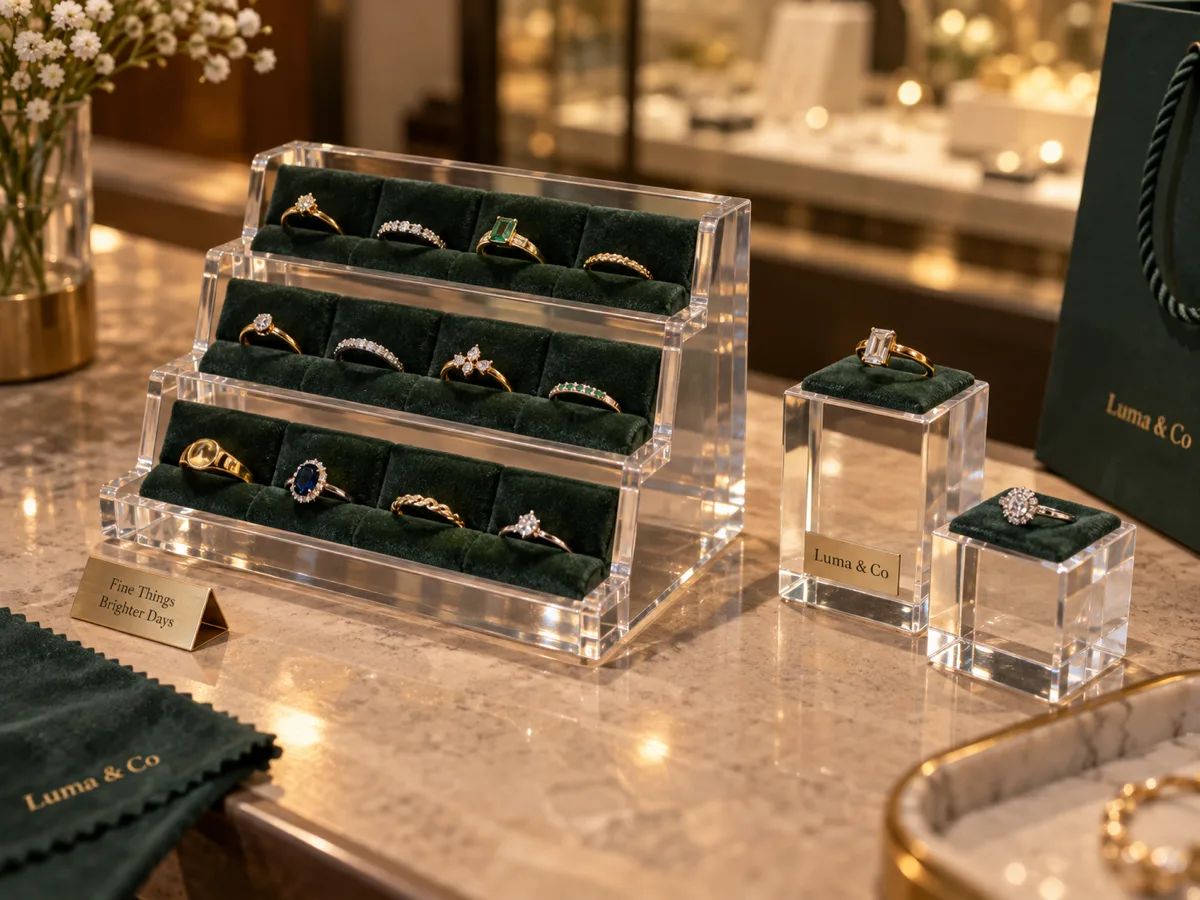
An acrylic ring display holds rings upright in velvet slots, on a stepped riser or on a single polished block, so each band and stone faces the shopper. We build ring trays, ring risers and single-ring blocks to your ring range from 100 pieces per design.
| Formats | Ring-row trays, stepped ring risers, single-ring blocks and cones |
|---|---|
| Capacity | 30–50 rings in a full 370 × 210 mm tray with ring-row inserts |
| Inserts | Flocked rows for high-count trays, wrapped velvet for presentation pads; 0.5–1 mm clearance so the insert lifts out |
| Base | 3, 4 or 5 mm sheet; diamond-polished edges; clear, mirrored or colored |
Delivered 2,400 velvet-lined organizers, the same seat and insert work used for ring pads.
Formats Acrylic display blocksAcrylic risersJewelry tray guide
Yes. A 4 mm or 3 mm base reads lighter on the counter, but a long unsupported span flexes more, so the drawing states which panels stay at 5 mm. The paid sample shows the thinner base with your rings on it before production.
Yes, if the drawing names the ring range. Slot width and pad height are set from your thinnest and widest bands, and the paid sample confirms that each one grips without forcing the stone.
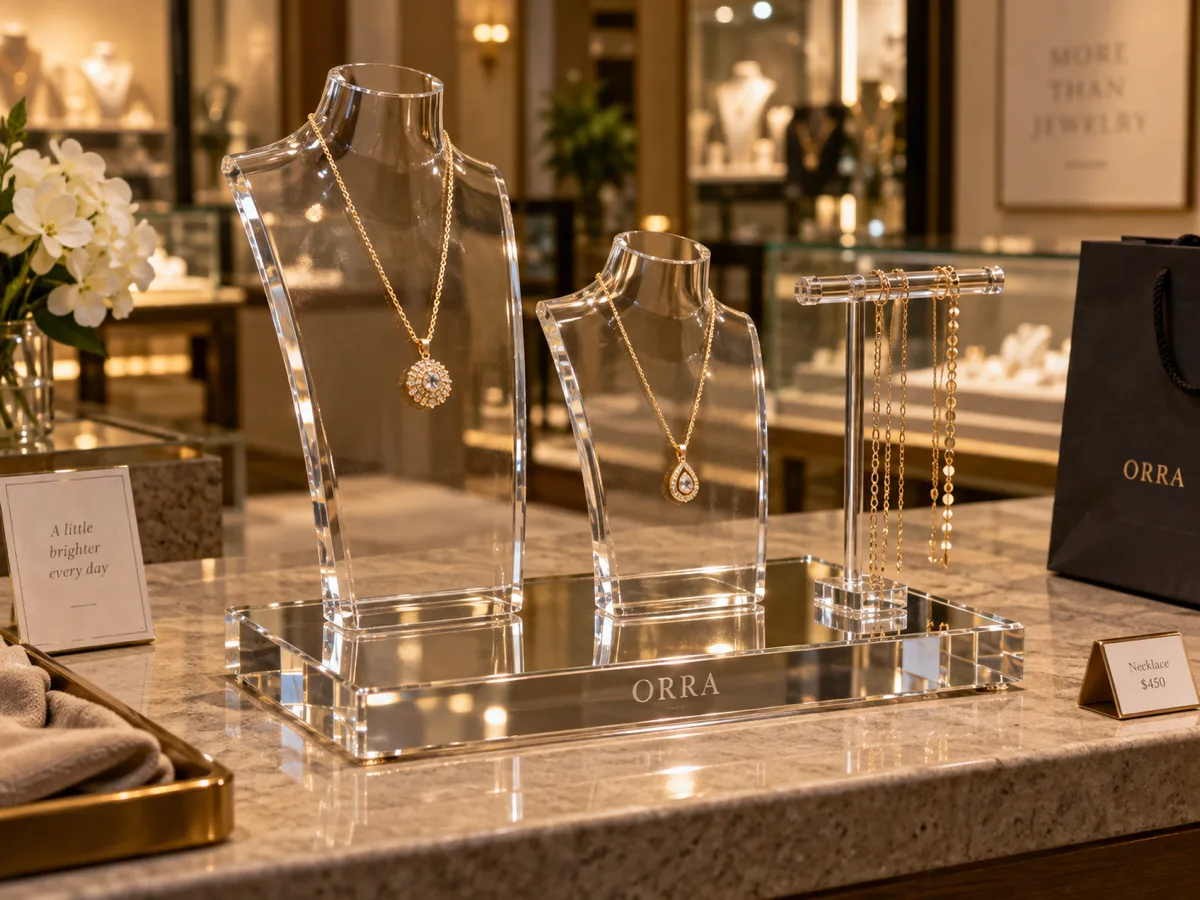
An acrylic necklace display is a bust, neck form, easel or hanging bar that lets a chain fall at its real length with the pendant facing forward. We build necklace busts, T-bars and pendant pads to your chain lengths from 100 pieces per design.
| Formats | Necklace busts and neck forms, T-bars and hook bars, pendant pads, easels |
|---|---|
| Height | Set by the longest chain plus pendant drop, so the pendant hangs clear of the base |
| Capacity | 6–12 pendants on a full-size pendant pad |
Formats Acrylic risersCustom acrylic traysJewelry display ideas
Tall enough for your longest chain and pendant to hang clear of the base. Send the chain lengths you display; we draw a set of bust heights around them, and the paid sample is checked with the real pieces.
Not when the base footprint and thickness are set for the heaviest piece. Name it in the brief; the drawing sizes the base for that load, and the paid sample is tested with it hung in place.
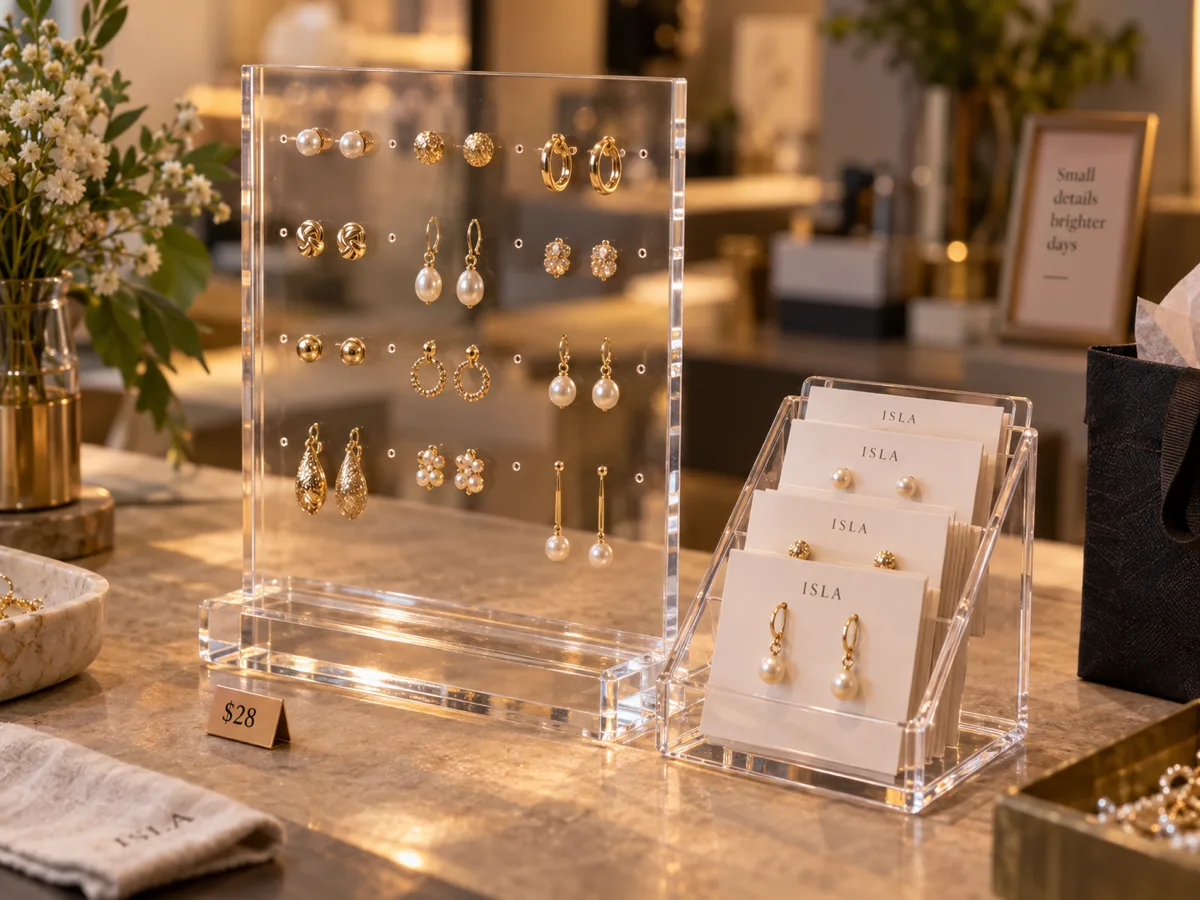
An acrylic earring display is an upright panel with laser-cut holes, a card holder or a tray insert that holds pairs side by side at eye level. We build earring panels, earring card holders and printed acrylic earring cards from 100 pieces per design.
| Formats | Upright panels with laser-cut holes, angled earring-card holders, earring trees, tray inserts |
|---|---|
| Holes | Hole size and pair spacing set on the drawing for posts or hooks, checked with your earrings |
| Capacity | 12–24 pairs on a full-size tray with earring flaps or card slots |
| Cards | Acrylic earring cards with a printed logo and post holes, made to your card size |
Formats Acrylic sign holdersCustom acrylic traysAcrylic vs wood jewelry displays
Yes. The card size, hole size and hole positions go on the drawing, the logo is UV printed or engraved, and the paid sample is checked with your earring posts before the run.
Studs need holes or slots; hooks hang from a bar or a top edge. One panel can carry both zones when the drawing marks which rows take which style.
An acrylic bracelet display is a T-bar, cylinder or cone that holds bracelets in the round, or a velvet-lined tray that lays them flat. We build bracelet bars, bangle stands and bracelet trays to your bracelet sizes from 100 pieces per design.
| Formats | Horizontal T-bars, bangle cylinders and cones, bracelet ramps, velvet-lined trays |
|---|---|
| Sizing | Bar and cylinder diameter drawn from the bracelet inner diameter |
| Watches | Watch cradles and cases sit on the watch display page |
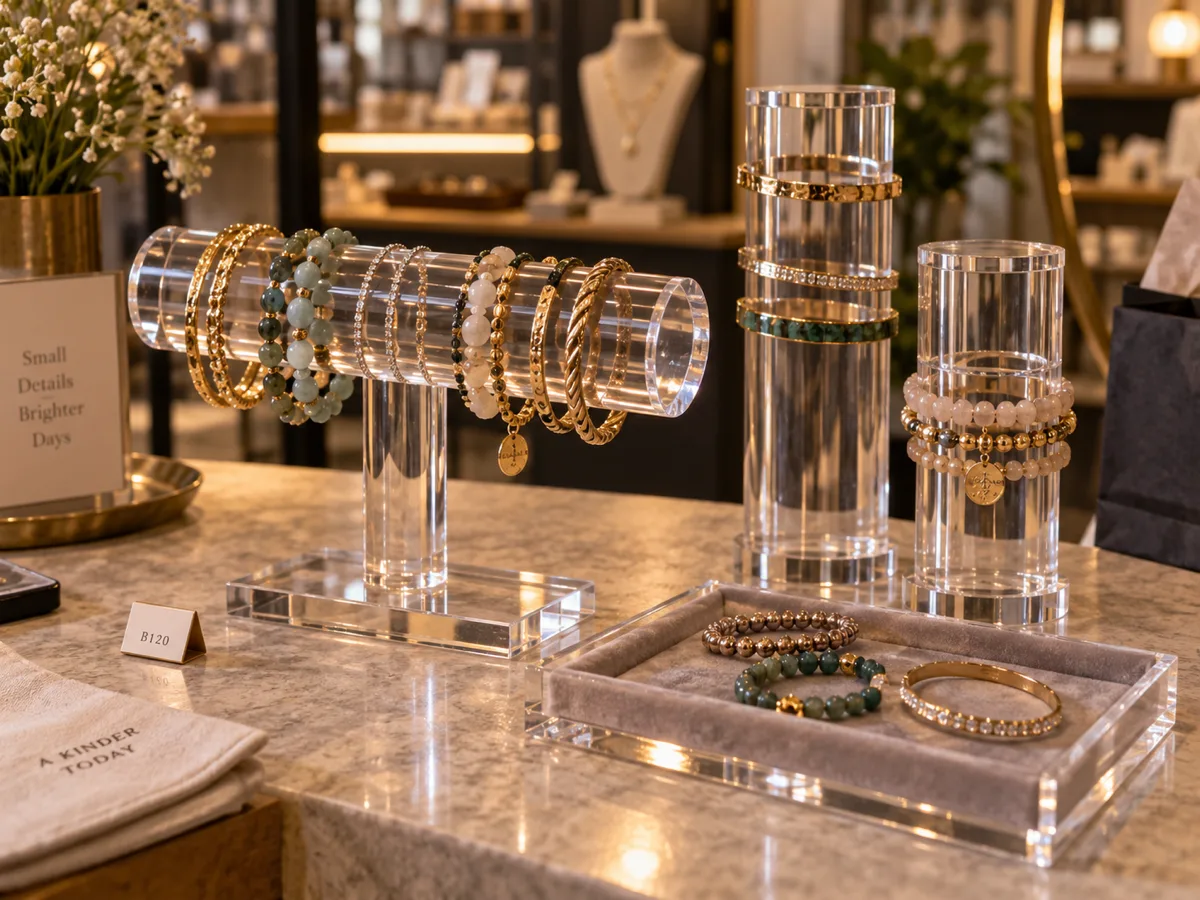
A T-bar suits chains, beaded and soft bracelets that drape; a cylinder or cone suits rigid bangles and cuffs that keep their shape. Many counters use one of each, quoted as two designs.
Delivered programs, shown anonymized with the figures published on each project page.
Delivered order
Counter display rollout for a 120-location US jewelry retailer
1,500 risers + 600 trays + 240 cases · production in 22 days
“We checked three suppliers and Wetop's polish was noticeably cleaner. Our VM team signed off on sight.”Procurement Director, US jewelry retailer
Delivered order
Watch display program for a European distributor
300 units · edge-lit acrylic bases · sample in 4 days · production in 18 days
“The mitered joints read as one solid piece of acrylic under the store lighting. That's the feel we needed for the flagships.”Product Manager, European watch brand
Delivered order
Modular show kit for an independent jewelry designer
80-piece kit · nests into 2 shipping cases · production in 15 days
“Everything nests into two shipping cases and sets up in about 20 minutes. Four shows in, nothing's scratched or broken.”Owner, independent jewelry brand
Delivered order
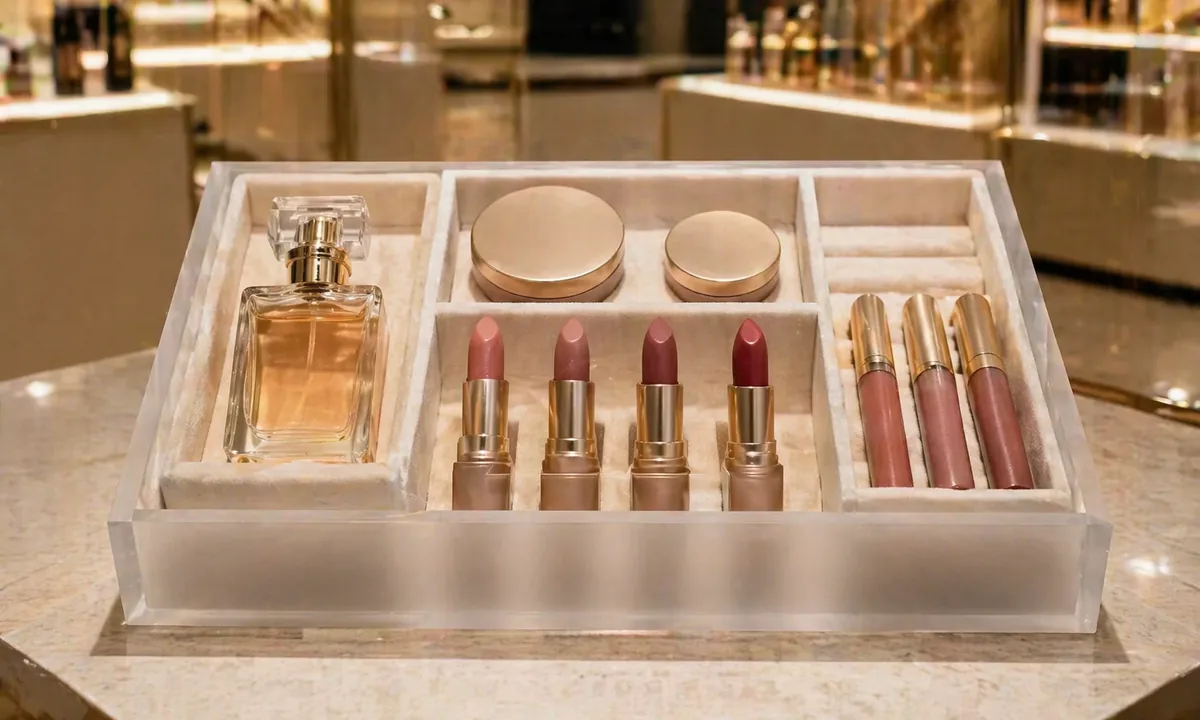
Cast acrylic shells with brand-dyed velvet seats — the same insert work that goes into jewelry trays and ring pads.
Delivered order
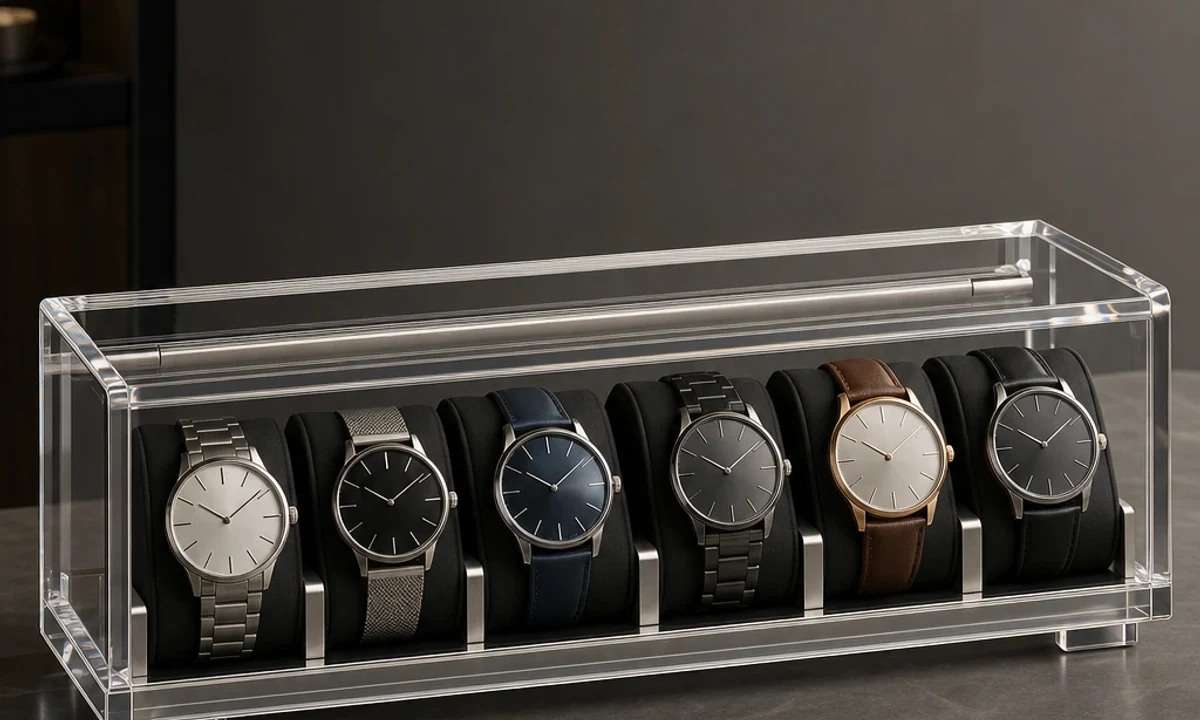
A 3-, 6-, 12-, and 20-watch family, each released after drawing, cradle fit, hardware, and packing approval.
Delivered order
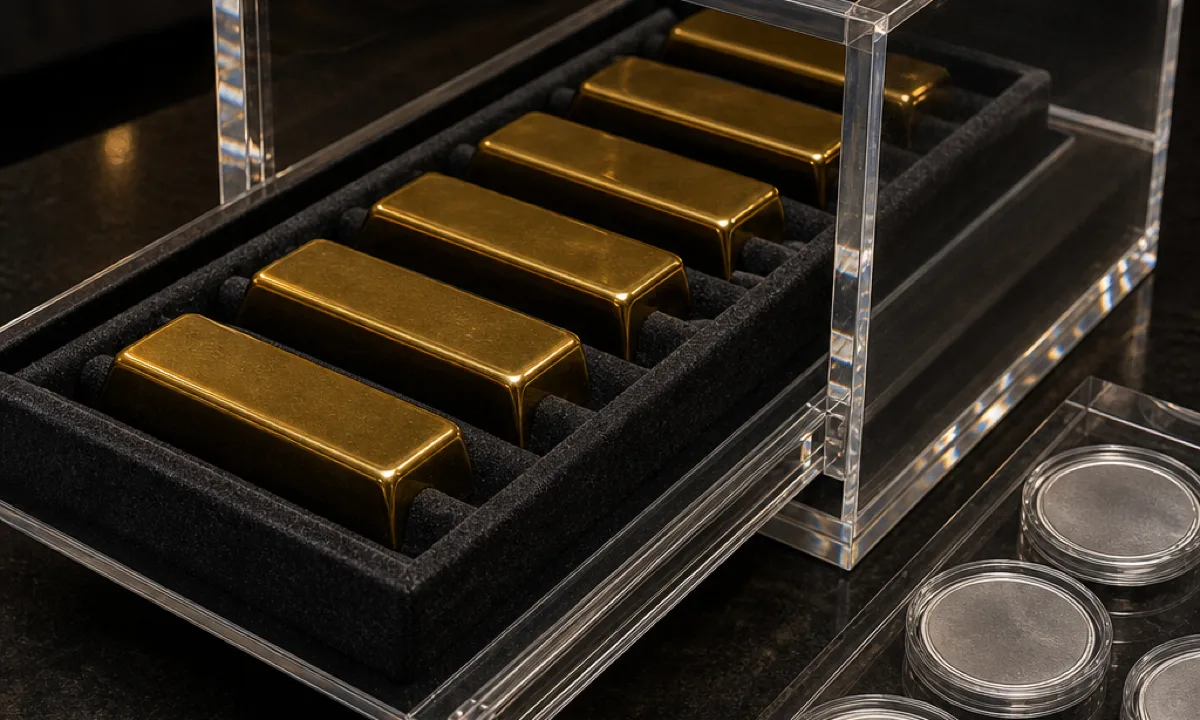
A one-ounce bar case with a sliding bottom, fit to a 35 × 55 × 6.5 mm reference and approved on the sample.
Compare jewelry display manufacturers on drawing control, paid-sample fit, optical finish, access hardware, repeat-order files, store-level packing, and inspection evidence. For custom acrylic jewelry display cases, the approved material grade, panel thickness, edge finish, insert fit, and lighting interface matter more than a generic clarity claim.
Choosing the fixture mix? The jewelry display ideas guide compares counter, wall, tray, riser, and case layouts; the acrylic vs wood guide compares brand tone and cleaning. More on acrylic materials.
Diamond-polished edges produce the highest optical clarity — light refracts cleanly through the acrylic, which matters when displaying gemstones and precious metals. For premium jewelry showcases, we recommend pairing diamond-polished clear acrylic with a mirrored acrylic base. The mirror doubles the visual depth without adding bulk. LED-compatible builds use frosted or edge-lit acrylic panels to distribute light evenly across the display surface.
Yes, built to your drawing and lighting spec. Edge-lit or frosted bases, backlit panels for wall showcases, and risers carry the LED strips in routed channels, so the light sits inside the acrylic rather than being glued on afterward. Send the strip width, color temperature, driver position, power and plug standard, and cable exit with your drawing; we build to it, don't design it, and check the lit paid sample before bulk.
MOQ is 100 pieces per design. This applies to jewelry display cases, ring holders, necklace stands, earring displays, and watch cases equally. Sample production takes 3–5 days, and we ship individual samples before bulk production so you can test fit, finish, and lighting in your actual retail environment.
We manufacture the acrylic watch display case — including the base, lid, and any riser or pedestal structure. Cushion inserts (velvet, leather, suede) are sourced from our textile partner and assembled in our facility. This keeps everything under one roof: you send one spec, receive one shipment. Cushion color and material are fully customizable.
Every piece ships with protective film on all polished surfaces, individual foam wrapping, and corrugated dividers between units. For mirrored and edge-lit pieces, we add rigid corner protectors and double-wall cartons. We ship FOB Shenzhen by default, with CIF and DDP available.
We don't stock or wholesale — every order is made to your spec in production quantities from 100 pcs. Unit price steps down as the run grows because setup, tooling, and polishing time spread across more pieces. We quote your target quantity and the next step up together. MOQ is 100 pieces per design, so 300 pieces split across three ring stands counts as three designs. For a phased rollout, tell us the annual volume and we will show the program pricing beside the first-shipment quote.
Yes. FOB Shenzhen is our default term, and we quote CIF or DDP whenever a buyer asks. A DDP figure is the delivered cost to your door — freight, customs clearance, duties, and final delivery folded into one number — so nothing arrives on top of the unit price after the goods land. Send the destination address, whether the order moves by sea or air, and your must-arrive date along with your specs, and we will show FOB and DDP side by side; most jewelry buyers want both so they can compare our number against their own forwarder. Payment terms are 30% deposit before production and the 70% balance before shipment, by T/T, PayPal, or Western Union.
Yes. We offer 50+ standard acrylic colors plus custom Pantone matching. Send your brand Pantone code or physical color sample with your inquiry. We'll produce an exact-match sample so you approve the color before bulk production. Pantone-matched colors occasionally have longer lead times (confirm in quote). This is especially popular for luxury jewelry brands rolling out across flagship stores — consistency matters. See material options.
Include the fixture dimensions, jewelry or insert dimensions, quantity per design, finish, brand artwork, lighting requirements, lock or access method, packing plan, destination, and launch date. A reference photo can start the quote, but the approved drawing controls production.
Send the actual ring pad, necklace form, watch cushion, or controlled dimensions. We build the interface into a paid sample, and the buyer approves fit and access before bulk release; sample fees are paid separately and are not credited to production.
Yes, when the insert is designed as a removable or captured component rather than bonded permanently. Keep separate drawing revisions and bill-of-material lines for the acrylic body and insert, then verify fit and removal on the paid sample.
No acrylic fixture should be promised as theft-proof. State the access risk, lock type, supervision model, and product value; the buyer approves the security plan, while Wetop fabricates the acrylic and hardware interfaces to the approved drawing.
Yes. Provide the store or collection matrix, carton labels, fixture counts, insert packs, and spare allocation. We quote store-level kitting separately from bulk packing so the field labor is visible before the order is released.
Retain the approved drawing revision, cutting files, print artwork, Pantone or swatch approval, insert specification, lighting bill of materials, packing file, and signed sample photos. A reorder should name the exact revision and list changes explicitly.
From a single boutique fit-out to a 100-location rollout, the same factory, team, and finish run every order. Share specs or a reference photo and we'll reply within 24 hours with recommendations and pricing.