

Delivered Project · Watch Displays · Collectors
Watch Collector Display Case Series: Four-Format Program
A buyer selling into the boutique watch-collector channel wanted one family of acrylic cases: tabletop cases for 3, 6 and 12 watches and a 20-watch wall panel.
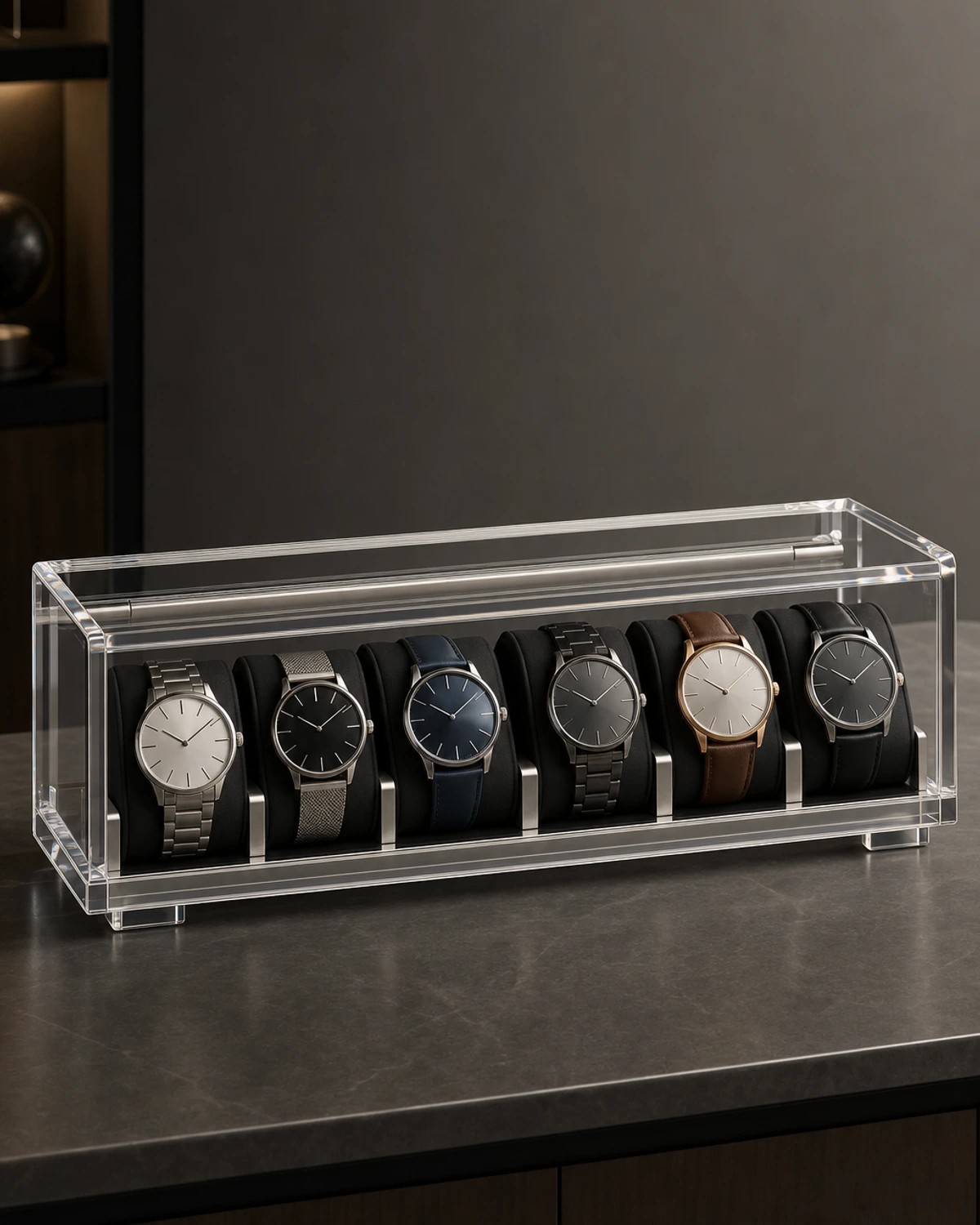
We delivered four drawings, each with silicone-pillow cradles fitted to the buyer’s actual watches, magnetic lids with a gasket and a named cast-PMMA grade. Delivered: a four-size collector-case family with controlled cradle fit, reviewed hinge and wall mounting, dust-control details, first-off inspection and packing by SKU.
- case sizes
- 4
- cradle fit checks
- 5
- watches in the largest case
- 20
Ordering a similar project
Each unique case geometry has a 100-piece production MOQ. Paid pre-production samples take 3–5 days; sample fees are paid separately and never credited. Standard production takes 15–20 days after the case drawing, cradle, hardware, material grade, and packing are approved.
Closest published price: this order was quoted per geometry from the drawings. The nearest public reference is a 300 × 200 × 250 mm, 5 mm UV-filtering collectible case with mitered joints and a magnetic lid at 200 pieces, listed from $15–30 per unit FOB Shenzhen on the acrylic cases hub. Cradle sets, hinge hardware, wall mounting, the named grade, packing and quantity set each format’s figure.
Key Takeaways
- A buyer in the boutique collector channel needed tabletop and wall-mounted watch cases that read as one family. We delivered 3-, 6-, 12- and 20-watch formats as four drawings under one visual standard.
- We approved cradle compression on five fit checks against the buyer’s actual watches and closed straps; nominal strap width alone did not establish fit.
- We recorded the hinge source, lid load, opening angle, gasket and cycle-test method on the approved drawing before bulk production.
- Light exposure mattered, so we specified the PMMA grade from a supplier datasheet and named it in the quote instead of a generic “UV grade” label.
- Packing changed by case size, and carton labels tracked geometry, quantity, finish version and destination so the mixed-SKU shipment stayed sorted.
The Brief
A buyer selling into the premium collector channel came to us with tabletop and wall-mounted cases that had to share one visual standard. Lid span, cradle count, access and mounting load changed with each format, so we made one controlled drawing per geometry.
We worked from the buyer’s actual watches and closed-strap dimensions, the case count by geometry, tabletop or wall use, opening frequency, room lighting, mounting substrate, cleaning method and packing route. Those inputs set the cradle-fit checks, hardware review, PMMA grade and shipment test.
Our Approach
We locked three things before bulk production: cradle fit, lid hardware and material grade.
Controlled silicone-pillow cradle set
We picked five fit checks from the buyer’s actual watch and closed-strap range, including the largest watch and thickest closed strap for each geometry. Those samples set lid clearance, spacing between watches, pillow compression and the force needed to insert or remove a watch. We recorded the approved compression and removal method on the drawing.
Magnetic closure and hinge set on the drawing
We specified the hardware source, lid load, opening angle, gasket, cycle count, test conditions and pass criteria. The cycle result was the acceptance record for the sample; we did not turn it into a promise of field life.
Named cast-PMMA grade
Light exposure mattered to this buyer, so we approved a named PMMA grade against its supplier datasheet and the display conditions. The quote named that grade.
Spec Breakdown and Production
Width, depth, height, sheet thickness, lid structure, mounting hardware, cradle spacing and packing were set on the drawing for each of the 3-, 6-, 12- and 20-watch formats. We released the wall-panel bracket after the buyer supplied the substrate and load inputs.
Four drawings, one controlled family
The shared standard fixed edge finish, corner treatment, closure appearance, cradle color and visible hardware across all four formats. Each drawing kept its own span, lid stiffness, hinge position, magnet location, internal clearance, cradle pitch, access path and base or wall-mount structure, so a change approved on the 3-watch case could not move into the 20-watch panel without a load and access review.
First-off inspection and packing by SKU
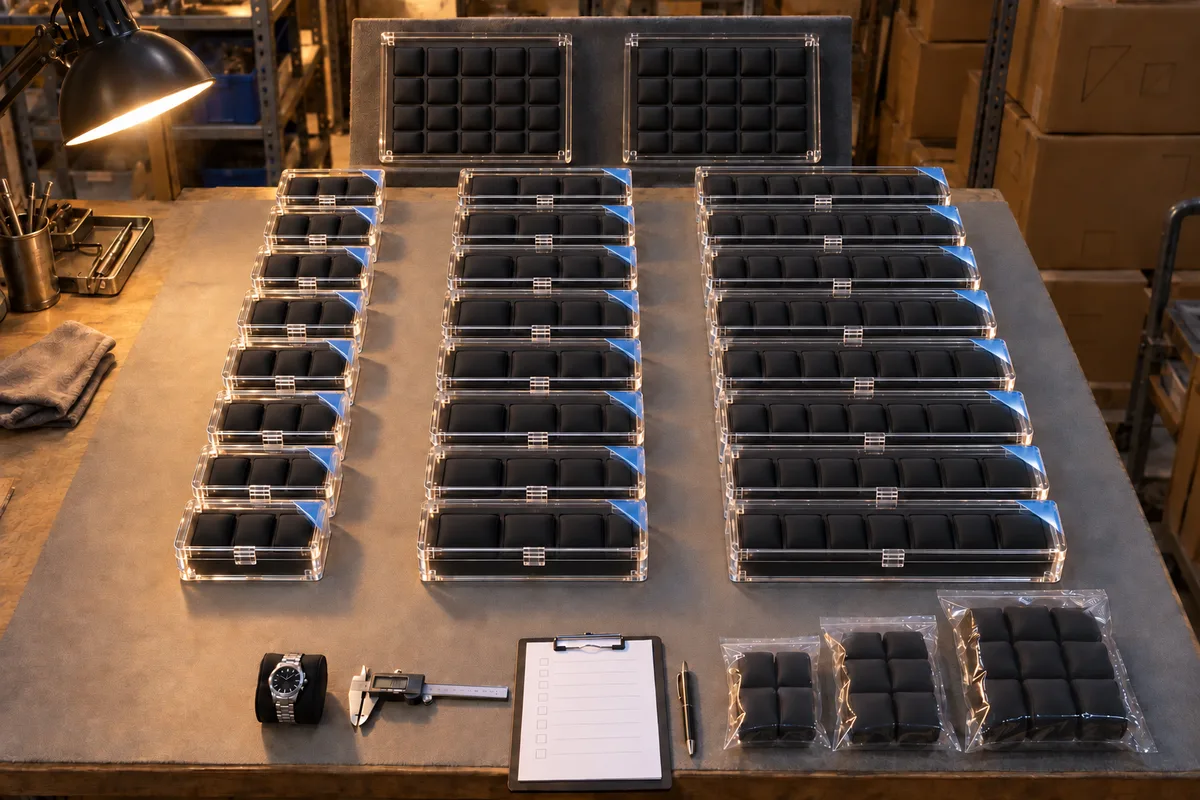
Production ran 15–20 days after drawing and sample approval and began with a first-off unit from each geometry. Inspection checked drawing dimensions, polished edges, joint clarity, lid alignment, opening path, magnet engagement, hinge movement, cradle count and spacing, and the wall-bracket interface. Cosmetic limits used an agreed viewing distance and light source; functional checks used the approved watch set, hardware and test method.
Packing changed with size. We protected each tabletop case so the lid, base and polished faces did not rub in transit, and put loose cradles and hardware in counted compartments or labeled bags. The wall panel was packed to protect its longest span and keep its mounting parts with the right SKU. Carton labels showed geometry, quantity, finish version and destination allocation, so we checked the mixed-SKU shipment before release and the buyer received it without opening every carton.
The Results
The four-format family gave the collector channel tabletop and wall-mounted cases under one visual standard. The release record named the material grade, hardware source, cradle-fit samples, acceptance tests, appearance standard, carton configuration and shipping marks, and the hinge record kept the load, opening angle, gasket condition, cycle count and inspection result.
Reorders start from the approved drawing, cradle record, hardware source and named material grade. A changed geometry gets its own fit, load, access and first-off review, and a watch or strap outside the approved fit set gets a separate fit review against the physical item or a buyer-supplied gauge.
What held the family together: we built the cradle set from the actual watch and closed-strap samples and kept the approved fit record with each case drawing.
If You're Planning Something Similar
Bring the largest watch and thickest closed strap for each size, plus any bracelets, deployant clasps or deep cases, to the fit set. Each geometry carries its own 100-piece MOQ. See custom acrylic cases, and for a wall format the extra-large display case buyer guide.
Need a watch collector display case family?
Send the watch count, case and closed-strap dimensions, quantity by geometry, tabletop or wall format, opening frequency, lighting, mounting substrate and packing route. We will return a drawing review and a quote.
Paid sample in 3–5 days · Sample fees paid separately and never credited