

How to Choose an Acrylic Supplier: 7 Red Flags
Use the quote, factory evidence, quality plan, sample, and commercial terms to compare suppliers against one approved specification.
Need this made?Custom acrylic fabrication services →
Key Takeaways
- A comparable quote should name the material grade, thickness and tolerance, finish, quantity, setup, lead time, payment terms, and Incoterm.
- Verify an ISO 9001 certificate against the issuer or an available accreditation database; the certificate does not approve a specific product.
- Use a live factory walkthrough to confirm the machines, material storage, work in progress, and inspection process relevant to your part.
- Ask for a written inspection plan, a production-representative sample, and a defined response to nonconforming work before issuing the purchase order.
- Choose a supplier whose documented processes and typical order size fit the approved product specification.
On this page
- What Your Quote Reveals Before You See a Sample
- How to Read a Factory Site Visit (or Video Audit)
- How to Validate ISO 9001 and QC Documentation
- Supplier communication and control red flags
- How to Match the Acrylic Supplier to Your Product Type
- Three supplier-control questions to ask
- Putting It Together: A Supplier Evaluation Checklist
- Appendix: 22 questions to send every shortlisted supplier
What Your Quote Reveals Before You See a Sample
Start the acrylic supplier comparison with one approved specification. A comparable quote should state the material grade, thickness and tolerance, surface finish, unit price, setup or tooling fees, sample lead time, production lead time, payment terms, and shipping terms. Record any missing item as an open question before comparing totals.
A price and lead time do not define the finished part. Ask the supplier to bind the quote to the material, finish, tolerance, drawing revision, packing, and approval route. The checklist below gives both sides the same comparison basis.
The nine-item quote checklist
| Item | Why It Matters | Red Flag If Missing |
|---|---|---|
| Material type | Cast vs extruded PMMA affects optical quality and edge polishing | Supplier can substitute without you knowing |
| Thickness + tolerance | Structural and aesthetic baseline | Parts may not fit or look as intended |
| Surface finish | Polished, matte, frosted — different cost and appearance | You get whatever’s cheapest that day |
| Printing method | UV, silk-screen, hot stamping — each has different minimum runs | Color and durability can vary wildly |
| Unit price | Per-piece cost at your order quantity | Obvious — but verify it covers the finish spec above |
| Setup / tooling fees | One-time mold or jig fees for custom shapes | Hidden costs appear on invoice |
| Sample lead time | Days from payment to sample dispatch | Reveals fabrication capacity |
| Production lead time | Days from approved sample to shipment | Reveals real capacity, not sales optimism |
| Shipping terms | FOB, EXW, CIF, DDP — determines who carries risk in transit | Unclear terms = disputed liability on damaged shipments |
Ask for all nine in your RFQ. If you’re not sure how to structure the request, our acrylic RFQ guide walks through exactly what to include and how to phrase it.
How to Read a Factory Site Visit (or Video Audit)
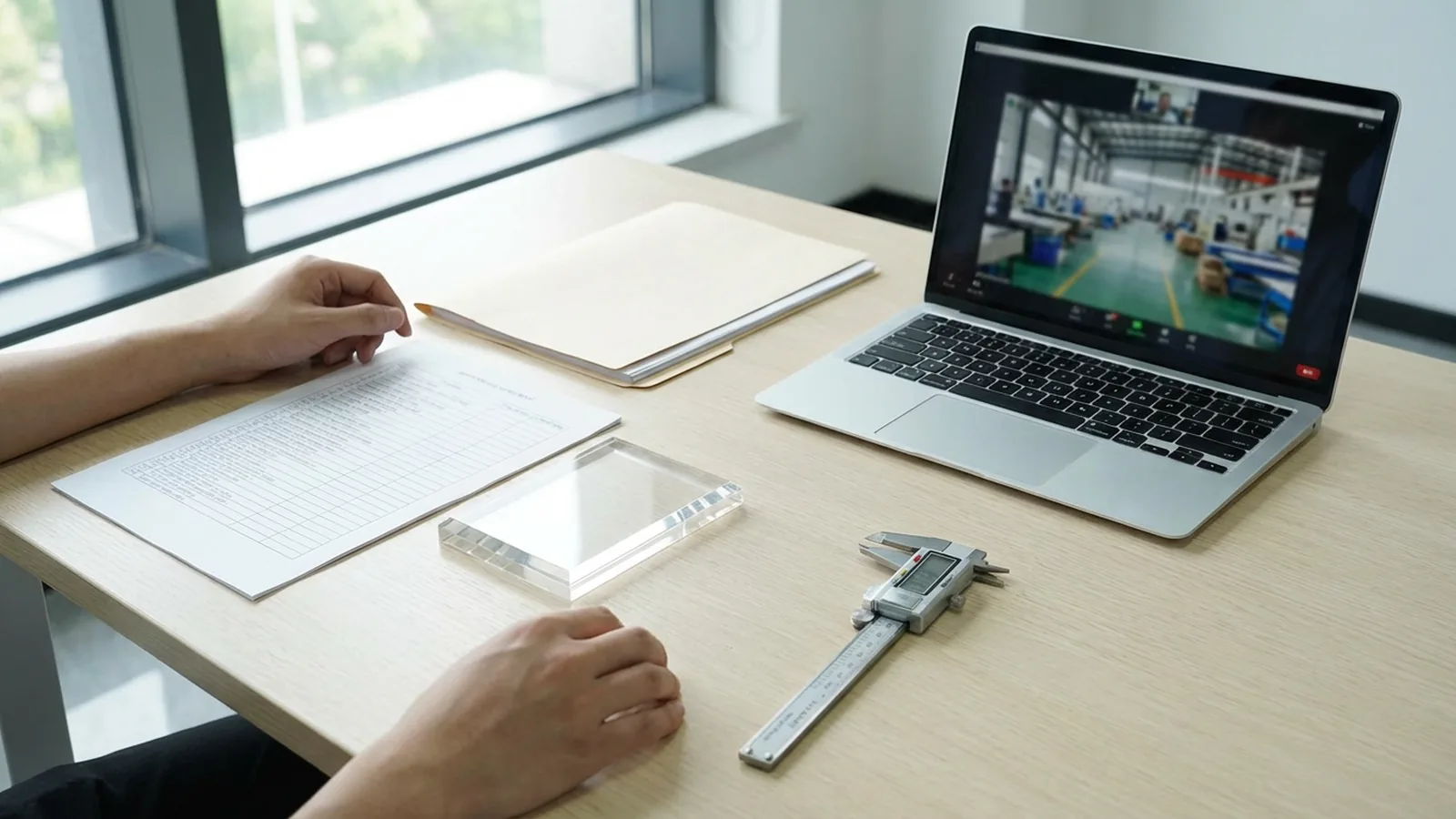
A live factory walkthrough can confirm the equipment, material storage, work in progress, and inspection stations tied to your order. A photo deck cannot show who controls each process or where the proposed work will run.
Ask the supplier to show the machines and operators proposed for your process route. Wetop’s 5,000 m² Shenzhen facility includes laser cutting, CNC machining, bending, polishing, printing, and assembly capabilities. If a supplier uses a partner process, ask who owns the specification, transfer record, inspection, schedule, and remedy at that handoff.
For a remote audit, request a live walkthrough and send the checklist in advance. Ask to see a relevant machine, one work-in-progress item, labeled material storage, and the inspection area. Record any unavailable area or document for follow-up instead of inferring the reason.
What to confirm on the visit or video call
- Machine list: does it match the capabilities on their website?
- Material storage: is raw acrylic sheet stored flat, labeled by grade and thickness?
- QC station: is there a dedicated inspection area with measurement tools?
- Work-in-progress: can they show you an order at a production stage similar to yours?
- Staff: are workers clearly assigned to specific processes, or does it look chaotic?
How to Validate ISO 9001 and QC Documentation
ISO 9001 addresses a quality-management system. It does not certify the performance or conformity of your specific acrylic part. Verify the certificate, then review the project drawing, sample, inspection plan, nonconformance route, and release evidence separately.
To verify: ask for the ISO 9001 certificate number and issuing certification body, then use the issuer’s or IAF CertSearch’s current verification path where available. Check the legal entity, site address, scope, issue and expiry dates, and status. Wetop states that it is ISO 9001:2015 certified; verify the current certificate itself rather than inferring the original certification year or issuing body from a marketing image.
List each required material and inspection document in the RFQ. Availability depends on the named material, sheet supplier, test scope, destination, and inspection plan. Ask the quote to state which datasheets, declarations, third-party reports, and inspection records are included.
The ISO 9001 quality management standard1 provides the framework; what matters is whether your specific supplier has built actual documented procedures around it — not just obtained the certificate.
Supplier communication and control red flags
Sample quality does not replace production controls. Review communication, drawing control, material traceability, inspection, and change approval before production starts.
Watch for these seven signals in the evaluation phase:
-
Response time degrades after the sample ships. Record the agreed update cadence and escalation contact before approval. A missed update becomes a specific issue to resolve, not a prediction by itself.
-
No documented QC process, just assurances. Ask which features get checked, the method and sample size, who releases the lot, and how the supplier handles nonconforming work.
-
The second quote changes price without a line-item explanation. Compare material grade, thickness, finish, quantity, packing, Incoterm, and drawing revision before accepting the change.
-
They cannot provide the agreed material identity or traceability evidence. Define the sheet grade, supplier documentation, and lot-record requirement in the order.
-
The sample took twice the quoted lead time with no proactive update. Treat the missed update as a diligence item: ask for the escalation contact, revised milestone record, and production communication plan before approving the order.
-
The legal entity and operating address remain unverified. Check the business registration, invoice entity, beneficiary, and production address before payment.
-
Reluctance to do a video audit. As covered above — if a factory won’t show you the floor live, ask why.
Use the evaluation stage to collect written process evidence and verify follow-through on agreed actions. The Institute for Supply Management2 publishes supplier-evaluation resources that procurement teams can adapt to their own risk criteria.
How to Match the Acrylic Supplier to Your Product Type
Suppliers can specialize in different product types and order sizes. Compare the proposed machines, fixtures, finishing route, inspection method, and prior work against your approved specification rather than relying on price or certification alone.
Industry bodies classify acrylic fabricators broadly, but within that category, capability ranges from basic laser-cut flat parts to complex multi-piece assemblies with print and structural components. Before requesting a quote, confirm three things: First, has this supplier made a product in your category before? Ask for photos or references — not a generic portfolio, but projects similar to yours in material, finish, and complexity. Second, do they have the specific fabrication processes your product requires? A cosmetics display with UV-printed logos and a mitered case body needs UV printing capability, CNC cutting for precise angles, solvent bonding skills, and in-house diamond vs flame polishing capability — not just a laser cutter. Third, what does their typical order size look like? A factory accustomed to 10,000-piece orders may not apply the same care to a 200-piece custom run. For a worked example of applying these checks to one product category, our acrylic standee supplier checklist walks through the print-and-cut capability questions standee buyers should ask before committing a PO.
For cosmetics and beauty brands, the cosmetics and perfume display application page details what fabrication capabilities actually matter for that product category — including surface finishes, printing options, and MOQ considerations for retail launches. For buyers sourcing retail display stands or POS fixtures, our acrylic display stand manufacturer hub shows the range of configurations and materials we fabricate most often, with specs by product type. Buyers evaluating suppliers for case and display-box work should cross-check what an acrylic display case manufacturer actually builds — a category where fabrication quality differences (edge polishing, corner joints, UV resistance) are directly visible to the end customer and reveal supplier skill gaps quickly.
Three supplier-control questions to ask
Three questions make the supplier’s production controls visible before the purchase order.
Question 1: “What happens when the production run has defects?”
Ask how the supplier identifies nonconforming work, who decides whether to stop or release production, what evidence reaches the buyer, and which remedy terms the order includes. A quality claim without a defined process does not answer the question.
Question 2: “Can I see a piece from a current production order for a different customer?”
The supplier must protect other customers’ confidential work. Ask instead for an authorized production example, an anonymized inspection record, or a live view of the relevant process that does not expose protected designs.
Question 3: “What is your material traceability process?”
Define the material identity and traceability record required for the order. The supplier should state what it records, how long it retains the record, and how it connects the incoming sheet to the finished lot. Do not assume a batch number or retention period unless the quote or quality plan includes it.
Ask these questions on the first inquiry call and record the answers in the supplier comparison. The process overview and quality control page show the same categories for Wetop; verify the project-specific details in the quote and quality plan.
Putting It Together: A Supplier Evaluation Checklist
Use the checklist before committing to production. Treat each failed or unverified item as an open risk that needs evidence, a written control, or a sourcing decision.
| Category | Pass | Fail |
|---|---|---|
| Quote completeness | All 9 items present in writing | Missing material grade, tolerance, or lead time |
| Factory verification | Video audit or in-person visit completed | Photo deck only, video audit declined |
| ISO 9001 status | Certificate verified against registrar’s registry | Certificate number unavailable or expired |
| QC documentation | Written inspection process with specific checkpoints | Verbal assurances only |
| Communication pattern | Agreed update cadence and escalation contact | Missed updates remain unresolved |
| Product-type fit | Portfolio includes similar product category and complexity | Generic portfolio only, no comparable projects |
The custom acrylic fabrication page lists Wetop’s stated processes, materials, and finishing options. Confirm the project route, inspection, and any partner process in the quote. For a production example, see the multi-category acrylic display rollout case study.
Appendix: 22 questions to send every shortlisted supplier
Send the same 22 questions to every supplier on the shortlist and ask for written answers by the same deadline. The questions fall into five groups: capacity, material traceability, QC, lead time and tooling, and account stability. A supplier that answers each one with a number, a document, or a named person is giving you evidence you can compare. Answers like “plenty of capacity” or “rigorous QC” leave the question open. The questions work on any acrylic supplier, including us. For the on-site version of this review, use the supplier audit checklist.
Capacity (Q1–5)
Every fabricator already tracks four capacity numbers for its own scheduling, so Q1–Q4 should come back without hesitation. Tie each answer to your SKU and delivery window, not to a factory-wide maximum.
- Machine count by process. How many CNC routers (and bed sizes), laser cutters, polishing stations, bonding tables, and print lines do you run? One machine on a critical process means no backup if it goes down during your order.
- Shift pattern and committed load. Which shift will run my parts, and how much of the CNC, polishing, bonding, or printing time in my window is already booked?
- Actual peak output. What was your highest shipped daily output last quarter for this product family, from the shipping log rather than a theoretical maximum?
- Reserved production window. Which dates can you reserve for my order in the quoted production plan?
- Bottleneck and surge plan. Which stage limits daily output for my product (often polishing, bonding cure, or QC rather than cutting), and what is the written plan if my volume doubles mid-program?
Material traceability (Q6–10)
- Are sheet mill certificates included in the QC packet for every batch, or only on request?
- Which mills supply your cast acrylic sheet?
- What happens if the specified sheet is unavailable mid-run: switch mill, pause, or notify me first?
- How do you document whether a part is cast or extruded acrylic?
- What extra lead time applies to UV-stabilized, anti-yellow, or color-matched grades?
QC system (Q11–15)
- What is inspected at incoming, in-process, and final stages, and at what sampling rate?
- What was last quarter’s defect rate, split into cosmetic, dimensional, optical, and structural?
- Can I see the most recent ISO 9001 surveillance audit, including nonconformances and corrective actions?
- What is your root-cause and corrective-action process when a buyer reports a defect after delivery, and how long does each step take?
- How many defect events do you log per quarter, and what share close on time? Very few logged events can mean defects are not being recorded.
Lead time and tooling library (Q16–18)
- First vs repeat lead time. How does repeat-order lead time differ from first-order lead time, and what makes up the difference?
- Tooling retention. Which drawings, CNC programs, jigs, fixtures, approved samples, and packaging specifications from my order will you keep, for how long, and how is each item tied to the approved revision? Put the agreed retention period in the PO instead of assuming a default.
- On-time record. What share of orders over the last four quarters shipped on or before the quoted date?
Retained tooling can shorten engineering setup on a repeat order, but material, artwork, dimensions, finish, and inspection still run again. Wetop’s standard production time is 15–20 days after sample approval; any repeat-order reduction is quoted against the actual retained files and fixtures.
Account stability, finance, IP, and references (Q19–22)
- How concentrated is your revenue in your largest customer, and what protects my open orders if a major account changes?
- What are your standard payment terms for first and repeat orders?
- How are my drawings handled: who has access, how are files transferred, what happens to them after the project, and who owns the tooling if the program moves?
- Can you give three references from similar work in the last 18 months who will take a 15-minute call?
How to score the answers. Score each question 0 (deflected or marketing language), 1 (industry-typical but not supplier-specific), or 2 (specific number, document, or named person). A low score in capacity or QC matters more than one in finance, because those two groups decide whether the order ships on time and to spec. A supplier that changes its capacity numbers between calls, or shortens its lead time as you push, is telling you the first number had no basis.
Footnotes
-
ISO 9001 — Quality management systems — ISO’s overview of the ISO 9001 quality management standard, including what the certification covers and how it is issued and maintained by accredited certification bodies. ↩
-
Institute for Supply Management — Professional association for supply chain and procurement managers; publishes research and standards on supplier evaluation, qualification, and risk management used by procurement teams across manufacturing industries. ↩
Published price point
Test the supplier checklist on a real specification
From $6 per unit at 500 pcs, FOB Shenzhen
Published comparator for a 150 × 100 × 100 mm case in 3 mm clear acrylic with a magnetic lid. It is not a flat supplier price; product geometry, material, finish, inspection, packing, and quantity determine the quote.
Paid samples are quoted separately and are never credited to production.
Thank you!
We've received your inquiry. Our team will reply within 24 hours — usually faster.
Frequently Asked Questions
How do I verify an acrylic supplier's ISO 9001 certification?
Request the certificate and issuing body, then check the issuer's current verification route or an available accreditation database. Match the legal entity, site address, scope, certificate number, issue and expiry dates, and status. Treat a missing or unverifiable certificate as an unresolved diligence item rather than proof of certification.
What is a reasonable MOQ for a custom acrylic supplier?
MOQ depends on the product, material yield, setup, decoration, packaging, and supplier. Wetop's standard production MOQ is 100 pieces per design; the quote states any product-line exception. Compare suppliers at the same approved specification and quantity.
How long should acrylic sample lead time take?
Ask each supplier to quote sample time from specification confirmation and payment. Wetop's standard sample reference is 3–5 days, but complex tooling, color matching, sourced hardware, and buyer revisions can extend it. A longer schedule does not by itself prove outsourcing.
What should I look for in an acrylic supplier's quote?
A complete quote specifies: material type (cast vs extruded PMMA), thickness and tolerance, surface finish, printing method if applicable, unit price, tooling or setup fees, lead time (sample and production separately), payment terms, and shipping terms (FOB, EXW, or DDP). Missing any of these requires a follow-up before you can make a fair comparison.
Is it safe to order custom acrylic products from China?
Apply the same diligence used for any overseas supplier: verify the legal entity and claimed certificate, approve a production-representative sample, define required material documents and inspection evidence, and write the Incoterm and remedy process into the order. Document availability depends on the named material, supplier, test scope, and destination.
What capacity numbers should an acrylic fabricator disclose before a PO?
Four: machine count by process, the shift pattern and load already committed in your delivery window, actual peak shipped output for your product family, and the production dates it can reserve for your order. Ask for each in writing and tied to your SKU. A factory-wide maximum does not show whether the polishing, bonding, or QC stage your part needs has room.
Compare the supplier against your production brief
Send the drawing, quantity, finish, required documents, and destination. We will state the proposed material, process, inspection plan, commercial terms, and paid-sample scope in the quote.