





What Is a Floating Frame? How to Choose One
The float is a mounting method, not a frame style; the build you need depends on whether you frame a canvas or suspend a print in mid-air.
Need this made?Floating acrylic frames →

Key Takeaways
- A floating frame displays a piece with visible space around it instead of covering its edges — the term names two different builds: a wood floater frame that surrounds a canvas with a shadow gap, and a double-panel float mount that suspends a print between two clear panels.
- In an acrylic floating frame, two clear panels clamp the artwork and a 25–50 mm margin of transparent acrylic around it creates the illusion that the piece hangs in mid-air against the wall.
- Double-panel float builds are almost always acrylic rather than glass: acrylic sheet transmits 92% of visible light (ASTM D1003) at roughly half the density of glass, so a two-panel build stays wall-safe instead of doubling into a heavy, fragile sandwich.
- Conservation practice favors non-adhesive mounting — corners, strips, or reversible hinges — which is exactly what a clamped float mount provides: the piece is held by pressure, not glued down.
- For bulk buyers, custom acrylic floating frames run from a 100-piece MOQ with no tooling fees, samples in 3–5 days, and production in 15–20 days.
On this page
What a floating frame is
A European contemporary-art network approved 420 colored acrylic floating frames across 11 sizes and 4 colors for a 22-day production run. A floating frame displays artwork with its edges visible and open space around it instead of a mat or lip covering the piece.
The effect comes from a deliberate gap: a shadow gap around a canvas, or a transparent margin around a print held between two clear panels. The approved artwork, panel and mounting drawing determines the exact dimensions.
That one-sentence definition hides a fork, and the fork is the first thing to get right because it decides which product you are actually shopping for. “Floating frame” names two different builds. The first is the floater frame: a wood or metal frame for stretched canvases, shaped like an L in cross-section, that surrounds the canvas without touching its face and leaves a shadow gap between canvas edge and frame wall. The second is the float mount: a frame for flat pieces — art prints, photographs, documents, textiles, pressed botanicals — that suspends the piece between two panels, almost always clear acrylic, so it reads as hanging in mid-air against the wall.
Both are real, both are common, and search results mix them freely, which is why buyers regularly order the wrong one. The test is the object: if it is a stretched canvas on wooden bars, you want a floater frame; if it is flat, you want a float mount. The rest of this guide covers both, but goes deepest on the double-panel acrylic build — it is the version we manufacture, and the version with the most decisions hiding inside it.
How float mounting works
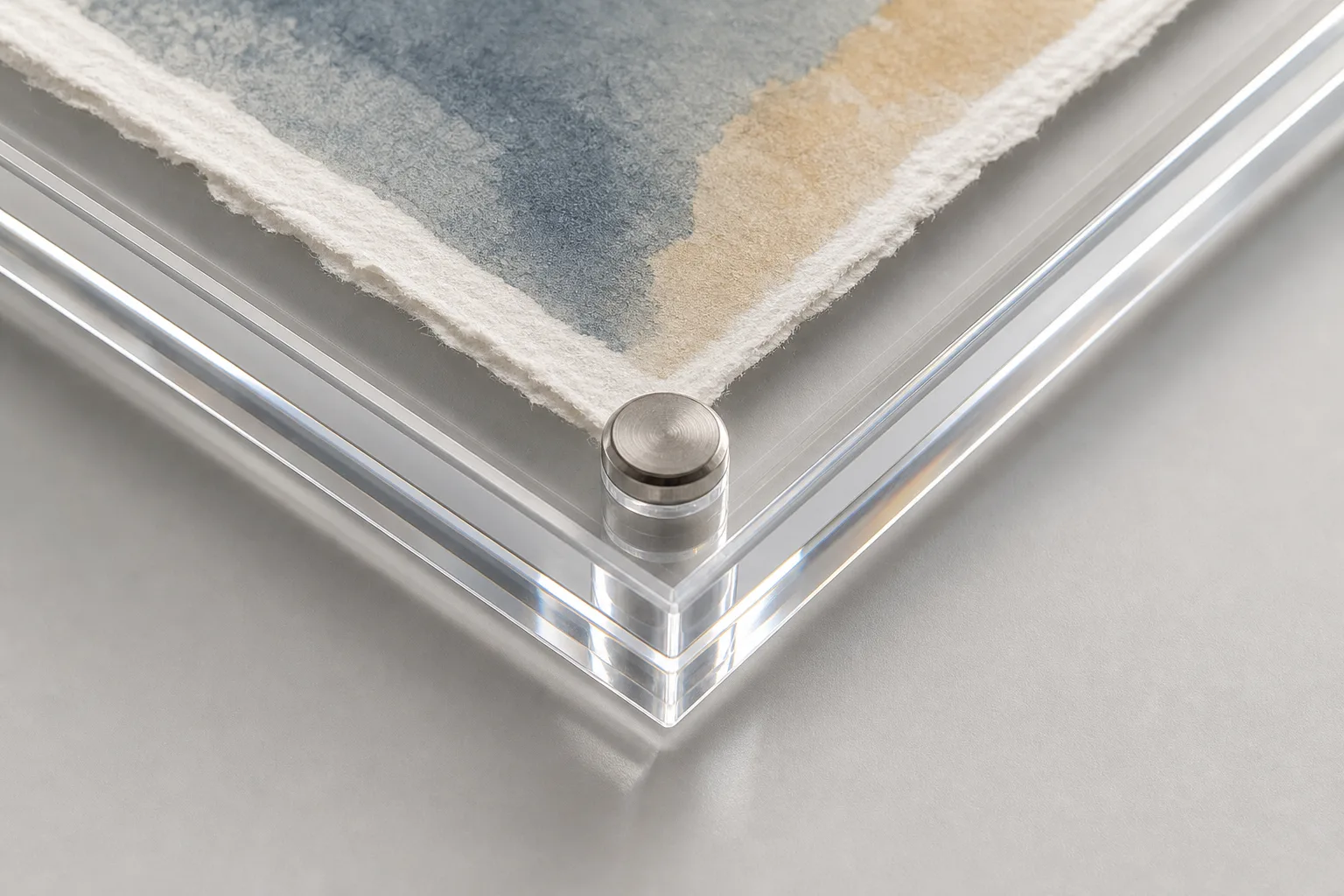
Float mounting holds a flat piece by clamping, not adhesive: two rigid clear panels close over the artwork and grip it with even pressure, leaving a transparent margin on all sides. The wall shows through that margin, which is what produces the floating illusion — the eye sees the piece, then the wall, with no visible border between them.
The clamping detail matters more than it looks. Conservation guidance for works on paper favors non-adhesive attachment — photo corners, mounting strips, reversible hinges — precisely so the object can be removed unchanged.1 A pressure-held float mount is aligned with that logic by construction: open the panels and the print comes out as it went in, which is why the format is loved by galleries and by anyone framing something irreplaceable. It also means the format forgives change — a print lab can ship the same frame with rotating artwork, and the end customer can swap the insert without tools or skill.
The canvas floater frame floats by different means, and it is worth thirty seconds even if your work is flat, because knowing the mechanism keeps the two products distinct. A floater frame is an L-shaped molding: the vertical leg forms the outer wall, the horizontal leg forms a ledge behind the canvas. The stretched canvas screws to that ledge from behind, so nothing touches the painted face and the front edge of the frame wall sits proud of the canvas surface. The deliberate 6–12 mm gap between canvas edge and frame wall — usually painted black or a dark tone so it reads as shadow — is the entire effect. No glazing, no clamping, no margin: if someone quotes you a “floating frame” without asking whether the piece is canvas or flat, they have skipped the question that decides the build.
The geometry gives you three numbers to specify. The margin — how much clear acrylic surrounds the piece — typically runs 25–50 mm; narrower reads cramped, wider turns the frame into the object. The standoff depth — how far the panels sit off the wall — runs 15–20 mm on barrel-mounted builds and is what casts the soft shadow behind the piece. And the panel split: the front panel runs thinner (3–4 mm) for lightness and clarity, the back panel a gauge heavier (4–5 mm) because it carries the hanging hardware and keeps the sandwich flat.
Floater frame vs float mount vs acrylic build
The decision between the builds is mostly made by the object you are framing, then refined by weight, safety, and how often the contents change. The table below is the fast comparison across the three common builds.
| Wood floater frame | Glass float frame | Acrylic double-panel float | |
|---|---|---|---|
| Object | Stretched canvas | Flat prints, documents | Flat prints, photos, botanicals, memorabilia |
| How it floats | Shadow gap (6–12 mm) around canvas | Print suspended between two glass panes | Print clamped between two clear acrylic panels |
| Glazing weight | None | Heavy — two panes of glass | Roughly half of glass at equal thickness |
| Breakage risk | Low | Highest of the three — double glass | Low — acrylic resists shattering |
| Swappable contents | No — canvas is screwed in | Rarely — usually sealed builds | Yes — magnet builds open in seconds |
| Edge treatment | Painted or veneered wood | Exposed glass edges | Diamond-polished acrylic, glass-clear |
| Typical buyer | Artists, canvas printers | Vintage / decor niche | Galleries, print labs, retail brands, awards programs |
The weight row is the quiet decider for anything sold at volume or shipped to end customers. A float build doubles the glazing by definition — two panels, not one — so the panel material’s density gets multiplied exactly where it hurts. Cast acrylic’s density of 1.2 g/cm³ is roughly half that of glass,2 which keeps a two-panel A2-size frame comfortably inside the weight range of ordinary picture-hanging hardware, and keeps parcel shipping survivable without glass-crate packaging. Optically you give up nothing that matters at display distance: acrylic sheet transmits 92% of visible light with haze under 2% (both per ASTM D1003).3
The edge row deserves a word too, because on a floating frame the edges are not trim — they are the frame. A wood floater shows painted molding; a glass build shows raw pane edges; an acrylic float build shows the cut faces of the panels themselves, which is why edge finish is a named spec on every frame we quote. Diamond-polished edges — machined optically flat — read as glass-clear and make the panel perimeter part of the floating effect; flame-polished is the cost-effective step down for straight runs. A floating frame with frosted saw-cut edges undoes its own premise: the eye catches the cloudy border before it reads the suspended art.
One more comparison point matters for anything displayed near windows or bright retail lighting: light itself is the enemy of works on paper — fading and discoloration from display are cumulative and irreversible, which is why conservation guidance treats long-term display of originals so cautiously. UV-filtering acrylic grades exist for exactly this, screening the ultraviolet band while staying visually identical to standard clear sheet,4 and on a floating frame the upgrade applies to the front panel only.
What belongs in a floating frame
Floating frames suit anything whose edges are part of the story: deckle-edged art prints, full-bleed photography, documents and certificates, pressed botanicals, textiles, tickets, maps, and vinyl records. If a piece would lose something by having its edges covered with a mat, it is a float candidate.
That “edges are the story” rule explains where the format shows up commercially. Fine-art print sellers float deckle-edged giclée prints because the ragged handmade edge is the premium cue a mat would hide. Photographers float full-bleed images so the composition runs to the physical edge. Brands float memorabilia — a first ticket, a pressed flower from a product launch, a founding document — because the object reads as an artifact when it hangs in space rather than sitting behind a border. And award programs float certificates between panels for the same reason: the paper becomes an object, not a page.
The format also earns its keep operationally in a way buyers rarely anticipate: it separates the frame from the content in the supply chain. A conventional matted frame is built around one artwork at one size; a magnet-closed floating frame is a reusable fixture that accepts anything flat within its margin. Print labs use this to hold one frame SKU against a whole catalog of print sizes. Galleries rotate exhibitions through the same wall of frames. Retail brands ship the frame and the insert as separate line items and let store staff assemble. When I review a frame program with a buyer, this is usually the moment the order consolidates — five artwork sizes collapse into two frame sizes with generous margins, and the per-unit price drops with the consolidation.
What does not belong in a float mount is anything with real depth. A stretched canvas needs a floater frame, not panels. Objects past roughly 10 mm thick — medals, folded jerseys, dimensional artwork — need a clear acrylic shadow box with a spaced cavity rather than clamping pressure. I draw this line early with buyers because it is the most common mis-order in the category: the double-panel build works by pressing gently on the whole face of a flat object, and anything thick enough to hold the panels apart turns the clamp into a bridge and the fit into a rattle.
Size, thickness, and hardware
Three specs turn a floating frame idea into an orderable product: panel size (artwork plus 25–50 mm of margin per side), panel thickness (3–4 mm front over 4–5 mm back at typical sizes, stepping up past about 600 mm), and closure hardware — corner magnets for swappable contents, screw standoffs for a fixed, architectural look.
Thickness scales with panel span because stiffness, not strength, is the constraint — a large thin panel bows, and on a floating frame any bow is doubly visible because the eye can sight along the clear margin. At A4 to A3 sizes, a 3 mm front over a 4 mm back is comfortable; around A2, move to 4 over 5; past 600 mm on the long side, 5 mm panels front and back keep the sandwich flat. Since founding Wetop in 2008 I have signed off hundreds of frame programs, and undersized panel thickness on oversized frames is the failure I reject most at the drawing stage — it costs a few dollars to fix on paper and a whole production run to discover on a wall.
Hardware is a genuine fork, not a price tier. Corner neodymium magnets make the frame a system: panels open in seconds, contents swap without tools, and galleries or print labs can sell one frame with rotating inserts — if that is your model, our magnetic picture frames buyer guide goes deep on magnet strength, placement, and closure feel. Screw-post standoffs bolt the sandwich to the wall with a 15–20 mm reveal, read as permanent and architectural, and suit signage, certificates, and installations where nobody should open the frame casually. Both run in the same production flow, alongside engraving, UV-printed branding, and Pantone-matched colored margins.
Choosing one, and ordering at volume
Choosing comes down to the three forks this guide has walked: floater frame for canvas versus float mount for flat work; magnets for swappable contents versus standoffs for permanence; and standard clear versus UV-filtering front panels for anything hung near light. Settle those, add artwork dimensions and quantity, and a floating frame is fully specified.
A complete floating frame spec fits in six lines, and sending all six is what gets a quote back in one pass: artwork dimensions (or the largest insert the frame must accept), margin width per side, front and back panel thicknesses (or “recommend”), closure hardware (magnets or standoffs), front panel grade (standard clear or UV-filtering), and quantity with a ladder if you want volume breaks. Add reference photos if you have a look in mind — we quote from photos and dimensions daily, and the drawing we return for approval is what locks the build before anything is cut.
For B2B buyers, the economics are friendlier than most expect because acrylic floating frames are cut products, not molded ones — there are no tooling fees, so the 100-piece MOQ carries no setup penalty and custom sizes cost design time, not amortization. Samples ship in 3–5 days, production runs 15–20 days, and every piece is inspected against the approved sample in our ISO 9001-certified factory. We have built these programs for galleries and retail brands alike — our colored acrylic floating frames case study walks a real gallery rollout, from tinted-margin sampling to multi-location delivery.
If you are ready to spec one, start at our acrylic floating frames page for the build options, or browse the wider custom acrylic picture frames range if you are still deciding between floating and conventional formats. Then send us your artwork size, quantity, and hardware preference — reference photos are enough to start — and we respond with a line-item quote within 24 hours.
Footnotes
-
Matting and Framing for Works on Paper and Photographs — Library of Congress — the LOC’s preservation guidance recommending non-adhesive attachment (mounting corners, strips, reversible hinges) and warning that light exposure causes permanent fading, the conservation logic behind pressure-held float mounting and UV-filtering front panels. ↩
-
Polymethylmethacrylate (PMMA / Acrylic) material properties — MakeItFrom — material database entry listing PMMA’s density at 1.2 g/cm³, the figure behind the weight comparison between double-panel acrylic and glass float builds. ↩
-
OPTIX general purpose acrylic sheet — Plaskolite product data sheet (PDF) — Plaskolite OPTIX acrylic sheet product data sheet — 92% total light transmission and under-2% haze (ASTM D1003), the optical clarity figures cited for float-mount glazing. ↩
-
ACRYLITE Gallery UV filtering (OP3) acrylic — Röhm — a sheet manufacturer’s documentation of UV-filtering framing-grade acrylic, the front-panel upgrade referenced for artwork displayed near windows or bright retail lighting. ↩
Frequently Asked Questions
What is a floating frame?
A European contemporary-art network used 420 colored acrylic frames across 11 sizes and 4 colors in a 22-day production run. In specification terms, a floating frame displays the artwork with visible space around its edges, either through a canvas shadow gap or a clear-panel float mount.
How does a floating frame hold the artwork in place?
The 420-frame gallery program approved standoff-mounted acrylic frames against the actual artwork and wall layout before production. A double-panel acrylic build captures a flat piece between panels, while a canvas floater is fixed from behind and keeps a visible shadow gap; the approved mount drawing controls the attachment method.
What is the difference between a floater frame and a float mount?
The gallery network ordered flat-art frames, not canvas floater profiles, so its approved build used acrylic panels and standoff hardware. A floater frame surrounds a stretched canvas with a shadow gap; a float mount holds a flat print, photo, document or textile within a visible clear margin.
Are acrylic floating frames better than glass?
The art-network buyer selected acrylic for its colored-through frame program, but that project does not make acrylic universally better than glass. Compare the actual panel mass, surface-hardness needs, mounting hardware, artwork sensitivity, cleaning method and quoted material datasheet before choosing.
Can I order custom floating frames in bulk?
The gallery network ordered 420 frames across 11 custom sizes, showing how a multi-format program can share one approval and packing plan. Current MOQ is 100 pieces per design, paid samples take 3–5 days, and production takes 15–20 days after approval; sample fees are paid separately and are not credited to production.
Specify a floating-frame program
Send the artwork dimensions, clear margin, panel thickness, mount method, quantity, packing and destination. We will return a line-item quote and a paid-sample plan; sample fees are paid separately and are not credited to production.