

Case Study · Art & Galleries · Europe
420 Colored Acrylic Gallery Frames for a Contemporary Art Network
A European contemporary art gallery network replaced their legacy black-and-white wooden frames with a system of custom acrylic gallery frames.
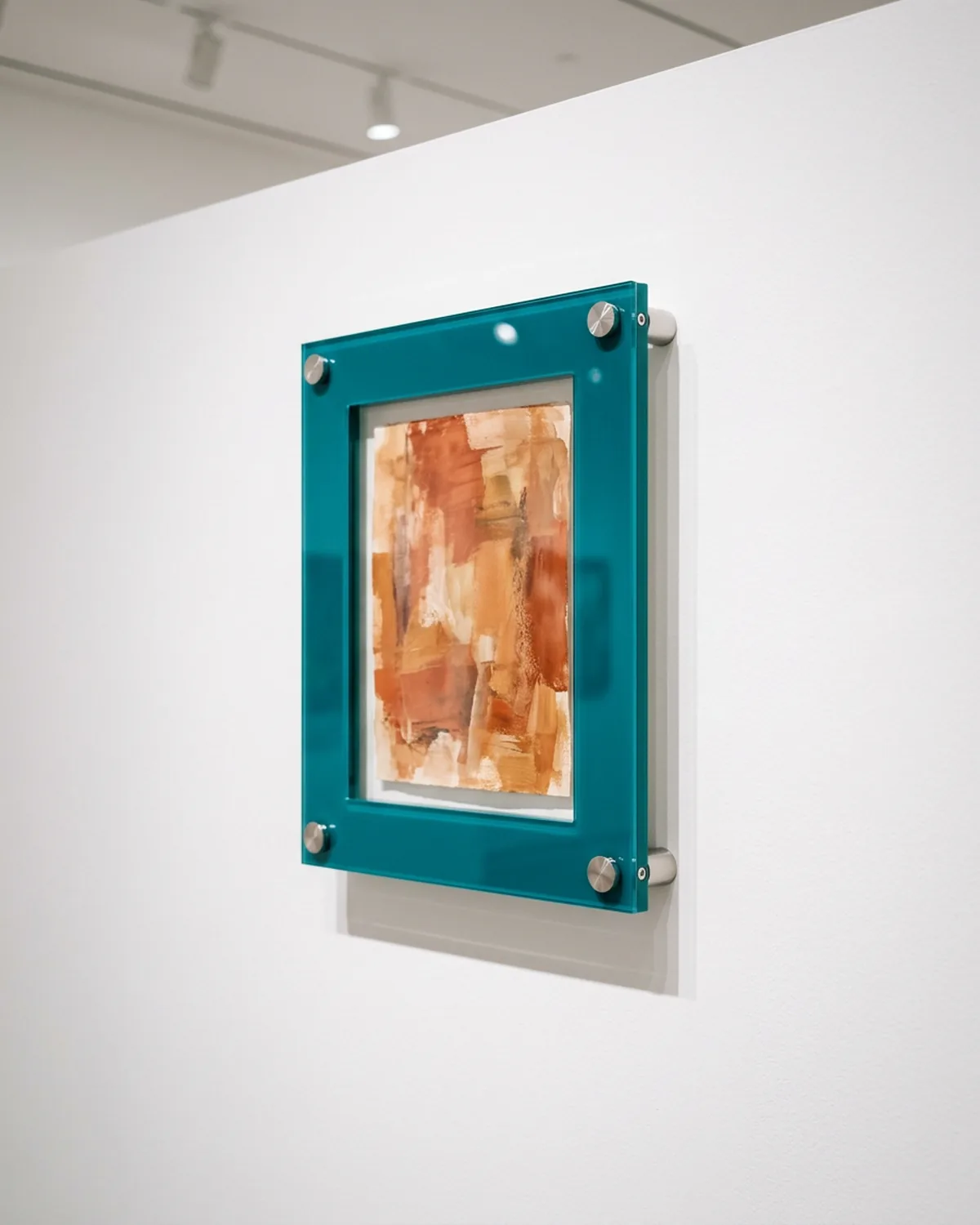
The system uses Pantone-matched cast acrylic in four colors, flame-polished edges, and a standoff float mount that suspends each piece 12 mm off the wall. We shipped 420 frames across 11 custom sizes in 22 production days. Three months later, the curatorial team reordered 260 more to extend the palette for the next exhibition.
- units shipped
- 420
- production time
- 22 days
- custom sizes
- 11
- Phase 2 reorder
- +260
Key Takeaways
- Cast acrylic with pigment mixed at the material stage holds its hue through the full thickness — painted or film-laminated alternatives chip at cut edges and break the gallery-wall illusion within one exhibition cycle.
- For colored acrylic gallery frames, edge finishing is the whole game. Flame-polished edges on cast color give a deep, gem-like gloss under track lighting; machined matte edges look unfinished next to the art.
- 4 mm standoff bolts with UV-safe acrylic adhesive suspend the artwork 12 mm off the wall, casting a soft shadow line that reads as "floating" without hardware entering the sightline.
- 420 frames across 4 Pantone colors and 11 custom sizes delivered in 22 production days; color deviation between batches held at ΔE 1.4 against a ≤ 2.0 spec.
- Phase 2 reorder of 260 frames placed at month 3 to extend the palette with two additional colors for the next exhibition cycle.
The Challenge
The network rotates exhibitions roughly every eight weeks across its member galleries. Their existing inventory — black and white wooden frames in fixed A3 / A4 / 50×70 cm sizes — had started to feel static against the pop-art and abstract programming the curators were bringing in. The frames read as "invisible" when the goal was for the exhibition design itself to contribute to the mood of each show.
The curatorial team wanted acrylic gallery frames that did three things at once — and none of the off-the-shelf options they'd tested could deliver all three:
- Tailored to non-standard artwork dimensions. Their incoming pieces ranged from 240 × 300 mm studies to 900 × 1200 mm canvases. Fixed-size frames meant mats, gaps, and a fragmented wall — none of which worked for the tight-hung exhibitions the curators wanted to stage.
- A specific color palette that complemented the art rather than competing with it. Generic "red" or "blue" acrylic from catalog suppliers shifted two or three Pantone steps batch-to-batch, which is visible on a wall of 20 frames under track lighting.
- The floating mount effect — the illusion that each piece hovers off the wall — without visible hardware or sagging, across sizes up to 1.2 meters on the long edge.
Our Approach
We proposed a three-part build — material, color, mount — and walked the curator through the trade-offs before quoting. Their initial reference images showed a painted-MDF frame with a floating back; our recommendation shifted the build onto cast colored acrylic with a standoff mount, which cost roughly 12% more per unit but removed the edge-chipping failure mode entirely.
Cast colored acrylic, not painted or film-laminated
For the outer frame, we specified cast acrylic with the pigment mixed into the sheet at the material stage — not painted onto clear acrylic, not film-laminated over clear stock. On a gallery wall under track lighting, the difference is obvious. Cast colored acrylic shows the same hue through the full thickness, so when the edge catches the light it reads as a single solid color. Painted acrylic chips at cut edges and reveals the clear substrate; film-laminated sheets develop edge lift over months of handling during exhibition swaps.
We matched each of the four colors — a muted crimson, a soft cobalt, a pale blush, and a deep emerald — to the client's Pantone targets with a ΔE tolerance of ≤ 2.0, verified against their brand guide under D65 daylight. The full 420-unit Phase 1 order ran in a single cast batch per color so hue stayed uniform across the palette; measured variance held within ΔE 1.4.
Flame-polished edges vs machined matte
On a clear acrylic frame you want the edge to disappear. On a colored acrylic frame you want the opposite — a deep, gem-like gloss that becomes part of the piece. We flame-polished every edge after CNC cutting, then inspected each frame under D65 track lighting rather than workshop fluorescents, so the finish is judged under the same light it lives under.
| Edge method | Look under track lighting | Durability through exhibition swaps | Cost impact |
|---|---|---|---|
| Machined matte (as-cut) | Dull, cloudy, reads as unfinished | Snags on packing material; chips visible on dark colors | Baseline |
| Diamond-polished | Clean, flat gloss | Good, but softer shine on saturated colors | + 6–8% |
| Flame-polished | Deep, gem-like gloss — reads as a design object | Best edge integrity through repeated handling | + 10–12% |
Standoff float mount instead of hidden hardware
For the floating effect, we engineered a 4 mm stainless standoff bolt system with UV-safe acrylic adhesive bonding the artwork backing to the colored outer frame. The standoffs suspend each piece 12 mm off the wall, casting a soft shadow line that reads as "floating" without any visible hanging hardware. UV-safe adhesive matters here — archival-grade materials are non-negotiable when the frame lives in daylight-adjacent gallery space for months at a time.
The Results
Phase 1 cleared pre-shipment inspection, with edge-polish rejects pulled and remade before crating. Galleries are among the most quality-sensitive buyers we ship to; a single chipped edge visible from two meters away ends the piece's life on the wall. The curator signed off on the first shipment of 20 air-freighted samples before we released the ocean-freight bulk, which let us catch a small hue drift on one color before it replicated across the batch.
The Phase 2 reorder is the outcome that matters most. In gallery work, reorders come cycle-by-cycle rather than year-by-year — each new exhibition is a fresh opportunity for the curator to swap suppliers. Three months of wall time, two exhibition rotations, and a palette extension order tell us the system held up through real use.
"The cast color holds batch-to-batch. We hung 20 frames on one wall and couldn't see a seam between them. Flame-polished edges were the detail that sold the curators; they read as intentional design, not a framing afterthought."
What This Means for Your Project
If you're sourcing acrylic gallery frames for exhibitions, the two decisions that most affect how the finished piece reads on the wall are how the color is introduced and how the edge is finished. Painted and film-laminated acrylic look similar to cast colored acrylic in a sample photo; under gallery track lighting, across a 20-frame wall, the difference is immediately visible. And on colored acrylic specifically, the edge finish is half the product — flame-polished edges turn the frame into a design object; as-cut edges make it look like a prototype.
The other decision is sizing strategy. Fixed A3 / A4 / 50×70 cm frames are cheaper per unit but force the curator to crop or mat work to fit — which pulls the exhibition away from the original artist's intent. In this project, CNC-cutting every frame to the exact millimeter dimensions of each piece cost 8–10% more per unit but eliminated mats entirely and made the tight-hung wall plan possible. For a permanent gallery system rotated across seasons, custom sizing typically pays back in the reduced install time and the visual consistency it buys.
On timing, treat color approval as the long pole in the schedule rather than the production run itself. In this program the 420-frame run took 22 production days, but every Pantone target was locked on physical samples before anything went into bulk — order those samples the same week the exhibition calendar is fixed, and the standoff hardware spec, drilling pattern, and wall layout can all be finalized while they are in transit instead of after they arrive. Our gallery wall layout guide for acrylic framescovers the grid and salon formulas behind that wall plan.
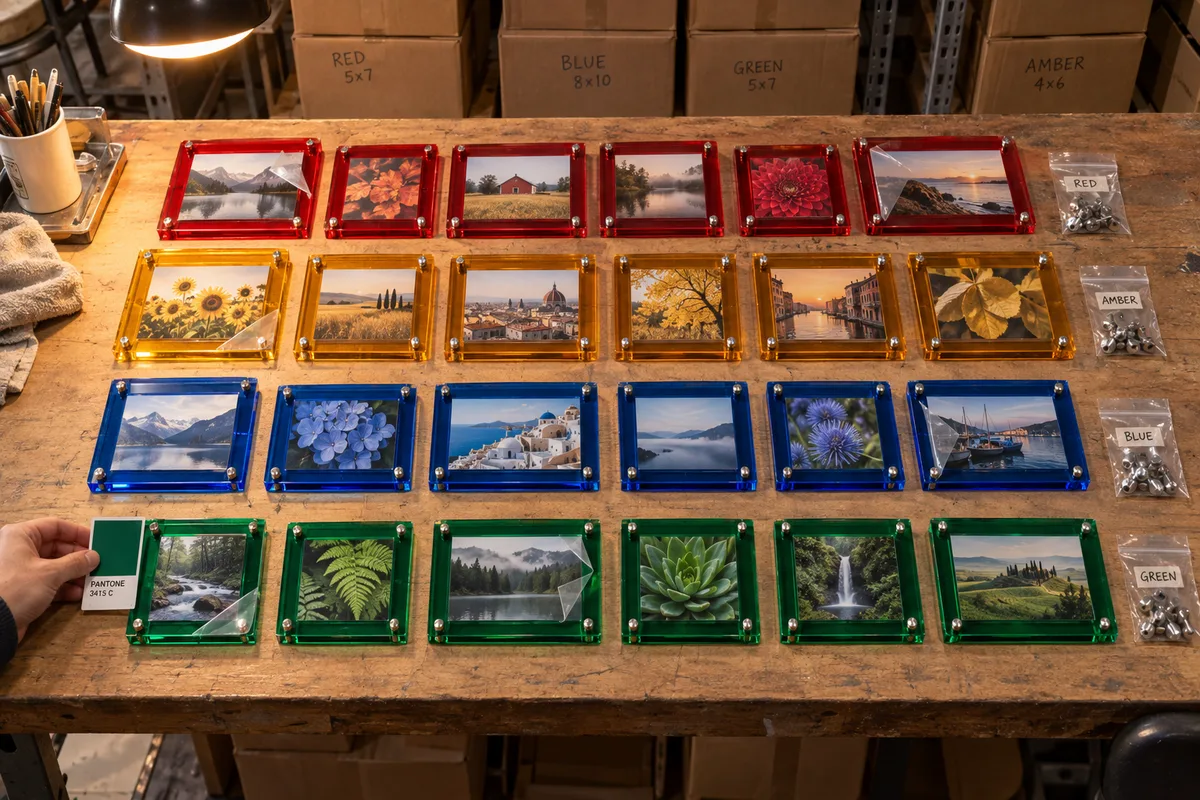
Planning custom acrylic gallery frames for your exhibition?
Send us your Pantone targets, a shot list with artwork dimensions, and your exhibition opening date — we'll come back with an edge-finish recommendation, a standoff mount spec, and a quote.
Sample in 5–7 days · Production in 18–25 days · Single-unit color sample on request