Cosmetic Display Design: 8 Key Decisions
Most cosmetic brand briefs ask for 'a clean acrylic counter display' and leave the rest to the fabricator.
Need this made?Custom cosmetics displays →
These eight decisions are the ones that move unit price, sample turnaround and whether the display reaches stores on time, so make them on purpose.
Key Takeaways
- MOQ is the first lever: Wetop's 100-piece floor accommodates a single-region pilot before chain rollout, but unit cost still falls 20-35% between a 100-piece pilot and a 500-piece production run.
- Acrylic thickness is a load decision, not a style one: 4-5 mm for tabletop risers, 6 mm for shelves spanning more than 300 mm, 8 mm for any panel above 500 mm height.
- UV print and silkscreen cost roughly the same per unit at 100+ pieces, but silkscreen has a $80-150 setup-plate fee that flips the math under 100 pieces.
- Multi-SKU displays need an SKU spec sheet (bottle diameter + height + base shape per SKU) at the RFQ stage; designing the slot fit after sample approval doubles your timeline.
- Sample lead time is 3-5 days; production is 15-20 days from approved sample. With drawing approval, sample shipping, review and sea freight, the honest timeline from first RFQ to first carton landed is roughly 11-14 weeks for an overseas brand buyer.
On this page
- What Makes a Good Cosmetic Display Design?
- Decision 1: MOQ — Pilot or Production Run?
- Decision 2: Thickness — Load Math, Not Style
- Decision 3: Clarity and Finish — Clear, Frosted or Tinted?
- Decision 4: Logo and Print Method
- Decision 5: Anti-Theft and Lockup for Prestige SKUs
- Decision 6: Multi-SKU Layouts — How Many Slots?
- Decision 7: Packing — Counter-Ready or Flat-Pack?
- Decision 8: Lead Time and Sample Workflow
- RFQ Checklist for Cosmetic Displays
What Makes a Good Cosmetic Display Design?
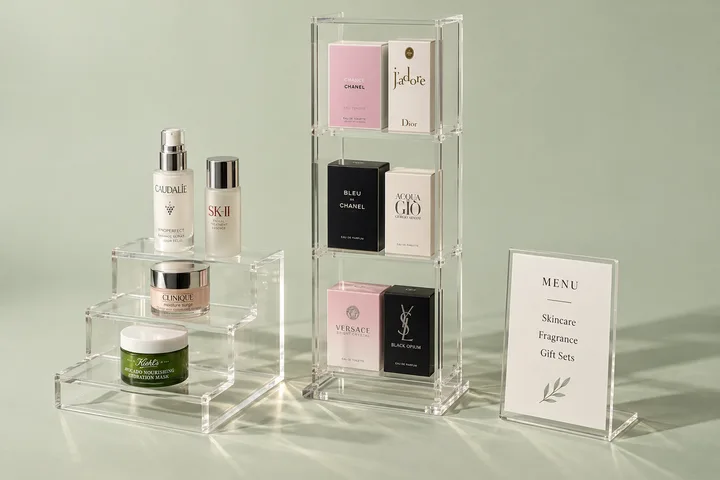
A good cosmetic display design shows the product in true color, holds each SKU securely at the right height, carries the brand mark cleanly, and survives daily testers and cleaning. In practice that comes down to eight decisions: quantity, acrylic thickness, finish, logo method, security, SKU slots, packing and lead time. Settle them before you ask for quotes.
Most articles on cosmetics displays cover merchandising: eye level, color blocking, riser heights. This guide covers the other half, the specification a brand team has to write before a fabricator can quote and sample. If you want to see the formats we build for beauty and fragrance brands, our cosmetics displays application page shows them.
I get a version of the same brief every week from beauty brand buyers: “We want a clean acrylic counter display, 100 pieces, holding our hero SKU and three supporting items, with our logo somewhere visible. Send a quote.” When I see that brief I already know it’s missing six of the eight specifications below, and every missing spec is a back-and-forth email that pushes the sample date out. Get them right at the brief stage and the sample lands clean on the first round; get them wrong and the brand team can burn three weeks revising, which on a retail launch deadline is the difference between making the floor set and missing it.
Decision 1: MOQ — Pilot or Production Run?
Production starts at 100 pieces per design. That floor lets a beauty brand pilot a custom cosmetic display in one region before committing to a full chain rollout; 100 pieces can cover a regional test, staff training units and replacements.
Hundreds of B2B orders later, two MOQ patterns dominate the cosmetic brand inquiries that come through my inbox. The pilot-first buyer orders 100 pieces, validates the display in 5-10 stores over a quarter, then comes back for a 300-500 piece production run with the lessons learned baked in. That costs more per unit on the pilot but avoids locking hundreds of units into a fixture that has not proved itself at the counter. The production-confidence buyer skips the pilot, orders 300+ pieces straight from sample approval, and accepts the variance risk because they’ve sourced similar fixtures before.
Unit cost falls 20-35% between a 100-piece pilot and a 500-piece run because cutting and printing setup time is shared across more units; above 1,000 pieces the curve flattens. For comparison, a delivered repeat order of 6 × 6 in printed acrylic countertop displays has held $8.20 each EXW; it is a different product, not a cosmetics display quote. Below 100 pieces per design we do not open a production run; a paid sample is the way to evaluate the product first.
Decision 2: Thickness — Load Math, Not Style
Acrylic thickness on a cosmetic display is set by what sits on it and how far the panels span. Skip the load math and you’ll either over-spec (paying 30% more material than you need) or under-spec (visible sag on shelves under foundation bottle weight by month three of retail life).
The reference we use: 4 mm cast acrylic for lightweight tabletop risers holding lipsticks and small containers; 5 mm for standard countertop risers and base trays under 300 mm span; 6 mm for shelves spanning more than 300 mm under foundation, perfume or palette weight; 8 mm for towers, enclosed cases and structural panels above 500 mm tall. Specify “cast acrylic,” not just “acrylic”: extruded grade is cheaper but more prone to crazing at edges and slightly hazier optically. Our acrylic thickness guide covers the span math in more detail.
Two related choices belong in the same brief. The back panel of an enclosed display can usually drop one thickness step because it carries no load. And if the display will be packed and reshipped between locations, such as pop-ups or travel retail, step up one thickness; transit handling stresses panels more than a static counter does.
Decision 3: Clarity and Finish — Clear, Frosted or Tinted?
Finish shapes the brand impression more than any other single spec. Clear cast acrylic transmits about 92% of visible light per manufacturer datasheets1, so product colors read true; it is the usual choice for color cosmetics where shade is the purchase trigger. Frosted acrylic softens light and suits skincare and fragrance. Tinted acrylic adds brand color to backs and bases without competing with the product.
Three rules save a sample revision. Put clear acrylic behind transparent bottles (perfume, foundation, serum); frosted behind a clear bottle looks muddy under store lighting. For skincare with white or pastel packaging, frosted is the safer default. Use tinted panels as accents, such as logo backers and base trims, at 10-20% of total acrylic surface rather than the main face; a fully tinted display reads as commodity packaging, not a retail fixture.
For light-sensitive products, consider a UV-filtering acrylic grade for the panels facing the product. Protection depends on the grade, thickness and wavelength range, so we name the selected sheet and its datasheet on the quote2. Our clear vs frosted vs colored acrylic guide covers the wider trade-off, including mirrored backs.
Decision 4: Logo and Print Method
Logos go onto cosmetic displays by one of four methods. UV printing handles full-color logos and gradients with no screens, so it is economical from the first 100 pieces. Silkscreen gives solid, opaque spot colors but needs a setup plate per color (typically $80-150 per plate); for single-color logos at 100+ pieces, silkscreen unit cost is competitive with UV print, but under 100 pieces the plate cost flips the math toward UV. Hot stamping adds real metallic foil, runs at a 30-50% upcharge versus silkscreen, and limits the logo to what the foil die can stamp cleanly. Laser engraving marks the acrylic itself with no ink.
How to choose, in order:
- Single color or multi-color? Multi-color logos point to UV printing; each extra screen color adds setup.
- Does the brand need true metallic? Hot stamping is the method that gives real metallic shine; metallic-look UV inks read flatter under store lighting.
- How many pieces? Under 100 pieces, UV print wins on total cost regardless of logo complexity. Over 500 pieces with a single-color logo, silkscreen wins.
- How hard is the cleaning? Counter displays are wiped daily. Laser engraving is the method that survives indefinitely; printed marks can fade or scuff over a 12-24 month retail life under heavy cleaning. Printed marks last best when staff follow the soft-cloth and mild-detergent method in our acrylic display cleaning guide, never alcohol wipes.
Send a vector logo file (AI or PDF) with Pantone references and your preferred method. We print from your supplied artwork; we do not redraw or design logos, so the file must be production-ready. Our UV printing on acrylic guide explains the white ink layer and color approval.
Decision 5: Anti-Theft and Lockup for Prestige SKUs
If your displayed product unit retails above $80 or contains controlled fragrance compounds (alcohol-based perfumes), some form of anti-theft hardware enters the spec. There are three common routes: tethering the product to an open display, an enclosed showcase with a key or magnetic lock, or a hybrid where an empty hero bottle sits on an open riser and live stock is kept in a locked drawer.
The hybrid approach separates presentation from stock control when the retailer’s policy allows it; the display itself does not remove theft risk. Our delivered indie beauty pearlescent lipstick wall display settled the same open-versus-controlled-access decision on a wall format.
For an enclosed display, confirm three things at the brief stage: the lock type (key, magnetic, or RFID; RFID adds 25-40% to fixture cost but speeds staff service time), whether the door is hinged or lift-off (hinged is more secure; lift-off is simpler), and the tallest SKU plus about 10 mm of finger room for staff. Our acrylic display cases use the same construction as enclosed cosmetic showcases.
Decision 6: Multi-SKU Layouts — How Many Slots?
I get the same briefing mistake on cosmetic display work most weeks: a buyer asking us to “design slots for 8-12 product types” without specifying which 8-12. The slot pattern is expensive to change after the sample is cut, because every slot is a cutting path that has to be redone. Fix the SKU list at the RFQ stage.
For each SKU, send: the base diameter (round) or width × depth (square or rectangular), total height, base shape, and for perfume the cap height. A simple table of SKU code plus four numbers is enough for us to draw the slot pattern.
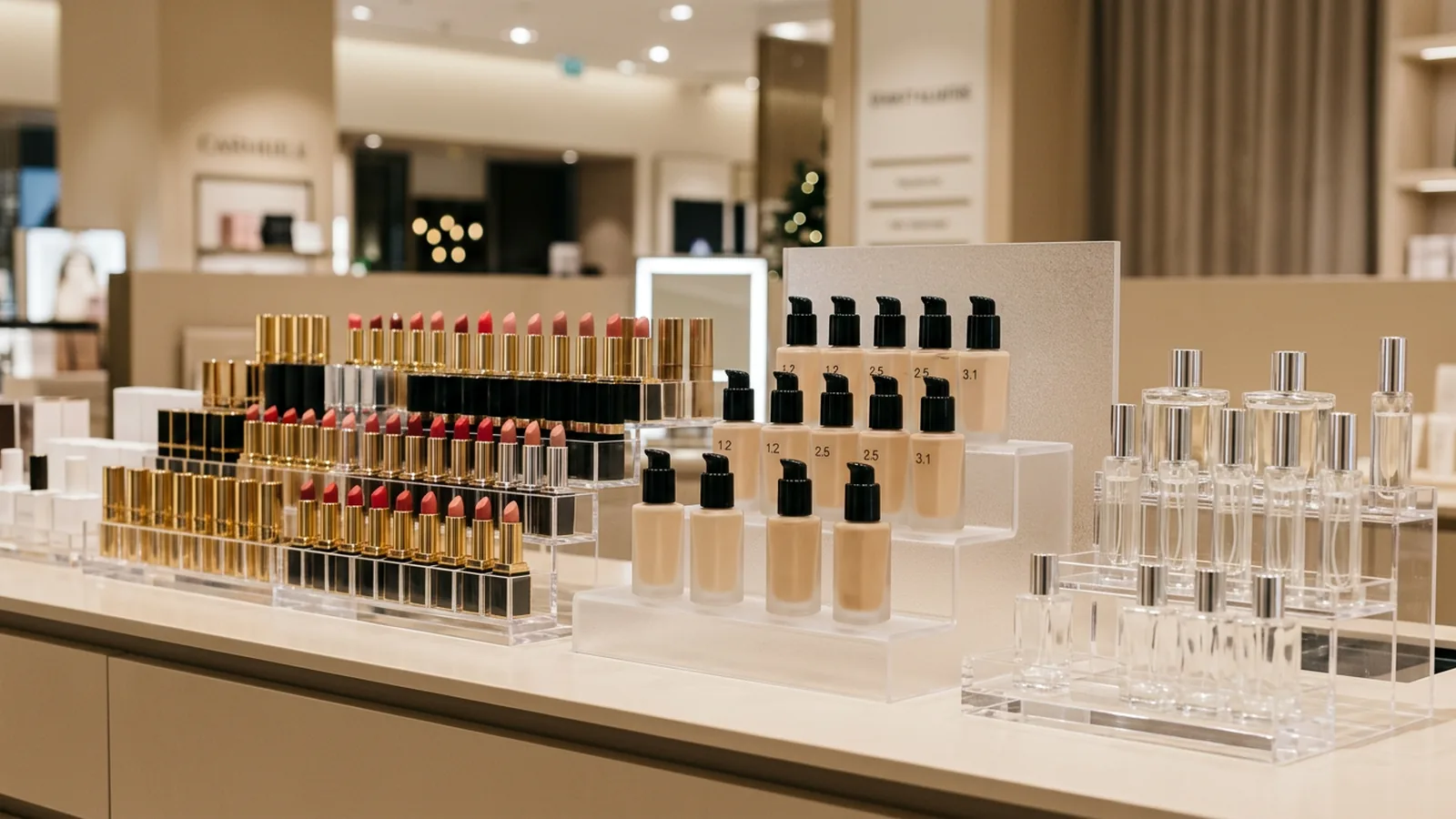
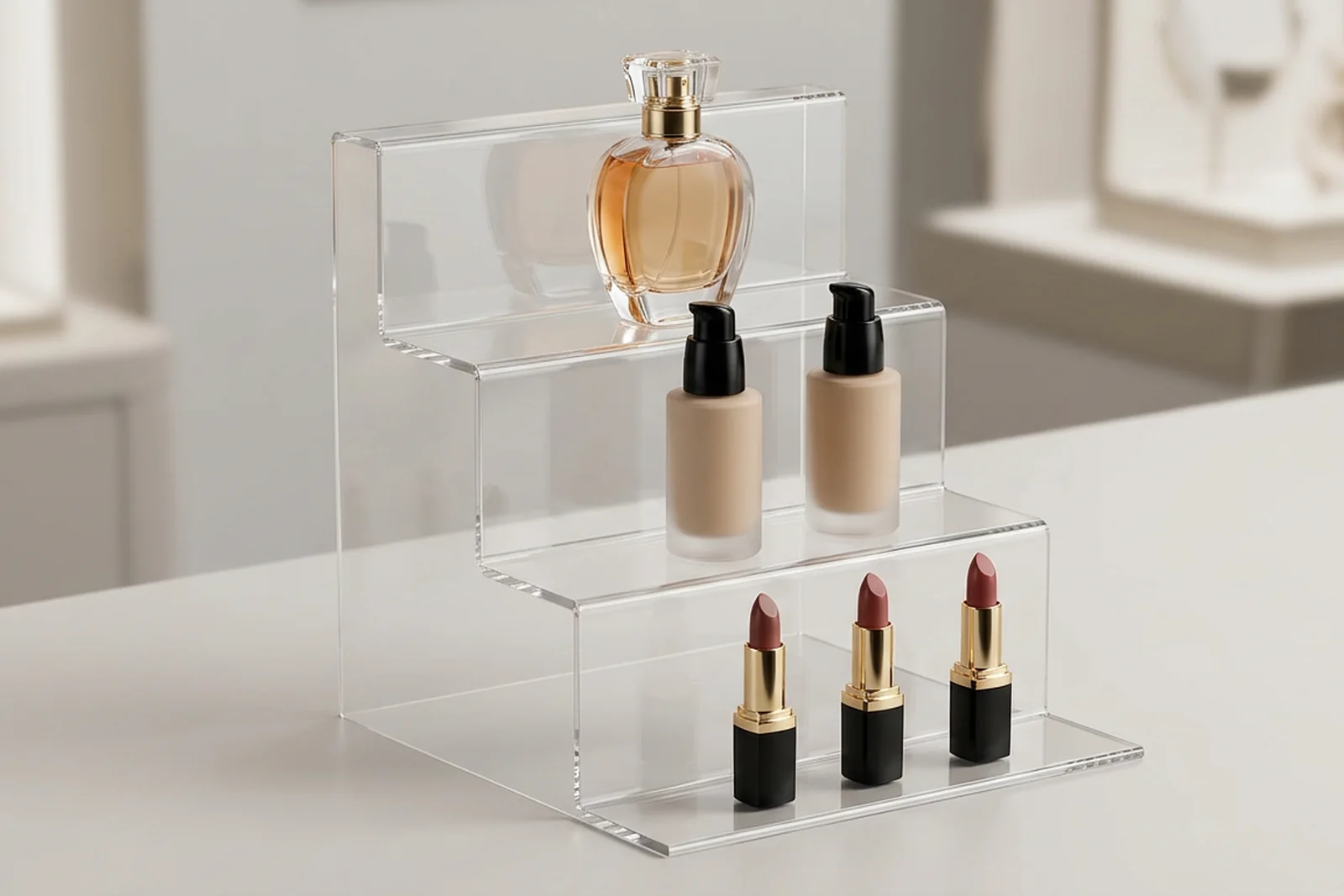
For mixed products, group slots by base size rather than by category: a row of lipsticks, a row of foundations, a row of mascaras reads better and cuts cleaner than mixing them on every tier. If store staff will rotate SKUs, one universal slot sized for your largest base gives flexibility at the cost of a looser fit for smaller items; the cost premium for universal slots is roughly 5-10%, and the flexibility pays back the first time you launch a new SKU into the program. Our acrylic risers are the usual starting point for multi-SKU counters, and our acrylic vs melamine cosmetics display guide compares the two common structures. When the tiers should stay fixed in one piece, a 3 tier acrylic display stand replaces the loose risers.
Decision 7: Packing — Counter-Ready or Flat-Pack?
Counter-ready displays arrive assembled in foam-lined cartons, so store staff unbox and place them, but they take more freight space. Flat-pack displays ship disassembled with an assembly sheet, so freight is lower, but someone in each store has to spend 5-15 minutes per unit assembling them. Choose by who is available in store.
Counter-ready suits prestige and fragile displays: diamond-polished edges, hot-stamped logos or tight fits where field assembly risks misalignment, and accounts without a visual merchandising team. Flat-pack suits large rollouts (300+ stores) where freight weighs heavily on landed cost and an installer team is already visiting stores. The break-even between the two lands at roughly 200 stores for a typical mid-size cosmetic display; below that, counter-ready is cheaper end to end once field labor is counted.
ISTA transit-test procedures are the usual industry reference for checking that packed displays survive handling3. Our standard packing for cosmetic displays shipped to the US and EU uses foam-lined inner cartons with corner protectors and interleaving paper for polished surfaces. If a retailer imposes carton sizes or pallet rules, send them with the RFQ so the master carton is sized to match. Our packing standard describes how visible faces are protected.
Decision 8: Lead Time and Sample Workflow
For a first-time overseas brand buyer shipping by sea, the honest end-to-end timeline is roughly 11–14 weeks from RFQ to first carton at your warehouse. The factory part is short: 3–5 days for the paid sample and 15–20 days of production after approval. The rest is approvals, sample shipping, sea freight and customs.
| Stage | Typical time |
|---|---|
| Brief clarification, quote and production drawing | About 1 week (first reply within 24 hours) |
| Your drawing review and approval | About 1 week |
| Paid sample production | 3–5 days |
| Express sample shipping to your office | 5–7 days |
| Sample review and any revision | About 1 week |
| Production after sample approval | 15–20 days |
| Sea freight to a US East Coast or EU port | 25–35 days |
| Customs clearance and final delivery | 5–10 days |
Air freight cuts the freight leg to 5-7 days at roughly 4-6x the sea freight cost; most brand buyers absorb that only on a hard launch deadline. Samples cost USD 200–500 depending on complexity, are paid separately and are never credited to production. We make the sample in the production material with your logo method so you approve the real thing. For complex multi-SKU displays, our pre-production sample approval checklist covers why a new part needs a physical sample and when a repeat SKU can skip it.
When I read a new brief, I look for the hardest fixed date first (launch, trade show, store opening) and plan backward from it with a margin for customs. Put that date in your first message.
RFQ Checklist for Cosmetic Displays
Send these seven items and the first reply can be a quote instead of a list of questions:
- Quantity per design, or tiers such as 100, 250 and 500.
- Display dimensions, or a reference photo with rough sizes.
- Acrylic specification: clear, frosted or tinted; thickness; UV-filtering grade if needed.
- Production-ready logo file (vector AI or PDF), print method and Pantone references.
- SKU fit sheet: base size, height and base shape for each product.
- Packing preference (counter-ready or flat-pack) and any retailer carton rules.
- Destination and any fixed launch date.
We’ve shipped custom acrylic cosmetic displays to beauty brands across the US, UK, Canada, EU, and Korea: prestige counter programs, indie brand pilot rollouts, and DTC pop-up systems. Our factory is ISO 9001 certified, and SGS or RoHS documents are available for named materials where the program requires them. The acrylic RFQ guide walks through a complete first inquiry, and our custom acrylic fabrication overview covers fabrication and finishing options. When you are ready, send the brief through our contact page; we respond within 24 hours.
Footnotes
-
Plaskolite OPTIX general-purpose acrylic sheet datasheet (PDF) — manufacturer datasheet rating general-purpose acrylic sheet at 92% total light transmission per ASTM D1003; supports the point that clear acrylic lets product colors read true. ↩
-
Plaskolite — acrylic sheet products and technical data — major North American acrylic sheet manufacturer whose UV-filtering grades and datasheets are the reference for specifying protection of light-sensitive products. ↩
-
ISTA — International Safe Transit Association — the standards body for packaged-product transit test procedures, such as the ISTA 3-series, used to check that packed display fixtures survive shipping and handling. ↩
Frequently Asked Questions
Can I order custom cosmetic displays in small batches?
Production starts at 100 pieces per design, which can cover a regional test plus training and replacement units. Below 100 pieces, a paid sample is the way to evaluate the display, because cutting and printing setup cannot be spread across a production run.
How long does sample-to-production take for a custom cosmetic display?
A paid sample takes 3–5 days once the drawing is approved, and production takes 15–20 days after you approve the physical sample. Sample shipping, your review, any revision, freight and customs come on top, so plan the full schedule from your store date backward.
What's the sample policy for custom cosmetic acrylic displays?
A sample costs USD 200–500 depending on complexity, is paid separately and is never credited to production. It is made in the production material with your logo method, so you approve the real appearance, not a mockup. Express shipping is quoted at cost.
How do I spec a multi-SKU cosmetic display where the slots fit different bottle sizes?
For each SKU send the base width or diameter, total height and base shape; for perfume, add cap height. We set the slot dimensions on the production drawing from that sheet, then check the fit with your real products on the paid sample before production.
How do you ship custom cosmetic displays to the US or EU without breakage?
200 kg is a practical point at which buyers usually compare sea and air freight rather than assuming parcel service. Displays ship with protective film on visible faces, foam or dividers, corner protection and cartons sized to the unit. Tell us at the RFQ stage whether units ship assembled or flat-packed, any retailer carton or pallet rules, and any transit test you require, so packing is quoted correctly.
Ready to price a cosmetic display program?
Send the display dimensions, SKU fit sheet, artwork, quantity tiers, packing plan and destination. We return a line-item quote and paid-sample plan; sample fees are billed separately and never credited to production.