Frosted Acrylic vs Clear vs Colored: Light & Cost
Specifying the wrong acrylic finish is a quiet, expensive mistake; most buyers only discover it after production, when the display doesn't read as expected on the shelf.
Need this made?Custom acrylic boxes →
Key Takeaways
- Clear acrylic transmits 90–92% of visible light (ASTM D1003) — the highest of any finish — making it the default for product display cases where buyers need to see what's inside.
- Frosted acrylic diffuses light and cuts glare, but needs an extra etching or sandblasting step, or pre-frosted sheet, which adds cost versus clear at the same thickness.
- Colored acrylic fades faster than most buyers expect outdoors — standard cast color can show noticeable fade within 6–12 months of direct UV exposure without UV-stabilized sheet specified.
- All three finish types are available in cast and extruded PMMA; cast is preferred above 5mm for edge polishing quality, regardless of finish.
- Finish choice affects fabrication cost, lead time, and raw material sourcing — colored and frosted sheet sometimes requires advance ordering, which can add 3–5 days to production.
On this page
- Frosted Acrylic vs Clear Acrylic: Which Finish Fits?
- The Finish × Use-Case Matrix
- Fabrication Differences: What Finish Costs You
- UV Resistance: How Fast Each Finish Fades
- Cast vs Extruded: Does It Matter for Finish?
- How to Specify Finish in Your Drawing or RFQ
- Frosted vs Matte vs Satin Acrylic
- Mirror Finish: Coating Tier, Scratch Life and Safe Cleaning
- Mixing Clear and Frosted on One Product
- Common Finish Mistakes
Frosted Acrylic vs Clear Acrylic: Which Finish Fits?
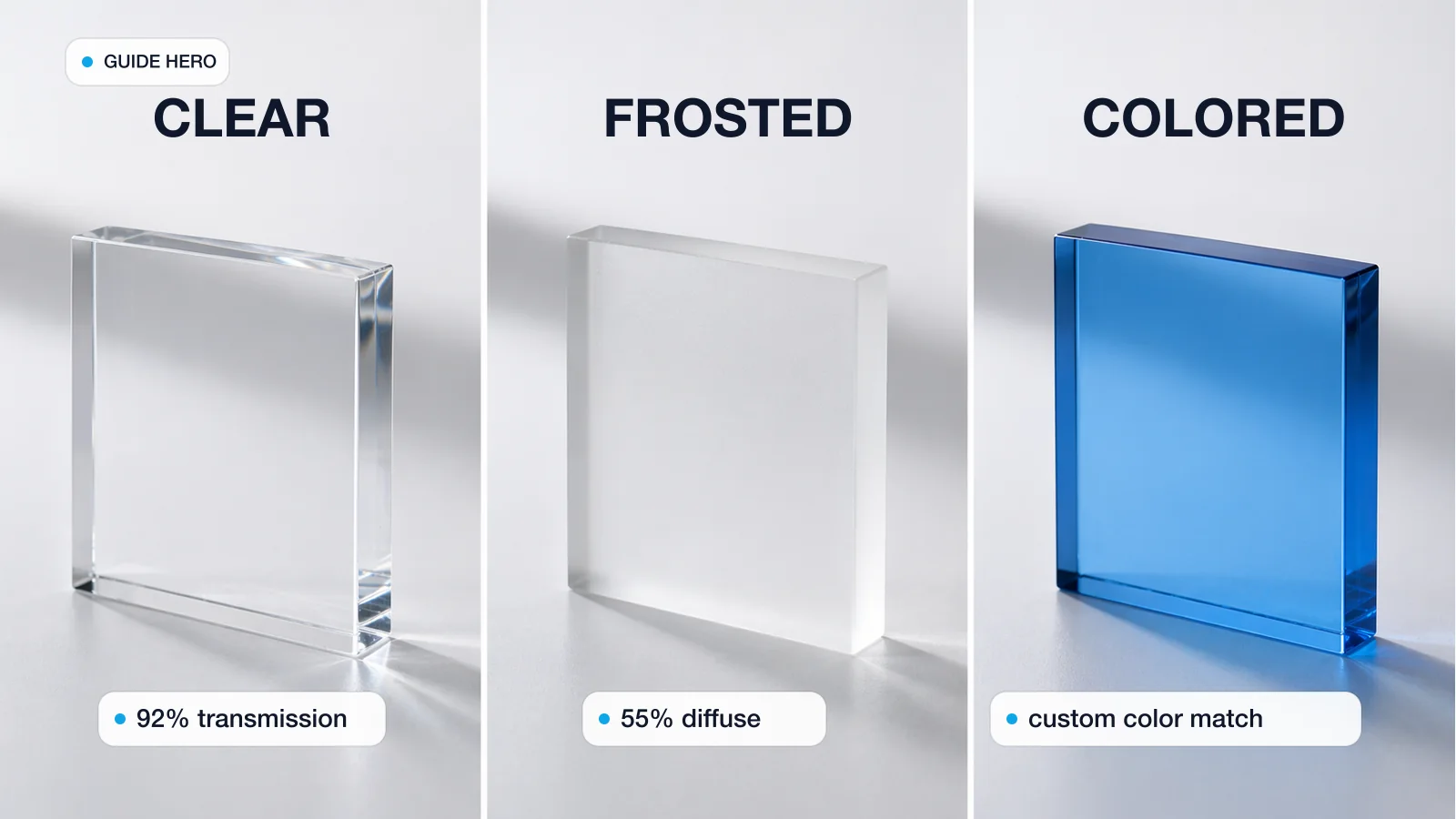
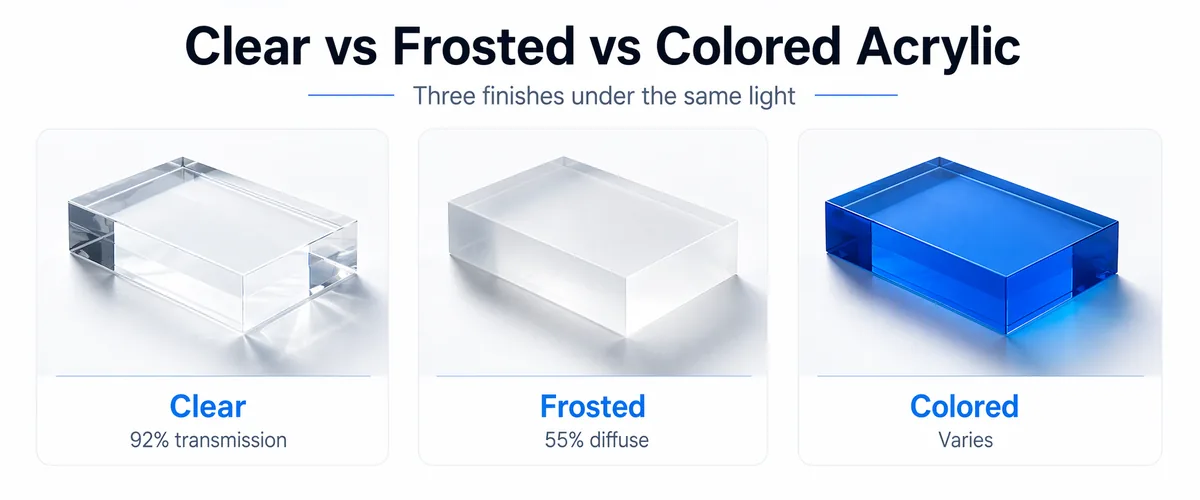
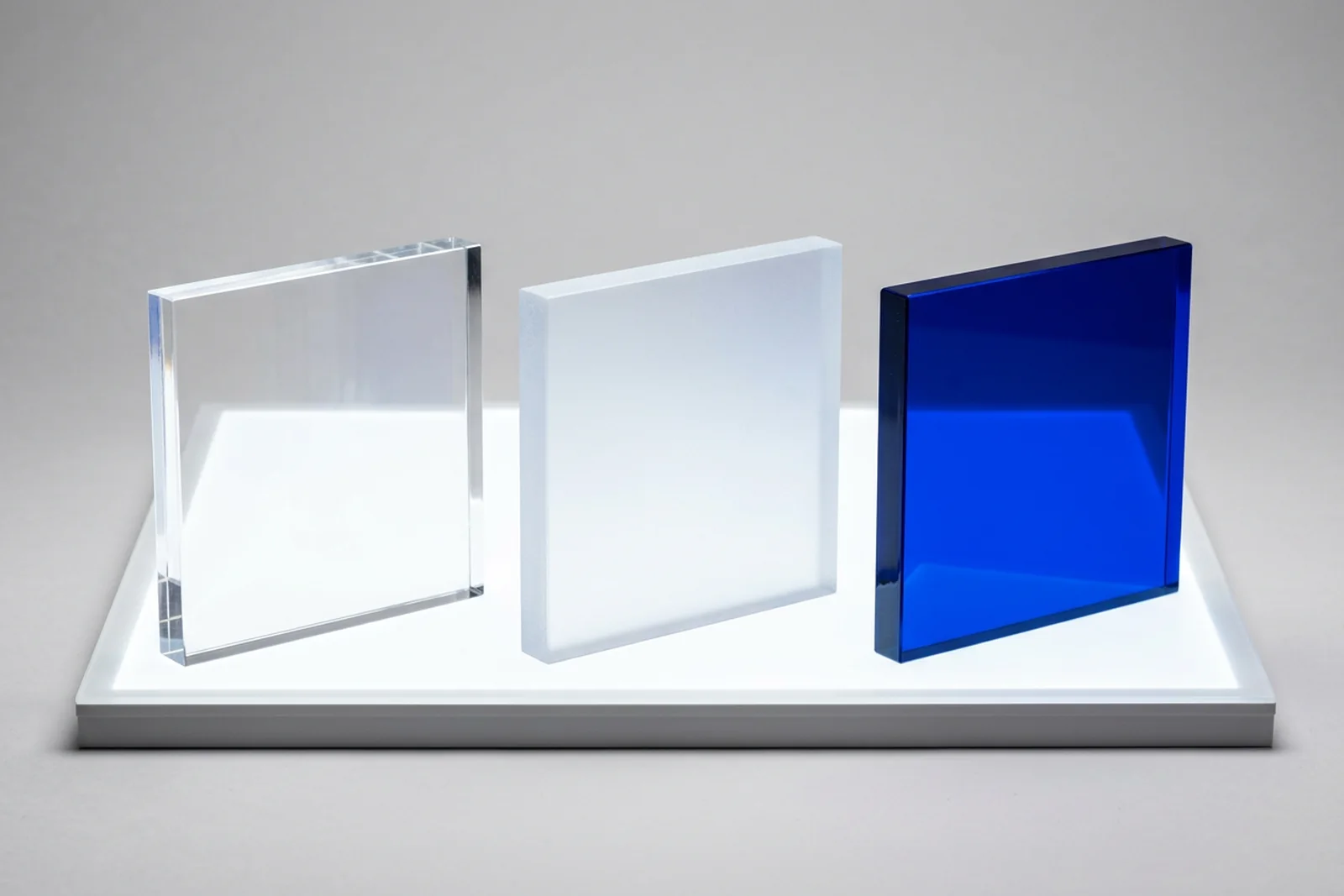
Choose clear acrylic when people must see the product, frosted acrylic when you need to soften glare or hide what sits behind the panel, and colored acrylic when brand color matters more than visibility. Clear passes light with full detail, frosted passes light but scatters the detail, and colored tints or blocks it.
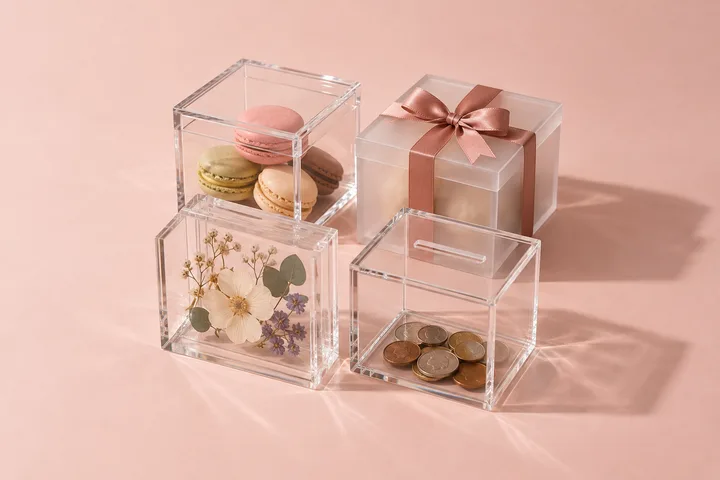
Clear acrylic transmits 90–92% of visible light per ASTM D1003,1 the closest a plastic gets to glass, and it is the right choice for a display case roughly 80% of the time. Frosted acrylic still lets light through, but its textured surface scatters it, so glare and hot spots disappear along with the detail behind the panel. Colored acrylic absorbs part of the spectrum; light tints shift what you see, dark and opaque colors block it. Every finish option below can be combined in one part through our custom acrylic fabrication work, so the decision is per panel, not per product.
| Finish | What Passes Through | Common Mistake |
|---|---|---|
| Clear cast/extruded | Light with full color and detail (about 92%) | Glare from direct overhead lights |
| Frosted (etched, sandblasted, or satin sheet) | Diffused light, about 86% for a colorless satin sheet and 60% for a white one at 1/8 inch; detail does not pass | Assuming all frosted sheet is equally opaque |
| Colored (light tints) | Tinted light, 60–85%; product color shifts | No Pantone or swatch reference |
| Colored (dark/opaque) | 0–30%; little or no light | Using opaque where clarity is needed |
Frosting does not have to cost much light: ACRYLITE lists its colorless Satinice sheet at 86% transmission at 0.118 inch and its white diffuser grade at 60%.2 Exact transmission for frosted and colored sheet still depends on texture, color and thickness, so take the figure from the datasheet of the sheet being quoted.
The Finish × Use-Case Matrix
When an inquiry arrives without a finish, I ask two questions: does the end user need to see the contents, and is there a brand color requirement? If the first answer is yes, as it is for most retail display cases, collectible cases and cosmetics stands, start with clear. If a brand color overrides visibility, colored acrylic takes priority. Frosted wins where diffusing light is the point: sign inserts that must read under overhead lighting, organizer bases that need a matte look without paint, and privacy panels.
| Product Type | Recommended Finish | Why |
|---|---|---|
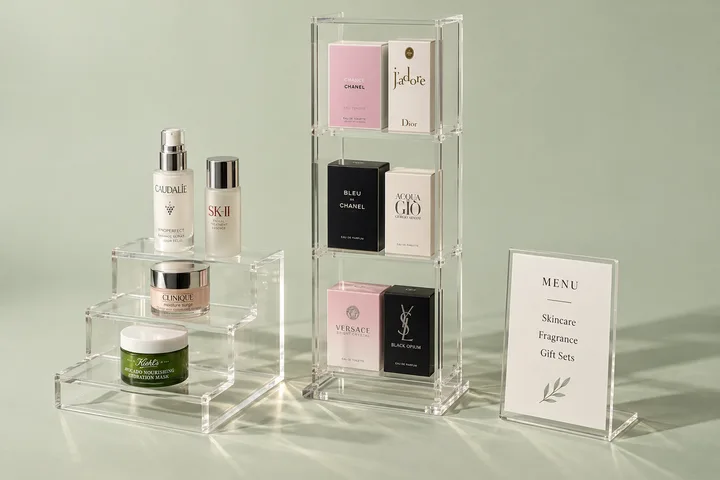
| Retail display cases | Clear | Product visibility is the conversion mechanism |
| Sign holder faces | Frosted | Diffuses overhead glare; text reads without hot spots |
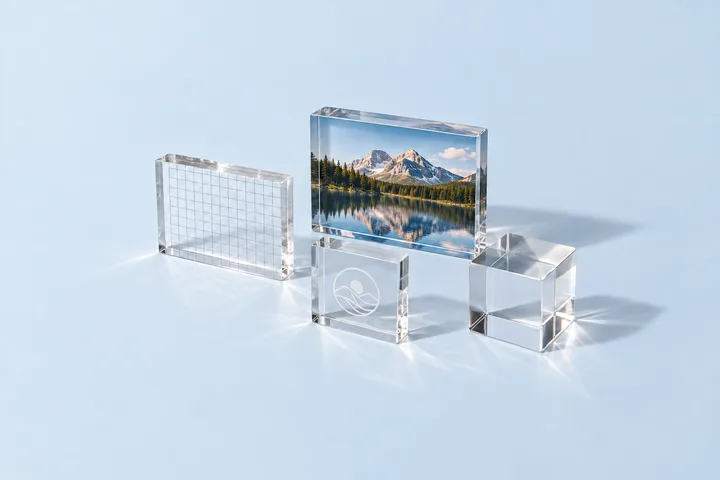
| Award plaques | Colored or clear | Colored for brand identity; clear for embedded imagery |
| Cosmetics organizer base | Frosted | Matte luxury feel; hides fingerprints better than clear |
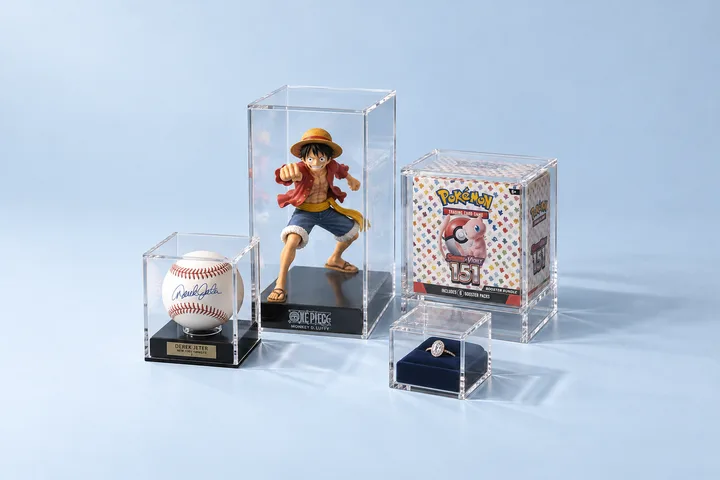
| Trading card display cases | Clear | Card art must be fully visible |
| Trophy bases | Colored (black, smoke) | Visual weight and premium brand signal |
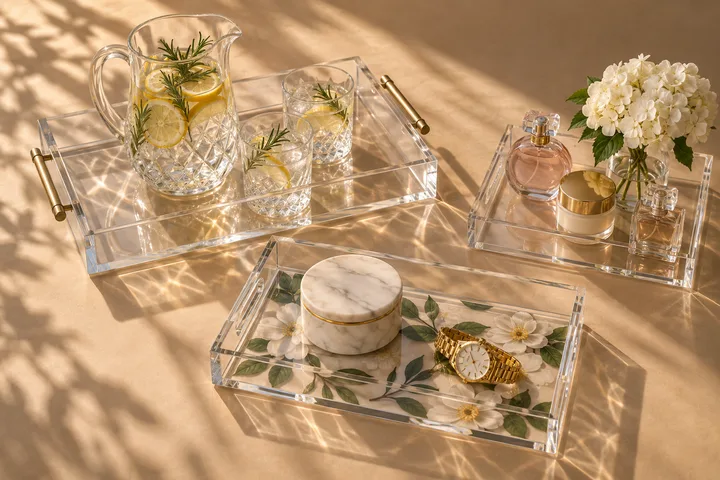
| Hotel amenity trays | Frosted or clear | Frosted hides scratches longer in high-use environments |
| Countertop riser displays | Clear | Product on top must read clearly from 3–5 feet |
| Point-of-purchase signage | Colored or frosted | Brand color match; no need for see-through |
| Collectible display cases | Clear | Maximum optical clarity for high-value contents |
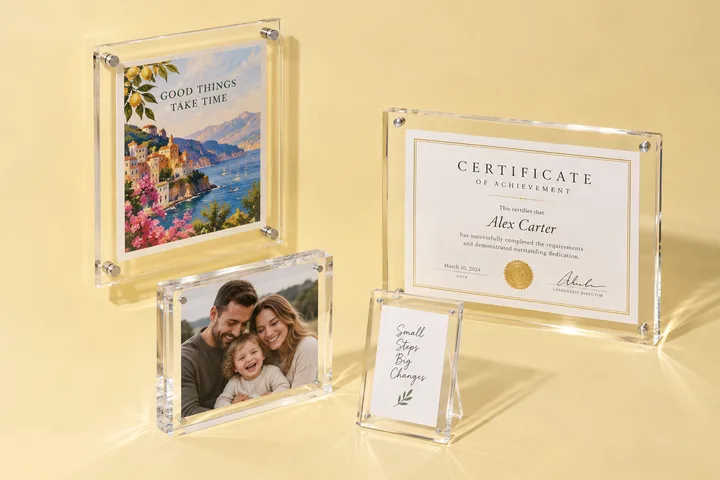
For retail examples across these finishes, see the retail acrylic display ideas guide and our custom acrylic display stands range.
Fabrication Differences: What Finish Costs You
Clear acrylic is the fabrication baseline: cut, polish, assemble. Frosted acrylic adds either a post-process step or a pre-frosted sheet with limited thicknesses. Colored acrylic may need advance sheet sourcing. Each can add cost and, sometimes, time before production starts.
I see this gap most often on frosted jobs. A buyer sees frosted acrylic on a competitor’s product, assumes it’s just a standard material option, and is surprised when the unit cost comes in 15–20% higher than the clear version of the same product. Frosting is either applied after cutting, by sandblasting or chemical etching, which adds labor per piece, or bought as pre-frosted sheet, which is not available in every thickness stocked in clear. An 8mm frosted case wall, for example, is often cut from clear sheet and etched. Specialty colors outside black, white, and standard palette require advance sheet ordering, which can push production start back by 3–5 days. For a 15–20 day production run, that’s a real timeline impact that needs to go into your project schedule. Finish is separate from thickness; the acrylic thickness guide covers that decision.
| Finish | Fabrication Path | Extra Steps | Typical Cost vs Clear | Lead Time Risk |
|---|---|---|---|---|
| Clear | Cut → Polish → Assemble | None | Baseline (1×) | Low |
| Frosted (pre-frosted sheet) | Cut → Polish → Assemble | None (but material sourcing limits) | +5–10% (material premium) | Low–Medium |
| Frosted (post-process etching) | Cut → Etch/Blast → Polish → Assemble | 1 additional step | +10–20% per piece | Medium |
| Colored (standard colors) | Cut → Polish → Assemble | None | +5–15% (material premium) | Low |
| Colored (specialty/custom colors) | Source sheet → Cut → Polish → Assemble | Advance sourcing required | +10–25% | Medium–High (+3–5 days) |
UV Resistance: How Fast Each Finish Fades
PMMA resists UV better than most plastics, which is why acrylic outlasts polystyrene and ABS outdoors. Röhm guarantees its clear PLEXIGLAS sheet against visible yellowing for 30 years.3 Resistant is not UV-proof, though. Colored acrylic fades faster than clear because pigments degrade at a different rate than the base polymer, and saturated reds, blues and yellows can show visible color shift within one to two seasons of direct sun exposure.
The common accelerated weathering test is ASTM G154,4 which uses fluorescent UV lamps to simulate sun exposure; sheet makers that publish UV performance reference it. For colored acrylic that will sit outdoors or near a window, ask the supplier to confirm the sheet is UV-stabilized and to provide that grade’s weathering data. Non-stabilized colored acrylic is cheaper; UV-stabilized sheet costs 15–30% more but is the only defensible spec for anything that lives near a window or outdoors. We supply UV-stabilized colored sheet for all outdoor and retail window applications and will note this on the material spec in your quote. Frame programs should also define cleaning and exposure controls; see the clear acrylic yellowing and care guide for frames.
| Finish | Indoor (no direct sun) | Retail window / south-facing | Outdoor / full sun |
|---|---|---|---|
| Clear cast | Stable indefinitely | Very stable (5+ years) | Stable 5–10+ years |
| Frosted (PMMA base) | Stable indefinitely | Stable 3–5 years | Stable 3–5 years, slight yellowing |
| Colored — light tints | Stable | 2–4 years before shift | 1–2 years |
| Colored — saturated (red, blue, yellow) | Stable | 1–2 years | 6–12 months noticeable fade |
| Colored — UV-stabilized | Stable | 4–6 years | 3–5 years |
| Black/white (opaque) | Stable | Stable 5+ years | Stable 3–5 years |
I’ve seen buyers regret this one more than any other finish decision. A retail chain specified non-UV-stabilized blue colored acrylic for window display cases. Six months later, the cases nearest the window had faded to a noticeably different shade than the ones in the back of the store. Re-ordering corrected it, but the display cadence was broken and the reorder cost was on the buyer. Specifying UV-stabilized sheet from the start would have cost roughly $80 more per case. It’s a predictable problem with a straightforward fix — it just has to be specified before production.
Cast vs Extruded: Does It Matter for Finish?
The finish decision is mostly independent of cast versus extruded sheet until edges are polished or thickness goes above 5mm. Cast acrylic gives a cleaner diamond- or flame-polished edge, which matters on clear and frosted pieces where edges show. Extruded acrylic is fine for thin parts without polished edges, whatever the finish.
Cast acrylic has higher molecular weight and etches more evenly, which is why nearly all frosted-to-order pieces we fabricate start with cast sheet. Extruded sheet can be chemically etched too, but the texture is often slightly less uniform. Most standard colored stock is extruded, because color is mixed into the melt; cast colored sheet exists but is less commonly stocked and costs more, so cast colored sheet above 8mm for polished edges is usually sourced on request. Plaskolite’s technical library5 documents optical properties for both routes, and the cast vs extruded acrylic guide covers the full comparison.
| Finish | Cast Preferred? | Notes |
|---|---|---|
| Clear | Yes, above 5mm | Better polish, optical clarity at thickness |
| Clear | Either, below 5mm | Extruded adequate for thin signage |
| Frosted (etch-to-order) | Cast preferred | More consistent etch uniformity |
| Frosted (pre-frosted sheet) | Often extruded | Pre-frosted stock is commonly extruded |
| Colored | Often extruded stock | Cast colored available; higher cost + longer sourcing |
| Colored (premium edges) | Cast required | Polished edges on colored require cast base |
How to Specify Finish in Your Drawing or RFQ
“Frosted” can mean several different textures, and “colored” without a code produces guesswork. Specify the finish per panel with a reference, and approve it on a physical sample before production.
For clear acrylic, the finish variable to state is the edge polish: flame polish for most display work, diamond polish for awards and premium cases where the edge is a design element. Our edge finish standard and the diamond vs flame polishing guide explain the difference. For frosted acrylic sheet, state the texture (light, standard or heavy) and send a reference photo or sample, because texture depth changes both opacity and light transmission. For colored acrylic, give a Pantone or RAL reference; “red” is not a color spec. If stocked sheet cannot match the reference, we confirm the closest option and you can approve it or move to a custom-tinted sheet, which adds a color-development fee and a material minimum. Finish, color and texture are then locked on the approved physical sample.
| Finish | Must specify | Helpful to include | Avoid |
|---|---|---|---|
| Clear | Polishing method (flame vs diamond) | Thickness, cast vs extruded | “Clear and polished” without method |
| Frosted | Texture depth (light / standard / heavy) | Reference photo or sample | “Frosted” without texture reference |
| Colored | Pantone or RAL code | Transparency level (tint vs opaque) | Color name only (“blue”, “red”) |
Include the end use in the RFQ as well, particularly UV exposure, because it changes the sheet grade we recommend.
Frosted vs Matte vs Satin Acrylic
Frosted, matte and satin acrylic all describe a textured, low-gloss surface, but they are not standardized terms. In practice, satin or matte usually means a fine texture that stays fairly translucent and shows light detail, while frosted usually means a heavier etched or sandblasted texture that diffuses more light and hides what is behind the panel.
Heavily frosted sheet is close to opaque; satin-etched sheet is translucent and fine-textured. A common RFQ mistake is writing “frosted” while attaching a reference image of a light satin surface. Without a texture reference, the fabricator has to guess, so send the image or a physical sample and approve the texture on a swatch.
Mirror Finish: Coating Tier, Scratch Life and Safe Cleaning
Mirror acrylic is cast PMMA with a vacuum-deposited aluminum or silver layer on the back face and a protective backing over it. We fabricate it into finished pieces such as cosmetics risers, podiums, tester bars, box panels and display backs; we do not sell loose mirror sheet. Its scratch life depends on the coating tier, not the PMMA, and it needs a different edge finish and cleaning routine from clear.
Mirror suits cosmetics displays because a lipstick on a mirrored riser reads as two, so the counter looks full at the same unit count. At 5 mm, acrylic mirror weighs about 5.9 kg/m² against roughly 12.5 kg/m² for glass mirror, and when a fragrance bottle drops on it, it cracks in place instead of shedding shards into open product. We default to 5 mm for tabletop risers and 8 mm for heavier products or spans over 300 mm. Thin 3 mm mirror is a poor choice for permanent retail: it can bow under warm counter lights, and a mirror face shows any bow far more than clear does.
| Spec | Standard mirror coating | Premium hardcoated mirror | 5 mm glass mirror |
|---|---|---|---|
| Substrate hardness (Mohs) | about 2.5–3.0 (cast PMMA) | about 2.5–3.0 (cast PMMA) | 5.5 |
| After months of daily wiping | Hazes first at the wipe line | Holds clarity far longer | No change |
| Where it fits | 4–6 month seasonal display | Permanent counter fixture | Fixed, low-touch walls |
| Cost | Baseline | About 12–18% more on the substrate | n/a |
| Under a drop | Cracks, no loose shards | Cracks, no loose shards | Shatters, sheds shards |
Both acrylic tiers share the same PMMA; the topcoat decides scratch life. That is why sheet makers publish abrasion-resistant grades separately from uncoated sheet and rate them with ASTM D1044 (Taber abrasion haze) and ASTM D3363 (pencil hardness). The gap does not show at sample approval or install. It shows after months of staff wiping a riser two or three times per shift. For a permanent fixture, write “hardcoated mirror, abrasion-rated to ASTM D1044” on the RFQ rather than “mirror acrylic”.
Edge finish matters more on mirror than on any other finish. Never flame polish a visible mirror edge: the heat weakens the coating bond at the edge, and fogging then creeps inward from the perimeter under normal cleaning. I specify CNC routing plus a clear sealing pass for permanent fixtures, or diamond polishing plus the same sealer for hero pieces at about 2.5 times the labor of CNC.
Cleaning is where most mirror fixtures fail. Safe: 70% or stronger isopropyl alcohol on a clean microfiber cloth, or pH-neutral dish soap diluted in water, then rinse and dry. Banned: ammonia glass cleaner, abrasive pads and melamine sponges, paper towels, acetone, MEK and any solvent stronger than isopropyl alcohol. Wipe in one direction, not in circles, because circular wiping leaves a halo that shows under counter LEDs. We ship a one-page cleaning card with cosmetics fixture orders so counter staff have the rules in hand. For a color-shifting alternative to mirror, see the iridescent acrylic guide.
Mixing Clear and Frosted on One Product
Two finishes on one product is common: clear panels for visibility, frosted panels for a matte look or privacy. We fabricate mixed-finish parts across acrylic display cases, cosmetics and perfume displays, and acrylic awards. Mark the finish per panel on the drawing; clear and frosted panels bond with the same solvent cement, with no structural penalty.
Three combinations have worked across hundreds of projects. Display cases use clear walls with a frosted base, so product shows through the walls and the base grounds the display. Cosmetics organizers use a frosted exterior with clear dividers inside, which hides fingerprints outside and keeps products visible inside; the cosmetics acrylic display guide covers that category. Awards use a clear body on a colored base to carry the brand palette. On logo blocks, clear, frosted and color-matched finishes also decide the decoration method: UV print on clear, laser engraving on frosted, reverse print on color-matched.
Common Finish Mistakes
Writing “frosted” when the reference shows satin. I see this on probably three out of every five new frosted acrylic inquiries. The two are different textures. Send the reference image.
Assuming colored acrylic fades like clear. Clear cast acrylic handles direct outdoor sun for 5–10+ years with minimal color shift. Saturated colored acrylic without UV stabilization can show visible fade in six months of direct exposure. Treat UV exposure as part of the color spec.
Putting a premium finish on a hidden surface. Diamond-polished edges on interior dividers or heavy etch under a tray base add cost with no visible return. We flag these when we see them on a drawing.
Using standard colored sheet near a window. By a clear margin in my experience, this is the finish decision buyers regret most. The shift is gradual, so it is often noticed only on a later rollout, when faded and new units sit side by side. Specifying UV-stabilized sheet from the start avoids it.
If temperature is part of the brief, the plexiglass temperature-rating guide explains why the named grade and heat case must be reviewed before finish. For finish choice across a multi-SKU program, see the colored acrylic floating frames case study. To lock your finish spec, send us your drawing or RFQ and we’ll respond with a material and fabrication recommendation within 24 hours.
Footnotes
-
Clear acrylic visible-light transmittance ~92% (ASTM D1003 luminous-transmittance method) — Röhm PLEXIGLAS technical page documenting the ~92% light transmittance the clear/frosted/colored light-transmission values in this guide reference. ↩
-
ACRYLITE Satinice technical information (PDF) — sheet maker’s light-transmission table: colorless 0D010 DF at 86% and white WD008 DF at 60% for 0.118-inch sheet. ↩
-
PLEXIGLAS 30-year guarantee — Röhm — the maker guarantees no visible yellowing for 30 years and retained high light transmission for clear-grade PLEXIGLAS sheet. ↩
-
ASTM G154 QUV fluorescent-UV accelerated weathering test explained (Q-Lab) — the weathering-equipment maker’s description of the UVA-340 / UVB-313 fluorescent-UV exposure cycles used to simulate sun exposure; the basis for the UV-fade ratings on colored acrylic sheet. ↩
-
Plaskolite Cast and Extruded Acrylic Sheet — US-based PMMA sheet manufacturer. Their technical library documents optical properties, color options, and UV performance data for both cast and extruded acrylic sheet. A primary reference for material spec validation. ↩
Frequently Asked Questions
Which acrylic finish is best for a retail display case?
Clear acrylic is best for most retail display cases because 90–92% light transmission (ASTM D1003) keeps product color and detail visible. Frosted acrylic is appropriate for sign holder faces, privacy panels, and display bases where glare reduction matters more than see-through clarity.
Does frosted acrylic cost more than clear?
Yes. Frosted acrylic requires either a chemical etching bath or sandblasting after cutting — an extra labor step that typically adds 10–20% to per-piece fabrication cost compared to clear at the same thickness and dimensions. Some suppliers sell pre-frosted sheet, which avoids the post-process but narrows your thickness options.
How quickly does colored acrylic fade in sunlight?
Standard (non-UV-stabilized) colored acrylic can show noticeable color shift within 6–12 months of direct outdoor sun exposure. UV-stabilized colored sheet — tested to ASTM G154 accelerated weathering — significantly extends this range, typically 3–5 years before visible fade. Always specify UV-stabilized if the application is outdoor or in a south-facing window.
Can you mix clear and frosted acrylic in the same product?
Yes, and this is a common design choice. We fabricate display cases with clear side panels and a frosted base, or frosted back panels with clear fronts. The two finishes bond with standard solvent cement — there is no structural penalty for combining them. Specify the finish per panel in your drawing.
What is the minimum order quantity for colored or frosted acrylic?
Our MOQ is 100 pieces per design for any finish: clear, frosted, or colored. Colored sheet in less-common colors sometimes requires advance sourcing, which can add 3–5 days to the standard 15–20 day production lead time. Standard black, white, and common colors are typically stocked.
Is frosted acrylic vs clear acrylic better for hiding fingerprints?
Frosted acrylic hides light fingerprints and fine surface marks better than a clear gloss face, but grease can still darken the texture temporarily. Specify the cleaning method with the finish and approve it on a physical sample; the [acrylic furniture care guide](/guide/how-to-clean-custom-acrylic-furniture/) shows how to lift grit before wiping large finished surfaces.
Should a backlit logo use frosted acrylic or clear acrylic?
Frosted acrylic diffuses LED hotspots, while clear acrylic carries light with less diffusion. A backlit logo normally uses a frosted diffuser behind a clear or colored face, with the actual LED spacing tested on the sample.
Can colored acrylic be matched to an exact Pantone?
A Pantone code is the comparison target, not a guarantee that a stock sheet matches exactly. We show the closest available sheet or quote a custom-color route, then the buyer approves a physical swatch before production. The Pantone matching acrylic guide explains the three color routes.
Does a frosted finish change bond-line appearance?
Yes. A solvent-bonded joint can read glossier than the surrounding frost, especially at exposed corners. Put the finish and joint orientation on the drawing, then approve the corner on a paid sample before bulk production.
Can only one face of an acrylic panel be frosted?
Yes. One-side frost keeps the opposite face smoother and easier to wipe, while two-side frost creates stronger diffusion. State which face is cosmetic and which faces the product or light source.
What should an RFQ say about clear, frosted, or colored acrylic?
List the finish per panel, the viewing side, the Pantone or swatch reference, the lighting condition, and whether the finish must continue across polished edges. Use PMMA as the technical material name; the [Plexiglass and acrylic terminology guide](/guide/plexiglass-vs-acrylic-terminology/) explains the commercial naming variants. That gives the factory enough information to quote material sourcing and sample checks.
Is frosted acrylic the same as matte acrylic?
The words overlap, and suppliers use them loosely. In a spec, matte or satin usually means a fine, low-gloss texture that stays fairly translucent, while frosted usually means a heavier etched or sandblasted texture that diffuses more light and hides more detail. Because the terms are not standardized, send a reference sample or photo and approve the texture on a physical sample.
Can frosted acrylic be colored?
Yes. Colored or tinted sheet can be etched or sandblasted like clear sheet, and some colors are sold pre-frosted. Frosting softens and lightens how the color reads, so approve the color on a frosted swatch at production thickness rather than on a gloss chip.
Need to approve an acrylic finish before production?
Send the product geometry, lighting condition, finish reference, quantity, and destination. We will return a line-item quote and paid-swatch or sample plan; sample fees are billed separately and are not credited to production.