



Retail Display Ideas: 20 Acrylic Formats
Use product load, store position, finish, artwork, and installation conditions to compare twenty acrylic retail display formats.
Need this made?Acrylic display manufacturer →
Key Takeaways
- Polishing cost depends on visible edge length, access, finish criteria, and the approved method; compare it as a separate quote input.
- The display categories in this guide cover countertop, checkout, tiered, sign, literature, floor, and wall-mounted formats.
- MOQ is 100 pieces per design; sample scope and production timing belong to the current quote.
- Choose the acrylic grade from the finish target, geometry, lighting, and approved production sample.
- LED-lit displays and light boxes are built to the buyer's drawing and lighting spec; send both together so one quote covers the acrylic and the lighting.
On this page
- Countertop Product Showcases
- POP and POS Checkout Displays
- Tiered Riser Displays
- Sign Holders and Price Talkers
- Literature and Brochure Stands
- Floor-Standing Freestanding Display Units
- Wall-Mounted Displays
- LED-Lit Displays Built to Your Lighting Spec
- Material and Finish Selection Across All Display Types
- What Custom Retail Display Production Actually Costs
Countertop Product Showcases
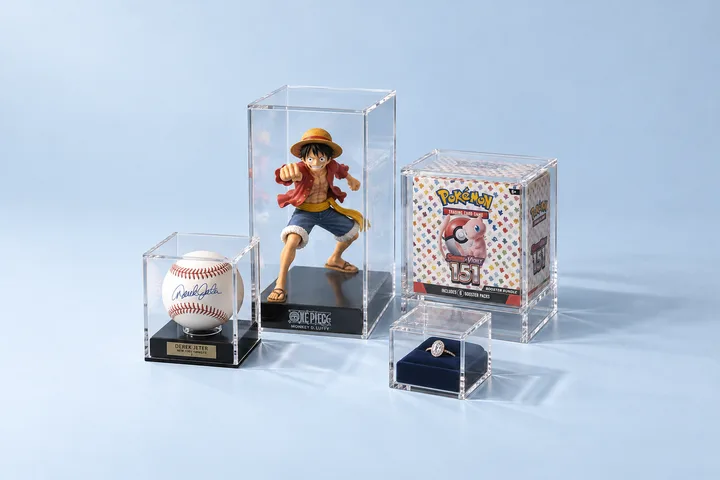
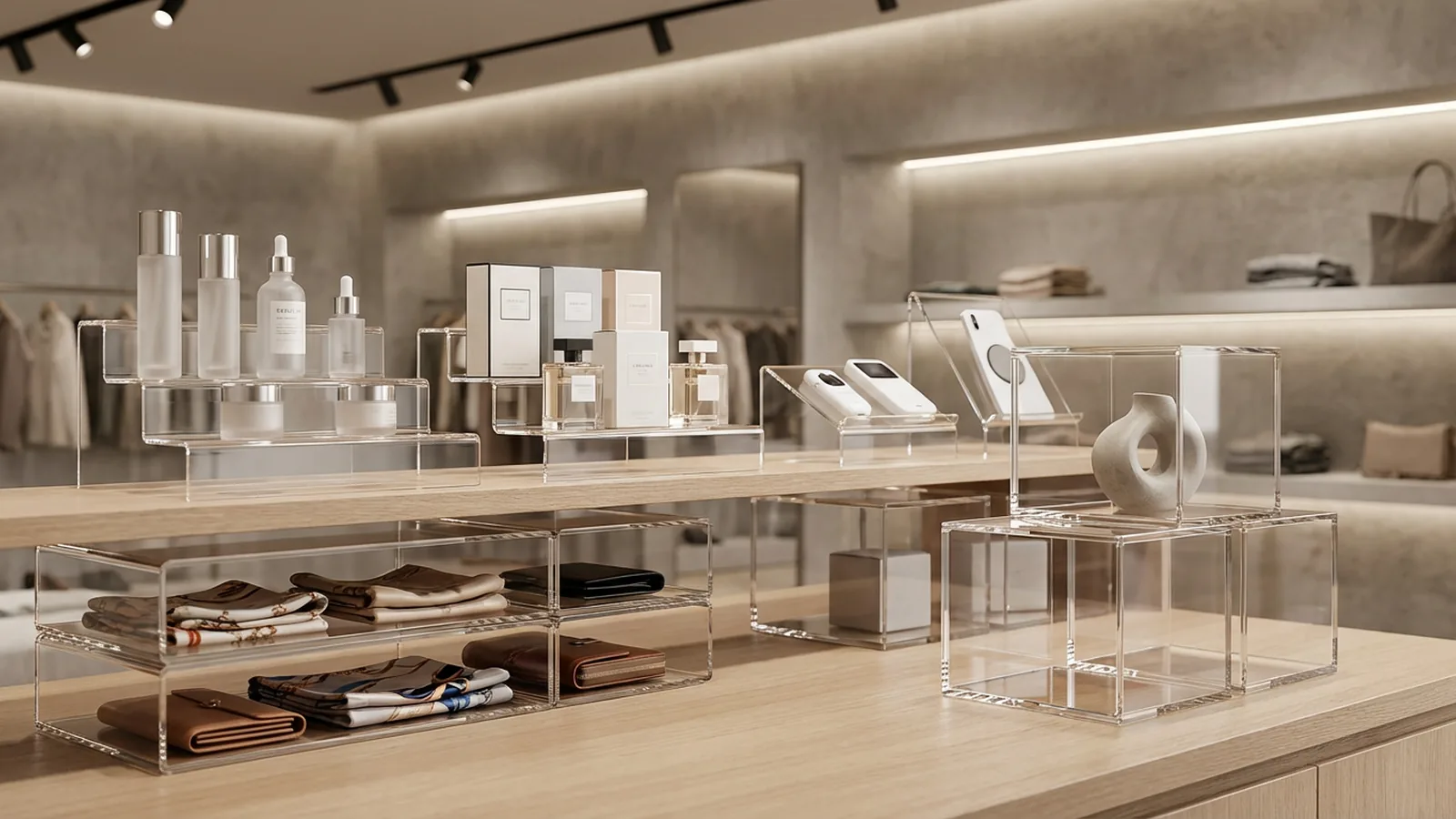
Retail display ideas become useful to buyers when each concept includes the product load, footprint, viewing distance, access, finish, artwork, quantity, and installation conditions. Countertop formats commonly include open-front pedestals, stepped risers with a fence rail, and enclosed showcases with a removable lid; quote each against the same brief.
Polishing cost changes with visible edge length, access, finish method, and acceptance criteria. An open-front pedestal and an enclosed showcase also differ in part count, joints, lid hardware, print scope, and packing, so compare them through a design-specific quote rather than a fixed percentage.
Three countertop concepts and what drives cost:
| Concept | Typical Thickness | Polishing Level | Relative Cost |
|---|---|---|---|
| Open-front pedestal | Drawing-specific | Quote-specified finish | Quote baseline |
| Stepped riser with fence rail | Drawing-specific | Quote-specified finish | Adds bends, tiers, or joints |
| Enclosed showcase with lid | Drawing-specific | Quote-specified finish | Adds enclosure, lid, and hardware |
For cosmetics and fragrance countertop work, see our cosmetics and perfume display application page. That category has the most nuanced finish and clarity requirements of any countertop display we fabricate.
POP and POS Checkout Displays
Point-of-purchase displays at checkout face repeated restocking and customer handling, so the fabrication spec should name the load, access cycle, joint design, and acceptance test. A product photo cannot establish whether a thin wall or joint will withstand the intended use.
Three POP concepts cover many briefs. A flat-pack tray insert uses dividers inside an existing wire rack or gondola shelf. A countertop spinner adds a center rod, tier trays, bearings, and assembly. A formed tray adds a mold and a thermoforming step. The supplier should quote thickness and sample timing from the product load, fixture interface, and drawing.
For the POP and POS display application, standardizing tray-insert dimensions around an existing fixture can reduce repeated design and setup work. Compare that route with a custom footprint at the actual reorder quantities.
POP display cost and MOQ reference:
| Concept | Acrylic Thickness | Assembly | Typical MOQ | Cost Driver |
|---|---|---|---|---|
| Flat-pack tray insert | Drawing-specific | None | 100 pcs per design | Load, divider spacing, fixture fit |
| Countertop spinner | Drawing-specific | Yes (rod + base) | 100 pcs per design | Assembly, bearing, rod sourcing |
| Thermoformed tray | Drawing-specific | Forming mold | 100 pcs per design | Mold, material, forming trial |
Tiered Riser Displays
Tiered risers serve bakery, footwear, skincare, fragrance, and other products that need vertical separation. The drawing should set the tier count, rise, run, angle, load, and viewing position; the fabrication route depends on those approved inputs.
Tier angle changes the fabrication route. A flat-stacked riser uses horizontal platforms, while an angled riser may require a formed bend or a bonded angled joint. Set wall and joint-face thickness from the product load, span, material grade, joint method, and handling test; approve the result on a production-representative sample.
Tiered riser thickness and application guide:
| Load Category | Recommended Thickness | Typical Riser Count | Notes |
|---|---|---|---|
| Cosmetics / skincare (light) | Drawing-specific | Buyer-approved layout | Confirm finish on sample |
| Footwear / packaged goods (medium) | Load-specific | Buyer-approved layout | Review visible-edge finish |
| Electronics / heavy fragrance (heavy) | Engineering review | Buyer-approved layout | Verify anti-tip requirement |
See our acrylic displays product hub for the full range of riser configurations, including flat-back wall-mount risers for shelf gondola integration.
Sign Holders and Price Talkers
Sign holders range from simple shelf-edge pockets to floor-standing frames with weighted bases and hardware. The quote should distinguish pocket material, card size, attachment, base construction, finish, packing, and quantity even when both formats sit in the same product family.
Three sign holder concepts cover many retail applications: shelf-edge pockets attached by clip or adhesive, countertop T-bar or L-shaped holders, and floor-standing panels with weighted bases. Confirm card size, viewing angle, attachment, stability, packing, and quantity before choosing thickness or comparing prices.
Our acrylic sign holders product page shows made-to-order configurations with options for snap-open frames, magnetic closures, and double-sided visibility.
Shop! Association publishes retail-experience research and examples that buyers can use when defining placement and communication goals.1 Clear acrylic is one option when the brief calls for an unobstructed view of the printed card and surrounding product.
Literature and Brochure Stands
Literature and brochure stands are used in real estate offices, banks, hotel lobbies, and automotive showrooms where a visitor needs to pick up a physical document without staff assistance. Two inputs need particular attention on a first order: the printed-piece dimensions and the loaded structural condition.
Two common failures start with missing inputs. A pocket based on a reference photo may not fit the buyer’s actual brochure, and a floor-standing unit can deflect when the sheet stack, cantilever, column, or base is underspecified. Supply the printed-piece dimensions, stack quantity, unit height, base condition, and handling plan, then approve the loaded sample.
Literature stand configuration guide:
| Stand Type | Pocket Specification | Column / Base | Dimensions to Confirm |
|---|---|---|---|
| Tabletop single pocket | Drawing-specific | Base per drawing | Printed-piece width, height, and stack depth |
| Tabletop multi-tier | Drawing-specific | Base per load review | Pocket count, spacing, and loaded depth |
| Floor-standing single-column | Load-specific | Weighted or anchored base | Overall height, pocket position, and footprint |
| Floor-standing rotating | Load-specific | Rotation hardware per drawing | Overall height, footprint, and access clearance |
Our acrylic brochure holders covers the pocket sizing standards and custom footprint options we fabricate most frequently for hospitality and financial services clients.
Floor-Standing Freestanding Display Units
Floor-standing display units carry product across multiple shelves while customers, carts, and cleaning routines add service loads. Their drawings need a structural frame, shelf spans, bracing, base stability, anchoring, and cleaner compatibility that a countertop concept may not require.
Two drawing checks matter: lateral bracing for the shelf and panel loads, and a base or anchor strategy for the expected reach and impact conditions. The fabricator should size panels, frame members, hardware, and ballast from the complete drawing, then verify stability on a loaded sample or agreed engineering review.
For apparel and fragrance retail, use the product load, shelf span, fixture height, access, and installation method to set the frame and shelf specification. Our case studies archive shows project structures, but each new program still needs its own drawing and approval sample.
Floor-standing unit structural specifications:
| Unit Height | Vertical Panel | Shelf Thickness | Base Spec | Lead Time |
|---|---|---|---|---|
| Under 1m | Drawing-specific | Load-specific | Base per stability review | Quoted schedule |
| 1–1.5m | Drawing-specific | Load-specific | Weighted or anchored base | Quoted schedule |
| 1.5–2m | Engineering review | Engineering review | Weighted or anchored base | Quoted schedule |
| Above the reviewed freestanding range | Engineering review | Engineering review | Frame and anchoring per review | Quoted schedule |
Wall-Mounted Displays
Wall-mounted acrylic retail displays range from a single shelf bracket holding a hero product to a grid of acrylic shadow boxes. The wall, anchors, hardware, and acrylic parts share the structural load, so the complete installation needs a site-specific review.
Three concepts cover many wall-mounted briefs. Floating shelves use concealed or visible hardware; shadow-box grids repeat individual enclosures; wall-panel backings carry clips or brackets. Set sheet thickness, panel size, hardware, anchors, joints, packing, and installation from the wall survey, product load, and approved drawing rather than copying a standard gauge or panel format. Floating and wall shelf formats are covered on our acrylic shelves page.
VMSD publishes store-design examples that buyers can use when planning sightlines, product hierarchy, and wall placement.2 Measure sell-through against the retailer’s own baseline rather than applying a universal uplift.
LED-Lit Displays Built to Your Lighting Spec
We build LED-lit retail displays — edge-lit signs, lit shelves and bases, light boxes — to your drawing and lighting spec. You supply the display drawing and the lighting design; we build the acrylic and the lighting to them. We don’t design the display or the lighting.
What the drawing should state:
- The panel dimensions, named sheet grade, edge finish, and approved artwork
- Where the light sits: LED channel, lit edge, cavity depth, diffuser, and cable exit
- The acceptance checks for the lit unit, such as even brightness and no hotspots along the LED edge
- Packing: shipped assembled, or panels and lighting packed as a kit
What the lighting spec should state:
- Light source, color temperature, dimming, and switch
- Input voltage, plug type, and driver position
- The certification marks your destination market requires on the driver or the finished unit
For a lit display, the quote names panel material, dimensions, graphics, edge finish, lighting components, packing, and quantity. Approve it on a separately paid sample that is never credited to production; power the sample on and check it under your store lighting before bulk.
Use our acrylic displays product hub to choose the display configuration, then send the drawing and the lighting spec together.

Material and Finish Selection Across All Display Types
Every retail acrylic display decision eventually comes down to two material questions and one finish question. The two material questions: cast or extruded PMMA, and what thickness? The finish question: what level of edge polishing does this display tier require?
Cast and extruded PMMA use different manufacturing routes and can respond differently to machining, polishing, bonding, and thermal finishing. Select the named sheet grade from the drawing, visible-edge target, cleaning plan, and maker guidance, then approve the finish on the production-representative sample.
Flame and diamond polishing use different thermal and mechanical routes. The named sheet, edge geometry, tool access, cleaner exposure, finish criteria, and approved sample should determine the method for each visible edge. Do not apply one finish as a blanket default across every retail display.
For a deeper look at how acrylic thickness interacts with display type and structural load, our acrylic thickness guide covers the load, span, and fabrication cost tradeoffs in full detail.
What Custom Retail Display Production Actually Costs
Pricing a custom retail acrylic display starts with four inputs: material, part count, decoration, and quantity. The quote should also name edge finish, fixtures, inspection, packing, and delivery scope so buyers can compare the same specification.
Variable 1: Acrylic thickness. Material use, cutting, edge finishing, fixtures, and handling can all change with thickness. Ask for each proposed gauge against the same drawing and acceptance criteria.
Variable 2: Part count and assembly. A display with more parts requires additional cutting, edge finishing, assembly, and inspection. Compare alternate constructions against the same drawing and acceptance criteria.
Variable 3: Printing and decoration. Silk-screen, UV print, and laser engraving use different setup, coverage, color, and inspection inputs. Price the approved artwork route at the actual quantity.
Variable 4: Order quantity. Quantity changes how programming, fixtures, samples, inspection, and packing are allocated. Compare the pilot and rollout quantities on the same Incoterm and packing scope.
For a chain-scale example, see the 50-store multi-category acrylic display rollout case study. For a project-specific quote, send us your dimensions, quantity, product load, artwork, and reference sketch.
Footnotes
-
Shop! Association; Retail Experience Design; a retail-experience trade association that publishes industry research and examples for manufacturers, designers, and retailers. ↩
-
VMSD; Visual Merchandising + Store Design; the leading trade publication for retail store design and visual merchandising professionals; publishes research, case studies, and product benchmarks used by visual merchandising teams at major US and European retailers. ↩
Frequently Asked Questions
What is the minimum order for custom retail acrylic displays?
MOQ is 100 pieces per design for custom retail acrylic displays. Use a separately paid sample, which is never credited to production, to confirm fit, finish, artwork, and product placement before bulk approval.
How long does it take to produce custom retail displays?
The quote should state separate sample and production schedules for the named design. Multi-part assembly, approval rounds, packing, and delivery scope can change both dates, so plan the rollout from the confirmed project schedule.
Can I get the same display in multiple store sizes?
Yes. We can quote one display concept in multiple widths for different fixture footprints. The quote and approval plan must identify which variants receive physical samples and which dimensions or interfaces require separate buyer sign-off before production.
What acrylic thickness is best for a retail countertop display?
Start with the product load, span, footprint, joint design, handling pattern, and anti-tip requirement. The supplier should propose wall and base thickness from the drawing, then confirm fit and stability on a production-representative sample.
How much does a custom retail acrylic display cost?
Unit cost depends on material grade and thickness, part count, edge finish, print coverage, fixtures, packing, and quantity. Send dimensions, load, artwork, finish target, quantity, and a reference image so each route can be priced against the same scope.
Rolling out a retail program?
Send us store count, SKU types, and target launch date. We'll quote a 100-piece pilot and 500-piece scale-up in one response, with sample lead time included.