Jewelry Store Display Ideas for Retail Buyers
Compare counter, wall, tray, riser, and case layouts against the actual jewelry, store plan, lighting, access, and reorder brief.
Need this made?Acrylic jewelry displays →
Key Takeaways
- Set the lighting angle, color-rendering target, fixture dimensions, and viewing distance before asking a factory to quote.
- Tiered risers separate pieces vertically; flat trays keep more products on one plane. Choose the layout against the store plan and SKU mix.
- Acrylic trays can accept removable velvet inserts when the approved visual brief calls for a dark, soft-touch background.
- Five store positions organize the comparison: tower, counter, wall, window, and table.
- MOQ for custom acrylic jewelry displays starts at 100 units per design at Wetop, which opens premium merchandising fixtures to boutique retailers and new DTC jewelry brands that are locked out of metal and wood fixture MOQs.
On this page
What Makes Jewelry Display Ideas Actually Work
Jewelry store display ideas should start with the product dimensions, fixture footprint, viewing distance, access method, lighting brief, and reorder plan. Put those inputs on the RFQ, then approve the chosen material, color, fit, and packing on a paid sample before production; sample fees are paid separately and never credited.
Specific fixture shapes, material choices, and color palettes sit on top of that brief. Our case studies archive documents fabrication methods from delivered projects; use only a case whose material and process match the proposed jewelry fixture. This guide compares ten layout options and the questions a retail buyer can resolve before sampling.
Start the fixture worksheet with one row per jewelry group. Record the largest product dimensions, the number of pieces shown at once, the viewing side, staff access, customer access, lighting source, security hardware, and cleaning method. Add the counter, wall, or window dimensions and note any existing brackets or power outlets. This separates store decisions from factory decisions: the retailer controls the assortment and planogram, while the fabricator proposes panel geometry, joints, inserts, and packing against those inputs. Before releasing production, place the actual jewelry in the paid sample, check clearances from every viewing side, open each access point, inspect reflections under the intended light, and confirm how staff will remove and replace every piece. Photograph the approved arrangement and attach it to the released drawing so the production and store teams review the same reference.
10 Jewelry Store Display Layout Options
Ten jewelry display layouts cover the vast majority of high-performing custom merchandising fixtures we ship. Each solves a specific shopper-intercept moment (window stopping power, counter conversion, wall SKU browsing, or discovery of a hero piece) and each has a typical material and cost profile.
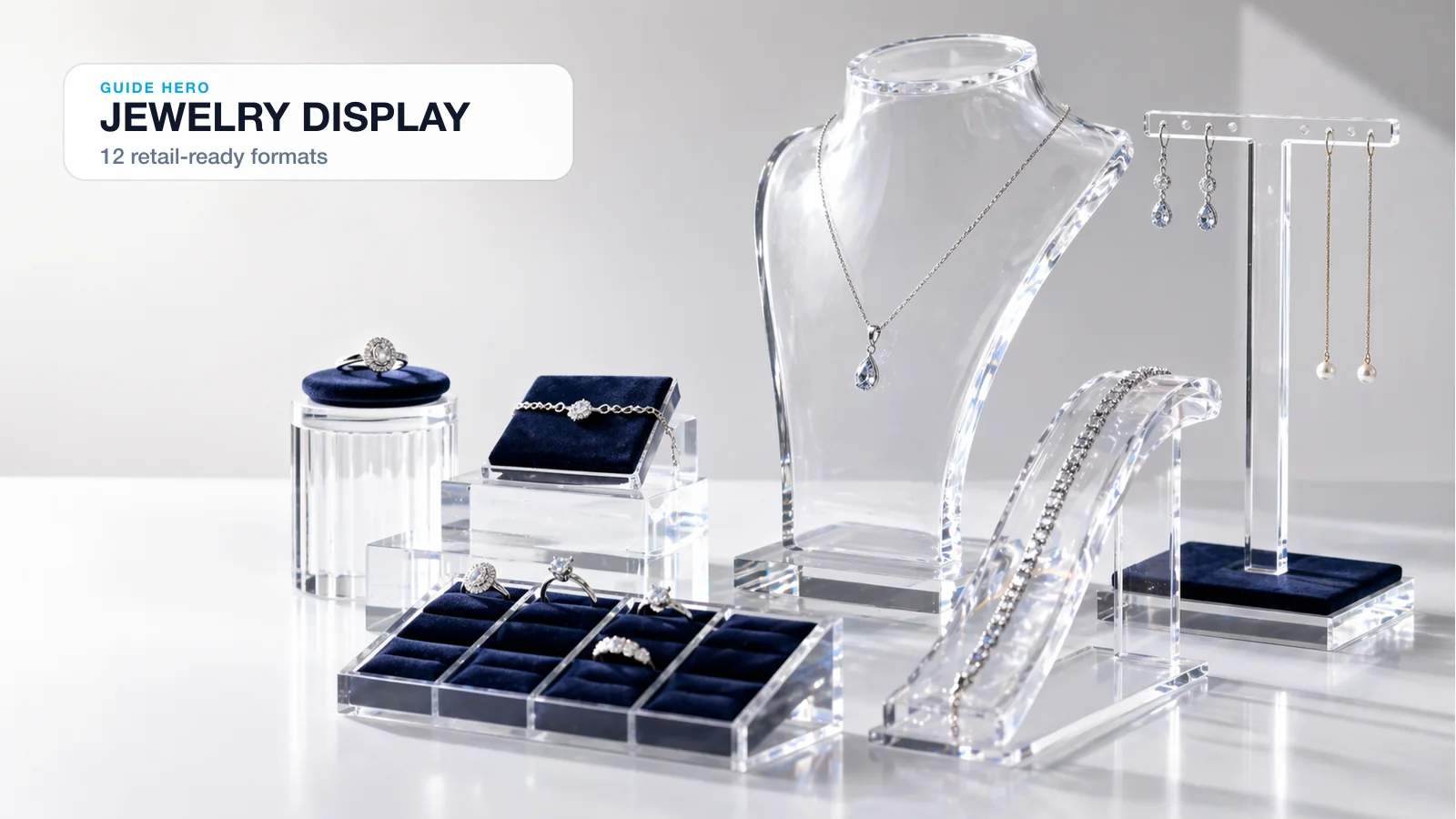
1. Tiered Acrylic Riser Grids. Three to five stepped platforms inside a counter case can display rings or earrings in rows. The tier geometry creates vertical separation between pieces. Quote each riser set against its dimensions, material, finish, packing, and quantity.
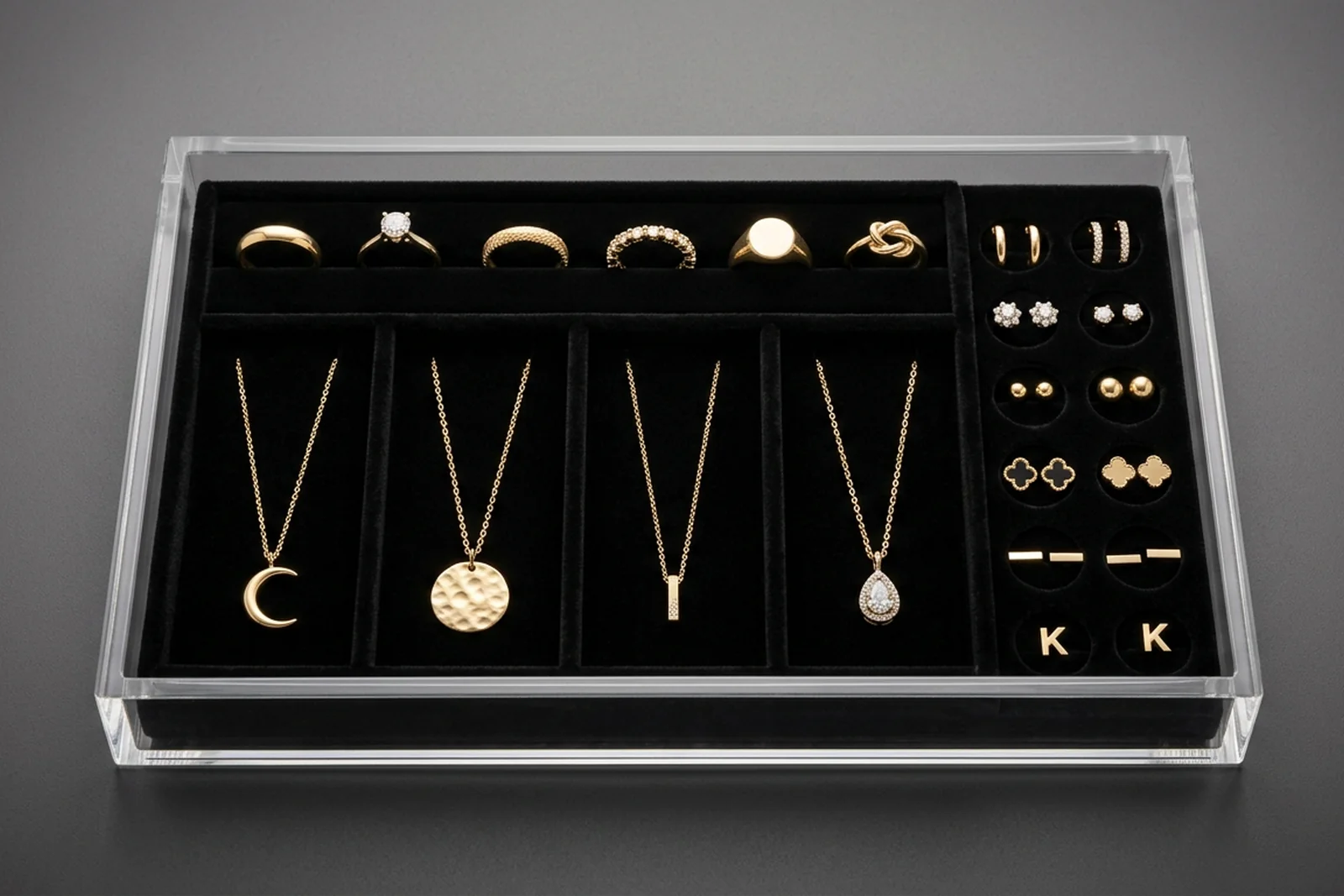
2. Velvet-Lined Acrylic Drawer Trays. Clear acrylic trays with black or navy velvet inserts, each tray holding a buyer-approved number of pieces in die-cut slots. The tray format lets staff pull the entire tray out for inspection without dismantling the display. Quote the slot pattern, insert material, tray dimensions, packing, and quantity together. See our case study on luxury cosmetic organizers with velvet inserts for documented velvet-insert acrylic fabrication; jewelry slot geometry still requires its own sample approval.
3. T-Bar and Multi-Arm Necklace Stands. Vertical acrylic or metal bars with crossing arms hold necklaces at eye level. The vertical presentation shows chain length and pendant drop; quote the bar height, arm count, base geometry, material, packing, and quantity. 4. Bust and Neckform Displays. 3D forms (usually black flocked or clear acrylic) shaped like a neck display a statement necklace in the context of how it would be worn.
5. Ring Bar Finger Displays. Horizontal bars or vertical sticks hold rings in a row, sometimes tilted at an angle. Confirm the approved position count and ring clearances on the sample. 6. Tower Display Cases. Full-height vertical glass or acrylic cases can present selected pieces or brand graphics; lighting and access hardware are quote-specific options.
7. Wall Pegboard and Hook Systems. Grid pegboards with interchangeable hooks support changing assortments and higher SKU counts. Confirm the hook load, spacing, wall attachment, and replenishment method. 8. Window Display Platforms. Solid acrylic display blocks in three heights or platform stages at varying heights inside storefront windows can separate selected pieces and support a seasonal visual brief. An acrylic pedestal can give a single hero piece its own stage.
9. Table-Top Event Displays. Portable modular displays for trade shows, pop-ups, and event activations use acrylic risers and reusable packing. Confirm the packed dimensions, component count, assembly method, and quantity before quoting. 10. Mirror-Backed Accent Displays. Display fixtures with integrated mirror backing give shoppers front and reflected views; approve mirror position and edge protection on the sample.
Layout Principles: Hierarchy, Focal Points, Negative Space
Use three layout controls in the planogram: visual hierarchy, isolated focal points, and negative space. Set the density from the real assortment, viewing distance, access method, and store trial rather than treating one arrangement as a universal sales formula.
Visual hierarchy means deciding which piece is the hero and which pieces support it. Tiered acrylic risers create a repeatable height difference, but the number of levels and the spacing around each piece should come from the approved planogram. Isolated focal points means reserving clear space around a selected piece so it does not overlap visually with its neighbors; approve that spacing against the real SKU assortment.
Negative space discipline is a planogram decision, not a universal sales formula. Test a lower-density and higher-density arrangement in the intended store, then use the observed result to set the final slot count and spacing.
Lighting: CRI, Beam Angle, and Approval
Jewelry display lighting should be specified alongside the fixture because color rendering, beam angle, glare, heat, and mounting position affect the approved presentation. Compare the proposed light source with the actual merchandise before freezing the production spec. The Gemological Institute of America (GIA)1 publishes reference material on gemstones and lighting.
Two lighting specifications to record are Color Rendering Index (CRI) and beam angle. CRI describes color rendering compared with a reference source on a 0–100 scale, as documented by the Illuminating Engineering Society (IES)2. Beam angle describes how narrowly or broadly the fixture distributes light. Select both values through a comparison using the actual jewelry, proposed display material, intended viewing distance, and store ambient light; the factory should build to the buyer-approved lighting schedule rather than a universal preset.
Color temperature, CRI, and beam angle should be tested together. Compare candidate lights with the actual metals, stones, display material, and store ambient light, then record the buyer-approved values on the lighting schedule. For acrylic color options, see our guide on clear vs frosted vs colored acrylic.
Material Matrix: What to Specify Where
The material review below compares acrylic, metal, wood, and short-life board or foam construction. The buyer should select a route from the load, finish, service environment, cleaning method, packing, and approved sample.
Custom acrylic supports transparent structures, custom shapes, and removable velvet inserts. Wetop’s production MOQ is 100 units per design. Metal (brass, gold-plated steel, stainless) and wood can serve different weight, finish, and brand requirements. Compare the materials with the same dimensions, finish, packing, quantity, and shipment terms rather than relying on a generic price range.
Wood (walnut, oak, lacquered MDF) can support a natural-material brief. Its moisture response, grain variation, coating, packing, and unit-to-unit appearance require approval. Paper, foam, or fabric-wrapped board can suit a temporary program when the expected load, cleaning method, and service life support them.
Our luxury cosmetic organizer case study documents a related velvet-insert fabrication process. A jewelry program still needs its own insert material, slot geometry, bonding, and sample approval.
5 Common Jewelry Display Mistakes
Five merchandising mistakes repeat across jewelry retail often enough that they’re worth calling out explicitly. Each is avoidable at the display-design stage but expensive to fix after fixtures are installed. For broader industry compliance and retail disclosure context, the Jewelers Vigilance Committee (JVC)3 publishes the compliance frameworks most US jewelry retailers operate under.
1. Over-dense layouts that remove the planned hierarchy. Set the slot count from the real assortment and confirm it with a store trial. 2. Lighting selected without the merchandise. Compare the proposed CRI, color temperature, beam angle, and glare with the actual products before approval. 3. Equal-height presentation with no hierarchy. Tiered risers create vertical differentiation, but the final arrangement remains a retailer decision.
4. Material contrast approved without the product. Compare the fixture material, color, and surface finish with the real jewelry under the proposed lighting before approval. 5. Treating the window and interior display as the same brief. Record the viewing distance, daylight exposure, lighting, access, security, and seasonal graphics for each location instead of assuming one layout works in both.
Which to Spec for Your Store
Custom acrylic is one candidate for independent retailers, chains, and brand pop-ups. Select it only when its structure, finish, insert options, cleaning method, and approved lighting test meet the project brief.
Spec custom acrylic if: the design needs transparent construction, custom geometry, removable inserts, or repeatable color and finish controls. Spec metal if: the brief requires its weight, surface finish, or hardware characteristics. Spec wood if: the approved visual brief requires wood grain or a natural-material finish and the service environment suits it. Add paper, foam, or fabric-wrapped board only if: the expected service life, load, cleaning method, and packing plan support those materials.
For custom acrylic jewelry display programs, Wetop’s production MOQ is 100 units per design. Options can include clear or colored acrylic construction, laser-cut velvet drop-in inserts, tiered risers, T-bars, bust forms, and counter or window formats. Browse our acrylic display stands hub, review acrylic organizers with drawer inserts, or contact us with the store concept, fixture count, dimensions, and target launch date. We respond within 24 hours with either a quote or the questions needed to prepare one. For product-page context, see our jewelry displays application page and the documented velvet-insert process in the acrylic cosmetic organizer case study.
For complementary guides, see retail acrylic display ideas for broader retail merchandising patterns, custom POP displays for CPG brands for adjacent retail display thinking, and acrylic thickness guide for the structural spec decisions behind any custom acrylic fixture.
Footnotes
-
Gemological Institute of America (GIA), a reference source for gemstone properties and care. ↩
-
Illuminating Engineering Society (IES), a US professional body that publishes lighting standards and guidance referenced for the CRI definition. ↩
-
Jewelers Vigilance Committee (JVC), an industry compliance organization referenced for retail disclosure guidance. ↩
Frequently Asked Questions
What is the best material for jewelry displays?
The best material depends on the approved visual brief, load, access method, cleaning plan, and budget. Acrylic supports transparent structures and custom shapes, and it can be paired with removable velvet inserts. Metal, wood, paper, foam, and fabric-wrapped board serve different weight, finish, and service-life requirements.
What is jewelry merchandising?
Jewelry merchandising is the practice of organizing jewelry on display fixtures so shoppers can see, compare, and access the range. It includes fixture selection (tower, counter, wall, window, table), layout within the fixture (tiered risers, flat trays, or hanging), lighting design, product adjacency, and rotation schedule.
How do you display jewelry in a retail store?
Five core display types cover most jewelry retail needs: tiered acrylic risers for ring and earring groupings, velvet-lined trays for individual fine jewelry pieces, T-bar displays for necklace presentation, bust displays for necklaces and chokers, and tower cases for large statement pieces. Layer these within counter cases for high-margin fine jewelry, wall cases for broader SKU visibility, and window displays for brand and promotional storytelling. The golden rule: every piece should have its own focal moment, not compete with neighbors for attention.
What lighting is best for jewelry displays?
Specify jewelry lighting against the actual merchandise and store environment. Record the proposed CRI, color temperature, beam angle, glare control, mounting position, and heat limits, then compare the sample under the intended ambient light before approval.
What is the MOQ for custom jewelry displays?
At Wetop, custom acrylic jewelry displays start at a 100-unit production MOQ per design. Quote the quantity for each design separately, because dimensions, material, finish, inserts, packing, and shipment terms affect the unit price.
Explore Custom Acrylic Products
Browse product categories to compare formats, materials, and customization options before choosing the closest fit for your project.