Lucite Embedment Awards Buyer Guide: 10 Specs to Get Right
A lucite embedment is the physical receipt for a deal. Bubbles in the cure, a shifted tombstone, a yellow tint at year two — and that receipt becomes a souvenir of what went wrong on the fabrication side, not the deal.
Key Takeaways
- Lucite embedment is liquid PMMA poured around an embedded object, NOT machined cast acrylic sheet — the two materials look similar but only the poured process allows full 3D encapsulation
- Bubble-free cure requires vacuum-degassing the resin before pour and a temperature-controlled cure (20–22°C) for 24–72 hours — rushed cures are the #1 cause of trapped bubbles around embedded artifacts
- Industry sizing conventions matter: IB M&A tombstones run 5–7 inches, PE/VC deal toys 4–6 inches, IPO commemoratives 6–9 inches — clients notice when a vendor delivers a sized-wrong piece for the sector
- Yellowing at year two is a UV stabilizer issue, not a cleaning issue — non-UV-stabilized PMMA yellows visibly within 2–3 years under office LED, while UV-stabilized resin holds clarity 10+ years
- MOQ for custom lucite embedment is typically 10–50 pieces depending on artifact complexity; lead time is 3–5 weeks including the cure cycle, not 5–7 days like flat acrylic awards
On this page
- What “Lucite Embedment” Actually Means
- Deal Toys vs Recognition Awards vs Memorial Pieces
- The Embedment Process — Pour, Cure, Polish
- Embedded Object Categories
- Common Embedment Failures and How to Spot Them
- Cast Acrylic vs Liquid PMMA Resin
- Engraving Combined With Embedment
- Industry Sizing Conventions by Sector
- Lead Time, MOQ, and Pricing Reality
- Lucite Embedment RFQ Cheatsheet
What “Lucite Embedment” Actually Means
Lucite embedment is a custom award format created by suspending an object — a printed deal tombstone, banknote, microchip, photograph, or scale model — inside a clear PMMA resin block by pouring liquid acrylic around the object in stages, then curing, demolding, and polishing the cast piece. The result is a permanent, glass-clear award that physically encapsulates the artifact at the center of the transaction it commemorates.
The name “lucite” is industry shorthand carried over from DuPont’s mid-century trade name for poly(methyl methacrylate)1. Today the material is more accurately called acrylic embedment or PMMA embedment, but the buyer language hasn’t shifted — investment banks, PE firms, and law offices still order “a lucite” when they mean a custom-cast embedded award. Since founding Wetop in 2008 I’ve fabricated lucite embedment programs for closings, IPOs, retirement events, and board-level recognition across financial services, technology, and government clients in 25+ countries. The category has its own vocabulary, sizing conventions, and quality benchmarks — none of which transfer cleanly from generic acrylic award fabrication.
For the broader awards category including engraved cast plaques and trophies, see our acrylic awards hub.
Deal Toys vs Recognition Awards vs Memorial Pieces
Three broad use cases dominate lucite embedment buying: deal toys and tombstones (transaction commemoratives), recognition awards (career achievements, retirements, sales milestones), and memorial or commemorative pieces (event anniversaries, founder gifts, board legacy items). Each comes with its own sizing convention, embedded artifact type, and budget range — buying a deal toy and a retirement award from the same template produces a wrong-feeling result for both occasions.
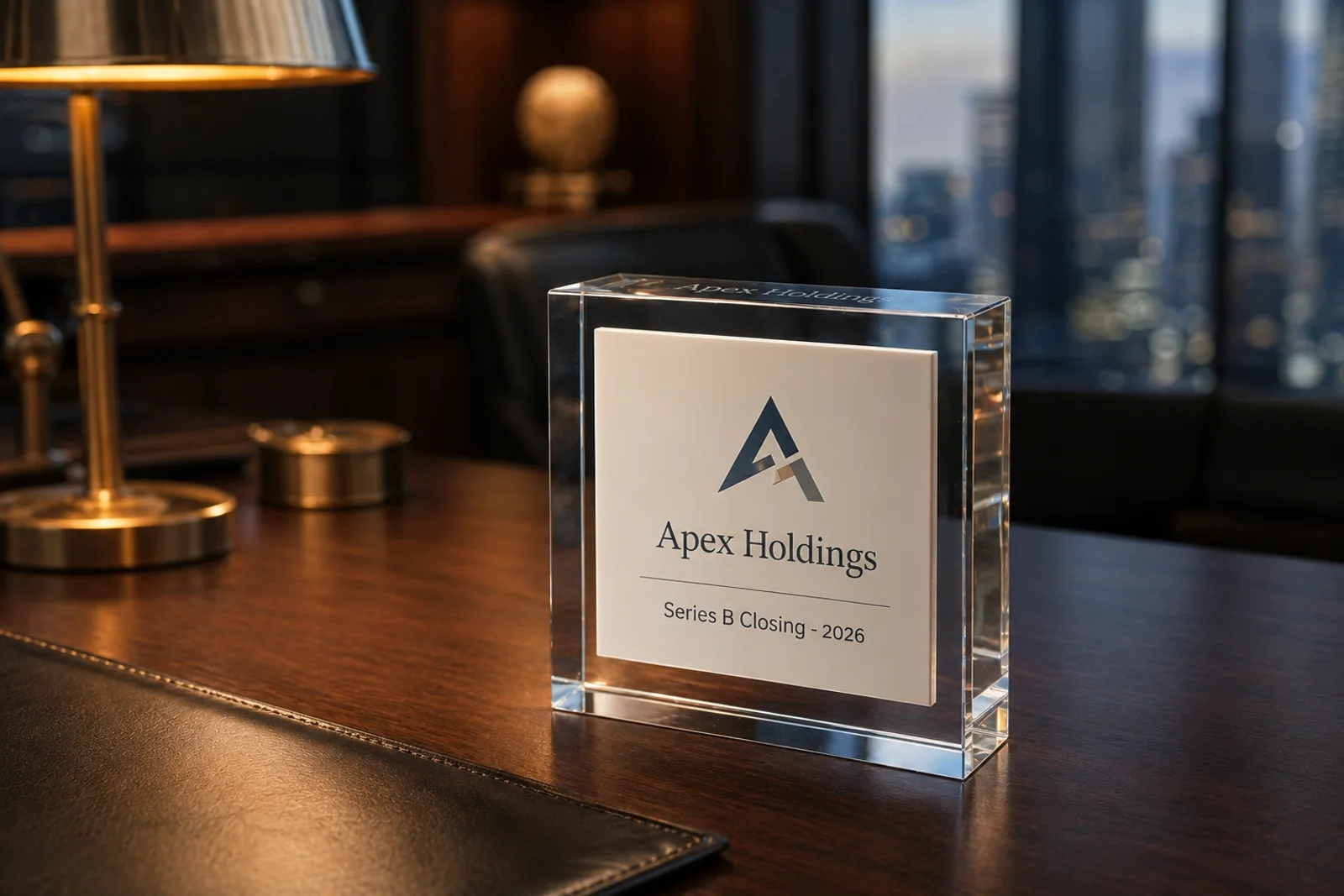
Deal toys and tombstones are the dominant lucite embedment format in financial services. The artifact is typically a printed announcement of the closed transaction — the deal “tombstone” published in financial press, reformatted for embedment — surrounded by 4–6mm of resin on each face. Investment banks order them in batches of 10–50 after every M&A close, IPO, or significant debt issuance, distributed to deal-team members and counterparts at the client and counter-party firms. Recognition awards run larger and more sculptural: columnar shapes, layered cubes, etched faces, often paired with metal nameplates. Memorial pieces are the most varied — anything from a small photo embedment commemorating a board member’s tenure to a large multi-artifact piece marking a 25-year company anniversary.
| Format | Primary Use | Sectors | Typical Size | Embedded Artifact |
|---|---|---|---|---|
| Deal toy / tombstone | Transaction close | IB, PE, M&A, debt, IPO | 5–7 inch | Printed announcement, banknote, micro logo |
| Recognition award | Career milestone | Corporate, sales, government | 8–12 inch | Photo, certificate, metal plate |
| Memorial / commemorative | Event, anniversary | Boards, family offices | Varied | Multi-piece, sculptural |
The Embedment Process — Pour, Cure, Polish
A lucite embedment is built in three to five staged pours rather than a single fill. The mold is prepared, the first base layer of liquid PMMA resin is poured to 30–50% of the final height, partially cured to a tacky-firm state, the embedded artifact is positioned and weighted to prevent shift, the second pour fills above the artifact and cures, and additional pours add height or layer separation as the design requires. After full cure the piece is demolded, machined to dimension, edge-finished, and diamond-polished.
The cure cycle is the rate-limiting step. PMMA resin polymerizes exothermically2 — the chemical reaction generates heat as monomer chains link into polymer. Pour too thick a layer at once and the internal heat exceeds the resin’s tolerance, producing bubbles and cure haze; pour too thin and you spend three weeks instead of one finishing the piece. Staged pours at 20–40mm per layer with 24–48 hour intervals between stages is the working recipe my production team has refined across the embedment programs we’ve delivered since 2008. Vacuum degassing the resin before each pour pulls dissolved air out of solution before it has a chance to nucleate as a bubble around the artifact. Skipping degas is the most common process shortcut — and the most visible failure on the finished piece.
For the broader manufacturing context across acrylic processes, see our how acrylic products are made guide and our diamond vs flame polishing guide. For a real-world awards program example, see the university athletics trophy locking display case study. To commission a deal toy or recognition program, send us the artifact details and quantity for a quote with cure time and polish grade included.
Embedded Object Categories
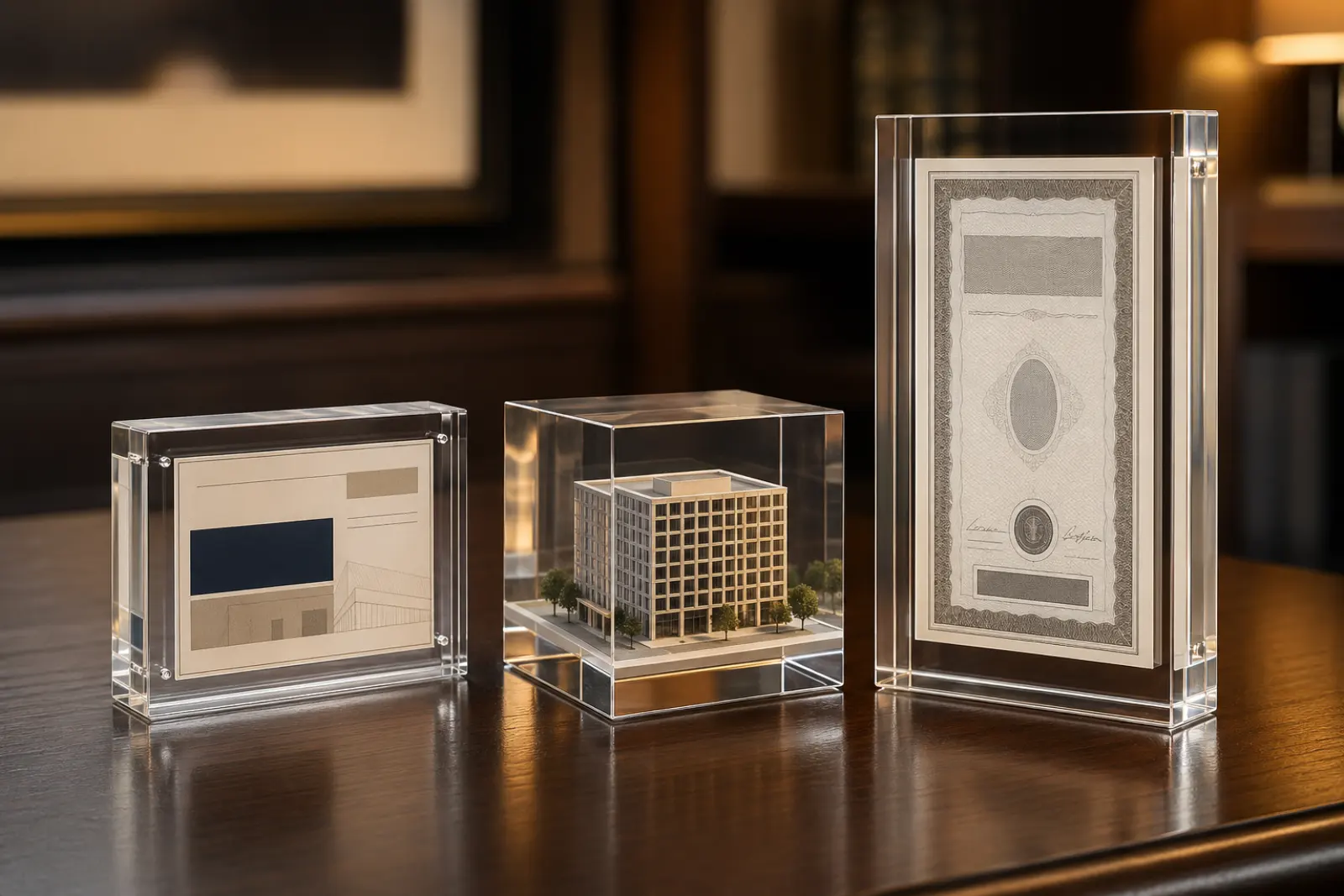
Most rigid, non-porous, heat-tolerant objects embed cleanly in lucite. The categories I see most often across our embedment programs are: printed tombstones (deal announcements reproduced on archival paper), banknotes and currency (often the closing-day currency from cross-border transactions), small electronics and microchips (after thermal pre-test), business cards and certificates, photographs with archival sealing, and 3D scale models — anything from a miniature building model commemorating a real estate close to a printed circuit board commemorating a hardware launch.
Banknotes are a special case worth flagging. Currency contains cellulose paper that absorbs the resin’s residual monomer if not pre-sealed, producing a brown-tinted halo around the bill within months of the cure completing. We pre-laminate every embedded banknote in a thin archival sleeve before the pour — a 5-minute process that prevents the most common embedment failure I see on competitor work. Photographs face the same risk plus a UV-fading vector; archival photo prints with a pre-applied protective film are the working standard. Microchips and small electronics tolerate embedment well if pre-cooled before pour to offset the exotherm and pre-cleaned to remove flux residue that produces internal haze.
What does NOT embed: organic material (flowers, food, leather), anything containing moisture (the exotherm vaporizes water and you get steam bubbles), magnets above neodymium grade (the cure reaction heat partially demagnetizes), and any object too dense to suspend without sinking through the partial-cured base layer. We pre-test every novel artifact in a small embedment sample before committing the production pour — the test costs us 48 hours and saves a buyer a four-week rebuild.
Common Embedment Failures and How to Spot Them
Four failure modes account for nearly every embedment quality complaint: trapped bubbles, yellowing, object shift during cure, and cure haze. Each has a distinct cause, a distinct visual signature, and a distinct point in the process where the failure was introduced — meaning a buyer who can identify the failure mode at delivery can also identify which fabrication step the supplier cut a corner on.
Bubbles appear as pinpoint or millimeter-scale air pockets in the resin, usually clustered around the embedded artifact where the monomer met the artifact surface during pour. Cause: insufficient vacuum degassing of the resin before pour, or a too-thick single pour layer trapping air during cure. Visual signature: small spherical voids visible from any angle. Acceptable on a budget-tier embedment under perhaps 1mm diameter and at low count (under 5 across the piece); unacceptable on a premium tombstone or recognition award. Fix on the supplier side: fully degas every pour batch and stage pours at 20–40mm layer thickness.
Yellowing appears as a warm amber tint developing across the resin, usually within 12–24 months of receiving the piece. Cause: non-UV-stabilized PMMA resin3, or low-grade resin formulation with residual catalyst continuing a slow secondary reaction at room temperature. Visual signature: piece looks “old” against a white reference card while a freshly produced piece looks neutral. The only fix is replacement — yellowing cannot be reversed by polishing or cleaning. Specify “UV-stabilized PMMA, 10-year color stability minimum” on every RFQ.
Object shift appears as the embedded artifact sitting off-center, tilted, or partially submerged below where it should be in the final cure. Cause: insufficient weighting during the staged pour, or partial-cure base layer too soft when the artifact was placed. Visual signature: the artifact looks “wrong” relative to the piece geometry — usually too low, sometimes rotated. Fix: weight the artifact with a temporary jig during the second pour, and verify partial cure has reached working firmness before placement.
Cure haze appears as a milky or cloudy region within the resin volume, usually in a band corresponding to a specific pour layer interface. Cause: temperature spike during cure, contaminant on the partial-cured layer surface before the next pour, or moisture exposure during cure. Visual signature: distinct cloudy band visible against backlight. Fix: temperature-controlled cure room at 20–22°C, clean room conditions during pour, and humidity below 60% in the cure environment.
In 18+ years building custom acrylic in Shenzhen I’ve watched dozens of new clients arrive holding a yellowed deal toy from a previous vendor, asking why “lucite” yellows. The answer is always the same: it doesn’t, when the resin is correctly specified. The piece they’re holding wasn’t UV-stabilized PMMA — it was a cheaper formulation that the previous vendor sourced to hit a price point. Specifying the right resin is half the buyer’s job; verifying the supplier actually pours that resin is the other half.
Cast Acrylic vs Liquid PMMA Resin
Cast acrylic and liquid PMMA resin are the same chemistry but different forms — and only one form supports embedment. Cast acrylic is sheet stock: liquid monomer is poured between two glass plates at the resin manufacturer, fully cured into a flat sheet, and shipped to fabricators who cut, machine, and glue it into finished products. Liquid PMMA resin is shipped as the unreacted monomer (plus catalyst, stabilizer, and additives) for the fabricator to pour, embed, and cure on-site around an artifact.
Embedment requires liquid form because there’s no way to fully encapsulate a 3D object inside a pre-cured sheet. You can sandwich a flat object between two cast acrylic sheets (a process called acrylic lamination) but the result is two visible glue lines, not a single homogeneous resin volume. A real lucite embedment has zero visible interfaces between the resin and the artifact — which is the look buyers are paying for and which only the staged liquid pour produces.
For the broader cast acrylic process and where cast wins over poured resin (flat awards, machined trophies, sheet-format displays), see our cast vs extruded acrylic guide.
The two acrylic embedment workflows produce visually distinguishable results. Cast-and-machine awards have crisp, dimensionally precise edges — the geometry comes from CNC routing of a fully cured sheet — but no embedded artifact. Liquid-pour embedment has slightly softer edges (resolved by post-cure machining and polishing) and the embedded artifact at the geometric core of the piece. A buyer evaluating a lucite tombstone vendor should ask whether they pour their own resin in-house or outsource the pour to a separate fabricator and assemble flat acrylic over the artifact post-hoc — the second answer means you’re not getting an authentic acrylic embedment.
Engraving Combined With Embedment
Most lucite embedment awards combine the embedded artifact with surface engraving — recipient name, deal date, deal value, custom message — laser-etched onto the top surface or sand-blasted into a side face. Three engraving methods integrate cleanly with embedment, each with a distinct cost adder and visual outcome.
Laser engraving on the polished top surface produces a frosted-white text that reads cleanly against the clear resin underneath. It’s the fastest engraving method (15–30 minutes per piece) and the lowest cost adder (typically $5–15 per piece for short text). The trade-off is the engraving is permanent and visible from every angle — fine for clean recipient information, harder to integrate with elaborate brand graphics. Sand-blast engraving produces deeper, more dimensional text with a softer edge, suited for company logos or longer message text. Cost adder: $15–40 per piece depending on graphic complexity.
The third method is embedded engraving — laser-etching a thin clear acrylic insert that is then placed inside the staged pour, so the engraving floats inside the resin volume rather than sitting on the surface. This produces the highest-end visual result: the recipient’s name appears to be suspended in mid-air at the center of the piece. Cost adder: $30–80 per piece because the etched insert must be perfectly bubble-free at its own staged pour interface. We use this for premium recognition awards and for IPO commemoratives where the buyer wants the deal date to read as “inside the deal.” I push our team toward embedded engraving on any commission with a per-piece budget over $250 — the perceived value lift relative to surface laser etching consistently surprises buyers during sample review, and it’s the single decision that separates a memorable lucite embedment from a forgettable one.
Industry Sizing Conventions by Sector
Sizing conventions for lucite embedment have evolved sector by sector, and a piece that’s the wrong size for the sector reads as out-of-touch even before the recipient picks it up. Investment banking M&A tombstones cluster at 5–7 inch rectangular faces because that’s the desk-shelf footprint partners and senior bankers expect on a deal display wall. PE and VC deal toys run smaller and more sculptural — 4–6 inches with cubes, pyramids, or layered rectangles — reflecting the more design-forward culture of those sectors. IPO commemoratives go the opposite direction — 6–9 inches, often multi-piece (a main embedment plus a paired smaller piece) — because the IPO is the most ceremonially significant moment in the company’s life and the embedment scales accordingly.
| Sector | Typical Format | Size Range | Cost Range | Common Embedded Artifact |
|---|---|---|---|---|
| IB M&A tombstone | Rectangular flat-face | 5–7 inch | $80–200 | Printed deal announcement |
| PE / VC deal toy | Sculptural cube / pyramid | 4–6 inch | $100–300 | Logo plate, mini banknote, small model |
| IPO commemorative | Layered or multi-piece | 6–9 inch | $200–500 | Stock certificate replica, ticker tape, share certificate image |
| Debt issuance tombstone | Rectangular | 5–6 inch | $80–150 | Bond announcement, currency note |
| Law firm closing gift | Rectangular w/ document image | 5–7 inch | $80–200 | Embedded contract excerpt, client logo |
| Sales / retirement award | Columnar upright | 8–12 inch | $100–250 | Photo, certificate, milestone date plate |
| Government / mil contract | Plaque-format | 6–10 inch | $150–400 | Embedded document, agency seal |
The cost ranges above assume standard UV-stabilized PMMA, diamond-polished edges, 10–50 piece quantities, and surface laser engraving. Embedded engraving inserts, multi-stage layered embedments, and metal plate inclusions all push toward the upper bound or above. Across the embedment programs I’ve personally signed off on since 2008, the most common sizing miss is buyers ordering oversized pieces — 8-inch IB tombstones for what should be 6-inch, typically because they scaled from a memorial-piece reference rather than a sector convention. The fix is upstream: pick the sector convention first, scale within it second. For pricing guidance on smaller pilot quantities and first-time embedment commissions, see our low MOQ acrylic ordering guide.
Lead Time, MOQ, and Pricing Reality
A custom lucite embedment runs 3–5 weeks from approved artwork to delivery. Our standard company MOQ across product categories is 50 pieces; for embedment programs specifically we accept programs down to 10 pieces because mold-cost and pour-stage labor amortizes differently than flat-acrylic fabrication. Pricing scales toward the upper range below 25 pieces.
The full lead-time breakdown: 1 week for mold prep and artifact preparation (laminate sealing, color profiling for printed tombstones, thermal pre-test for electronics); 1 week for the staged pour and full cure cycle; 1 week for demolding, edge machining, and diamond polishing; 3–5 days for engraving, final QC, and packing for shipment.
The cure cycle is the rate-limiting step and cannot be safely accelerated. I’ve had clients arrive on a Tuesday with a Friday deadline asking us to “just rush the lucite” — and the honest answer is that rushing the cure is exactly how you produce the bubble-and-haze pieces those clients are trying to avoid. For tight-deadline programs we recommend pre-staging mold prep and artifact preparation as soon as the deal is announced (or anticipated), so that the moment artwork is approved the pour can begin within 24 hours. Three to five weeks is the working timeline; eight weeks is the comfortable timeline for a complex multi-piece program.
MOQ flexibility depends on the artifact complexity. A single standard tombstone repeated across 50 pieces uses one mold and one pour batch — efficient. Fifty different tombstones (one per recipient, varying deal date and recipient name) requires per-piece artifact preparation and individual artwork — higher MOQ, longer lead time, higher cost per piece. Across 2,000+ B2B projects since founding Wetop in 2008, the most common embedment program structure I see is 25–50 pieces of an identical tombstone with per-piece engraved recipient names, which fits cleanly within the working MOQ band and allows engraving to be applied as a final post-cure step.
For the broader sourcing process and supplier evaluation, see our acrylic RFQ guide and our supplier audit checklist for acrylic.
Lucite Embedment RFQ Cheatsheet
A complete lucite embedment RFQ specifies seven things — getting all seven right at the inquiry stage cuts two weeks off the typical clarification cycle and produces a quote that doesn’t change during production.
1. Embedded artifact: Image (high-res), physical sample, or both. For printed tombstones provide the print-ready artwork file. For 3D objects provide dimensions and photographs. Flag any heat-sensitive or moisture-bearing components for thermal pre-test.
2. Quantity and variation: Total piece count, plus any per-piece variation (recipient names, dates, deal values). One identical artifact across all pieces is the fastest production path; per-piece variation requires per-piece artwork prep.
3. Final dimensions: Length × width × thickness in inches or millimeters, OR sector convention (e.g., “standard IB M&A tombstone, 6-inch face”) if you don’t have a specific size in mind.
4. Resin specification: “UV-stabilized cast PMMA, 10-year color stability minimum.” Verbatim language eliminates substitution to cheaper non-stabilized formulations.
5. Edge finish: “Diamond polish, all visible faces.” Avoid the generic “polished” descriptor.
6. Engraving requirement: Surface laser engraving / sand-blast / embedded insert engraving — pick one or specify “TBD, recommend by sector.” Include the text or graphic file.
7. Deadline and ship-to: Final delivery date, ship-to address (per piece if individual recipients or single address). Allow 3–5 weeks from approved artwork for working timeline; 8 weeks for complex multi-piece programs.
Cross-border shipping notes. For deal-toy programs distributed to counterparts in different jurisdictions — common in cross-border M&A and IPO closings — customs treatment varies by country. Most jurisdictions classify lucite awards under HS code 9505 (festive/commemorative articles) or 8306 (decorative pieces) at low or zero duty. A “commercial samples” or “gift, no commercial value” declaration is acceptable for B2B deal-toy distribution; we attach a commercial invoice with itemized values and a gift letter on request. For shipments into the EU, REACH compliance documentation accompanies the bill of lading.
We’ve shipped lucite embedment programs to investment banks, PE firms, law offices, government agencies, and corporate recognition programs across the U.S., U.K., Canada, Singapore, and the EU. ISO 9001, SGS, REACH, and RoHS documentation ships with every order. UV-stabilized resin and full cure verification are our defaults — not upcharges. Send your embedment brief to inquiry@wetopacrylic.com — we respond within 24 hours with a quote, sample-pour offer, or clarifying question. No commitment required at the quote stage.
Footnotes
-
Poly(methyl methacrylate) — Wikipedia — PMMA polymer reference and DuPont “Lucite” trade-name history cited in “What Lucite Embedment Actually Means.” ↩
-
Plaskolite cast acrylic — cast PMMA manufacturer cited for the exothermic-polymerization data behind staged-pour cure timing in “The Embedment Process.” ↩
-
Fluorescent UV / QUV accelerated-weathering exposure of plastics (Q-Lab), including ASTM D4329 — Standard Practice for Light/Water Exposure of Plastics — the accelerated UV-weathering protocol behind the yellowing failure-mode analysis; non-UV-stabilized PMMA discolors under the fluorescent-UV exposure cycles this ASTM D4329 practice specifies. ↩
Frequently Asked Questions
What's the difference between a lucite embedment and a regular acrylic award?
A regular acrylic award is machined or laser-cut from a pre-formed cast acrylic sheet, then engraved on the surface — the artifact lives ON the award. A lucite embedment is created by pouring liquid PMMA resin around an object inside a mold, so the artifact lives INSIDE the cured block. Embedment is the only acrylic process that fully encapsulates a 3D object — banknotes, microchips, scale models, printed tombstones — in glass-clear resin permanently.
Can any object be embedded in lucite?
Most rigid, non-porous, non-heat-sensitive objects can be embedded. Banknotes, printed tombstones, microchips (when cooled), business cards, photographs (with archival treatment), and small 3D models embed cleanly. Heat-sensitive electronics, food, organic material, and anything containing moisture cannot — the exothermic cure reaction reaches 60–80°C briefly and trapped moisture creates haze. We pre-test every artifact submitted for embedment in a small resin sample before committing the full pour.
How long does a lucite embedment take to make?
Three to five weeks for a custom lucite embedment from approved artwork: 1 week for mold preparation and artifact prep, 3–5 days for the staged pour and cure cycle, 4–7 days for demolding, edge machining, and diamond polishing, and 3–5 days for engraving and final QC. Standard flat acrylic awards ship in 1–2 weeks; embedment runs longer because the cure cycle cannot be accelerated without introducing bubbles or stress fractures.
Why do some lucite embedments yellow over time?
Two reasons. First, non-UV-stabilized PMMA resin yellows under prolonged exposure to office LED or natural light — the polymer chains oxidize and shift the visible spectrum toward amber. Second, low-grade resin formulations contain residual catalyst that continues a slow secondary reaction at room temperature, also producing yellowing. We use UV-stabilized resin with full cure verification on every embedment, which holds optical clarity for 10+ years on a desk under typical office light.
What's the typical cost range for a custom lucite embedment deal toy?
Custom lucite embedment ranges roughly $50–$300 per piece depending on size, embedded artifact complexity, and engraving requirements. A 5-inch IB tombstone with a printed deal announcement embedded, no metal inserts, runs $80–$150. A 6-inch PE deal toy with a scale model, embedded business card, and laser-engraved metal plate runs $200–$300. The cost drivers are artifact preparation labor and pour stage count — not the resin itself.
Commissioning a deal toy or recognition program?
Send the artifact (image or sample), quantity, and deadline. We quote with cure time, polish grade, and engraving options included — and ship a small resin test before committing the full pour.