Bakery Display Cabinet Buyer Specification
Specify the product zone, access method, cleaning plan, dimensions, materials, and destination-market document requirements before requesting a quote.
Key Takeaways
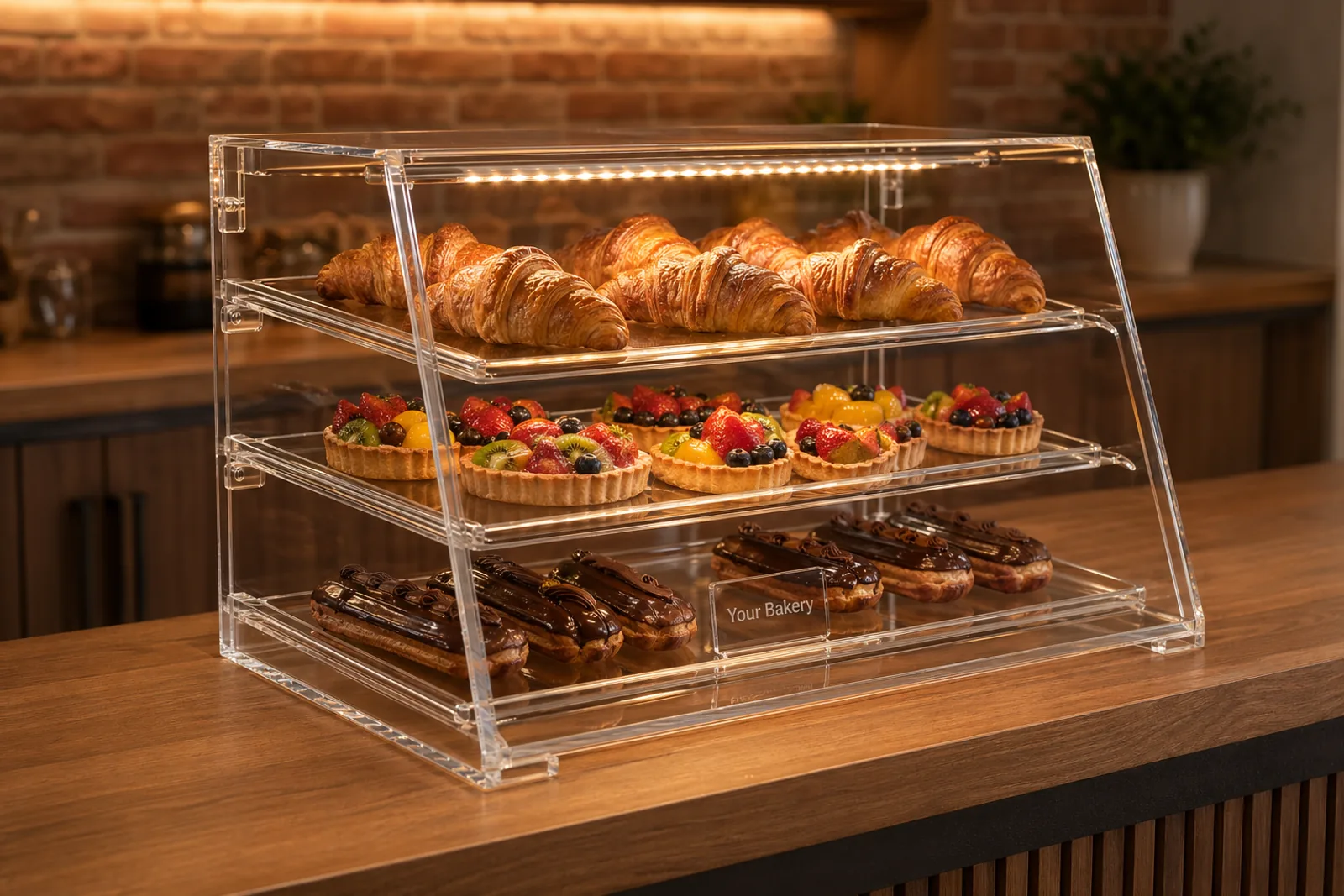
- A pastry display case may be refrigerated equipment or an ambient acrylic showcase; Wetop fabricates the second category
- For any direct food-contact zone, name the acrylic grade and request the documents required for the destination market and intended use
- For self-serve formats, confirm the applicable food-shield requirements with the buyer's local authority before freezing the geometry
- 3000–3500K warm-white LED at CRI 85+ makes pastries look fresh; cooler 4000K+ LED makes butter-laminated croissants read gray
- Approve the edge finish and cleaning protocol together; avoid alcohol, ammonia, acetone, and abrasive cleaners on acrylic
On this page
- What Wetop Builds: Ambient Acrylic Pastry Displays
- The Three Pastry Display Case Formats
- Acrylic vs Glass for Pastry Display Cases
- Food-Grade Acrylic & FDA 21 CFR 177.1010
- Sneeze Guard Geometry: NSF/ANSI 2
- Hygienic Construction Standards
- Lighting Inside an Acrylic Pastry Display Case
- Cleaning Protocols That Won’t Craze Acrylic
- Custom Pastry Display Case RFQ Cheatsheet
What Wetop Builds: Ambient Acrylic Pastry Displays
A bakery display cabinet may be refrigerated equipment or an ambient acrylic showcase. Wetop fabricates the second category: custom acrylic displays for products whose storage and service conditions do not require active cooling. Confirm the product, temperature-control requirement, access method, cleaning plan, dimensions, and destination-market documents before requesting a quote.
Refrigerated equipment and ambient acrylic displays use different specifications and suppliers. Wetop fabricates ambient acrylic showcases; it does not build compressor, gasket, or condensate systems. The buyer must confirm the storage and service conditions for every product before selecting the display format.
For the application landing covering both formats and our case study portfolio, see our food and bakery displays page.
Build a zone map before drawing the cabinet. Mark every area that may touch an unpackaged product, every customer-facing opening, the staff access path, removable trays, hinges, lighting, and the surfaces cleaned during a shift. Add the product dimensions, service temperature, holding time, cleaning method, counter size, power supply, destination market, and local review contact. The buyer can then state which zones require a named material document and which parts are presentation-only. The factory uses that map to propose panels, joints, doors, lids, hardware, and packing without guessing at the product use. Review the paid sample with the actual tray or packaged item, open every door and lid, test removal for cleaning, inspect the approved edge finish, and confirm that the supplied documents identify the selected material. Record any change on the drawing before production approval.
The Three Pastry Display Case Formats
This guide compares three ambient formats: countertop showcases, tower displays, and tiered countertop risers. Dimensions, access, enclosure, and food-shield requirements come from the buyer-approved drawing and local requirements.
A rear-access countertop showcase can support staff service. A tower can support packaged items when the product and local requirements permit that use. An open tiered riser has no enclosure, so the buyer must confirm whether the intended products and service model require a shield or cabinet.
| Format | Typical Height | Best SKU Categories | Bakery Layout |
|---|---|---|---|
| Countertop showcase | Drawing-specific | Buyer-approved products | Staff-served counter |
| Tower display | Drawing-specific | Buyer-approved packaged products | Queue line or floor position |
| Tiered countertop riser | Drawing-specific | Buyer-approved packaged products | Endcap or side counter |
For the full range of acrylic display configurations beyond pastry, see our acrylic displays hub.
Acrylic vs Glass for Pastry Display Cases
Acrylic and glass have different density, scratch response, impact behavior, forming routes, joint options, and replacement needs. Compare named grades and finished constructions at the same dimensions, hardware, packing, quantity, and service conditions.
Weight, geometry, impact behavior, cleaning, and replacement planning all belong in the material decision. Compare acrylic and glass with the same dimensions, thickness, hardware, packing, quantity, and shipment terms; do not rely on a generic weight or tooling-cost ratio. Confirm who will move or clean the cabinet, how damaged panels are contained, and which material the buyer and local authority approve for the intended zone.
For the full material comparison covering both display performance and shipping economics, see our acrylic vs glass displays guide.
Food-Grade Acrylic & FDA 21 CFR 177.1010
Do not treat “food-grade acrylic” as a complete specification. For any direct food-contact zone, name the acrylic grade, intended use, destination market, and document requirements. FDA 21 CFR 177.10101 covers specified acrylic and modified acrylic plastics under stated conditions of use; it does not make every cast PMMA sheet suitable for every food application.
The document pack is order-specific. Ask the supplier to identify the proposed resin or sheet grade and list the available declarations or test reports before sample approval. The buyer remains responsible for confirming that the selected material, construction, and documents meet the destination market and intended use.
Two practical RFQ rules are to name the required document in the purchase order and to make sure every supplied declaration or report identifies the material it covers. Confirm any batch-level traceability requirement before ordering. For the broader QC framework, see our quality control and certifications page and our supplier audit checklist.
Sneeze Guard Geometry: NSF/ANSI 2
NSF/ANSI 2 is a U.S. food-equipment standard that includes requirements relevant to food shields. The applicable geometry and evidence depend on the service format, equipment scope, and local adoption.
Confirm shield depth, height, slope, access, and food-zone coverage against the current standard documentation2 and the buyer’s local requirements. Put the approved dimensions on the drawing rather than copying values from a generic diagram.
Food-shield rules depend on the service format and jurisdiction. A staff-served countertop showcase and a self-serve display can face different access and shielding requirements, so the buyer should confirm the applicable rule with the local authority before approving the geometry.
When you spec a self-serve pastry display case, put the buyer-confirmed food-shield standard, dimensions, and evidence requirement on the RFQ. Certification and testing scope are quote-specific; do not budget from a generic range or assume that a material declaration certifies the finished cabinet.
Hygienic Construction Standards
For a hygienic-construction review, identify the food-contact zones, internal corners, seams, joints, cleaner exposure, and access for inspection. The buyer and local authority must approve the finished design and the cleaning method for the intended use.
Internal corner geometry should follow the approved cleaning and fabrication brief. Where a radius is required, state the value on the drawing and verify the routed corner or added fillet on the sample. Price the joint design against the actual panel thickness, dimensions, finish, and quantity.
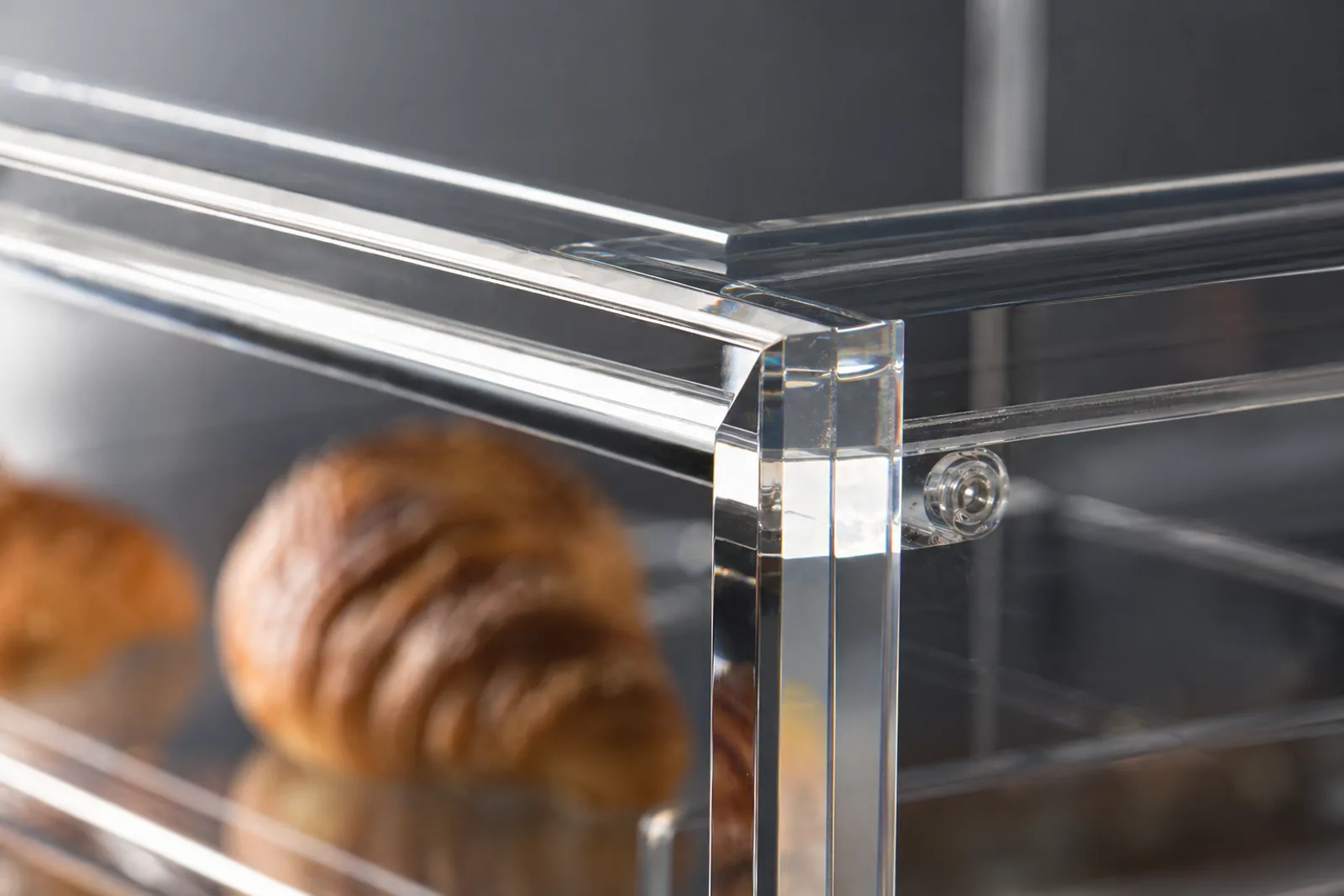
Choose the edge finish against the visual standard, joint design, handling, and cleaning method. Flame polishing can introduce surface stress, while mechanical polishing uses progressive abrasive steps. Neither finish makes acrylic compatible with alcohol, ammonia, acetone, or abrasive cleaning. Quote the selected finish against the actual edge length and geometry. For the full comparison, see our diamond vs flame polishing guide.
Lighting Inside an Acrylic Pastry Display Case
For an illuminated cabinet, compare color temperature, CRI,3 brightness, heat, glare, and mounting position with the actual products. Record the buyer-approved LED and electrical specification on the drawing; do not use one color or power value as a universal bakery standard.
For an illuminated cabinet, compare the proposed LED with the actual products and approved finish before production. Record the approved color temperature, CRI, mounting position, power supply, voltage, and plug standard on the drawing. Any strip or channel change is quote-specific and requires a new visual and electrical approval.
LED placement changes reflections, coverage, service access, and local heat. Compare top, front, and side mounting on the sample, then record the approved channel, angle, diffuser, driver, wiring, and access method.
Cleaning Protocols That Won’t Craze Acrylic
Use a soft microfiber cloth with mild detergent and water, then dry the surface. Avoid alcohol, ammonia-based glass cleaner, acetone, and abrasive tools. The cleaning frequency should follow the buyer’s hygiene plan, and any proposed cleaner should be tested on the approved material and finish before rollout.
Alcohol, ammonia, acetone, abrasive cleaners, and rough tools can damage acrylic or its finished edges. Use a soft cloth with mild detergent and water, dry the surface, and test any proposed cleaner on the named material and finish before rollout. A sanitizer concentration should not be called acrylic-safe without material-specific evidence and buyer approval.
Put the buyer-approved cleaning method in the operating instructions. If the order includes an SOP card, confirm its text, placement, material, and packing before production. For daily and stain-removal procedures, see our acrylic cleaning and maintenance guide.
Custom Pastry Display Case RFQ Cheatsheet
A bakery display RFQ should identify the named material grade, dimensions, product zones, access, tier configuration, edge finish, buyer-confirmed food-shield requirements, lighting brief, branding, destination market, quantity, and required documents. The quote should state which requirements and documents it covers.
Material: Name the proposed sheet grade, intended use, food-contact zones, and required declarations or reports. Buyer and local-authority approval remains required.
Dimensions and format: Provide W × D × H in millimeters, plus the format (countertop showcase / tower / tiered riser / sneeze-guard add-on). Attach a sketch or CAD if available to reduce dimensional questions.
Edge finish: “Diamond polish on all visible edges. Flame polish unacceptable.” Verbatim language; avoid the generic “polished” descriptor that fabricators interpret loosely.
Food shield (when required): State the buyer-confirmed standard, geometry, service format, and evidence required at delivery. Do not infer finished-equipment compliance from a material declaration.
Lighting (if integrated): State the buyer-approved LED, color temperature, CRI, brightness, heat limit, driver, voltage, plug, channel, diffuser, mounting direction, testing, and service-access requirements.
Branding: Brand-color side panels, etched or printed logos, and any colored acrylic panels go in a separate spec block with Pantone references.
MOQ and lead time: We fabricate from 100 pieces per design. A paid sample is normally 3–5 days from an approved tech pack; its fee is paid separately and never credited. Production normally runs 15–20 days from approved sample. Our customization process and acrylic RFQ guide cover the broader buying process.
For a buyer-controlled planning example, see the UV-protected pastry display manufacturing plan. Ready to spec your program? Send us your brief with the dimensions, intended use, destination market, and quantity. We respond within 24 hours with either a quote or a clarifying question. No commitment is required at the quote stage.
Footnotes
-
FDA 21 CFR 177.1010, a federal regulation covering specified acrylic and modified acrylic plastics under stated conditions of use. ↩
-
NSF/ANSI 2 food equipment standards, referenced for food-shield requirements that must be checked against the current standard and local adoption. ↩
-
Color rendering index, referenced for the general CRI definition; the project value remains buyer-approved. ↩
Frequently Asked Questions
Does acrylic meet U.S. health code requirements for pastry display cases?
Acrylic suitability depends on the named grade, intended food-contact use, destination market, and required documentation. Put those inputs on the RFQ, request the available material documents for the named grade, and obtain buyer and local-authority approval before installation.
Can acrylic pastry display cases be used for refrigerated items?
No. An ambient acrylic showcase does not provide active cooling. The buyer must determine which products require refrigeration and use purpose-built refrigerated equipment for those products.
What's the typical lifespan of an acrylic pastry display case in daily commercial use?
Service life depends on material grade, thickness, joint design, load, environment, handling, and cleaning. Approve a soft-cloth and mild-detergent cleaning method, avoid alcohol, ammonia, acetone, and abrasive cleaners, and replace any panel that develops cracks or damage affecting service.
What's the minimum order quantity for a custom pastry display case?
Our production MOQ is 100 pieces per design for custom acrylic countertop showcases, tower units, tiered risers, or food-shield assemblies. A paid sample is normally 3–5 days from an approved tech pack; its fee is paid separately and never credited. Production is normally 15–20 days from approved sample.
How do I clean an acrylic pastry display case without damaging it?
Use a soft microfiber cloth with mild detergent and water, then dry the surface. Avoid alcohol, ammonia-based glass cleaner, acetone, and abrasive tools. Test any proposed cleaner on the approved material and finish before rollout. See our [acrylic cleaning and maintenance guide](/guide/how-to-clean-acrylic-displays/) for the full protocol.
Speccing a custom pastry display program?
Send dimensions, SKU mix, store count, destination market, and intended food-contact zones. We will confirm which material documents are available for the named grade and use.