Delivered project · Bakery & Confectionery
UV-Protected Pastry Display for Retail
A multi-location patisserie chain asked us for UV-filtering acrylic pastry displays for its front windows.
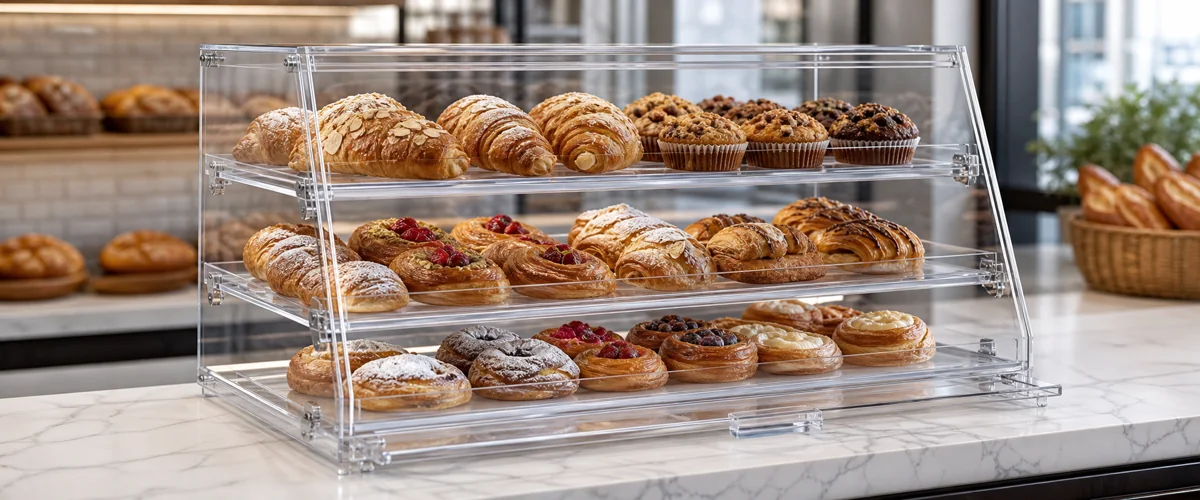
We built one design with a named UV sheet, a tip-out front pane and a slide-out crumb tray, approved it on a paid sample, and packed each case for warehouse or direct-store delivery. Delivered: one pastry-display design at 100 pieces or more, released on a named sheet record, an approved drawing and a physical sample.
Ordering a similar project
MOQ is 100 pieces per design. Paid samples take 3–5 days, are paid separately, and are never credited to production. Standard production takes 15–20 days after approvals, and Wetop responds to a complete brief within 24 hours.
Closest published price: this order was quoted from its own drawing. The nearest public reference on the acrylic cases hub is a 300 × 200 × 250 mm collectible case in 5 mm UV-filtering acrylic with mitered joints and a magnetic lid, from $15–30 per unit FOB Shenzhen at 200 pieces. A pastry display adds its own geometry, access, tray mechanism, sheet records, testing and packing, and was priced line by line.
Key Takeaways
- A multi-location patisserie chain needed UV-filtering pastry displays for its front windows, with easy access and cleaning. We delivered one design, at 100 pieces or more, to its warehouse and stores.
- We specified UV performance by the named sheet maker's current datasheet and the buyer's requested test, because “UV-protected” alone is not a number.
- We fitted a slide-out crumb tray and a tip-out front pane for wall-adjacent counters, and the buyer approved clearance, stop, hinge and opening on the paid sample.
- The chain approved food-contact suitability for its market; we supplied the material and construction record.
The Brief
The chain's brief for its front-window pastry displays started with window orientation, light exposure, the pastry envelope, counter and aisle geometry, cleaning method, market and the documentation it needed for the material.
Color retention under daylight mattered to the chain, so the buyer defined the exposure and acceptance method. We reviewed the named UV-filtering sheet against its maker's current datasheet and passed that record through. We also told the buyer plainly that the case does not preserve pastries or guarantee a service life.
Cleaning and access were separate inputs. The buyer sent the pastry and topper envelope, refill path, cleaner, tray-removal procedure, counter depth and aisle clearance, and we compared fixed, slide-out and tip-out options on the sample. The final brief named the sheet, pastry envelope, access direction, cleaning sequence, quantity, destination, inspection criteria and packing for one design at 100 pieces or more.
Our Approach
We settled three decisions on the drawing and the sample instead of reading them off a product photo: the named sheet and its UV record, the crumb-tray movement and the access geometry.
Named sheet grade and UV acceptance
The buyer named the wavelength band, transmission or exposure requirement and the evidence format it wanted. We identified the sheet maker and grade, passed through the current datasheet and arranged the buyer-requested test before approving the material. We did not assume one formulation, coating, cleaner compatibility or lifetime applied to all UV-filtering acrylic.
The named sheet affected material cost, minimum sheet quantity and lead time, and we put those effects in the written quote. The approved record covered the acrylic's optical requirement; pastry handling and shelf life stayed with the chain.
Slide-out crumb-tray access
We used a slide-out tray so staff could clean it separately. It rode on a polymer bearing strip with a physical stop, and we set clearance, stop travel, removal direction and removal force from the actual crumb load, cleaner and counter. The buyer approved movement, removal and cleaning on the production-intent sample.
Tip-out front pane and hinge geometry
A tip-out front pane let the cases stand against a wall. From the counter, aisle and pastry envelope the buyer supplied, we set hinge material, buffer, pivot position, opening angle and stop on the drawing. The buyer approved access on the sample against its own cycle test.
What We Built
The diagram shows the delivered construction: a dome in the named UV sheet, a tip-out front pane, a slide-out crumb tray and a base with a recessed tray rail. Thicknesses and clearances came from the released drawing and the approved sample.
Production and Cleanability
The paid sample took 3–5 days. Production took 15–20 days after the named sheet, drawing, access, tray movement, cleaning method, compliance record, sample, inspection plan and packing were approved.
We checked cleanability with the chain's actual product, cleaner, contact time, wipe material and disassembly sequence. Sheet documentation alone does not certify a fabricated food-contact application, so we recorded the material and construction, and the buyer or responsible authority approved suitability for its market and use.
Our inspection plan for this order covered dimensions, sheet record, edge and joint acceptance, tray movement, access, visual condition and packing, at a frequency and sampling level agreed with the buyer.
Install and In-Service Outcome
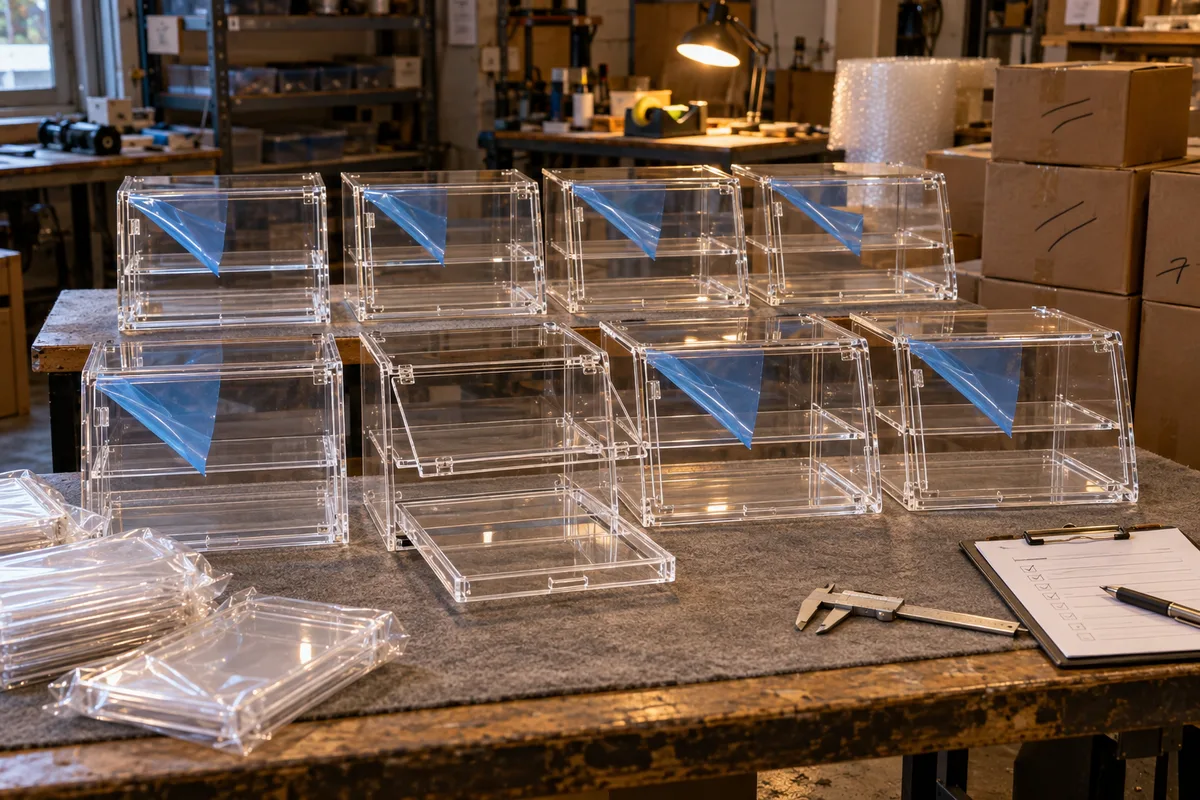
The chain split delivery between its central warehouse and direct-to-store shipments. Our packing specification marked removable parts, protective film, dividers, orientation, accessories, install note, carton quantity and destination label, so each receiving team could match its cases to the allocation file.
UV acceptance rested on the named sheet record and the buyer's exposure requirement, not on a warranty. Pastry color and shelf life still depend on formulation, light source, exposure, temperature, humidity and handling. We closed the order with a release package: named sheet record, approved drawing and sample, cleaning and access acceptance, inspection plan, allocation file and packing standard. The chain's sister brand later sent us its own inquiry.
What was approved: the named sheet record, pastry fit, access, tray movement, cleaner, compliance responsibility and packing, all on the production-intent sample before bulk release.
If You're Planning Something Similar
Tell us your window orientation and actual light source on the first call; we choose a UV-filtering sheet against your stated exposure and evidence requirement. Bring your real cleaner and a representative pastry setup to the sample review. The pastry display case buyer guide lists the access, cleaning and compliance inputs to send.
Reorders reuse the released CNC files, hinge schedule and tray-rail geometry when the named sheet, pastry envelope, cleaner, quantity, destination and packing still match. A new design goes back to a paid sample, with price and lead time confirmed fresh. See ourcustom acrylic cases.
Refitting pastry displays with UV-filtering acrylic?
Send your store layout, window orientation and unit count. We reply within 24 hours with a named-sheet recommendation, a tip-out or rear-hinge call for your aisle width, and a quote.