
UV Protected Display Cases: UV-Grade Acrylic for Sunny Windows
Standard PMMA in a south-facing window yellows visibly inside 6 months.
Need this made?Custom acrylic display cases →
Here is the UV-grade spec, the weathering data behind it, and the cost premium that actually buys fade resistance.
Key Takeaways
- Standard cast PMMA in a south-facing retail window typically reaches a yellowness index in the low double digits after roughly a year of direct exposure — visibly amber to any buyer walking past.
- UV-grade cast PMMA with cast-in HALS + benzotriazole stabilizer is engineered to hold delta-E and yellowness index low across long outdoor exposure — tier-one producer weathering data (ASTM G154 / ISO 4892-3) shows near-clear performance where standard PMMA fails.
- Cast-in UV stabilizer outperforms surface UV-block film over time — the film delaminates, scratches off in cleaning, and leaves uneven fade lines after months of daily handling.
- The cost premium for UV-grade PMMA over standard cast is usually 18–28% on the raw sheet, which works out to around 8–15% of the finished display case price.
- If the case sits within 1 meter of a south or west window, or anywhere outdoors, spec UV-grade up front. Retrofitting after the case yellows means rebuilding it.
On this page
Why Standard PMMA Yellows in 6 Months of Sun Exposure
A UV protected display case, built from UV acrylic (UV-grade cast PMMA), is the right spec when the case lives anywhere standard PMMA cannot — sun-exposed retail windows, west-facing skylit atria, vehicle showrooms, outdoor signage zones — and the difference between getting that spec right and not is roughly 6 months of acceptable appearance vs 18+ months. Standard cast PMMA with no UV stabilization typically reaches a yellowness index of 4–6 by month 6 of direct south-facing retail-window exposure, and 11–13 by month 12. That is the difference between a case that looks clear behind the product and a case that looks like an old amber lampshade — and it happens whether the buyer notices it month-by-month or all at once when a colleague flags it.
In our production experience shipping custom display cases into every kind of retail environment, the yellowing complaints almost always trace back to the same three words on the original PO: just say “acrylic”. The fabricator sources standard cast PMMA, the case looks perfect at unboxing, and 6–9 months later the buyer is asking why the clear case has gone the color of weak tea. The cause is photo-oxidation: UV-A (315–400 nm) and UV-B (280–315 nm) photons carry enough energy to break the C-H bonds along the PMMA polymer chain, oxygen attacks the broken chain end, and the resulting carbonyl groups are what your eye reads as yellow. Standard cast PMMA does not have any chemistry inside the sheet to absorb that UV before it hits the polymer, so the reaction runs every sunny day until the chains are degraded enough to be visible.
The reaction is cumulative and irreversible. Once the polymer chains have shifted to the yellow-shifted oxidation products, you cannot polish, clean, or chemically reverse them — the case is what it is. Worse, by the time YI is visible to a buyer (typically YI ≥ 5), the surface has also begun to embrittle: micro-cracks at stress-concentration points, edge crazing where the case meets a frame, and reduced impact resistance if anything bumps it. For a window-facing retail program where the case is meant to live 18–36 months in the same spot, standard PMMA is a 6-month material asked to do an 18-month job.
UV-Grade Cast PMMA — What the Spec Sheet Should Say
A UV-grade cast PMMA spec sheet should explicitly name the stabilizer system blended into the sheet at the casting stage — typically a HALS (hindered amine light stabilizer) at 0.1–0.3% by weight plus a benzotriazole UV absorber at 0.2–0.5%1 — along with documented yellowness index behavior under ASTM G154 accelerated UV-A 340 exposure2 and yellowness index measured per ASTM D19253.
When my buyers send me a sheet datasheet to validate before we run the case program, I look for four things in this order. First, the stabilizer chemistry is named, not just “UV-stabilized”. Generic “UV-stabilized” on a datasheet is the same warning sign as generic “acrylic” on a PO — the supplier may be running a token amount of low-grade UV absorber that washes out within a year, or they may be running a properly engineered HALS + benzotriazole combination that holds the panel for 8–10 years. Named chemistry is the difference. Second, the loading percentages are specified. A datasheet that says “contains HALS and benzotriazole UV absorber at 0.4% combined” tells you the supplier knows what is in the resin; “contains UV inhibitors” tells you nothing useful.
Third, the yellowness index curve is published, not just a marketing claim. A real UV-grade PMMA datasheet will show YI plotted against ASTM G154 hours, typically through 2,000+ hours (roughly 12 months of outdoor southern-US equivalent). Budget-grade “UV” PMMA shows a single number with no curve and no test method, which is not data — it is an assertion. Fourth, the warranty is in writing for the actual use case. A 10-year non-yellowing warranty for outdoor signage from a tier-one PMMA producer is worth something; a 1-line “UV-resistant” claim from a generic supplier with no test data behind it is not. We source the UV-grade PMMA we run for sun-exposed cases from documented tier-one cast producers — the same upstream that supplies premium signage manufacturers — and we keep the spec sheet on file with each program. For thickness selection inside the UV-grade family, the same rules from our acrylic thickness guide apply: load and span first, then UV grade as a separate material decision on top. UV-grade runs across our full acrylic display cases range at the same fabrication lead time as standard PMMA.
The other detail buyers miss: UV grade is a sheet-level spec, not a coating you can add later. If a finished case is fabricated from standard PMMA and the buyer realizes after delivery that the location is sun-exposed, the only fix is to refabricate. Spec UV-grade upfront when the location is window-facing, west-facing, south-facing, in a skylit atrium, in a vehicle showroom, or anywhere outdoors. For window-facing retail programs that also need finish variation, our colored acrylic floating frames case study shows how we keep color stability and clarity on a sun-exposed gallery wall over the same kind of 12-month service window.
Cast-In UV Stabilizer vs Surface UV-Block Film
Cast-in UV stabilizer outperforms surface-applied UV-block film across the full lifespan of a retail case. The film performs comparably for the first 4–6 months, then loses to the cast-in stabilizer once edge delamination, cleaning scratches, and uneven fade lines start appearing — typically around month 8 of daily retail handling.
The two approaches solve the same problem with very different mechanics. Cast-in stabilizer is a chemistry decision made at the PMMA polymerization stage: HALS molecules and benzotriazole UV absorbers are dissolved into the monomer along with the initiator and dispersed evenly through the full thickness of the sheet. There is no layer, no interface, no surface that can fail. Every cubic millimeter of the panel has the same stabilizer concentration, so a scratch on the surface or a chip on the edge exposes more stabilized material, not raw unstabilized PMMA. The stabilizer is consumed slowly as it absorbs UV photons over time, but a properly loaded UV-grade sheet holds protective concentration for 8–12 years of outdoor exposure depending on latitude and orientation.
Surface UV-block film is a polyester or polyurethane film with UV absorber concentrated in the film, applied to standard PMMA with a pressure-sensitive adhesive — a retrofit approach to turning a standard case into a UV-protected acrylic display case without resourcing the underlying sheet. The film carries a much higher UV-absorber loading than cast-in chemistry can — that is why it can perform briefly — but it has three structural weaknesses that show up repeatedly on real cases. Edge adhesion: the film is cut to the panel edge, and any flexing, thermal cycling, or solvent contact at the edge starts the delamination. Once the edge lifts even a millimeter, dust and moisture wick under and the failure accelerates. Cleaning: retail cases get wiped daily, and film surfaces scratch at a fraction of the load PMMA itself can handle. By month 6 there is visible scratch haze in the high-traffic wipe zones. Uneven fade: once the film has any pinhole, scratch path, or peeled edge, the underlying standard PMMA yellows in those local zones while the still-protected zones stay clear, and the case develops blotchy fade lines that are arguably worse than uniform yellowing.
For any program with a service life under 6 months — short trade-show runs, seasonal pop-ups, tactical retail tests — UV-block film over standard PMMA is a defensible budget call. For anything 12 months or longer, especially window-facing retail or outdoor adjacency, cast-in UV-grade PMMA is the spec. In our production experience the pattern is consistent: film-based cases tend to come back for refurbishment inside the first year as the surface layer fails, while cast-in UV-grade cases come back for capacity expansion, not for fade.
Weathering Data — Delta-E and Yellowing Index Over a Year of Sun
The reason UV-grade is the default spec for sun-exposed programs is not a Wetop lab result — it is the published weathering behavior of the material itself. Tier-one cast-PMMA producers (Röhm PLEXIGLAS, Plaskolite OPTIX, Mitsubishi Acrylite) run accelerated weathering on their UV-filtering grades and publish delta-E and yellowness-index curves; independent material databases such as MakeItFrom and AZoM summarize the same behavior. Across those sources the pattern is consistent: a properly stabilized UV-grade cast PMMA holds delta-E under 2 and yellowness index in the low single digits through roughly a year of southern-US outdoor equivalent, while unstabilized cast PMMA drifts to a delta-E above 5 and a yellowness index in the low double digits over the same exposure.
The standard test behind those numbers is ASTM G1542 — the accelerated UV-A 340 lamp cycle that stands in for outdoor sun in a controlled chamber — with yellowness index calculated per ASTM D19253 (ISO 4892-3 is the equivalent international protocol). When you ask a sheet supplier for data, this is the curve to request: YI plotted against G154 hours, for both the UV-grade and the standard grade, on the same thickness. The table below gives representative published/typical figures across the four spec options buyers usually compare, plus the cost premium relative to standard cast PMMA. Treat these as typical material behavior, not a guaranteed measurement of any one lot — the value is the relative gap between rows.
UV performance comparison — typical published values, ~1-year outdoor-equivalent exposure
| Spec | 6-mo delta-E | 12-mo delta-E | 12-mo YI | Cost premium vs standard |
|---|---|---|---|---|
| Standard cast PMMA | 2.8 | 5.4 | 12 | baseline |
| UV-block film over standard PMMA | 1.1 | 3.6 | 7 | +6–10% |
| Cast-in UV stabilizer (UV-grade PMMA) | 0.6 | 1.4 | 2 | +18–28% |
| UV-grade premium tier (HALS + benzotriazole + IR-block) | 0.5 | 1.2 | 1 | +35–45% |
The delta-E numbers map to perceived color shift on the standard CIE scale: delta-E under 2 is generally imperceptible side-by-side, 2–5 is noticeable in direct comparison, and above 5 is obvious to any buyer without a reference. The yellowness index numbers map to amber appearance: YI under 3 reads as colorless, 3–7 reads as faintly warm, 7–12 reads as visibly yellow, and above 12 reads as amber. In practice, the spec line that matters is “12-mo YI under 5” — that is the threshold for a case that still looks clear at the end of its first year of retail service.
The premium tier (last row) adds an IR-block additive that reduces solar heat gain inside the case — relevant for cases holding cosmetics, pharmaceuticals, or food products where elevated case-internal temperature drives separate degradation paths. For pure clarity-and-no-yellowing duty, the third row (cast-in UV stabilizer) is the cost-effective spec for most retail programs. That includes a coin display case in a sunlit shop window: the coins need no UV protection, but a yellowed case still hides them. The UV-protected pastry display project shows how we controlled the sheet grade, exposure requirement, access, cleaning method, inspection, and packing.
Cost Spread — UV-Grade vs Standard at Typical Case Sizes
For a typical countertop UV-protected acrylic display case of 400 × 300 × 350 mm in 5 mm PMMA, the UV-grade upgrade adds roughly $12–$25 to a unit cost in the $150–$220 range — about 8–15% of the finished case price. The math gets more favorable at larger case sizes, where the sheet is a higher share of the bill of materials, and less favorable at small sizes where fixed fabrication costs dominate.
Three cost components shift when a buyer specs UV-grade instead of standard PMMA. Raw sheet cost is the headline: UV-grade cast PMMA from documented tier-one producers runs 18–28% more per square meter than equivalent standard cast PMMA, with the spread driven by stabilizer chemistry, loading percentage, and producer brand. Fabrication cost does not change — UV-grade PMMA cuts, polishes, and bonds identically to standard cast on our floor; we run the same laser power, the same flame-polishing settings, the same Weld-On bonding. Freight and packaging does not change either; the panel weight is identical. So the case-level premium is pure raw-material delta, diluted across the rest of the bill.
The math at three representative case sizes, assuming UV-grade adds +25% on the sheet line:
- Countertop display case, 400 × 300 × 350 mm, 5 mm walls: standard ~$185, UV-grade ~$203, premium ~10%.
- Floor-standing display case, 600 × 500 × 1500 mm, 8 mm walls: standard ~$680, UV-grade ~$755, premium ~11%.
- Window-facing tower case, 800 × 800 × 2000 mm, 10 mm walls: standard ~$1,420, UV-grade ~$1,600, premium ~13%.
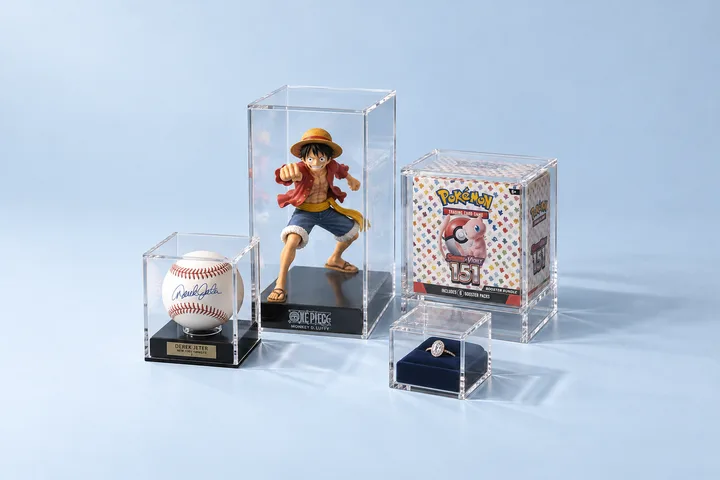
These are directional illustrative figures, not a published price list — actual quotes vary with finishing, hardware, lighting, and order quantity. The point is that the UV-grade premium is a single-digit-to-low-double-digit percentage of the finished case, not a doubling. For sun-exposed programs where the case lives 18+ months in front of a window, UV-grade is the spec that pays back inside year one — every yellowed standard case that has to be replaced costs you the full case price plus shipping plus fixture-down time, which is far more than the UV-grade premium would have been on day one. Signed jerseys (see our UV-filtering jersey shadow boxes), autographed balls, and printed photo cards are the merchandise where this decision bites hardest, which is why our sports memorabilia display cases carry UV-grade as a standard quote option.
If your program is borderline — case sits 2 meters back from the window, with partial shade from an awning, in a north-facing or east-facing exposure — request paired UV-grade and standard material swatches and stage them in the actual location for 60–90 days before you commit. We can include two 100 × 100 mm material swatches at no charge with a UV-program quote; these are flat material swatches, not production samples. On the contact page, note the location, the window orientation, and the merchandise, and we will send the right swatches plus a UV-grade vs standard recommendation in writing. For archival and museum collections, where the requirements are stricter than retail and call for conservation-grade cases, see our museum-grade acrylic display case specs.
Related guides
Footnotes
-
Roehm — PLEXIGLAS UV-filtering grades technical overview — tier-one cast PMMA producer documentation on HALS + benzotriazole UV stabilizer chemistry and UV-filtering grade specifications. ↩
-
ASTM G154 accelerated UV-A 340 weathering protocol, Q-Lab — weathering-test authority describing the ASTM G154 fluorescent-UV protocol and its UVA-340 lamp (simulating shortwave summer sunlight), the accelerated exposure cycle used to project outdoor PMMA durability inside a controlled chamber. ↩ ↩2
-
ASTM D1925 — Standard Test Method for Yellowness Index of Plastics — the reference test method for calculating yellowness index from spectrophotometer readings on transparent plastics, used for the YI values cited from producer and material-database weathering data throughout this guide. ↩ ↩2
Frequently Asked Questions
What is a UV-protected acrylic display case?
A UV-protected acrylic display case is a cast PMMA case fabricated from sheet that has UV stabilizers — typically a HALS (hindered amine light stabilizer) plus a benzotriazole UV absorber — blended into the polymer at the casting stage, not coated on after. The stabilizer system absorbs UV-A and UV-B before it can break down the polymer chain, which is what causes standard PMMA to yellow and embrittle. Weathering data published by tier-one cast-PMMA producers (e.g. Röhm PLEXIGLAS, Plaskolite OPTIX) shows UV-grade grades holding delta-E under 2 across accelerated exposure equivalent to a year or more outdoors, while unstabilized cast PMMA drifts to a delta-E above 5 and a yellowness index in the low double digits over the same window.
Does standard plexiglass yellow in the sun?
Yes, measurably. Standard cast PMMA without UV stabilization typically shows a yellowness index of 4–6 by month 6 of direct south-facing window exposure, climbing to 11–13 by month 12. That is well past the threshold where a buyer walking past notices the case looks amber against the merchandise. The yellowing comes from UV-driven photo-oxidation of the polymer; once the chains have broken, the color shift is permanent. Spec UV-grade PMMA at the casting stage rather than trying to remediate a yellowed case later.
Is cast-in UV stabilizer better than UV-block film?
Cast-in stabilizer wins over the lifespan of a retail program. UV-block film applied to the surface of standard PMMA performs well for the first 4–6 months, but the film delaminates at the edges, scratches under routine cleaning, and develops uneven fade once the bond fails — typically by month 8. Cast-in stabilizer is dispersed through the full thickness of the sheet, so there is no surface layer to fail, no edge to peel, and no scratch path to expose unstabilized material. For any case with a 12-month or longer service life, cast-in is the spec.
How much more does UV-grade acrylic cost?
Raw UV-grade cast PMMA sheet runs roughly 18–28% more per square meter than equivalent standard cast PMMA. On a finished display case, where the sheet is one of several cost lines (fabrication, polishing, hardware, freight), the UV upgrade typically lifts the case price by 8–15%. On a $200 case the premium is around $16–$30. For a sun-exposed program where the alternative is replacing yellowed cases at month 12, the math almost always favors UV-grade upfront.
How do you measure if an acrylic display case is fade-resistant?
Two standardized tests cover the question. ASTM G154 specifies the accelerated UV-A 340 lamp exposure cycle that simulates outdoor weathering in a controlled chamber, and ASTM D1925 defines the yellowness index calculation from spectrophotometer readings. Combined, they give you a yellowness index curve over hours of UV exposure, and this is the data to ask a sheet supplier for: delta-E (overall color shift) and yellowness index plotted against G154 hours for both the UV-grade and the standard grade. A properly stabilized UV-grade sheet is engineered to hold delta-E under 2 and YI under 2 through roughly 2,000 hours (about a year of southern-US outdoor equivalent); standard cast PMMA typically does not.
Sun-exposed display program in the pipeline?
Send the location, the orientation, and the product the case will hold. We will recommend UV-grade vs standard PMMA with the cost delta spelled out, and ship a 100×100 mm sample of each grade so you can see the clarity yourself.