
Museum-Grade Acrylic Display Cases: UV, Oddy Test & Sealing Specs
A museum-grade case isn't a marketing label — it's a stack of measurable specs. Here's the spec language curators should write into their RFQ before any quote.
Need this made?Museum display cases →
Key Takeaways
- "Museum-grade" is not a label — it's a measurable spec stack: UV transmission below 5%, AR coating reflectance below 1%, climate-sealed base maintaining 45-55% RH, and adhesive-free mounting.
- Sensitivity drives the threshold: robust artifacts (metal, ceramic) tolerate UV transmission < 5%; archival pieces (paper, dyed textiles, photographs) need < 2%; conservation-grade (botanical specimens, manuscripts) need < 1%.
- Anti-reflective coating drops surface reflection from ~8% on polished acrylic to under 1% — at the cost of ~4% absolute light transmission. For dimly lit galleries the visibility gain is worth it; for brightly lit retail-style displays it usually isn't.
- Do not promise a humidity band from cassette mass alone. Require the conservator's target, finished-enclosure leakage data, conditioned sorbent specification, monitoring method, ambient assumptions, and maintenance plan.
- Do not assign a universal 50-year life or generic price to a custom case. Compare quoted construction, replaceable components, cleaning limits, maintenance, test evidence, and the consequence of artifact damage.
On this page
- What “Museum-Grade” Actually Means in Spec Language
- UV Protection — Transmission Thresholds for Sensitive vs Robust Artifacts
- Anti-Reflective Coating — When Coating Beats Untreated Polished Acrylic
- Material Inertness — the Oddy Test Decides What Shares the Air
- Climate-Sealed Base — Humidity Buffering for Sensitive Collections
- Mount System — Invisible vs Visible Mounts for Curators
- Traveling Exhibit Cases — the Standard Is Repeatable Assembly
- Cost vs Longevity — Build the TCO From Quoted Evidence
- Putting the Spec Stack Into Your RFQ
- Related guides
What “Museum-Grade” Actually Means in Spec Language
A museum-grade acrylic display case is defined by measurable numbers, not by the word “museum-grade”, which gets used loosely in catalogs and quote sheets. In spec language, museum-grade is not a property of the acrylic — it’s a stack of four measurable specs applied together: UV transmission below 5% across the 300-400 nm band, anti-reflective coating with specular reflectance below 1%, a sealed base maintaining 45-55% RH with a silica-gel cassette, and a mounting system using polymer rods or magnetic fixings rather than adhesive.
Write the required performance and evidence at the top of the RFQ. A case may include an anti-reflective surface yet use an unsuitable mount, or include a gasket without proving enclosure performance. The label is not evidence; accepted test reports, material declarations, drawings, and receiving inspection are. To order, our museum display cases page maps those inputs to a custom vitrine quote.
The other terminology point worth fixing early: “museum display case” describes a conservation and exhibition function, not an aesthetic. The buyer’s conservator should approve the object-specific requirements and the supplier should identify the evidence for each one. Fabrication capability alone does not establish independent conservation-laboratory capability.
UV Protection — Transmission Thresholds for Sensitive vs Robust Artifacts
UV protection is the single most consequential spec on a museum display case, because UV damage is cumulative, irreversible, and invisible until it’s already done. The threshold depends on what’s inside the case. For metal, stone, ceramic, and glass artifacts, museum-grade UV transmission below 5% across 300-400 nm is conservative. For dyed textiles, watercolor on paper, photographs, and historic prints, archival-grade below 2% is the working threshold; wall-hung textiles and flat objects often go in acrylic shadow boxes built to the same grade. For botanical specimens, illuminated manuscripts, and conservation-priority paper, conservation-grade below 1% is what I’d specify and what the Smithsonian’s conservation guidance points toward.1
The mechanism behind those thresholds is accelerated weathering. Xenon-arc test methods (ASTM G155, or the fluorescent-UV equivalent ASTM G154) expose materials to controlled UV irradiance and measure color drift over an equivalent exposure period; weathering-lab authorities such as Q-Lab publish this methodology and typical results. Cast PMMA with a UV-blocking layer holds color shift far tighter than bare cast acrylic — published and producer weathering data (for example Röhm’s PLEXIGLAS UV grades and Plaskolite OPTIX documentation) show UV-stabilized acrylic keeping delta-E low across long equivalent exposures, while unprotected material shows visible yellowing and higher delta-E over the same span. Delta-E above 1.0 is the threshold most conservators describe as “noticeable to a trained eye”; delta-E above 3 is the threshold a casual visitor would see. The point of museum-grade UV transmission is to keep the artifact under that 1.0 line for the life of the display.
Threshold reference by artifact class
| Sensitivity Class | UV Transmission (300-400 nm) | Typical Artifacts | Test Reference |
|---|---|---|---|
| Robust | < 5% | Bronze, stone, ceramic, lithic, glass | Museum-grade UV-laminated PMMA |
| Archival | < 2% | Photographs, dyed textiles, leather, painted wood | Archival-grade PMMA with UV co-extruded layer |
| Conservation | < 1% | Botanical specimens, manuscripts, watercolors, prints | Conservation-grade PMMA, multi-layer UV laminate |
Conservators also state the UV limit at the object rather than through the sheet: below 75 microwatts of UV per lumen, with sensitive material lit at about 50 lux.2 Unfiltered daylight carries roughly 600–1,000 µW/lm and daylight through window glass still 400–500. Standard clear acrylic still passes part of the incoming UV, while UV-filtering cast acrylic absorbs most of what clear transmits; the sheet maker’s UV data for the named grade is what shows a daylit gallery case can get under the line. UV grade typically adds 15–25% to material cost and buys nothing for stone, coins or glass, so on a mixed collection specify it per case, not as one blanket line for forty cases.
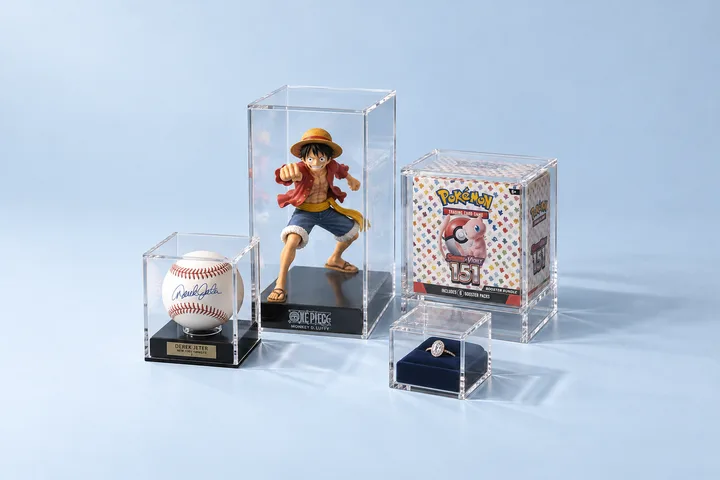
The same classes apply outside museums: a signed jersey or leather ball in a sports memorabilia display case falls in the archival row, because dyed textiles and leather sit there.
Three things to verify when a supplier quotes a UV transmission number: the wavelength range (300-400 nm is the conservation-relevant band, not just “below 380 nm”), the test method (most reputable suppliers reference ASTM D1003 or equivalent spectrophotometric measurement), and whether the value is for a virgin sample or after the supplier’s own accelerated aging. A virgin transmission below 5% that drifts to 12% after 5 years of UV exposure is a museum-grade case that turns into a commercial case in the back half of its design life.
Anti-Reflective Coating — When Coating Beats Untreated Polished Acrylic
Polished cast acrylic on its own is already optically excellent — roughly 92% light transmission with about 8% surface reflection split across the two air-acrylic interfaces. That 8% reflection is the visible glare you fight in any glass-fronted vitrine. Anti-reflective hard coat drops specular reflectance below 1% per ASTM E1331 specular gloss methodology3, at the cost of roughly 4% absolute light transmission — so AR-coated acrylic typically transmits around 88% versus untreated 92%.
That tradeoff is where curators have to make a deliberate decision. In a low-lux conservation gallery — 50 lux, indirect ambient with a single spot on the artifact — the 8%-to-1% reflection drop is the difference between a visitor seeing the artifact and seeing themselves. The 4% transmission cost is invisible because the eye can’t distinguish 88% from 92% at that brightness. AR is the right call. In a brightly lit retail-adjacent display — 500 lux, daylit storefront, vibrant artifact colors — the 8% reflection isn’t visually intrusive at high ambient, and the 4% transmission drop noticeably dims a vibrant piece. AR is usually the wrong call.
How to check AR coating durability before you commit
Three standard adhesion and abrasion tests to specify — and to ask a supplier to demonstrate on a sample — before an AR coating goes into a museum case build:
Tape peel test. Apply 3M 600 cellulose tape to the coated surface, press flat, peel at 90°. A museum-grade hard coat shows zero coating transfer onto the tape. A weak AR coating that will lift in cleaning will shed visibly on the first peel.
Cross-hatch abrasion test. Score a 1 mm grid through the coating with a calibrated cross-hatch cutter, then run the tape peel over the grid. ASTM D3359 grades adhesion 0B (worst) to 5B (best); museum-grade coatings should test 4B or 5B, and anything at 3B or below is worth rejecting. A related method, ASTM D1044 (Taber abrasion), is the reference for how much a hard coat hazes under repeated rubbing.
Cleaning chemical exposure. Apply isopropyl alcohol and a microfiber cloth in 50 wipe-cycles. The coating should show no haze, no streaks, no visible thinning. Curators clean cases regularly; an AR coating that fails at 50 wipes will be visibly degraded inside 12 months of normal exhibition use.
If a supplier quotes AR coating without naming the test references and the durability data, the coating is decoration, not a conservation spec. Ask for the cross-hatch grade and the peel-test result before you accept the quote.
Material Inertness — the Oddy Test Decides What Shares the Air
Nothing inside the enclosure may emit vapors that attack the object. The museum screen for this is the Oddy test: a sample of the candidate material is sealed for 28 days at 60 °C and high humidity with silver, copper and lead coupons, and any coupon corrosion keeps that material out of the case.4
The acrylic sheet is the easy part. Cast PMMA is stable at room conditions and widely accepted as glazing. The failures I see in quality review come from what is attached to it: solvent cement closed into a case before it has cured, rubber gaskets that sulfur-tarnish silver, wool felts, off-the-shelf paint on a deck, and MDF plinths hidden under laminate. Write the standard around components: adhesives cured and aired before enclosure, gaskets from conservation-accepted polymers, liners from tested stock, and no composite wood inside the sealed volume. If your institution runs an Oddy program, send us the pass list and my team checks the build against it line by line; if not, we build only from materials with published conservation acceptance.
Cure time belongs on the schedule. Solvent-bonded joints release vapor for days, so we stage museum cases in open racking to air before gaskets close the volume. That is one reason a gasketed conservation case takes the full 15–20 day production window even when the geometry looks simple.
Climate-Sealed Base — Humidity Buffering for Sensitive Collections
The base of a conservation case is an engineered enclosure, not just a pedestal. Whether a conditioned sorbent can hold the conservator’s target depends on enclosure leakage, sorbent type and conditioning, sorbent mass, internal volume, ambient temperature and RH, access frequency, and the permitted band. The case provider should not publish a universal service interval without those inputs.
Have the project’s qualified conservator or environmental specialist define the test conditions, acceptance band, duration, sensor accuracy, ambient profile, access cycle, and reporting method. A test result is valid only for the stated finished enclosure and conditions; a gasket, sachet, or conceptual drawing is not proof of climate performance.
Dust cover, gasketed case or microclimate
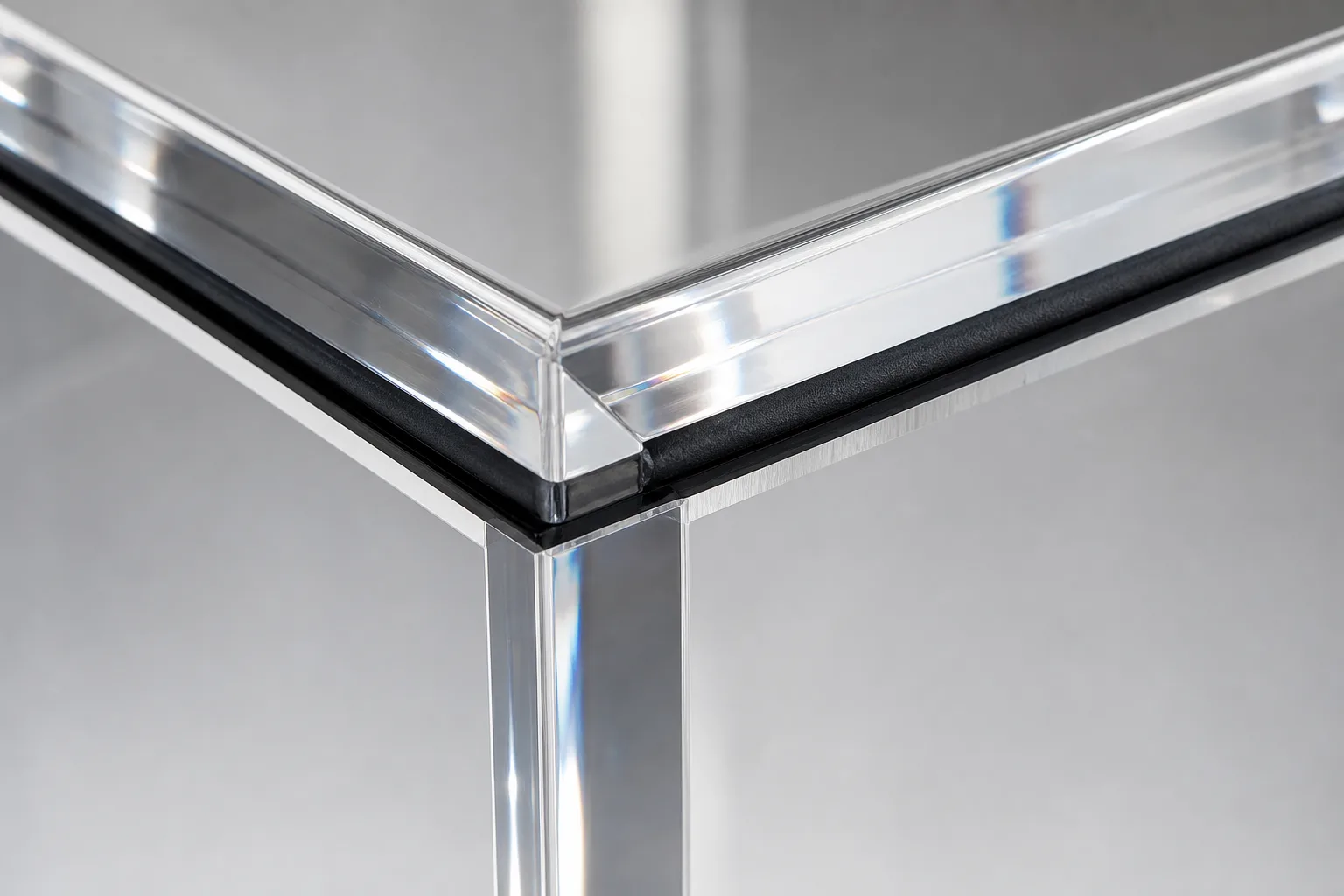
Name the sealing level, because most cases sold as “sealed” are dust covers and the three builds differ in cost and in what the museum must do after delivery. A dust cover, a five-sided hood over a base, keeps out handling, dust and pests, which is enough for stable ceramic, stone and most metal. A gasketed enclosure adds compressed gasket lines at every joint and a sealed cable path, so interior conditions drift slowly. A microclimate case adds a concealed conditioning chamber with its own access panel, so sorbent can be serviced without lifting the hood off the object.
The fabricator delivers the envelope; the conservation team owns the climate, including setpoint, sorbent conditioning and monitoring. Before shipment we verify the mechanical side: continuous gasket compression along every edge, an accessible chamber and no light leaks at the seams.
What the spec sheet should call out
The spec sheet should let the conservator verify at least these items at receiving:
- Cassette capacity in kg of conditioned silica gel (not “humidity buffered” without quantity).
- Internal case volume in liters (so the conservator can calculate buffer ratio independently).
- Tested hold time under the project’s stated ambient and access conditions, including sensor accuracy and recorded drift.
The reason this matters: a “humidity-controlled” case with a token sachet of silica gel under the artifact platform is not a buffered environment — it’s a dehydrated cookie. A real buffer is a sized, conditioned, accessible cassette with a gasket the cassette can actually rely on. Conservators servicing the case need to be able to remove and recondition the cassette without dismantling the artifact mount, so the cassette housing should be a base-access compartment with its own gasket — not an interior tray.
For broader manufacturing-process questions, our quality control and certifications page shows what our ISO 9001 certificate and inspection process cover.
Mount System — Invisible vs Visible Mounts for Curators
The artifact mount is where conservation engineering meets exhibition design, and it’s the spec layer where curators have the most aesthetic flexibility — provided the underlying material rules hold. Two non-negotiables: no adhesives in contact with the artifact (off-gassing plasticizers can shift pigments and degrade fibers over decades), and no ferrous metal in direct contact with metallic or magnetically sensitive artifacts.
Within those rules, three mount approaches each carry their own visual and conservation tradeoffs.
Polymer rod mounts (typically PMMA or polycarbonate). Clear acrylic rods threaded through the artifact’s natural openings (textile loops, ceremonial-object handles, mount points designed in by the artist) carry the artifact without adhesive contact. Visually nearly invisible from the gallery viewing angles, archivally inert, fully reversible. The default approach for textiles, ceremonial objects, and garments. Cost: moderate, mostly fabrication labor.
Magnetic mounts. Rare-earth magnets recessed into the case base couple to a soft-iron mounting plate hidden under the artifact (or, for ferrous artifacts, directly to the object). Useful for flat artifacts that need to stand vertically — historical documents in folio mounts, photographs, illuminated pages. Conservation-acceptable when the magnetic field strength is below the threshold for the artifact’s material sensitivity (negligible for paper, textile, organic materials; verify for any artifact with magnetic media or specific metallic content). Cost: higher than polymer rods because of magnet quality requirements.
Adhesive-free gravity mounts. Custom-machined cradles in PMMA or museum board hold the artifact in stable repose under its own weight, with no fixings at all. The right answer for heavy ceremonial bronzes, ceramic vessels, and stone artifacts where a custom cradle distributes weight across multiple contact points padded with conservation-grade fabric. Cost: variable, dominated by cradle machining time.
Deck stiffness and vibration
The object’s weight should spread across a designed, padded contact area with no point loads and no contact with the glazing; collection-care references such as the NPS Museum Handbook treat support as part of exhibit planning.5 In acrylic that means stepping the deck to the span: a 3 mm shelf that is fine at 200 mm visibly deflects at 600 mm, so museum builds move to 8–10 mm or add a concealed rib before a sag can tilt the object toward the glazing. Cradles and ring mounts are CNC-cut to the object’s measured profile at ±0.2 mm, then faced with conservation-accepted padding. Near foot traffic, loading docks or on upper floors, a shallow profiled recess keeps an object from walking under vibration better than a flat deck does; I flag any drawing where a top-heavy object stands free on smooth acrylic.
What I tell curators when a quote comes back with “adhesive-mounted” anywhere in the line items: send it back. Adhesive on or near the artifact is a category mismatch with museum-grade specification, regardless of how clean the rest of the case looks. For colored acrylic mounting frames designed to display fine art without adhesive contact, see our colored acrylic floating frames case study for an analogous approach in a gallery context.
Traveling Exhibit Cases — the Standard Is Repeatable Assembly
A touring case must dismantle, pack, ship and reassemble identically at every venue, put together by a different crew each time with no fabricator present. That replaces permanent solvent bonds with keyed, mechanically fastened joints that only fit one way. Fasteners are captive or bagged and labeled per panel, gasket surfaces must compress and release repeatedly without taking a set, and panel edges get crate protection, because a chipped edge at venue two is a failed case for the rest of the tour. Numbered panels and a one-page assembly sequence ship in the crate, and fastening is torque-light so nobody cracks a panel driving a screw home.
Before crating a touring case we run a full assemble-and-strike cycle on the factory floor. The buyer or appointed conservator still defines the material evidence, handling sequence and venue approvals. Our regional museum traveling exhibit case project shows how those decisions were recorded on a delivered, non-electrical order; it does not claim archival-grade status or validated conservation performance.
Cost vs Longevity — Build the TCO From Quoted Evidence
A conservation case may cost more upfront than a commercial enclosure, but no universal case price, replacement interval, or 50-year service life should be inferred from the label. Build the comparison from the supplier’s quote and the component evidence accepted by the conservator.
Include initial case cost, replaceable seals or filters, monitoring equipment, sorbent reconditioning, cleaning limits, access labor, inspection, expected component replacement, relocation, and the consequence of failing the artifact’s approved environment. State the analysis period as a buyer assumption rather than a promised product life.
For custom acrylic case configurations, see our acrylic display cases overview. A fabrication quote should not be treated as conservation approval.
Putting the Spec Stack Into Your RFQ
When you write the RFQ for museum display cases, the spec stack should appear as explicit line items with measurable thresholds, not as a single “museum-grade” descriptor.
- UV transmission target — name the percentage and the wavelength range (e.g., “UV transmission below 2% across 300-400 nm”).
- AR coating target — name the reflectance threshold and the test method (e.g., “specular reflectance below 1% per ASTM E1331”).
- Humidity buffer target — have the conservator name the RH band, ambient assumptions, access cycle, monitoring method, test duration, and maintenance plan.
- Mount system constraint — name what’s not allowed (e.g., “no adhesive contact with artifact; polymer rod, magnetic, or gravity-cradle mounts only”).
- Materials — “all interior components Oddy-pass or conservation-accepted; solvent joints cured and aired before enclosure”, plus the sealing level (dust cover, gasketed, or microclimate-ready).
- Touring (if any) — keyed dismountable construction and an assemble-and-strike check before crating.
Suppliers who quote against that RFQ language with matching specifications and named test methods are the suppliers who can actually deliver against the full stack. Suppliers who push back on naming the numbers, or who quote “museum-grade” without committing to the thresholds, are quoting marketing language. The RFQ is where the curator decides which is which.
We fabricate large display cases and full exhibit-case programs from UV-filtering and standard cast acrylic, with the quote split per case by sensitivity class. If you are scoping a project, send us the artifact dimensions, approved requirements, and required evidence. We will confirm which fabrication items can be quoted; conservation approval and any specialist environmental validation remain with the buyer’s qualified team.
Related guides
- Clear Acrylic Box for Display vs Lidded Cases — When Each Wins
- Acrylic Sheet Thickness Chart: Standard 1.5mm–25mm
Footnotes
-
Smithsonian Museum Conservation Institute — Conservation and Care of Collections — the Smithsonian’s conservation institute publishes guidance on light, UV, and humidity thresholds for museum environments; the under-1% UV transmission threshold for conservation-grade displays of light-fugitive materials is consistent with their published recommendations for sensitive collections. ↩
-
Agent of Deterioration: Light, Ultraviolet and Infrared — Canadian Conservation Institute — CCI guidance documenting the 50-lux benchmark, the traditional museum rule keeping UV below 75 µW/lm, and typical UV loads of daylight (~600-1000 µW/lm) and daylight through window glass (~400-500 µW/lm). ↩
-
ASTM E1331 — Standard Test Method for Reflectance Factor and Color by Spectrophotometry Using Hemispherical Geometry — the ASTM test method we reference for specular reflectance measurement on AR-coated acrylic; required for verifying that AR coating performance is below the 1% reflectance threshold quoted in museum-grade specifications. ↩
-
Oddy Test — AIC Conservation Wiki — the museum materials-screening protocol: a sample sealed with silver, copper, and lead coupons at 60 °C and high humidity for 28 days, with coupon corrosion indicating the material is unsafe near collection objects. ↩
-
Museum Handbook — National Park Service — the NPS reference for collection-care practice behind exhibit-case requirements, including object handling and exhibit conservation planning. ↩
Frequently Asked Questions
What does "museum-grade" actually mean for an acrylic display case?
Museum-grade is a spec stack, not a single property. At minimum it means UV transmission below 5% across 300-400 nm, anti-reflective coating with surface reflectance below 1%, a sealed base capable of holding 45-55% relative humidity with a silica-gel cassette, and adhesive-free mounting (polymer rods or magnetic fixings) so no off-gassing reaches the artifact. Any supplier using the term without naming those four numbers is using it as marketing language, not as a verifiable spec.
How is museum-grade acrylic different from regular cast acrylic?
Optically, museum-grade acrylic is cast PMMA with two added layers — a UV-blocking additive or laminate that holds transmission below 5% across the damaging 300-400 nm band, and a hard-coat anti-reflective treatment on the viewing surfaces. Mechanically it's the same cast PMMA, so it polishes and bonds the same way. The difference shows up in the measurable numbers: delta-E color shift under accelerated UV exposure (weathering methods such as ASTM G155), and percent specular reflectance measured per ASTM E1331.
When does anti-reflective coating actually beat untreated polished acrylic?
AR coating wins whenever ambient light is low or directional and the artifact is dark or visually quiet. In a 50-lux gallery with spot-lit objects, dropping reflection from 8% to under 1% is the difference between seeing the artifact or seeing your reflection. AR loses when ambient light is high and the artifact is bright — a 4% absolute drop in transmission from coating absorption can dim a vibrant piece. Specify AR for dim galleries, archival storage, and dark-toned artifacts; skip it for retail-bright displays of bright-colored work.
How long does the humidity buffer in a sealed museum case actually last?
There is no universal interval. Hold time depends on enclosure leakage, sorbent type and conditioning, sorbent mass, case volume, ambient temperature and RH, access frequency, and the permitted band. Have the conservator define the target and require a finished-system test and monitoring plan under stated conditions.
Are museum display cases worth it for objects without curatorial-grade value?
Treat this as a conservation-risk decision, not a generic price comparison. A qualified conservator should define the acceptable light, material, pollutant, humidity, access, and mounting conditions for the specific object. Compare suppliers on documented compliance with that specification and on maintainability, not a universal case life or annualized-cost claim.
What is the Oddy test and does acrylic pass it?
The Oddy test is the museum world's accelerated corrosion screen: a material sample sealed for 28 days at 60 degrees Celsius with silver, copper and lead coupons. If the coupons corrode, the material off-gasses and stays out of the case. Cast acrylic sheet is widely accepted for display glazing; the components to check are adhesives, gaskets, paints and fabric liners.
What should a traveling exhibit case specification include?
Dismountable construction with keyed joints that only assemble one way, captive or bagged hardware, gasket surfaces that survive repeated assembly, edge protection for transit and labeled packing. The test is repeatability: venue four should get the same case as venue one, assembled by a different crew without a fabricator on site.
Specifying a museum-grade case for your collection?
Send the artifact dimensions, materials, conservator-approved environmental targets, gallery lighting, access needs, and required test methods. We will confirm which fabrication requirements can be quoted and which performance evidence must come from the material or system provider.