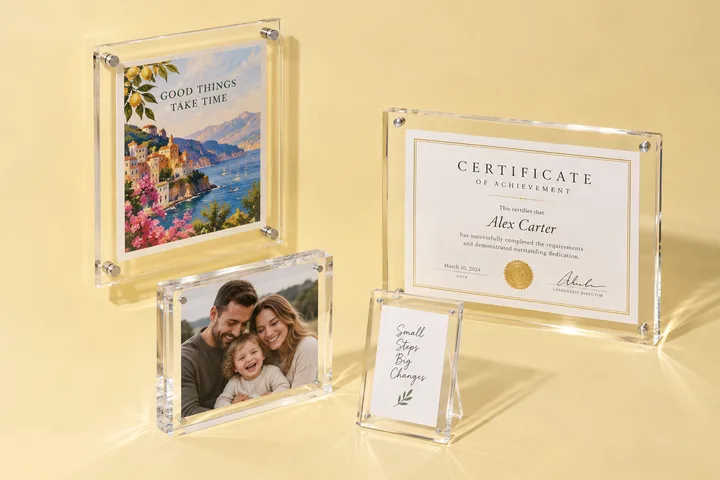

Clear Acrylic Box for Display vs Lidded Case
An open acrylic box and a lidded case solve different access, closure, and packing requirements. Define the form before the RFQ is locked.
Need this made?Custom acrylic display cases →
Key Takeaways
- 'Box' and 'case' are often used interchangeably in RFQs, but an open five-panel box and a six-panel lidded case require different hardware, access, inspection, packing, and pricing.
- An open clear acrylic box for display is strongest when staff need frequent access and the item is attended in a controlled, low-dust environment.
- A lidded case becomes more defensible as dust exposure, unattended hours, item value, or theft consequence increases. A lock is a separate decision from adding a lid.
- Price the hinge, latch or lock, joint or gasket, panel thickness, and packing separately. Hardware and assembly can materially change the quote, but there is no universal percentage.
- Do not use generic online unit-price bands for a custom case decision. Compare both forms at the same dimensions, material, quantity, finish, packaging, destination, and Incoterm.
On this page
Clear acrylic box for display vs lidded case
100 pieces per design is the MOQ; a separately paid sample takes 3–5 days, production takes 15–20 days, and 3–5 mm clear acrylic with ±0.2 mm as the standard working tolerance for named critical dimensions remains subject to the approved drawing.
| Exact reference point | Commercial basis | Source and limit |
|---|---|---|
| 150 × 100 × 100 mm, 3 mm clear acrylic, magnetic lid, 500 pieces | From $6/unit FOB Shenzhen | Acrylic cases hub — low-end reference for this exact spec only, not a universal case quote |
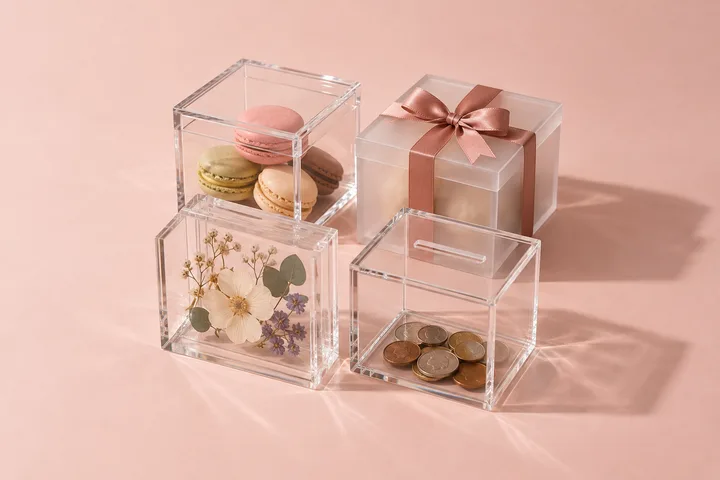
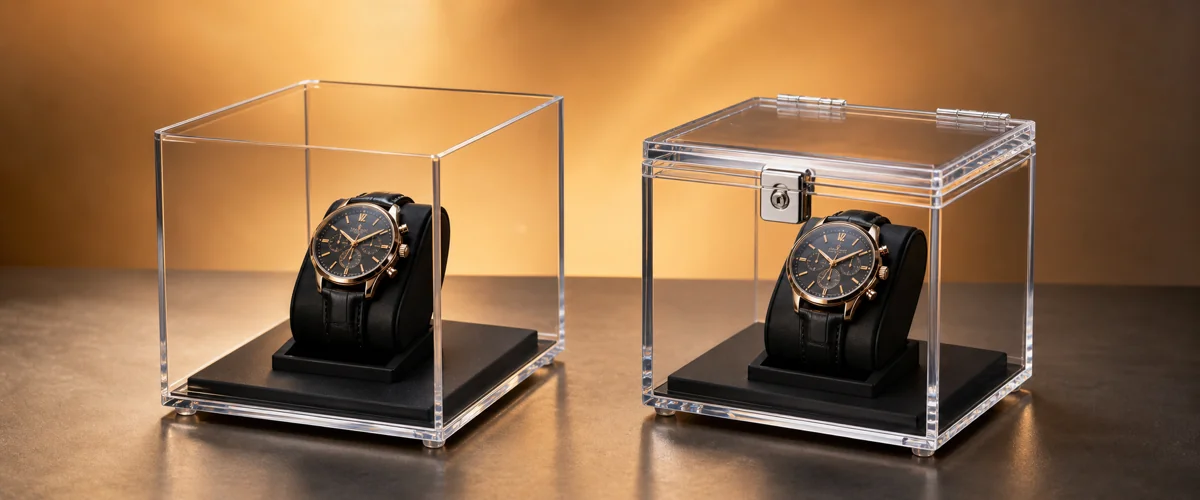
Buyers asking for a “clear acrylic box for display” may mean an open box or a lidded display case. An open box is usually five bonded panels with the top open. A lidded case adds a hinged or removable sixth panel and may add closure hardware or a specified lid interface. The two forms cost differently, ship differently, and behave differently in the field. Lidded box formats are on the clear acrylic box page.
Buyers often use “box” as a general word for a transparent enclosure. A fabricator needs to translate that into an open five-panel form or a lidded six-panel form before pricing. The distinction matters because the lid, hinge, closure, seal, access workflow, and packing change the build. This guide is the translation layer. For lidded case builds, see our custom acrylic display cases.
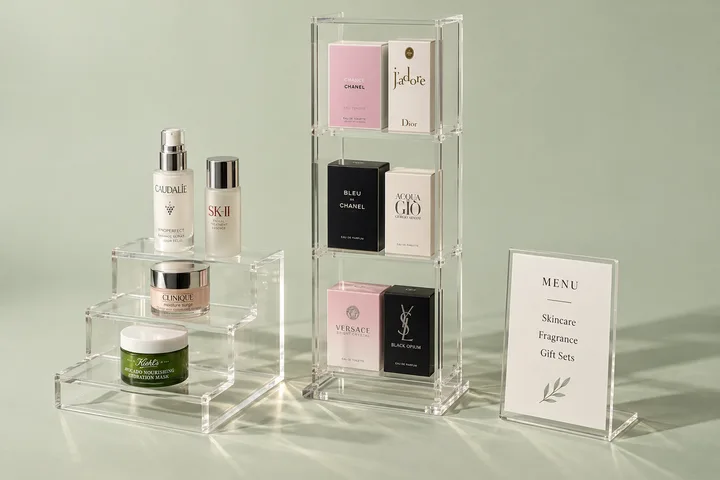
Same merchandised item, two form factors. The vocabulary buyers reach for is “box”; the form most B2B retail use cases need is “case.” Bridging that gap is what this guide does.
The simplest way to break the vocabulary deadlock is to look at the merchandised item. Six decision points — dust exposure, theft risk, accessibility frequency, item value, display environment, and unit cost ceiling — create a useful comparison record before the supplier prices the build.
Box vs Case: 6-Decision-Point Matrix
| Decision point | Open box wins when… | Lidded case wins when… | Verdict driver |
|---|---|---|---|
| Dust exposure | Display sits in low-dust retail floor, restocked weekly | Display sits in HVAC return zone, public lobby, or open trade-show booth | Environment |
| Theft risk | Behind-counter, attended, low-unit-value SKU | Unattended overnight, mall corridor, high-unit-value SKU | Attendance |
| Accessibility frequency | Staff handles item daily — restock, rotate, demo | Item is replaced monthly or less; access is the exception, not the rule | Workflow |
| Item value | Low replacement consequence | High replacement consequence | Loss tolerance |
| Display environment | Indoor, climate-controlled, controlled retail floor | Outdoor-adjacent, public space, or unsupervised after hours | Exposure |
| Unit cost ceiling | Quote favors simple open construction | Quote supports lid, closure, and added assembly | Spec headroom |
Read the matrix as a discussion record, not an automatic score. If access and the deployment environment consistently favor the open form, quote an open box. If exposure, unattended use, or removal consequence favors a barrier, quote a lidded case and specify the closure separately. Mixed signals belong in a side-by-side quote at the same dimensions and quantity. For a related decision frame on the chemistry (cast vs extruded vs polycarbonate, before form factor), see our cast acrylic vs PETG vs polycarbonate guide.
When an open box is sufficient (and when it bites you)
An open clear acrylic box for display is a strong fit for low-consequence, high-handling, attended merchandising. The form is simpler and often costs less than a comparable lidded case, but the actual gap depends on dimensions, material, quantity, finish, hardware, packing, and freight.
Staff workflow is one useful signal. A confectionery retailer may rotate promotional SKUs often and restock during peak periods; a lidded case adds an opening step to every restock. The same reasoning applies to fast-rotating shelf merchandising, sample bowls, point-of-sale impulse displays, and applications where the item is designed to be touched. For adjacent evidence on repeated retail fabrication and store deployment, see our shelf-edge sign holders supermarket case study; it is not an open-box case study.
An open box is exposed to the environment and gives direct access to the item. If dust, unattended hours, or the consequence of removal is material, include a lidded option in the RFQ and compare it against the open form. For conservation applications, do not infer performance from a retail lid; see our museum-grade acrylic display cases UV spec guide for the additional evidence required.
Do not assume the open box is sufficient on cost grounds alone. Run the matrix and price both forms when item loss, dust damage, or unattended access would be material. The cost ceiling belongs at the bottom of the decision, after the deployment risk is clear.
Lidded case features — hinge, latch, lock, dust-seal
A lidded display case is not one product — it’s a small spec family separated by four hardware decisions: hinge type, latch type, locking mechanism, and lid interface. Each can materially change fabrication and assembly cost, so calling them out separately is the cleanest way to compare quotes.
Hinge type. A friction hinge can hold a manageable lid open at an angle. A piano hinge distributes support along a long edge and may suit longer lids where localized hinge loading or visible sag is a concern. Quote the selected part, installation method, cycle requirement, and lid load; do not choose from a generic unit-price band.
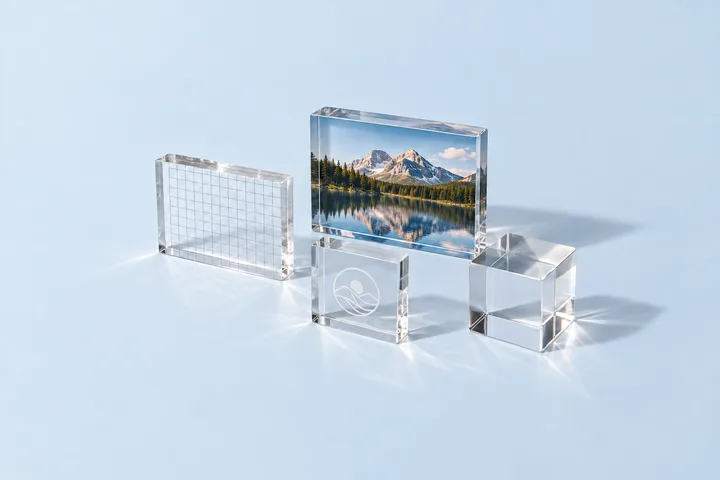
Latch type. Magnetic latches provide closure but not controlled access. Cam locks add key management and can slow restocking, so use them only when the threat model requires a lock. Dust-seal interface. A raw butt joint leaves a direct path at the lid interface; a recessed step interrupts that path; a gasket can add a more controlled interface when compression is designed and verified. Do not call any option “near-airtight” or conservation-grade without a documented test. For a related buyer-checklist read on case-grade specs, see our hub at acrylic cases, and for the structural-block alternative form, see acrylic blocks.
The pattern that makes case-grade hardware decisions tractable: write the hinge spec, the latch spec, and the lid-interface spec as three separate lines on the RFQ, not as a single “lidded case” line item. Suppliers can then identify which feature changes cost. ASTM D7901 provides a flexural test method relevant to PMMA panel comparison, while published hardness data can inform surface-material selection.2 Neither source establishes a universal case-height, thickness, hinge-cycle, or service-life rule; the approved drawing and production-representative sample control those decisions.
Cost vs longevity — when each wins on TCO
The total-cost comparison between an open box and a lidded case should include more than the upfront unit price. Use your own operating data for cleaning frequency, item loss, replacement rate, restocking time, keys, field shipping, and installation labor. Wetop does not have a published cross-buyer shrinkage or service-life dataset that can support universal percentages.
Ask the supplier to quote open, lidded, and locking versions at the same dimensions, material, finish, quantity, packing, destination, and Incoterm. Then add the buyer-owned operating costs and model at least a low- and high-risk scenario. For the broader cost framework on B2B custom acrylic, our custom POP displays design and cost guide covers the cost stack across form factors.
Spec sheet template — pick the right one in 3 questions
Three questions on the RFQ separate the open clear acrylic box for display from the lidded display case cleanly enough that we don’t need a long discovery call to price the project. The answers also drive the hinge, latch, and dust-seal decisions one layer down. Send these three on the first email and we’ll quote the right form on the first reply.
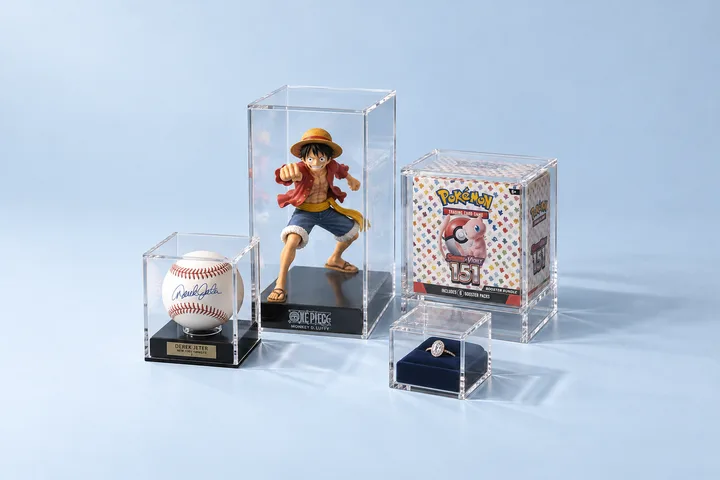
Question one: what is the merchandised item, and what is the consequence if it is exposed, damaged, or removed? Name the item (“graded trading card slab,” “premium fragrance tester bottle,” “promotional gift set,” or “boxed confectionery”) and describe the replacement or operational consequence. Do not convert retail value into a universal box-or-case threshold. Question two: is the display attended or unattended? Describe who can access it during operating hours and what happens after hours. Attendance informs the barrier and closure decision, but it does not by itself prescribe a lid or lock.
Question three: what is the dust environment? Describe HVAC airflow, public exposure, cleaning method, restocking frequency, and any food-service or conservation constraints. These conditions help decide whether to compare an open top, an overlapping lid, a recessed step, or a gasketed interface. They do not support a universal seal rating; request a test method when performance is critical. With those three answers we can quote the relevant form, hinge, closure, and lid interface without inventing fixed value or thickness thresholds.
If your RFQ subject line still says “clear acrylic box for display” but the answers point to a case, that’s fine — we translate the vocabulary on our side. Quote: send the item, dimensions, 3–5 mm material choice, named critical dimensions, access context, closure, quantity, packing, destination, and Incoterm through our intake form for a project-specific quote. Paid Sample: the 3–5-day sample is separately paid and never credited against the bulk order; bulk production is normally 15–20 days after the drawing and sample are approved. MOQ is 100 pieces per design, and the ±0.2 mm standard working tolerance applies only to named critical dimensions accepted on the approved drawing. The acrylic boxes hub shows open formats before you submit the brief.
Related guides
- Museum Display Cases: Anti-Reflective + UV Spec Guide
- Large Lucite Boxes — When ‘Lucite’ Branding Matters and When It Doesn’t
Footnotes
-
Cast PMMA flexural modulus ~3.1 GPa, the flexural property measured under ASTM D790 (AZoM material data) — materials-science reference showing the cast-PMMA flexural stiffness that sets the structural floor for case body and lid panels. ↩
-
PMMA acrylic Rockwell M hardness data (MakeItFrom) — material-property reference for comparison only; it does not establish hinge-cycle or visible-wear performance for a finished lidded case. ↩
Frequently Asked Questions
What's the difference between a clear acrylic box for display and a lidded display case?
5 panels make the usual open box: a base and four walls. A lidded display case adds a hinged or removable sixth panel and may add a latch, lock, or specified lid interface. Quote them as separate constructions because access, hardware, inspection, packing, and cost change with the approved design.
Which one is better for retail merchandising — open box or lidded case?
2 workflow questions lead the decision: how often staff need access and what happens if the item is exposed or removed. Open boxes favor frequent access in attended settings; lidded cases add a physical barrier. Compare both at the same dimensions, material, quantity, packing, destination, and Incoterm.
Do I need a lock on my lidded acrylic display case?
1 magnetic latch can keep a lid closed, but it is not a security control. A keyed cam lock may suit an unattended display or a higher removal consequence, while adding key management and access time. State the threat model and restocking workflow, then request latch and lock options separately.
How do I write the RFQ if I'm not sure whether to spec a box or a case?
7 inputs are enough to compare forms: item, dimensions, replacement consequence, access frequency, attended or unattended use, dust environment, and quantity. Ask for open and lidded options side by side; each quote should name material, thickness, joint, closure, packing, and transport assumptions.
What thickness should I spec for either form?
3–5 mm clear acrylic is the starting range for the examples in this guide, not a universal structural rule. Final wall, lid, and base thickness depends on span, load, hinge geometry, handling, and packaging. Put named critical dimensions and the agreed tolerance on the approved drawing; use the [acrylic thickness guide](/guide/acrylic-thickness-guide/) as a calculation method, not a substitute for engineering review.
Compare an open box and lidded case with a paid sample.
Send the item, dimensions, access workflow, closure, quantity, packing, and destination. The 3–5-day sample is paid separately and its fee is never credited to production.