Custom POP Displays: Types, Design and Cost
A $12 endcap display and a $120 endcap display can look identical in a photo.
Need this made?Acrylic display manufacturer →
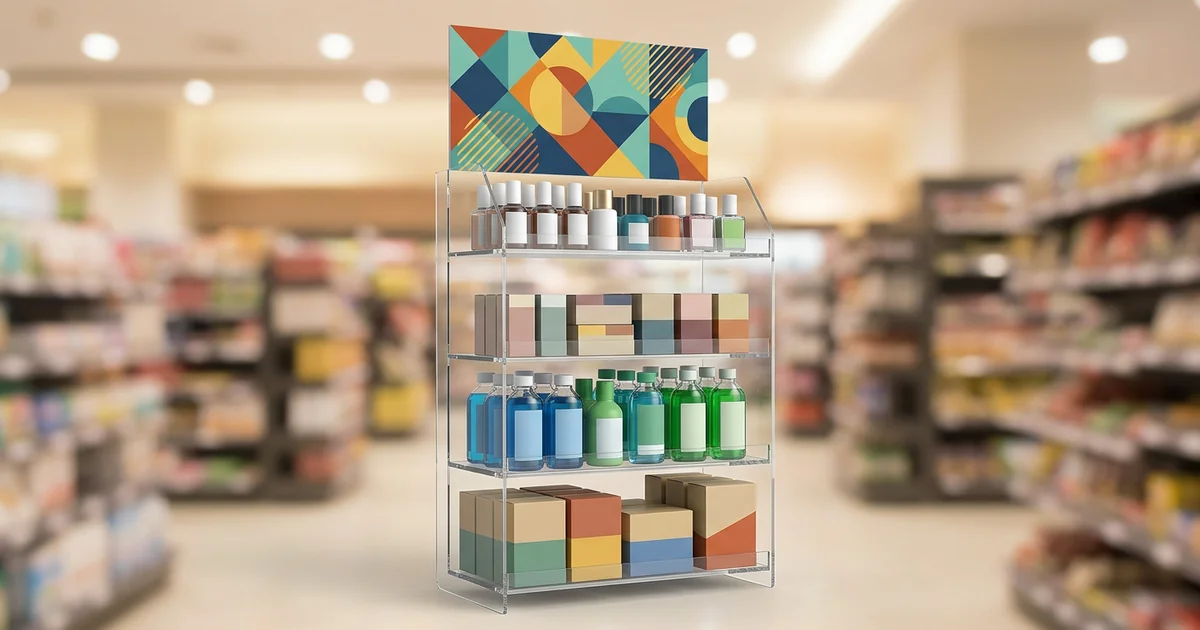
Before you ask for quotes, settle where the display stands, what it holds, how long it stays in store and how many stores get one; those answers pick the type, the material and most of the cost.
Key Takeaways
- POP display unit cost spans 8x from $15 corrugated counter units to $120+ premium acrylic endcaps — material, graphics, and MOQ are the three biggest levers, not size.
- The five formats that cover 90% of CPG POP work: floor-standing freestanding, endcap, counter PDQ, pallet, and clip-strip — each serves a distinct shopper-intercept moment.
- A custom acrylic POP display lasts 2–5 years in retail; corrugated cardboard lasts 4–12 weeks. Match material to campaign duration, not just budget.
- MOQ for custom acrylic POP starts at 100 units at Wetop; corrugated requires 500–1,000 to make sense economically — this single variable often decides the material.
- Lead time from approved design to US delivery is 30–45 days for custom acrylic POP; plan your retail launch backward from the on-shelf date, not the order date.
On this page
What Are Custom POP Displays?
Custom POP displays are point-of-purchase fixtures built for one brand’s product and placement: a countertop unit at the register, a floor stand in the aisle, an endcap, or a shelf-edge sign. They put the product where the shopper decides, in the brand’s colors and at the size the retailer allows. Unit cost spans $15 to $120+ depending on format, material, graphics and quantity.
“POP” and “POS” are used loosely. Strictly, point of sale means at or near the checkout counter1, while point of purchase covers anywhere in the store where a buying decision happens. Retail buyers and suppliers often use the two terms interchangeably.
The biggest mistake I see CPG brand teams make isn’t overspending — it’s specifying the wrong material for the campaign duration, so the display either looks tired before the promotion ends or carries permanent-fixture cost for a 6-week promo. This guide covers the research side: types, design decisions, cost drivers and timeline, with real cost ranges so you can benchmark quotes before you receive them. If you are ready to source a program, our POP and POS display application page covers what we build and how rollouts are quoted, and our custom acrylic display stands show the formats and published prices.
Types of POP Displays
Five POP display formats cover roughly 90% of the custom retail POP work we fabricate: freestanding floor displays, endcaps, counter / PDQ displays, pallet displays and clip strips. These format definitions align with the POP display categories used by the Shop! Association2, the trade body for retail and shopper marketing. Decide placement and product load first; material comes after.
| Type | Where it goes | Typical size | Typical custom cost / MOQ |
|---|---|---|---|
| Freestanding floor display | Aisles, entry zones, open floor | 3–6 ft tall | $40–$120 in acrylic with full-color graphics, MOQ 100 |
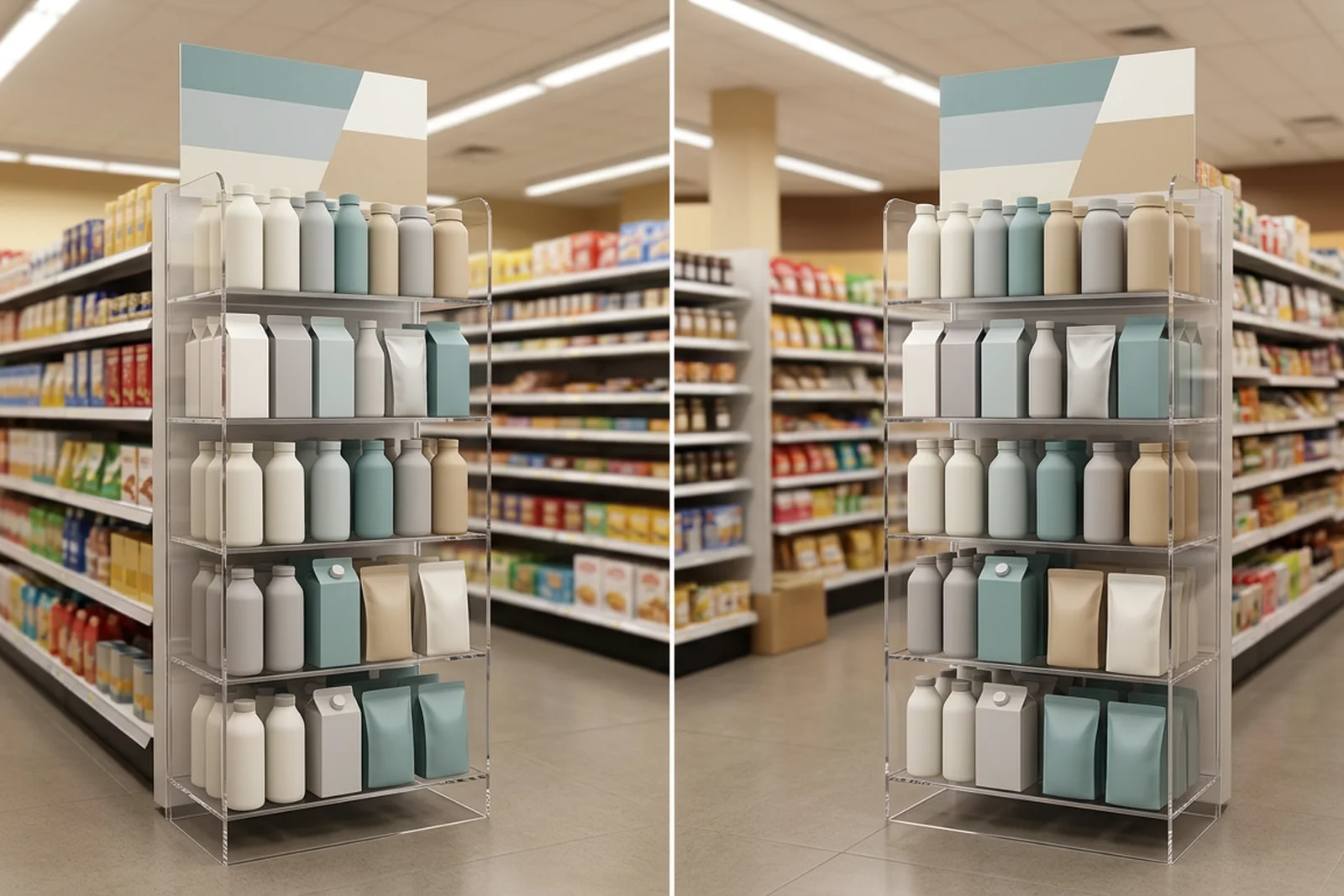
| End cap displays | End of a shelf run | 3–4 ft wide, 3–5 tiers | $60–$150 in acrylic, MOQ 100 |
| Counter / PDQ display | Checkout, pharmacy or service counter | 12–18 in tall | $15–$45 in acrylic, MOQ 100 |
| Pallet display | Warehouse clubs | Pallet footprint, branded surround | $8–$30 per corrugated surround, MOQ 500+ |
| Clip strip | Shelf edge near a related category | Narrow strip, 6–12 items | $3–$12, MOQ 500+ |
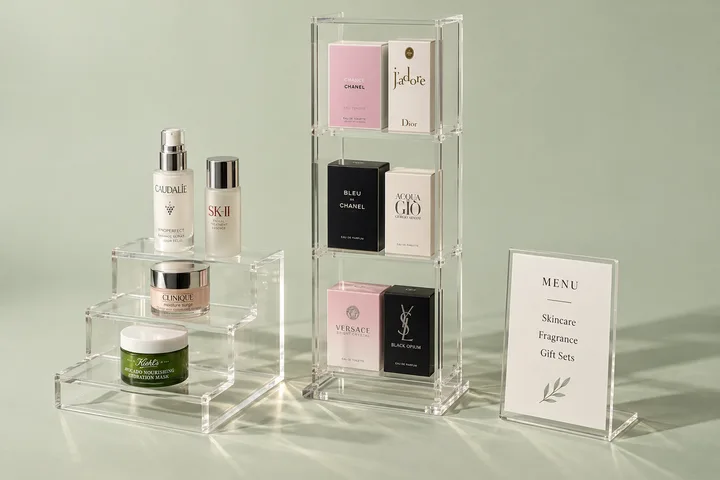
Shelf-edge sign holders and shelf talkers are often counted as a sixth type. Wetop builds the acrylic formats: countertop stands, tiered risers, floor and endcap components, sign holders and shelf-edge parts. For the countertop format in more depth, see our countertop display buyer guide. If your floor format is a graphic standee rather than a product-loaded fixture, our acrylic standee manufacturer verification guide covers footprint stability and flat-pack freight.
POP Display Design: Decisions That Drive ROI
Good POP display design starts with the store, not the artwork. These are the decisions I ask a brand team to settle before they request quotes, because each one changes the drawing.
- Footprint and height the retailer allows. Counter space and aisle clearance are set by the store, not by the designer. Get the maximum footprint in writing.
- Product load. Count the SKUs, facings and units per facing, and weigh a full load. Shelf spacing, sheet thickness and base size follow from this.
- Clarity at 10 feet. The display has to communicate before the shopper is close enough to read body copy. Build an information pyramid: brand mark (2-foot read), category identifier (6-foot read), product hero image (10-foot read), then the promotional message at stopping distance. Shopper-marketing research bodies such as the Path to Purchase Institute3 publish ongoing data on this in-store behavior.
- Brand system continuity. Use the same color system, type and visual voice as the packaging and the rest of the launch. A display that looks like it came from a different agency than the packaging cuts conversion measurably, because shoppers don’t connect it to the brand they’ve seen elsewhere.
- Product as hero. Over-designed POP that competes with the packaging for attention reduces conversion; good POP frames the product without fighting it.
- Restocking, cleaning and shipping. Store staff refill and wipe the display, so open fronts and reachable back rows matter. Decide assembled versus knock-down shipping before the drawing is final.
For acrylic displays, printing method is part of the design: UV printing handles full-color artwork directly on the acrylic, while screen printing suits solid spot colors. Our display stand branding methods guide compares them, and for beauty and prestige categories the cosmetic display design guide goes deeper.
Corrugated vs Acrylic vs Metal vs Wood
Choose the material from how long the display stays in store. Corrugated suits 4–12 week promotions and pallet surrounds; it ships flat and is widely recycled, with corrugated boxes recycled at 96.5% in the US in 2018 according to the EPA4. Acrylic suits 3-month to 5-year programs; metal and wood suit permanent fixtures. Supplier-retailer collaboration frameworks such as those published by the Retail Industry Leaders Association5 shape how these choices are made at major US retailers.
| Material | Typical unit cost | MOQ | Service life | Good for |
|---|---|---|---|---|
| Corrugated | $3–$15 (counter units) | 500–1,000+ | 4–12 weeks | Short promotions, pallet surrounds, test launches at volume |
| Acrylic | $15–$120 by format and size | 100 at Wetop | 2–5 years | Premium categories, endcap fixtures, boutique and regional launches |
| Metal | $100–$300+ | 100–500 | 5–10+ years | Heavy products, permanent fixtures, anti-theft |
| Wood / MDF | $80–$250 | 100–500 | Medium to long | Boutique, luxury beauty, craft spirits, artisan food |
Corrugated assembles in under 2 minutes and is designed to be recycled at the end of the campaign, but it degrades under moisture and rough handling. Acrylic is heavier to ship than corrugated and takes longer to make, but its 100-piece MOQ makes it viable for boutique and regional launches that corrugated MOQs exclude. Metal adds 10–15 days for custom tooling; wood carries moisture sensitivity and grain variation across units.
Acrylic displays are cleaned with a soft cloth and mild detergent; our acrylic display cleaning guide covers what to avoid. For the head-to-head decision between the two most common materials, read acrylic vs cardboard POP displays, and for finish choices within acrylic see clear vs frosted vs colored acrylic.
What Drives the Cost of Custom POP Displays
Six variables drive 90% of unit cost variance on custom POP display quotes: material, size, graphics method, assembly complexity, quantity tier and shipping origin. Since founding Wetop in 2008, I’ve watched buyers save 20–40% on the same quote just by understanding which levers to negotiate on — usually quantity tier or graphics complexity, rarely material once the durability requirement is set.
- Material is the largest single driver: corrugated $3–$15 per unit delivered for counter displays, acrylic $15–$120 depending on format and size, metal and wood $80–$300+.
- Size drives material cost linearly but fabrication cost non-linearly: a 6-foot floor display is often 3–4x the cost of a 3-foot one because of heavier bases, more assembly and higher dimensional freight weight.
- Graphics method: single-color silkscreen about $0.50–$2 per unit, full-color UV print $3–$12 per unit (see UV printing on acrylic), LED lighting work (LED channels, openings and diffuser panels built into the acrylic) $15–$60, plus the LEDs and driver you specify, built to your lighting spec.
- Assembly complexity: a simple 3-tier acrylic counter display might take 12 minutes of assembly labor; a 5-tier endcap with branded headers, an LED-lit base and locks might take 90 minutes.
- Quantity tier: unit cost drops at each threshold. Between 100 and 500 units the saving is typically 20–35%; between 500 and 5,000, typically 15–25%.
- Shipping origin: freight from China to US ports runs about $1–$4 per unit depending on display volume and container fill, roughly 5–15% of unit cost for small counter displays and 20%+ for large floor displays.
Our published reference for one named specification shows how quantity moves the price:
| Quantity | Published reference price (FOB Shenzhen) |
|---|---|
| 100 pieces | $28 each |
| 500 pieces | $16 each |
| 1,000 pieces | $12 each |
That reference is a 250 × 180 × 220 mm two-tier countertop stand in 5 mm clear acrylic with one-color UV branding and bulk packing; freight, hardware and individual packing are extra, and any other design is quoted in writing. Most acrylic displays carry no tooling or setup fee; where a complex custom part needs one, it is stated in the written quote. Our acrylic display stand cost guide and acrylic RFQ guide help you get accurate quotes on the first pass.
Timeline: From Brief to Store
Lead time from approved design to US delivery is 30–45 days for custom acrylic POP: a 3–5 day paid sample before approval, 15–20 days of production, then 10–18 days of ocean freight to US West or East Coast ports plus customs and inland transit. Air freight compresses transit to 5–7 days but costs 3–4x more per unit.
Metal POP adds 10–15 days for custom tooling and wood 5–10 days for milling and finishing; corrugated is fastest at 10–15 days of fabrication if designs are approved on the first pass. Plan backward from the on-shelf date. For an acrylic program on US shelves by June 1: warehouse arrival May 15 (14 days for distribution), production start April 10 (35 days including sea freight), final design approval April 3 (7 days for the sample), first RFQ around March 20. That is roughly 10–11 weeks from first RFQ to on-shelf.
Test the sample with the real product loaded. Most late changes come from a product that sits differently than the drawing assumed, and changing a sample costs far less than changing a production run. Our sample approval standard and packing standard describe what is checked before shipment. Multi-market programs such as our three-piece acrylic POS kit for a CPG brand are sampled first and then released to production as one controlled program.
Which Material to Spec for Your Launch
- Spec corrugated if the campaign is under 12 weeks, the order exceeds 500 units, the store environment is dry, and the display is a pallet surround or simple counter unit with a light load.
- Spec custom acrylic if the campaign runs 3 months or longer, the order is 100–500 units, the brand is premium and merchandising looks matter, the display is an endcap fixture that rotates products, or the display needs LED lighting built to your lighting spec.
- Spec metal if the display will stay 5+ years in high-traffic retail, anti-theft construction is required, or the product is heavy.
- Spec wood if the brand is premium boutique and warmth and texture carry the brand, and the budget supports it. For smaller counter formats, compare our custom menu-holder formats with the delivered acrylic sign-holder project.
For custom acrylic POP programs we build from 100 units per design, with clear or colored acrylic bodies, UV-printed full-color graphics, LED-lit bases and edges built to your drawing and lighting spec, multi-tier shelves, anti-theft locks for high-value products, and flat-packed shipping for lower freight. We work from your artwork and do not hold stock; every display is made to order. If your brief isn’t final and you want a second opinion on material, format or graphics before you issue RFQs, include that when you email us; I personally review every new CPG inquiry.
When you are ready, send the drawing or reference photos, the product dimensions and weight, the artwork files, the quantity per design and the destination to inquiry@wetopacrylic.com or through our contact page. We reply within 24 hours.
Footnotes
-
Wikipedia — Point of sale display — defines a point-of-sale display as a sales promotion found near, on or next to the checkout counter, and lists common forms including free-standing display units, counter display units, endcaps, shelf edging, standees and display stands. ↩
-
Shop! Association — Retail Experience Design — global trade body for retail marketing and shopper marketing, cited as the source for the POP display format categories in the format section. ↩
-
Path to Purchase Institute — shopper-marketing research body cited for shopper-intercept behavior and in-store POP effectiveness data behind the “10-foot clarity” hierarchy guidance. ↩
-
US EPA — Paper and Paperboard: Material-Specific Data — EPA facts and figures page reporting a 96.5% recycling rate for corrugated boxes in 2018; supports the point that corrugated displays are usually recycled after short campaigns. ↩
-
Retail Industry Leaders Association (RILA) — retail trade association cited for the supplier-retailer collaboration frameworks that govern POP material selection at major US retailers. ↩
Frequently Asked Questions
How much does a custom POP display cost?
Unit cost typically ranges from $15 for a small corrugated counter display to $120+ for a premium LED-lit acrylic floor display. The three biggest cost drivers are material, order quantity and graphics complexity. For a 500-unit order of mid-size custom acrylic countertop displays, expect $25–$45 per unit delivered. As a published FOB reference, a 250 × 180 × 220 mm two-tier countertop stand in 5 mm clear acrylic with one-color UV branding is about $28 each at 100 pieces, $16 at 500 and $12 at 1,000.
What is the MOQ for custom POP displays?
MOQ depends heavily on material. At Wetop, custom acrylic POP displays start at 100 units per design — low enough for boutique launches and regional test markets. Corrugated cardboard POP displays are typically MOQ 500–1,000 due to die-cutting and printing setup costs. Metal and wood fabrication MOQs run 100–500 depending on complexity.
What are the 5 main types of POP displays?
Freestanding floor displays (3–6 feet tall, in aisles, endcaps or entry zones), endcap displays (at the end of shelf runs, typically 3–4 feet wide), counter / PDQ displays (on checkout or pharmacy counters, 12–18 inches tall), pallet displays (full-pallet product stacks with a branded surround, used in warehouse clubs), and clip-strip displays (narrow strips on shelves for impulse add-ons). Shelf-edge sign holders and shelf talkers are often added to the list.
How long do custom POP displays last in retail?
Service life depends on material. Corrugated POP displays are designed for 4–12 week campaigns and degrade from moisture, handling and UV. Custom acrylic POP displays typically last 2–5 years in retail service; we've seen Wetop-fabricated displays still on-floor after 4+ years in premium cosmetics and electronics retail. Metal and wood displays last 5–10+ years.
How long does custom POP display production take?
A paid sample takes 3–5 days, and production takes 15–20 days after sample approval, plus 10–18 days ocean freight to US warehouses — about 30–45 days total from approval to US delivery. Air freight compresses shipping to 5–7 days but roughly triples freight cost. Work backward from the on-shelf date: that puts your RFQ roughly 8 weeks ahead.
Explore Custom Acrylic Products
Browse product categories to compare formats, materials, and customization options before choosing the closest fit for your project.