Delivered Project · Food & Hospitality
Restaurant Menu Holder Program for Multi-Location Buyers
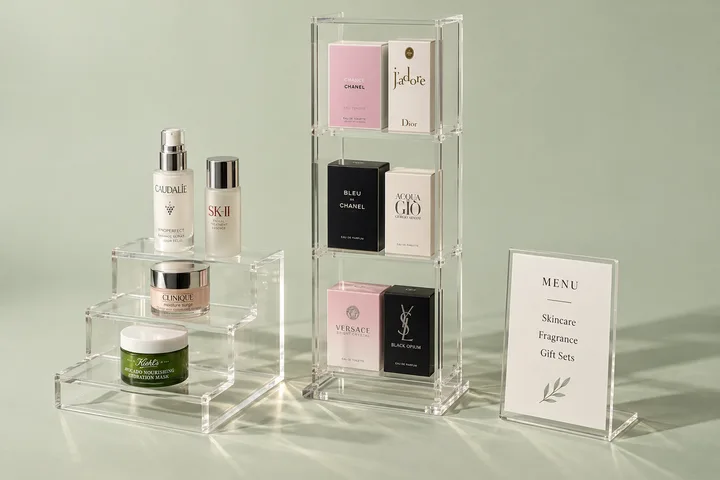
We engineered and delivered one coordinated program across hostess, table-top and table-tent formats for a multi-location restaurant group.
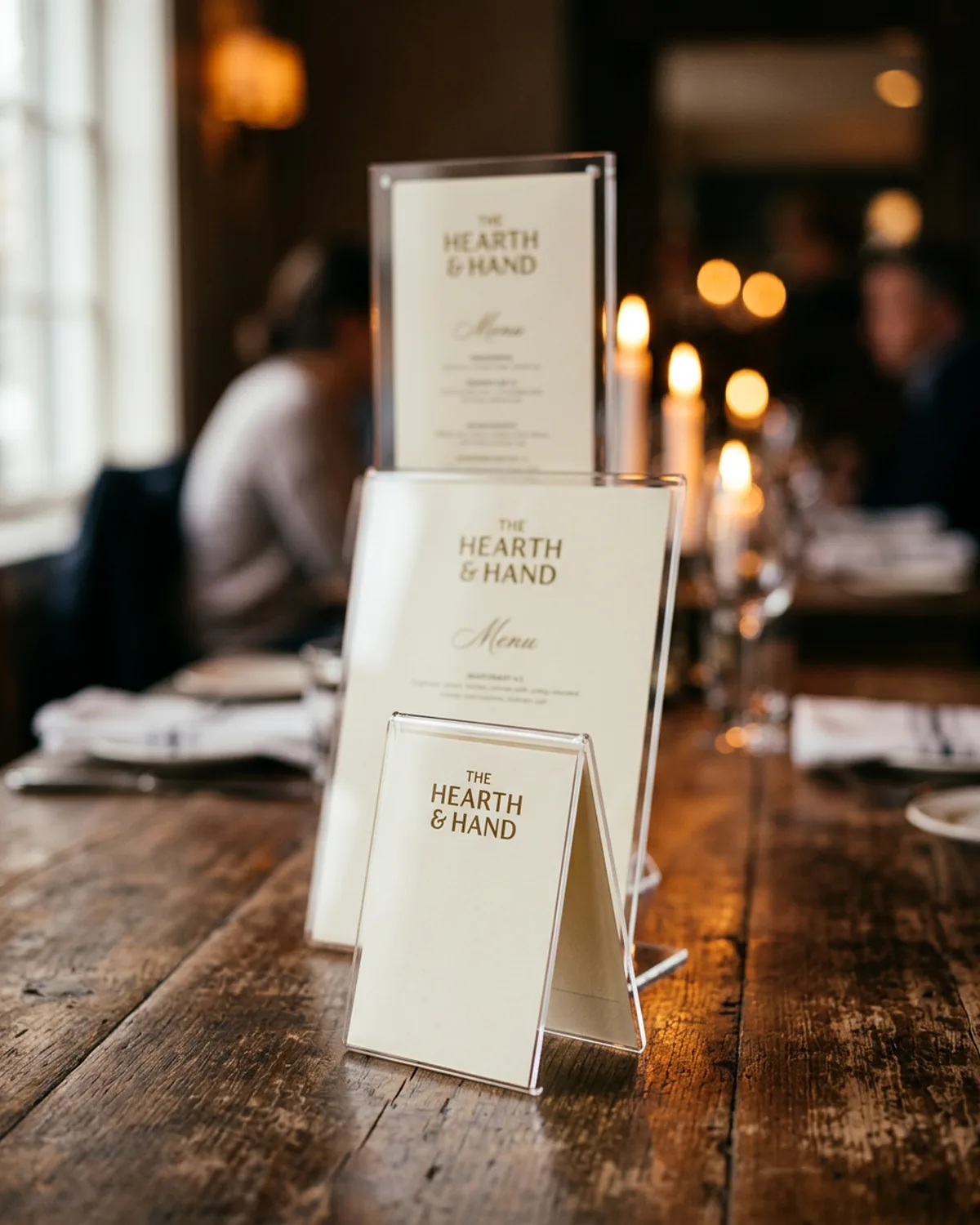
The specifications, sampling gates and QC controls below are the manufacturing path we ran. Project profile: Three coordinated menu-holder formats built around one artwork system, weighted-base options, fast insert changes, finish control, sampling, and rollout QC.
MOQ is 100 pieces per design. Paid samples normally take 3–5 days; sample fees are paid separately and never credited. Standard production takes 15–20 days after the drawing, insert, artwork, finish, inspection plan, packing and sample are approved. Wetop responds to a complete brief within 24 hours.
Different-specification price reference: the acrylic display manufacturer page publishes a two-tier countertop stand 250 × 180 × 220 mm, 5 mm clear, one-color UV logo: $28 each at 100 pcs, $16 at 500, $12 at 1,000 (FOB Shenzhen, published reference). That stand is a different specification and is not a quote for this program.
Key Takeaways
- We delivered three buyer-selected formats under one material, artwork and color-control system.
- Base thickness, footprint and panel height were drawing decisions; we verified final stability on the approved sample with the buyer's actual insert.
- We sized the CNC-routed insert slots around the approved paper or card sample, then checked practical swaps and acceptable side play.
- We approved edge finish and cleaning compatibility against the named sheet, cleaner and operating routine instead of assuming from a generic material label.
The Challenge
The restaurant group came to us with three mismatched formats: a hostess-stand display, table-top menus and small promotional table tents. Bought independently, they had produced visible brand drift, inconsistent insert sizes and three separate replacement workflows.
We built one coordinated family instead: stable on busy tables, compatible with the restaurant's approved cleaning routine and fast to reload for seasonal menus. Three controls drove the design:
- Stability at the approved footprint. We tested face height, base depth and low-positioned mass together on the sample; base thickness alone is not a stability guarantee.
- Edge finish and care. Fabrication stress and incompatible cleaners can craze PMMA, so we ran the drawing, finishing route and mild-detergent care instructions as one system.
- Fast insert swaps. We sized the slot around the buyer's real paper or laminated insert, then checked it during sampling for one-motion loading without visible side play.
Our Approach
We worked backward from those three failure modes. We started the program on cast acrylic at application-specific thicknesses, then approved geometry, finish and cleaning compatibility on a physical sample before production.
Base and footprint approved for the intended setup
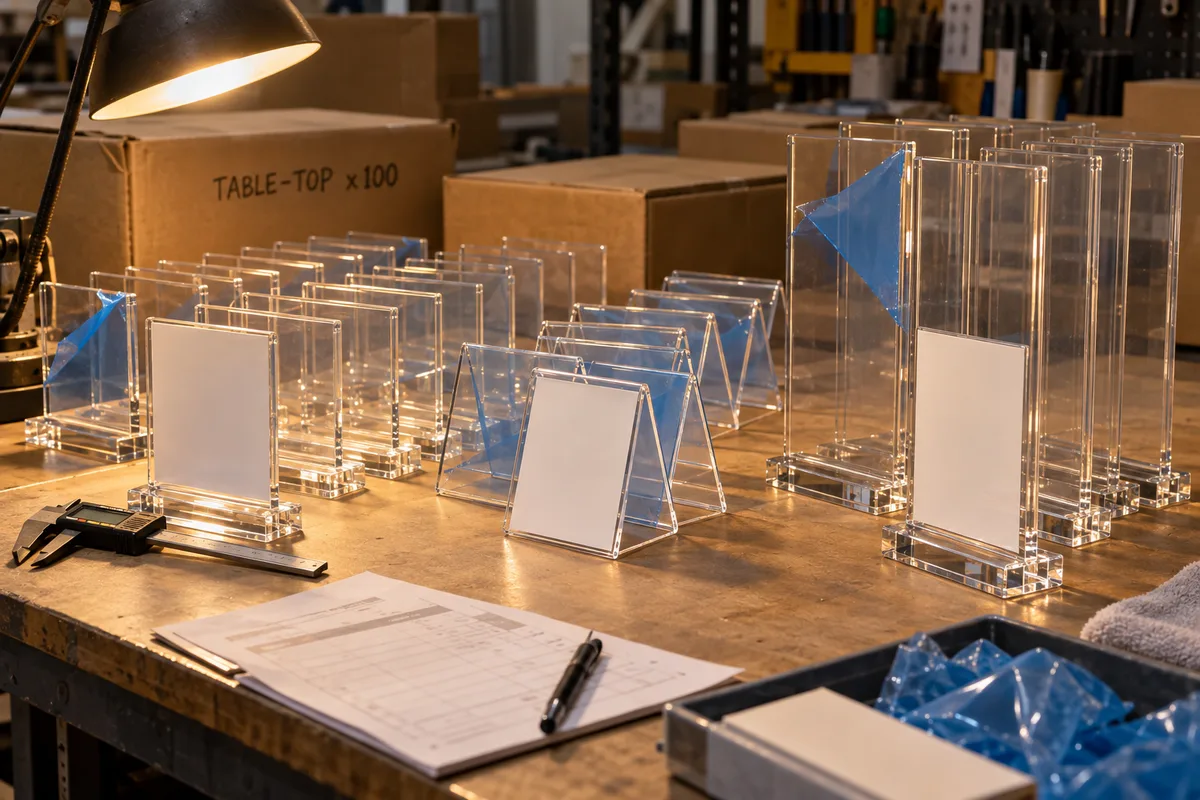
For the tall table-top format, we sampled alternative base thicknesses and footprints. More mass low in the assembly improved stability; we approved the thickness that passed the buyer's tip, wipe and table-footprint tests without making the holder unnecessarily bulky.
The production build paired that base with an approved clear display panel, a controlled bonded joint and silicone anti-slip feet. We quoted the cost movement by size and quantity after the footprint was locked, rather than applying a generic per-unit delta before the drawing review.
Finish route matched to cleaning exposure
We routed the visible edges through diamond polishing or a controlled flame-polish-and-anneal process. Flame polishing creates residual stress if it is not managed correctly, so we do not sell it as chemical-proof. The care instruction stayed simple: soft cloth, mild detergent, rinse and dry. Avoid alcohol, ammonia, solvent cleaner or a dishwasher.
| Edge finish | Setup cost | Edge-clarity retention | Cleaning chemical tolerance |
|---|---|---|---|
| Machine-buffed (extruded) | Low | Appearance depends on machining and care | Use only compatible mild cleaning |
| Flame-polished + annealed (cast) | Medium | Clear edge with stress-control step | Use only compatible mild cleaning |
| Diamond-polished (cast) | High | Flat optical edge | Use only compatible mild cleaning |
We used diamond polishing where the buyer wanted a flat optical edge with minimal heat input. We quoted the properly annealed flame-polished edge where its appearance and cost fit the brief. The approved sample, not a universal price claim, decided the production route.
CNC-routed slot sized to the approved insert
Slots routed too tight damage inserts; slots too loose let the menu sag. We dimensioned the slot from the buyer's actual paper, lamination and fold stack rather than assuming one universal thickness.
CNC routing kept the slot mouth controlled and deburred. We checked the first article with the approved insert pack, and the production run followed the inspection level and fit-check frequency on the approved QC plan.
The Results
Release checklist for a three-format program
Before the purchase order moved to production, we signed off one specification sheet covering all three formats. It carried finished dimensions, acrylic thickness, base footprint, insert size and stock, slot clearance, edge finish, logo method, protective film, packing quantity and carton labels, so the restaurant group could change menu artwork without accidentally changing the hardware specification. Because the table tents, countertop holders and hostess-stand frames used different insert stock, that difference lived in the same approval pack rather than in a late production message.
The golden-sample review imitated daily use. We inserted and removed the buyer's real printed menu several times, wiped the face with the approved cleaner, checked rocking on a standard restaurant table, and viewed the logo under the venue's typical light. We recorded the accepted sample, then used it to control cutting, polishing, assembly and packing. For volume work, we took first-article approval at each setup change to catch drift before it spread across the batch.
Store allocation was the final control. The packing list mapped each carton to format, quantity and destination, with a buyer-defined spare allowance. We prepared mixed-SKU rollout cartons by location once the store matrix arrived before packing. That turned installation into a count-and-place task instead of a sorting exercise at the restaurant. Approved programs remain useful for replenishment, but every repeat batch still receives a new first-article check against the retained reference.
The rollout was ready for production when all three formats shared an approved artwork system, each format had a signed sample and the packing list separated quantities by SKU and destination. Those controls became acceptance criteria on the quote and production drawing for the run.
Reorder readiness was designed in from the first run: approved drawings, CNC programs, artwork files and the golden sample remain the reference for later batches. A new bar-top or QR variant can reuse the shared visual system, while its geometry still receives its own sample approval.
Buyer decision summary: the insert stock, table footprint, cleaning routine and destination split were the four inputs we settled before sampling; they controlled stability, fit, finish and packing.
What This Means for Your Project
If you're specifying an acrylic menu holder rollout for multiple locations, the three decisions that most affect real-world durability are base thickness, edge finish method, andslot tolerance. None of these show up in a catalog listing. They are the reasons catalog pages do not settle. A thin base may look fine in a photo but must still pass use testing. Any acrylic edge can craze under incompatible chemicals, so finish control and care instructions belong on the same brief.
The second lesson is SKU consolidation on shared CNC programs. Designing the hostess-stand display, table-top bi-fold and table-tent holder around overlapping panel geometries makes later variants easier to quote and control. Across a QR code menu holder, a table tent sign holder, or a cafe menu stand variant, the same approach applies: design the family as one system, and later SKUs can reuse approved artwork and production logic without pretending every geometry is identical.
For the production sequence behind bent formats, see our acrylic heat-bending and thermoforming guide.
Planning an acrylic menu holder rollout for your locations?
Send us your dining-room floorplan, your insert sizes, and your location count. We will come back with a DFM review, a spec recommendation across hostess-stand, table-top, and table-tent formats, and a quote.
MOQ 100 pieces per design · Paid sample in 3–5 days, separately paid and never credited · Standard production in 15–20 days after approvals