



Quality Control · ISO 9001 · Since 2008
Acrylic Quality Control, Stage by Stage
We inspect each finished product against the approved drawing and sample before packing.
Send a sketch, drawing or sample target; we reply within 24 hours.
Wetop Acrylic runs a 4-stage acrylic quality control process across custom acrylic (PMMA) products, from incoming material inspection through pre-shipment verification, on orders made from 100 pieces per design.
Published as the Wetop acrylic standard: tolerances, edge finishes, inspection, sample approval and packing in citable tables.
Reference · cite by section anchor
The Wetop Acrylic Standard
The Wetop acrylic standard is the set of acceptance rules every custom acrylic order is checked against: the approved drawing for measurable dimensions and features, and the approved physical sample for finish, print appearance and fit. Each section below has a stable anchor you can cite.
Standard as of October 2026. This page is the single source for these limits; guides and product pages link here.
Tolerance by process
The limits below apply unless the approved drawing states otherwise. Part size, process, material thickness, hole position, bend angle and mating hardware can need their own acceptance limits, so the signed drawing controls the order. The acrylic fabrication tolerances guide explains how to write them.
| Process | What is checked | Acceptance limit |
|---|---|---|
| Incoming sheet | Thickness, clarity, surface and color consistency across sheets | Ordered sheet grade, supplier data and approved drawing. As-supplied thickness follows the sheet maker's published band (ISO 7823-1 for cast sheet); parts that mate on thickness are cut to the measured sheet lot |
| Laser cutting and CNC cutting | Cut dimensions against the approved drawing | ±0.2 mm standard working tolerance; ±0.1 mm on fit-critical 2D features after drawing review |
| Machining and hole-making | Hole position and fit of mating hardware | Limit stated on the approved drawing; fit checked against the approved sample |
| Bending and thermoforming | Bend angles, measured with precision gauges | Angle and limit stated on the approved drawing |
| Flatness of large or thin panels | Panel flatness at the support points and with the method named on the drawing | Limit, support points and gauge length stated on the approved drawing. No general flatness figure applies, because large thin sheet can bow slightly once cutting releases its internal stress |
| Printing and engraving | Print alignment against a positioning guide before the full run; alignment, color and adhesion at final inspection | Position per the approved drawing; color and appearance per the approved sample, with Pantone targets judged against the physical chip |
| Bonding and assembly | Joint appearance, bonding residue and hardware fit | Approved sample |
Inspection method, sampling and AQL
Every finished piece is inspected, so a Wetop order is never released on a statistical sample alone. Sampling tables apply when a lot is large enough for them to discriminate, and when your own inspection agency checks the order. The pre-shipment inspection guide works through the sample sizes for 200, 500 and 1,000-piece lots.
| Item | Standard | What it means for your order |
|---|---|---|
| Wetop final inspection | 100% piece-by-piece against the approved drawing and sample, on every order at every quantity | Sampling is never a substitute for the full check |
| Sampling system for larger lots | ANSI/ASQ Z1.4 (harmonized with ISO 2859-1), General Inspection Level II by default | Layered on top of the 100% check, and the plan a buyer's inspection agency uses |
| Acceptance levels | Critical 0 · major AQL 2.5 · minor AQL 4.0, unless the RFQ names tighter levels | An AQL is a process limit for the sampling plan, not a defect allowance in your order |
| Defect classification | Agreed in writing per product face before inspection: show faces and non-show faces | A scratch on a show face is a major; the same mark under a base is a minor |
| Small lots | 100 pieces is too small a lot for sampling statistics to separate good from bad | The 100% check carries the decision at the 100-piece minimum |
| Buyer-appointed inspection | Scheduled when production is complete and at least 80% packed, drawn at random from sealed export cartons | Held before the balance payment, while the goods are still at the factory |
Edge-finish classes
Name the edge finish per edge on the drawing. Every finished edge is checked after polishing for chips, unevenness and haze, and compared with the approved sample. The diamond vs flame polishing guide compares the two polished classes.
| Class | How it is produced | Checked for | Accepted against |
|---|---|---|---|
| Diamond-polished edge | Dedicated diamond polishing line | Chips, unevenness, haze | Approved sample |
| Flame-polished edge | Flame polishing | Chips, unevenness, haze | Approved sample |
| Cut edge, unpolished | Laser or CNC cut with no polishing step, where the drawing calls for it | Chips and cut dimensions | Approved drawing and sample |
Sample approval gate
Production does not start until the paid pre-production sample is approved in writing. A sample normally costs USD 200–500 depending on complexity. The sample approval checklist lists what to check.
- 1
Documents confirmed against the RFQ
Grade, market, and document type are named in the request. We confirm which material documents exist for that grade before the sample is quoted.
- 2
Paid pre-production sample
Built in 3–5 days from the drawing and the named sheet. The sample fee is paid separately and is never credited to or deducted from production.
- 3
Written sample approval
Your sign-off names the sample as the acceptance reference for finish, print appearance, and fit; the approved drawing controls measurable dimensions. Any change reopens sampling.
- 4
Production and 100% inspection
Standard production runs 15–20 days after approval. Every finished piece is compared with the approved sample before packing.
Packing and delivery acceptance
Stage 04 of the inspection also pulls packed cartons, counts quantity and checks labels and customs paperwork before release. Custom production carries no time-based warranty; acceptance is process-based, as below. The packing guide shows how cartons are built.
| Check | Standard |
|---|---|
| Protective materials | Protective film, foam inserts and corner protectors confirmed in place |
| QC photos | Sent to the buyer before shipment |
| Transit test | ISTA 3A sign-off where it is stated in the quote |
| Landed inspection | 7 days after delivery to inspect against the approved sample and drawing; transit damage or a spec failure is reviewed with photo evidence and remade case by case |
4-Stage Acrylic Quality Control Process
Each stage has a named checklist and a documented disposition for anything that fails. Measurable limits come from the tolerance table; finish and fit come from the approved sample.
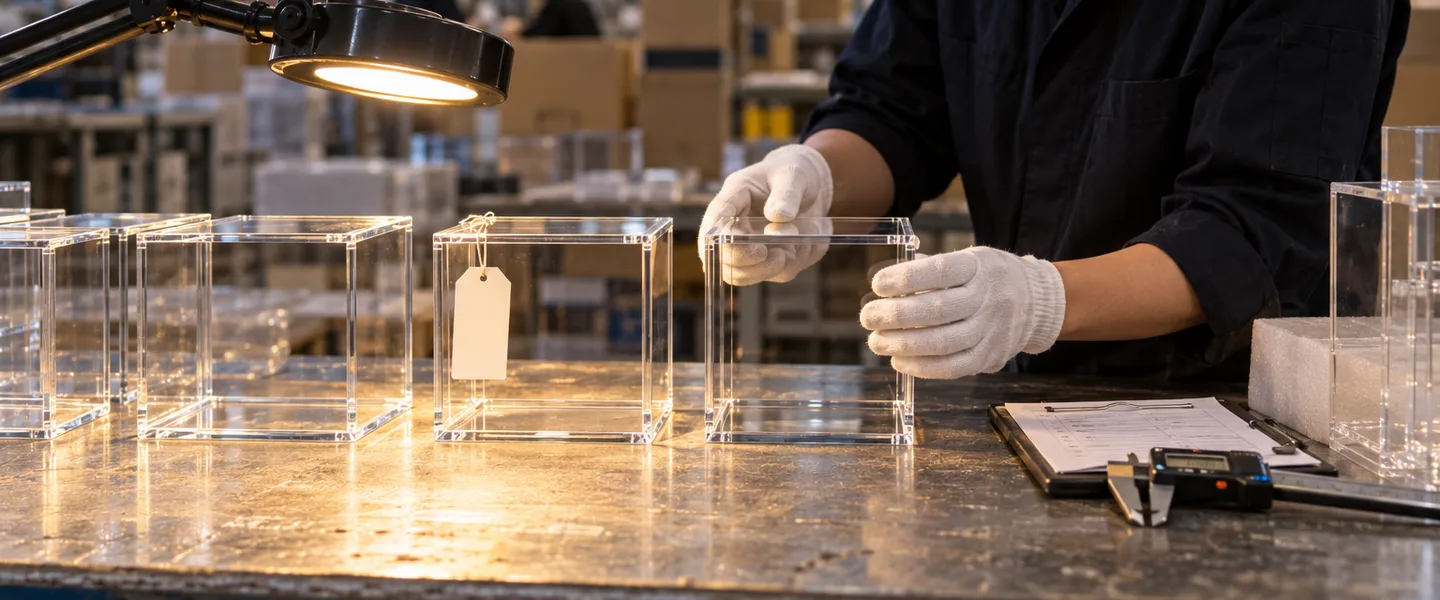
Incoming Material Inspection
Before production startsWhat we check
- Sheet clarity — no inclusions, bubbles, or haze
- Thickness checked against the ordered sheet grade, supplier data, and approved drawing
- Surface checked for scratches, scuffs, or protective film defects
- Color consistency across sheets (batch matching for colored acrylic)
If it fails
Material that misses the approved requirement is quarantined before cutting. The reviewed disposition can be supplier replacement, approved reclassification, or rejection; production does not use it under the original specification.
In-Process Inspection
During cutting, forming, and finishingWhat we check
- Cut dimensions verified against the approved drawing and the tolerance table above
- Edge quality after polishing — checking for chips, unevenness, or haze
If it fails
A nonconforming piece is held before the next station. The reviewed disposition records whether production can correct it or must recut or remake it against the approved drawing.
Final Product Inspection
After assembly, before packingWhat we check
- Side-by-side comparison with approved sample — every piece, not spot checks
- Surface inspection under direct light for scratches, fingerprints, or bonding residue
- Assembly integrity — joint appearance and hardware fit checked against the approved sample
- Print and engraving verified for alignment, color accuracy, and adhesion
If it fails
A piece that misses the approved drawing or sample is held for a documented correction, recut, or remake before packing.
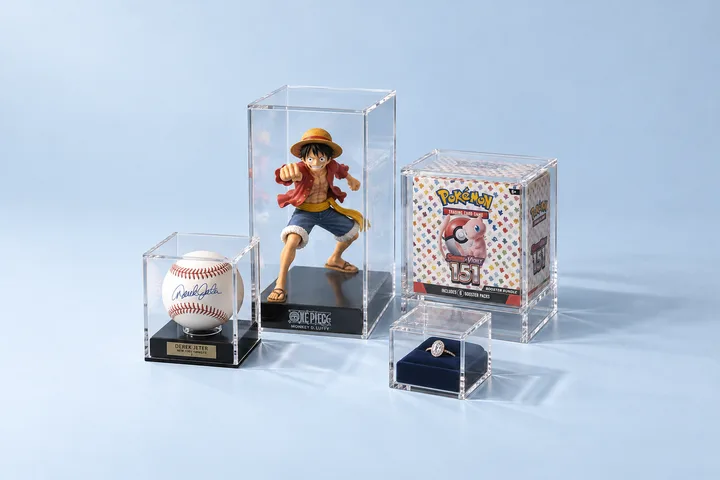
This is the same inspection standard applied to every product we ship — from display stands to display cases and trading card cases to custom boxes.
Pre-Shipment Inspection
Packed order, before leaving the factoryWhat we check
- Random pull from packed cartons — verify product quality survived packing
- Quantity count confirmed against purchase order
- Shipping labels, documentation, and customs paperwork verified
If it fails
A packing or product finding holds the affected shipment while the QC team reviews the lot and sets the required reinspection scope before release.
Certifications & Material Documentation
4 documents cover most supplier-onboarding and material-compliance requests for custom acrylic: the ISO 9001 certificate, the sheet supplier's TDS for the named grade, an SGS test report where one exists for that material, and the RoHS declaration or report for that material and scope.
ISO 9001 certificate
Wetop's own quality-system certificate
Quality system in place since 2008. An international quality-management standard, not a product-performance certificate; it covers the legal entity, site, activity, and validity period shown on the current certificate. Sent as a PDF on request for supplier onboarding; verify the certified scope against the proposed order.
Material technical datasheet (TDS)
The sheet supplier, for the named grade
Wetop fabricates acrylic and sources every sheet externally, so the TDS and any composition statement belong to the supplier's named grade, thickness, and color. We forward the supplier document for the material we will actually cut for your order; it is not a Wetop-authored specification.
SGS test report
SGS, for the specified material
Applies only to the material, test method, and scope named on the issued report. State the test your market or retailer requires at RFQ stage so we can confirm whether a matching report exists for that material.
RoHS declaration or test report
Supplier declaration or independent report, per material
Material- and scope-specific. Name the directive, material grade, and document type required; we confirm the available declaration or report for that material before production, not after.
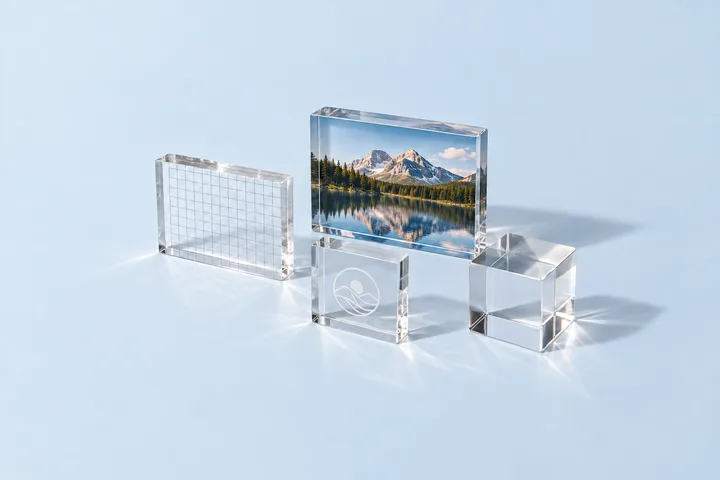
Wetop is a fabricator, not a sheet caster. A material composition statement or TDS is therefore the supplier's document for the grade we cut, forwarded for your order; we do not restate it as our own test data. Documents not listed here, such as a certification we do not hold, are not claimed, and we say so in the quote rather than after production. For acrylic blocks, displays, and every other product line the same four documents apply per named material.
Document confirmation is step 1 of the sample approval gate. To review a factory before the first order, use our supplier audit checklist.
What Happens If Something Goes Wrong
If a delivered product appears different from the approved drawing or sample, send the order evidence while the carton and packing are still available. We review the product, packing, and approval records before confirming a remedy for that order.
You report the issue
Email the order number and clear photos of the outer carton, inner packing, product label, and affected area to inquiry@wetopacrylic.com. Keep the product and packing available while we review the evidence.
We compare the evidence
Our QC team compares the photos and affected product with the approved drawing, sample, inspection record, and packing record. This review separates a manufacturing mismatch from packing damage, transit damage, or a specification difference.
We confirm the remedy in writing
If the review confirms a manufacturing mismatch, we document the affected quantity and agree the remedy, production timing, and shipping arrangement for that order. The approved drawing and sample remain the acceptance references for any correction or remake.
We document corrective action
We trace a confirmed production issue to the relevant process step and record the inspection or process change used for the correction. Learn how those checkpoints fit into the manufacturing process.
Frequently Asked Questions
How does acrylic quality control work on large orders?
100 pieces per design is the standard production MOQ, and the approved drawing and sample remain the acrylic quality control references as production scales. We inspect finished pieces against those references for dimensions, surface finish, print alignment, and assembly fit, with checkpoints between controlled production batches.
What does 100% inspection actually mean?
100% inspection means we check each finished product before packing. Our QC team compares the piece with the approved drawing and sample, measures the specified dimensions, inspects the surface and decoration, and checks assembly fit. A nonconforming piece returns to production for correction or remake.
What tolerance does acrylic quality control use?
±0.2 mm is Wetop's standard working fabrication tolerance unless the approved drawing states a different requirement. Part size, process, material thickness, hole position, bend angle, and mating hardware can require separate acceptance limits, so the signed drawing controls the order.
What happens if I receive a defective acrylic product?
3 photo sets help us review the issue: the outer carton, the inner packing, and the affected product from enough angles to show the mismatch. Email them with the order number to inquiry@wetopacrylic.com. We compare the evidence with the approved drawing, sample, inspection record, and packing record, then confirm the remedy and timing in writing for that order.
Can you provide material certifications and traceability for your acrylic?
3 details belong in the RFQ: the required material grade, the market or standard the document must address, and whether you need supplier or batch traceability. Available datasheets, declarations, and test reports apply only to the named material and scope. We confirm document availability against the requested specification before the order is approved.
Can enterprise buyers request a TDS or material composition statement for acrylic blocks?
Yes, for the named sheet grade. Wetop fabricates acrylic and does not cast sheet, so the technical datasheet (TDS) and composition statement come from the sheet supplier for the specific grade, thickness, and color ordered, and we forward them on request. Our own documents are the ISO 9001 certificate for the quality system, the SGS test report where one exists for that material, and the RoHS declaration or report covering that material and scope. Name the grade, the market, and the document type in the RFQ so we confirm availability before the sample is approved.
Have more questions? See our full FAQ.
Put acrylic quality control into your quote and sample plan.
Send the drawing, finish, quantity, packing, and inspection requirements for a written quote. Production runs from 100 pieces per design, after a paid pre-production sample is approved.