Acrylic Keychains
Custom acrylic keychains built to carry your artwork. Not off-the-shelf blanks.
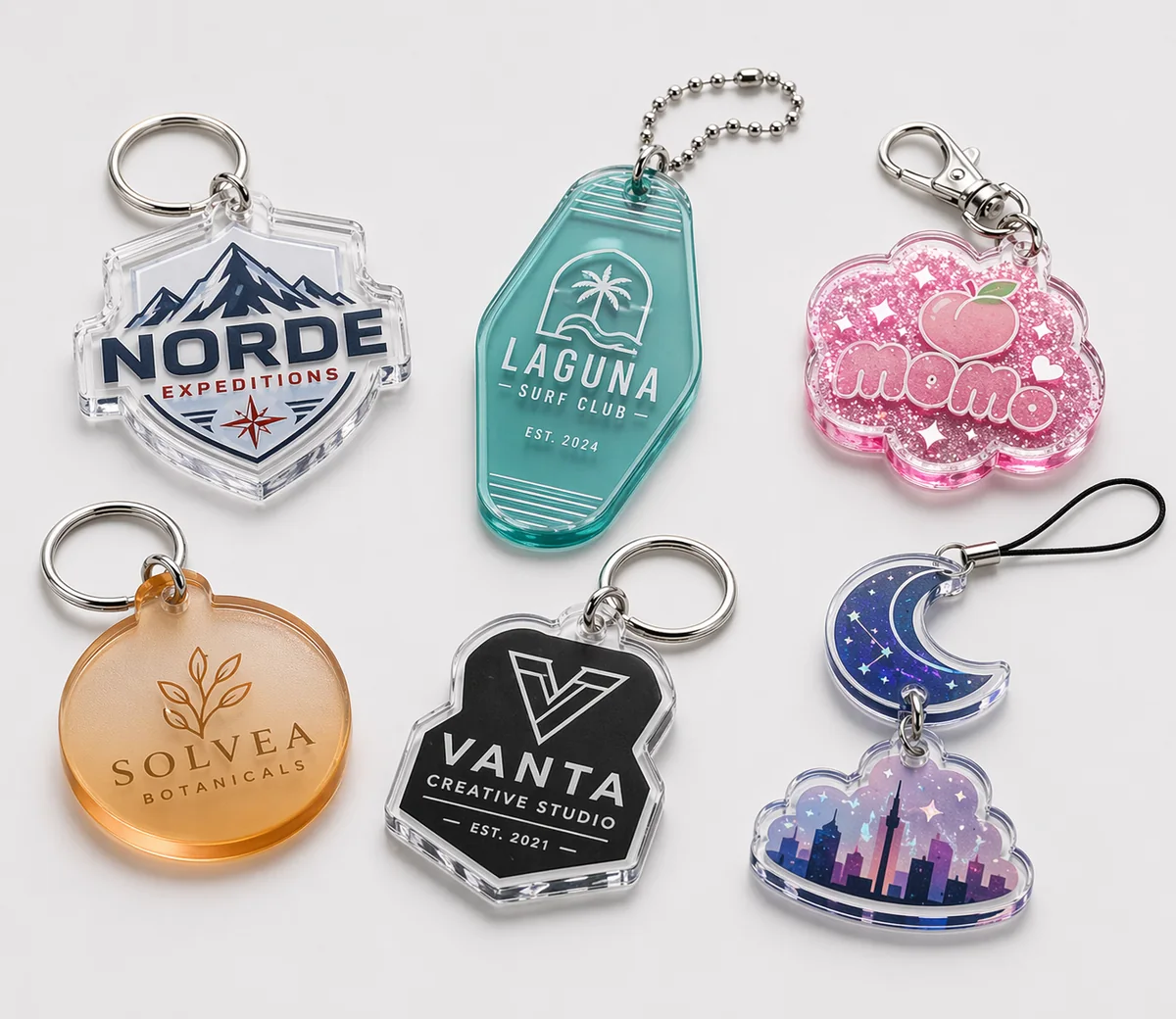
An acrylic keychain is a die-cut piece of clear or colored acrylic — also called an acrylic charm — printed with full-color UV artwork and fitted with attachment hardware for everyday carry. Wetop Acrylic manufactures custom acrylic keychains in any shape from your artwork file: single or double-sided printing at 1440 dpi, epoxy dome coating optional, 5 acrylic types including glitter. MOQ 100 pieces, samples in 3–5 days.
ISO 9001 Certified · 1440 dpi UV Printing · Double-Sided Standard · Epoxy Dome Available · Samples in 3–5 Days
Keychain Size & Shape Guide
Acrylic keychains range from 40mm mini charms to 150mm oversized collector pieces. The most popular size is 60mm — large enough for detailed character artwork, light enough for daily carry at around 4 grams. All sizes are laser die-cut to your exact artwork outline with a 3mm attachment hole positioned 3–5mm from the nearest edge.
| Size | Weight (3mm) | Design Area | Best For | Notes |
|---|---|---|---|---|
| 40mm | ~2g | ~35mm usable | Zipper pulls, phone charms, bag danglers | Smallest practical size — fine details may not print clearly |
| 50mm | ~3g | ~44mm usable | Promotional giveaways, party favors, bulk orders | Most cost-effective for high-volume orders |
| 60mm | ~4g | ~54mm usable | Character keychains, branded merch, fan goods | Most popular — best balance of detail and portability |
| 70mm | ~5g | ~64mm usable | Detailed character art, multi-element designs | Popular with anime and K-pop merch brands |
| 80mm | ~7g | ~74mm usable | Collector keychains, artist merch, retail products | Premium feel — noticeably larger in hand |
| 100mm | ~10g | ~94mm usable | Large bag charms, display-grade collector pieces | Statement piece — eye-catching on bags |
| 150mm | ~15g | ~140mm usable | Oversized display charms, limited editions | Best as bag charms or display, not key carry |
Design area = total size minus 3mm per side for laser cutting tolerance. Weights are approximate for 3mm clear acrylic.
Shape Options
Die-Cut Character Outlines
Laser follows your artwork's exact silhouette. The most popular option for anime, gaming, and original character keychains.
Standard Geometric Shapes
Circle, rectangle, heart, star, hexagon. Lower cutting cost for high-volume promotional orders.
Logo Cutouts
Company logos, mascots, and brand icons cut to shape. Popular for corporate giveaways and event merchandise.
Connected Multi-Piece
Two or more linked shapes on a single attachment ring. Used for character pairs and matching sets.
Any custom shape is available — these are just the most common starting points. Send us your outline and we laser-cut to match.
Attachment hole: 3mm diameter, positioned at the top center of the keychain. For character keychains, we place the hole above the character's head — not through the artwork.
Need a display piece larger than 150mm? Acrylic standees are built for tabletop and counter display at sizes up to 300mm.
Get a Multi-Piece Keychain QuoteHow Double-Sided Printing Works
Double-sided acrylic keychains — also called double-sided acrylic charms — have independent full-color artwork printed on both the front and back faces, separated by a white opaque layer that prevents light bleed between sides. This means each side displays its own design at full color intensity — even on clear acrylic. For a comparison of all four printing methods, see our Acrylic Ornaments hub page.
The UV printer makes two passes per side. First pass: white ink creates an opaque base on the acrylic surface. Second pass: CMYK color ink prints your artwork on top of the white base. The white layer is critical — without it, colors on clear acrylic look transparent and washed out.
For double-sided keychains, the printer runs this process on both faces. The two white layers sandwich the acrylic sheet, so each side's artwork is completely independent. Front and back can be entirely different characters, colors, and compositions.
The acrylic material — whether called acrylic, plexiglass, or Perspex — is the same: PMMA (polymethyl methacrylate), with 92% light transmission that makes UV-printed colors pop.
| Single-Sided | Double-Sided | |
|---|---|---|
| Artwork | Front only — back shows mirrored image through clear acrylic | Independent artwork on each face |
| Best for | Simple logos, text-heavy designs, budget orders | Character keychains, merch, collector items |
| Cost | Base price | Adds 15–20% |
| Print passes | 2 (white + CMYK on one side) | 4 (white + CMYK on both sides) |
| Visibility | One "good" side | Looks sharp from every angle |
Recommendation: If your keychain will hang from a bag, lanyard, or key ring — where both sides are visible — double-sided is worth it. For keychains displayed flat in packaging, single-sided saves cost.
When Epoxy Dome Coating Is Worth It
Epoxy dome is a thick, self-leveling resin applied over the printed surface of an acrylic keychain. It cures into a smooth, glossy dome that seals the UV artwork beneath — making the keychain scratch-resistant, water-resistant, and noticeably more premium in hand. Epoxy dome adds 20–30% to the per-unit cost and is the single biggest upgrade for keychains carried daily.
Always recommended
- Keychains carried daily on bags, keys, or phone cases
- Fan merchandise and collector keychains sold at retail
- Outdoor event giveaways — resists moisture, sweat, sunscreen
Optional — depends on budget
- Bag charms or zipper pulls with moderate handling
- Corporate keychains for gifts or mailers — UV coating may suffice
- Mid-volume orders (500–2,000 pcs) where 20–30% premium impacts budget
Skip it
- Keychains sealed in retail packaging and never removed
- High-volume promotional giveaways (10,000+ pcs) — UV coating is enough
- Laser-engraved keychains with no printed artwork
| Epoxy Dome | UV Coating | |
|---|---|---|
| Surface | Thick, rounded, glossy 3D dome | Thin, flat, matte or glossy |
| Scratch resistance | High — absorbs daily wear for years | Moderate — protects against light handling |
| Water resistance | Waterproof seal over artwork | Water-resistant, not sealed |
| Feel in hand | Smooth, substantial, premium | Same as bare acrylic |
| Cost impact | +20–30% per unit | +5–10% per unit |
| Best for | Daily carry, retail merch, collector items | Budget orders, display items, sealed packaging |
Acrylic vs Enamel: Which Keychain Material?
Acrylic keychains are printed directly from a digital file — no molds, no tooling fees, and every piece in an order can have different artwork. Enamel keychains require a metal mold ($50–$150 per design) and work best for simple, solid-color designs with a metallic premium feel.
| Factor | Acrylic | Enamel |
|---|---|---|
| Setup | No mold — print from artwork file | Metal mold required ($50–$150 per design) |
| Multi-design | Every piece can have different art at same cost | Each new design = new mold |
| Artwork type | Full-color, photo-quality, gradients | Solid colors, metallic fills, limited palette |
| Finish | Clear with printed art, optional epoxy dome | Metal with colored enamel fill |
| Lead time | 15–20 days | 25–35 days (mold + production) |
| Cost at 500 pcs | Lower | Higher (amortized mold cost) |
| MOQ | 100 pcs | Typically 100–300 pcs |
| Double-sided | Standard — independent artwork both sides | Single-sided only (back is flat metal) |
| Best for | Anime merch, multi-design runs, photo art, events | Premium collectible pins, metallic look, luxury |
Bottom line: Full-color artwork, multiple designs, or fast turnaround → acrylic. Metallic premium-weight collectible with 1–3 solid colors → enamel.
Keychains We've Built
Recent keychain projects from our Shenzhen factory.
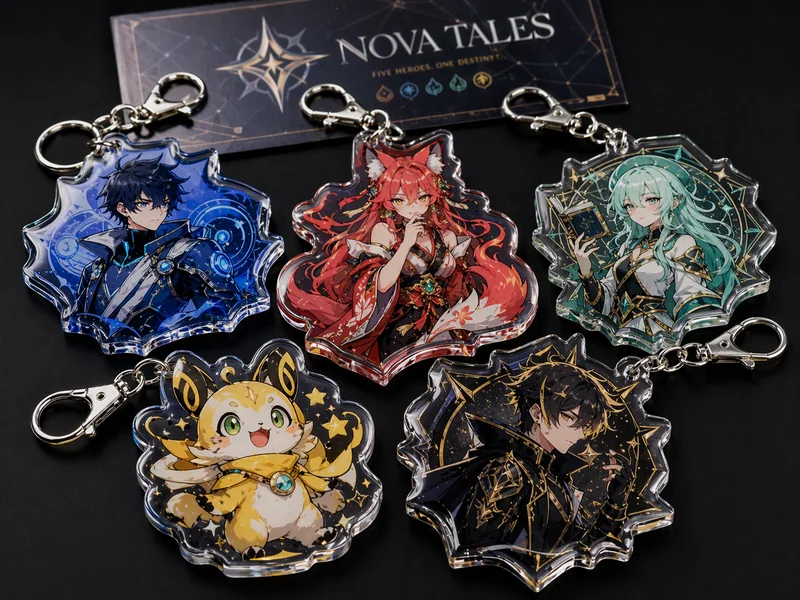
Anime Character Keychains
10,000 units · 60mm · Double-sided UV · 3mm clear · Lobster clasp · Epoxy dome · Card-backed packaging
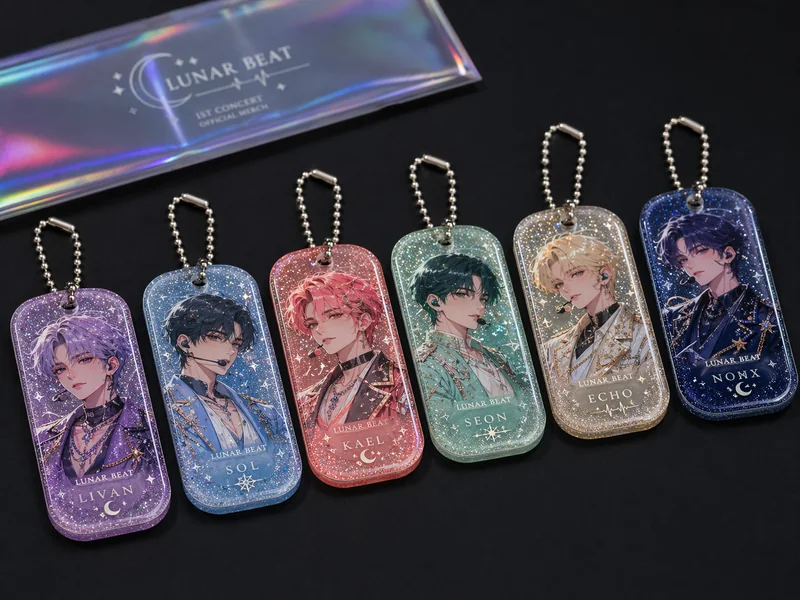
K-pop Idol Charms
25,000 units · 70mm · Double-sided UV · 3mm glitter acrylic · Ball chain · Epoxy dome · OPP bag
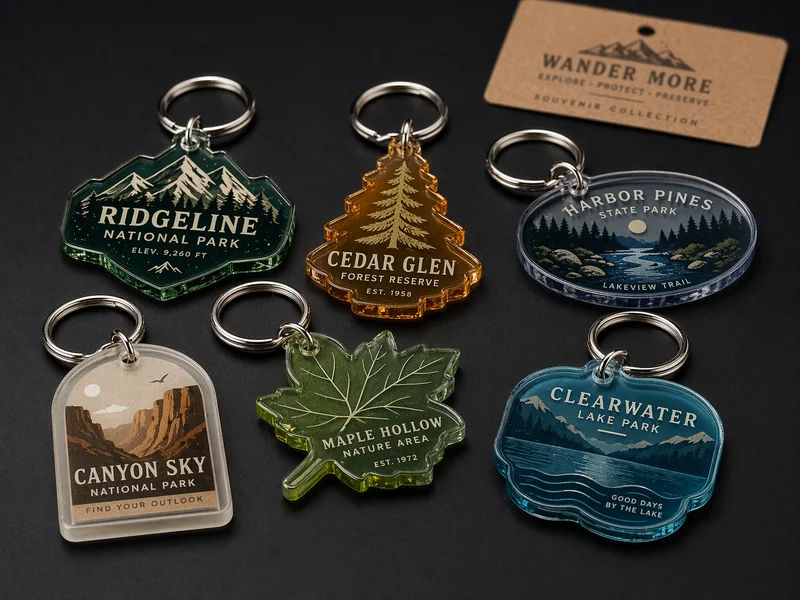
National Park Souvenirs
8,000 units · 50mm · Single-sided UV · 3mm colored acrylic · Split ring · No coating · Bulk OPP
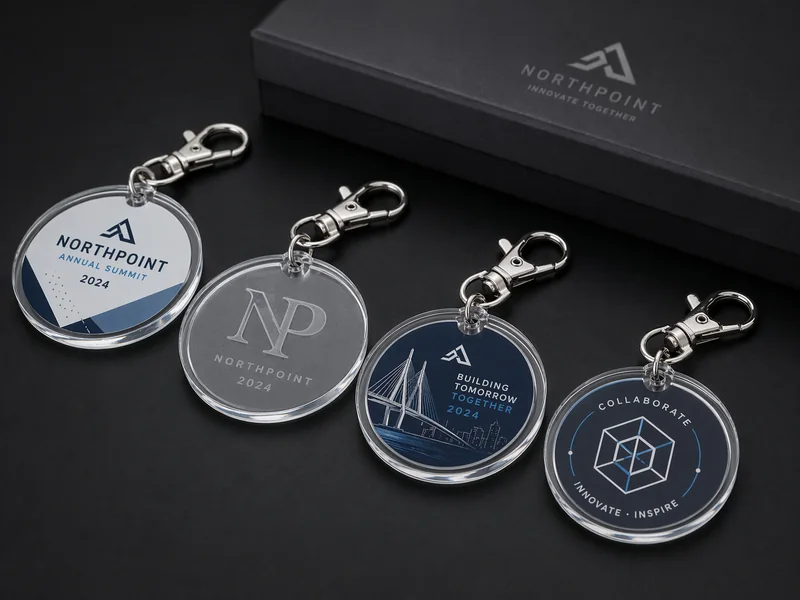
Corporate Event Keychains
3,000 units · 60mm circle · UV + laser-engraved logo · 3mm clear · Lobster clasp · UV coating · Branded box
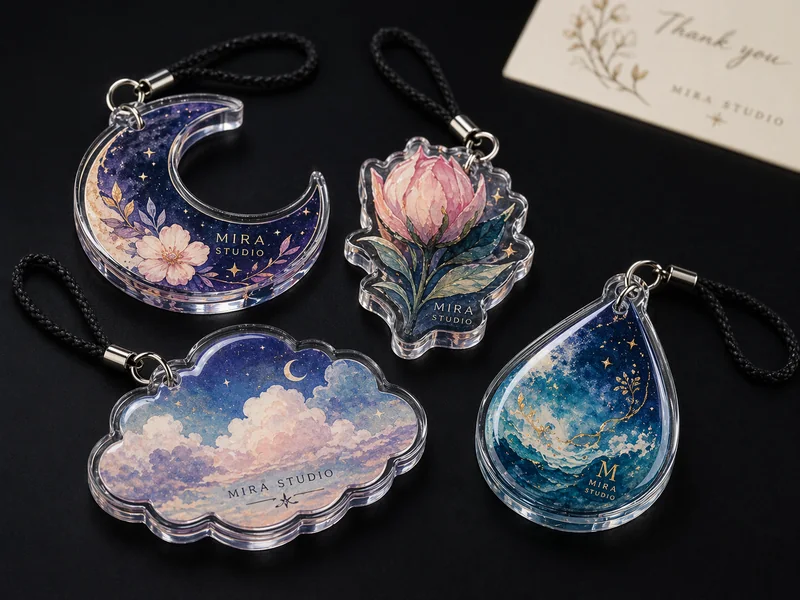
Artist Merch Collection
500 units · 80mm · Double-sided UV · 5mm clear · Phone strap loop · Epoxy dome · Card-backed packaging
A dozen-plus keychain designs per season, a few thousand units each. Enamel meant a new mold and a month of waiting per design. Wetop prints from a file and samples ship in days. Three years, color's stayed consistent.
Have a similar keychain project?
Quote a Similar ProjectSpecs, Customization & Artwork
Every acrylic keychain is laser-cut from cast acrylic sheet (PMMA, also known as plexiglass) and printed at 1440 dpi. Choose from 5 acrylic types, single or double-sided printing, 6 attachment options, and 3 coating levels. No molds, no screens — your digital file is the only setup needed.
Keychain Specifications
| Sizes | 40mm – 150mm (custom) |
| Thickness | 2mm, 3mm (standard), 5mm |
| Shape cutting | Laser die-cut to any outline from artwork file |
| Printing | UV full-color at 1440 dpi, single or double-sided; also silk-screen, laser engraving, hot stamping |
| Acrylic types | Clear, colored (50+ Pantone), glitter, frosted, mirrored |
| Attachment | Ball chain, lobster clasp, split ring, phone strap loop |
| Coating | Epoxy dome, UV coating (matte/glossy), none |
| Packaging | OPP bag (standard), card-backed, custom retail packaging |
| Attachment hole | 3mm diameter, positioned 3–5mm from edge |
| Production MOQ | 100 pieces per design |
| Sample lead time | 3–5 days |
| Production | 15–20 days |
Thickness Guide
3mm is recommended for all keychain sizes. 5mm adds 40–50% material cost — worth it for collector-grade merch at 80mm+.
Artwork Preparation
What Affects Keychain Pricing?
Custom acrylic keychain pricing depends on five factors: size, quantity, printing method, protective coating, and attachment hardware. We don't publish fixed prices because every keychain is custom — but here's how each variable moves the cost so you can plan your budget.
Size & Shape
50mm to 100mm roughly doubles material cost. Intricate die-cut silhouettes (character outlines with fine appendages) add cutting time vs simple geometric shapes.
Order Quantity
The biggest factor. Unit cost drops 30–40% between 50 and 5,000 pieces — no mold fees to amortize.
Single vs Double-Sided
Double-sided adds 15–20% — two extra print passes. Worth it when both sides are visible during carry.
Epoxy Dome Coating
The premium upgrade — adds 20–30% per unit (manual resin dispensing). UV coating adds 5–10%. No coating has the lowest unit cost.
Attachment Hardware
Ball chain is included. Lobster clasp or split ring adds 5–10%. Phone strap loops add 10–15% — additional assembly time per piece.
Who Orders Custom Acrylic Keychains?
Custom acrylic keychains are ordered by anime merchandise companies, K-pop agencies, corporate event teams, independent artists, tourism businesses, and schools. Wetop has produced custom keychains for buyers across 25+ countries — from 100-piece artist runs to 100,000-piece product launches.
Anime & Gaming Merch
5,000–50,000 pcs · 20–100+ designs
Double-sided UV print, epoxy dome, glitter acrylic, card-backed retail packaging. Often seasonal collections with dozens of unique character designs per run.
K-pop & Idol Goods
10,000–100,000 pcs per release
Multiple member variants (12 members × 3 colorways = 36 designs), phone strap loops, collectible packaging. Tight timelines tied to album and concert tours.
Artist & Indie Merch
50–2,000 pcs · 5–50 designs
Small-batch multi-design orders for convention booths and online stores. 100-piece MOQ and no mold fees make acrylic the go-to for independent creators.
Corporate Events & Gifts
500–5,000 pcs · 1–3 designs
Branded logo keychains for conferences, employee gifts, and client mailers. Often combined with laser engraving and custom retail boxes.
Tourism & Souvenirs
3,000–20,000 pcs per location
Location-themed keychains for national parks, museums, landmarks, and gift shops. Single-sided, split rings, cost-optimized for high-volume retail.
Schools & Fundraisers
200–1,000 pcs
Custom mascot or team keychains for school events, clubs, and fundraisers. Budget-friendly with ball chain and OPP bag packaging.
How to Order Custom Keychains
From your artwork file to delivered keychains — 3 steps.
Send Your Artwork
Share your design file (AI, PSD, PNG, or PDF) with the die-cut shape outline. Include size, quantity, single or double-sided, acrylic type, attachment, coating, and packaging preferences. No finished file? A sketch or reference image is enough to start.
We respond within 24 hoursApprove a Sample
We produce a physical sample with your exact artwork, acrylic type, printing, hardware, and coating. What you approve is what we produce at scale — same quality, same colors, same finish. Sample fees are paid separately and are not credited to production orders.
Sample ready in 3–5 daysReceive Your Order
Every keychain passes 100% visual inspection — print alignment, color accuracy, die-cut edges, hardware attachment, and coating quality. FOB Shenzhen standard; CIF and DDP available for door-to-door delivery.
Production in 15–20 daysFrequently Asked Questions
What size acrylic keychain should I order?
60mm is the most popular size — large enough for detailed character artwork, small enough for everyday carry at around 4g. For promotional giveaways where budget matters, 50mm keeps material and shipping costs down. For collector-grade merch or bag charms where visual impact matters more than portability, 80–100mm is the sweet spot. We recommend 3mm thickness for all keychain sizes — sturdy enough for daily use without adding unnecessary weight.
Do I need epoxy dome coating on my keychains?
Epoxy dome adds a glossy, rounded surface that protects UV-printed artwork from scratches, moisture, and fading. It is recommended for keychains carried daily on bags, keys, or phone cases — the coating absorbs surface scratches that would otherwise damage the printed ink. If your keychains are collectible items kept in packaging or displayed on stands, standard UV coating provides adequate protection at lower cost. Epoxy dome adds 20–30% to the per-unit price.
What file format do you need for custom keychain artwork?
Send your artwork as AI (Adobe Illustrator), PSD, or high-resolution PNG at 300 dpi minimum with a transparent background. Include a vector outline of the die-cut path — this is the exact shape the laser follows when cutting each keychain. No vector file? Send any image — our production team traces the cut path from your artwork at no extra charge. PDF and SVG files are also accepted.
How much do custom acrylic keychains cost?
Five factors determine keychain pricing: size (50mm vs 100mm), quantity (unit cost drops 30–40% between 50 and 5,000 pieces), printing (double-sided adds 15–20% over single-sided), coating (epoxy dome adds 20–30%), and attachment hardware (lobster clasp costs more than ball chain). A 60mm single-sided keychain with ball chain at 500 units sits at the lower end. A 100mm double-sided epoxy-coated keychain with lobster clasp at 50 units sits at the higher end. Send your specs — we respond within 24 hours with an exact quote.
Can I order keychains with different designs in one batch?
Yes. We print directly from digital files with no molds or screens, so every keychain in your order can have different artwork. Multi-design orders are priced the same as single-design orders at the same total quantity. This makes acrylic keychains ideal for merch lines, event exclusives, and artist collections where you need 10, 50, or 200+ unique designs produced in one run.
Have Keychain Artwork Ready? Let's Quote It.
Send us your design file — AI, PSD, PNG, or PDF — with shape outline, size, quantity, and preferences for printing, coating, and hardware. We respond within 24 hours with a detailed quote covering material, printing, assembly, coating, packaging, and timeline. No commitment required. Approve a sample before you commit to production.