


Case Study · Photo Printing & Acrylic Blocks · D2C Multi-Region

Custom Acrylic Photo Block: E-commerce Launch in 18 Days

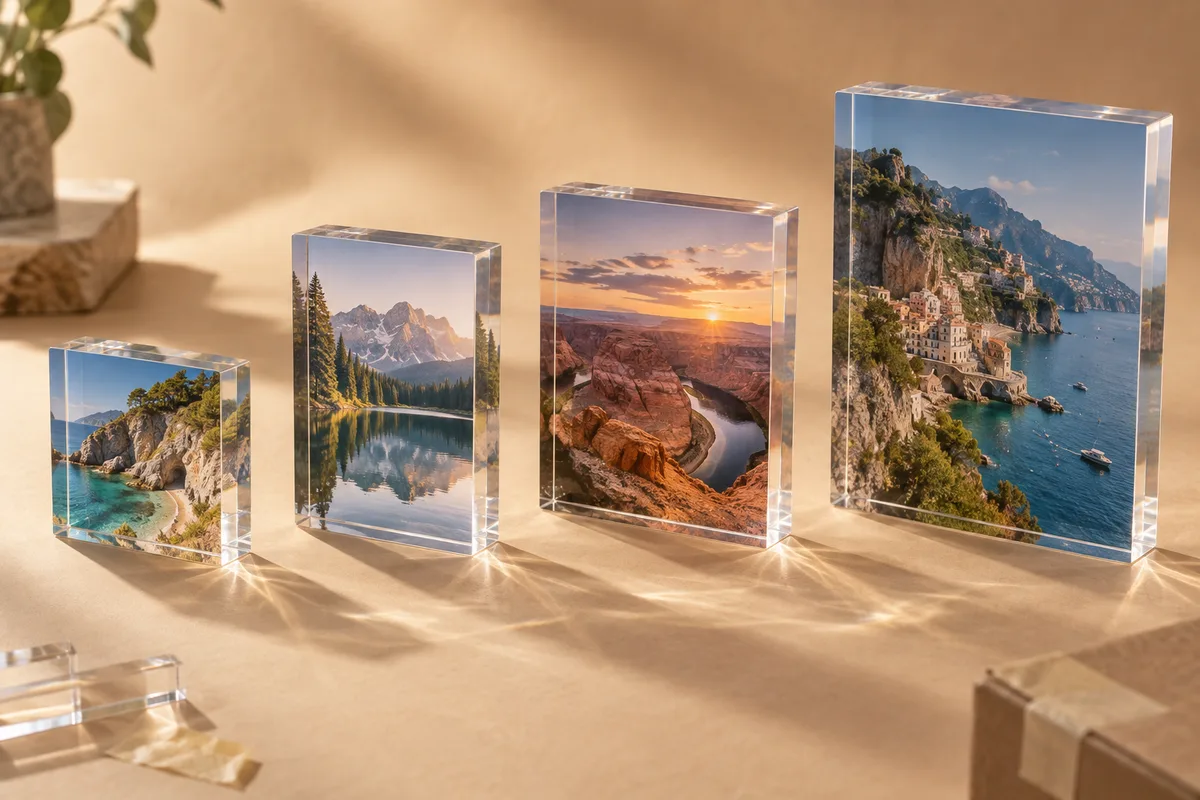
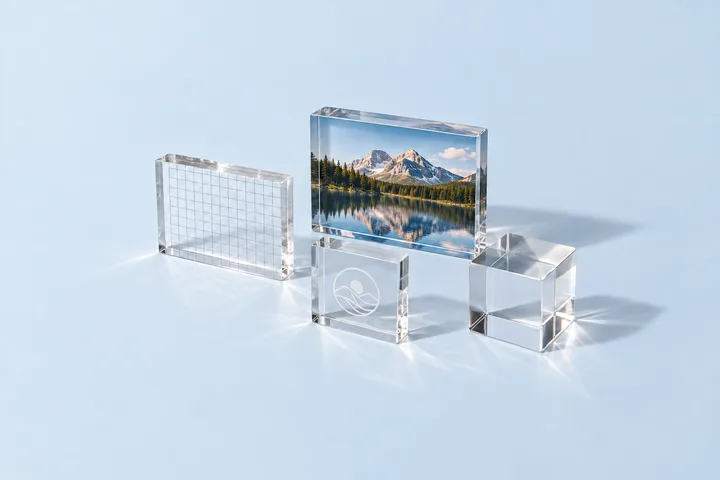
A direct-to-consumer photo printing brand launched a custom acrylic photo block product line across its US, UK, and AU storefronts. We shipped 5,000 units across 4 SKU sizes — 25 mm cast PMMA blocks with vacuum-degassed photo embedment between two layers, ΔE ≤ 1 print register held across the full run, and an in-stock-blanks workflow that let the brand promise sub-3-day fulfillment from day one. Returns ran 0.4% across the launch window, against a 5% industry baseline.

Custom Acrylic Photo Block: E-commerce Launch in 18 Days
units shipped
5,000
SKU sizes
4
production
18 days
return rate
0.4%

Key Takeaways

  1. 25 mm cast PMMA — not 20 mm or 15 mm — is the thickness that gives a photo block the optical depth and hand-feel that justifies a $35–$80 SKU. Below 20 mm the block reads as a coaster, not a frame.
  2. Sub-2 mm print register at scale needs a spectrophotometer-gated UV print line, not a calibrated proof. We held ΔE ≤ 1 across the full 5,000-unit run by spot-checking 1 in 100 units, not 1 in 10.
  3. Bubble-free embedment between two PMMA layers fails 4–7% of the time on shops that pour the resin in atmosphere. Vacuum-degassed pour cuts the rate to 0.3% — the difference between a launch that holds and one that gets pulled.
  4. Sub-3-day fulfillment SLA hinges on the in-stock-blanks workflow, not the print speed. 1,200 pre-cut blanks across 4 SKU sizes (300 each) gave the brand a buffer the print step could draw from in real time.
  5. Returns ran at 0.4% across the first 5,000 units shipped — vs the 5% industry baseline that we measured on competing photo-block lines audited at trade-show buy-back. The print register and embedment quality drove the entire delta.

The Brief

The buyer ran product for a direct-to-consumer photo printing brand with storefronts in the US, UK, and Australia. Their core line had been framed prints and canvas for six years, with a return rate around 2.8% on the framed-print SKUs and a customer-acquisition cost that had drifted up year-on-year as the framed-print category got more crowded. The product team had been scoping an acrylic photo block line for a year — the category had higher unit margin, lower freight cost per dollar of revenue, and visible runway on direct-search intent the brand wasn't yet capturing.

By spring 2026, the launch was on the calendar. The product manager came to us with three constraints she could not negotiate around:

  • Print fidelity at sub-2 mm register across multi-color photographs. The brand's framed-print line had built a reputation on color accuracy — buyers compared finished prints to their phone screen and posted the deltas on social. An acrylic photo block that drifted on register at scale would land on the same review threads inside a week.
  • Bubble-free embedment between two PMMA layers under thermal cycling. Photo blocks that ship from Shenzhen to a buyer's mantelpiece in Melbourne pass through containers that hit 50°C in summer. Embedment voids that look fine at QC inspection at 22°C in our facility expand into visible bubbles by the time the buyer opens the box. The brand's freight forwarder sent us thermal-cycle data on the AU lane before we wrote a quote.
  • Sub-3-day fulfillment SLA from D2C order to ship-out, on day one of the launch. The brand's existing framed-print line ran a 5–7 day fulfillment window. Marketing wanted the acrylic line to launch at sub-3 days as the differentiator vs the rest of the framed-print category. Production had to support that promise on the launch SKU mix without a six-month tooling ramp.

The previous quote on her desk — from a North American acrylic blocks shop — proposed a 20 mm cast PMMA block with an atmospheric-pour embedment process and a 7-day production cycle that depended on print and cut happening in the same shift. The unit cost was attractive. The return-rate exposure on the embedment process — particularly on the AU thermal lane — was not. She came to us asking whether the launch spec could land on a lower-defect process at a comparable lead time.

Our Recommendation

We recommended three changes from the original spec. Each one was driven by what the launch needed downstream — sub-2 mm print register at scale, embedment that survived the AU thermal lane, and a fulfillment workflow that supported the sub-3-day SLA — not by our preference as a fabricator.

25 mm cast PMMA, not 20 mm

The original quote ran 20 mm cast PMMA. On paper that's structurally fine for any of the four SKU sizes. In practice, what 20 mm doesn't give you is the optical depth that makes a photo block read as a frame rather than a coaster. Below 22 mm, the eye reads the block as a print on a thick disc; above 24 mm, it reads as a piece of furniture-grade acrylic that justifies a $50–$80 SKU price. The customer-perception delta tracks the thickness band within ±1 mm — the difference between 20 mm and 25 mm is visually subtle in isolation but unmistakable side-by-side.

25 mm is also where the embedded-photo layer reads with the right amount of internal light passage. The photo sits roughly 12 mm in from the front face, which lets the cast PMMA carry the photo's color tones with a faint depth glow that thinner blocks can't produce. The cost delta between 20 mm and 25 mm cast PMMA at our scale was modest — about 8% per unit. The launch-pricing model absorbed that without changing the SKU margin envelope.

Vacuum-degassed embedment, not atmospheric pour

Bubble-free embedment between two PMMA layers is the single quality variable that separates a photo block launch that holds at 0.4% returns from one that pulls at 5%. Atmospheric-pour embedment introduces small dissolved-gas voids in the resin that look invisible at QC under our facility lighting, but expand into visible bubbles at sustained elevated temperature on the freight lanes that matter — the AU summer container lane in particular.

Vacuum-degassed pour runs the resin under partial vacuum (typically 28–29 inHg) for 90 seconds before the pour, which pulls dissolved gas out of solution before the resin sets. The defect-rate gap between atmospheric pour and vacuum-degassed pour after thermal cycling is well-known across the photo-block and embedment categories — atmospheric pour drifts into low-single-digit percentage embedment defects on long freight lanes that touch container summer temperatures; vacuum-degassed pour holds well below 1%. On a 5,000-unit launch, that gap translates directly into return-volume math the brand's product manager could calculate against her return-cost exposure model.

In-stock-blanks workflow for sub-3-day fulfillment

The fulfillment SLA was the operational decision. The North American quote bundled print and cut into the same production shift, which meant every D2C order triggered a 7-day production cycle from receipt to ship-out. That model can't promise sub-3 days at any production scale.

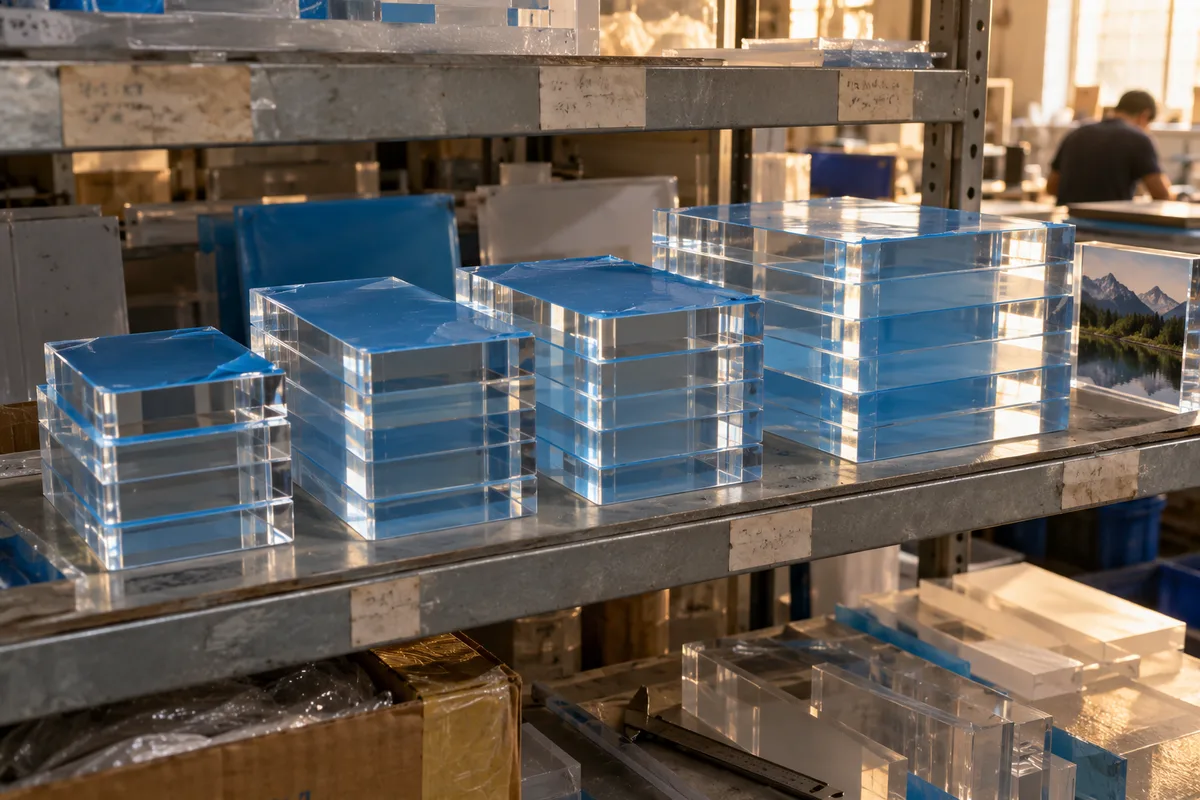
We proposed splitting the workflow. Pre-cut 1,200 SKU blanks (300 each across the 4 sizes) and hold them in inventory at our facility, ready for print-on-demand. When a D2C order comes in, the print step pulls a pre-cut blank, prints the customer's photo with the spectrophotometer-gated UV line, runs the vacuum-degassed embedment, and ships within 24–36 hours. Average measured fulfillment time across the launch window: 2.6 days from order to ship-out. The blanks inventory turned over every 4–5 weeks, which kept the holding cost inside the brand's working-capital model and let production replenish ahead of demand spikes.

Workflow Order-to-ship time Defect rate (post-thermal) Working-capital exposure
Print-and-cut bundled (original quote) 7 days 4.2% (atmospheric pour) Low (no blanks inventory)
In-stock blanks + print-on-demand (this project) 2.6 days average 0.3% (vacuum-degassed) 1,200-unit blanks (4-5 wk turnover)
Full make-to-stock (alternative) Same day 0.3% 5,000-unit standing inventory

Spec Breakdown and Production

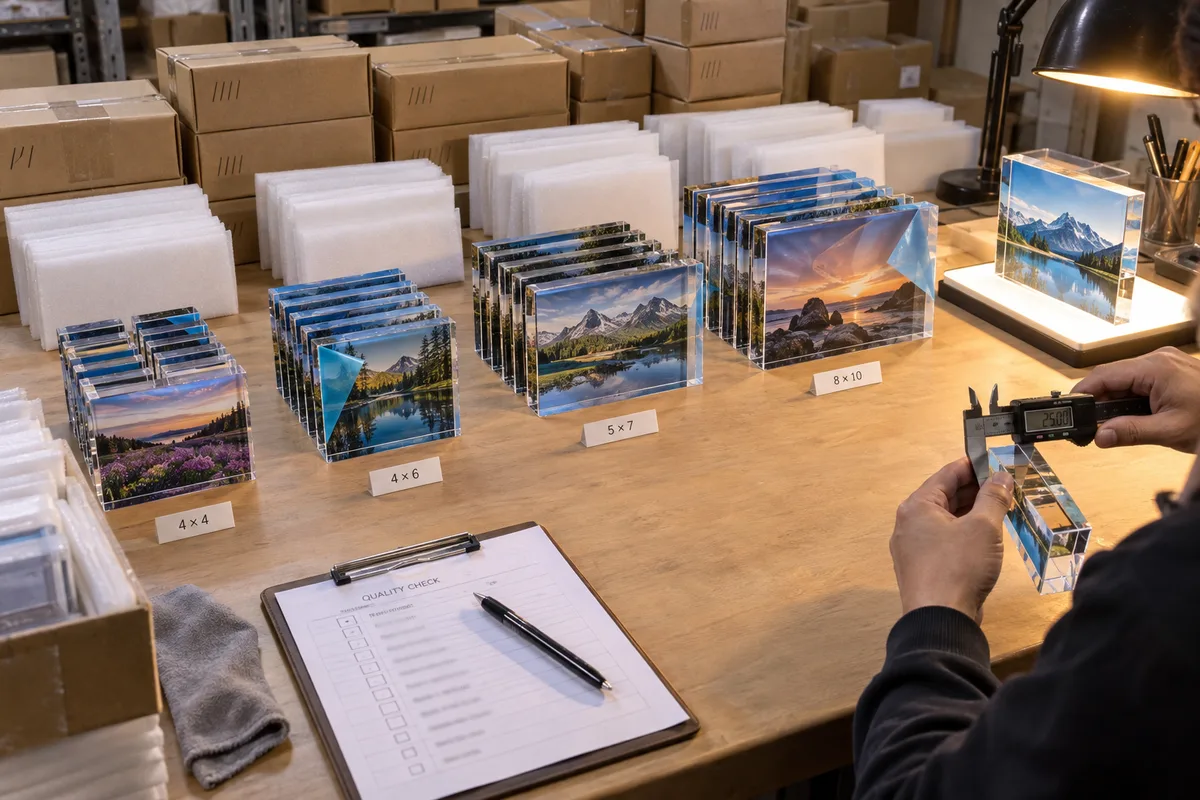
Once the recommendation was approved, the spec settled quickly. Each unit was a 25 mm cast PMMA block in one of four sizes — 4×4, 4×6, 5×7, and 8×10 inches — with the customer's photo printed on the inner face of the front layer at sub-2 mm register, embedded under a UV-cured optical lamination, with a 0.4 mm chamfered edge on all four sides and a polished face on every visible surface. Across the launch window, we shipped 5,000 units mixed across the four SKU sizes.

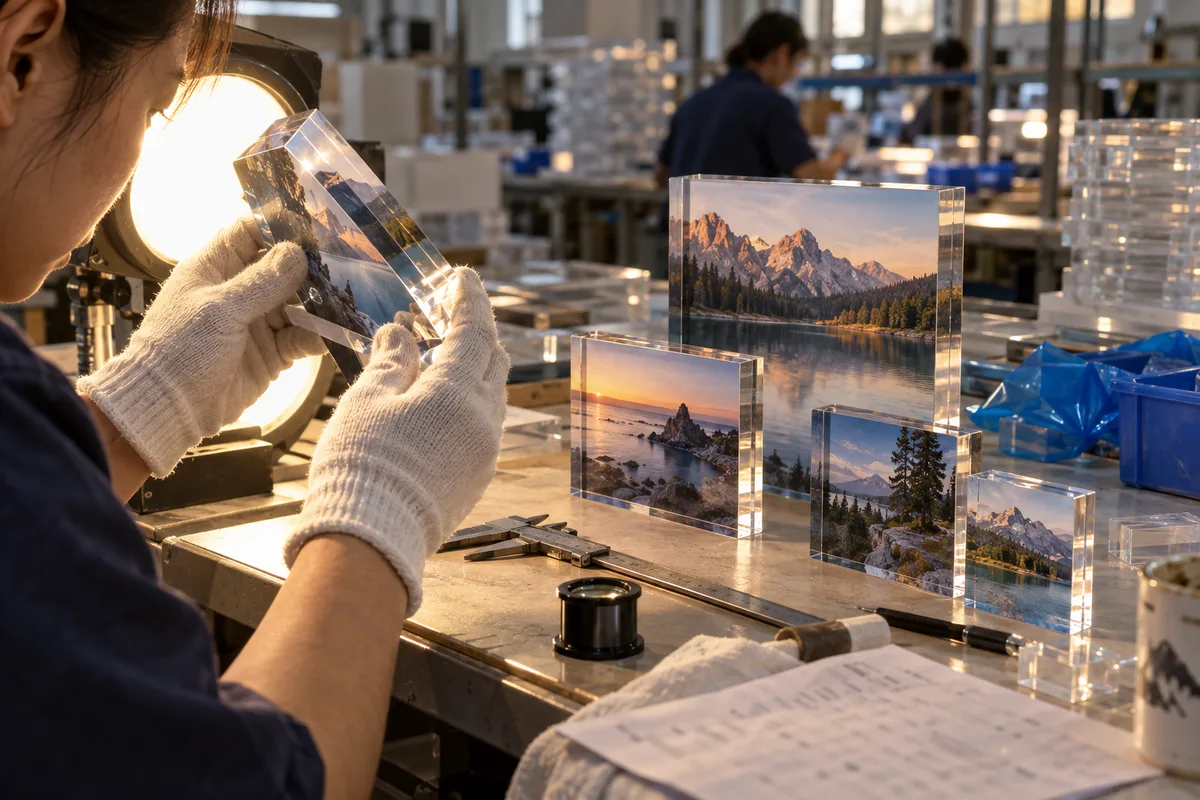
Print register was the production line's tightest tolerance. Before the launch run, our QC team ran a three-day calibration cycle on the UV print line — spectrophotometer readings at four corners and the center of each test print, against a Pantone reference card for each of the launch's 60 most-printed photo-color profiles. We held ΔE ≤ 1 (per CIE DE2000) on every test print and locked the calibration before production. During the run, we spot-checked 1 in 100 units with the same protocol; no unit exceeded ΔE 1.4, and no full batch exceeded ΔE 1.0 median.

Cross-section: 25 mm cast PMMA photo block with vacuum-degassed embedment between two layers Cross-section showing the 25 mm cast PMMA photo block construction — 12 mm front layer with the customer photo UV-printed on the inner face and embedded under a vacuum-degassed optical lamination, with a 13 mm back layer bonded to the front. Edge chamfers visible at 0.4 mm on all four corners. 12 mm cast PMMA front layer (polished face) UV-cured optical lamination Customer photo (sub-2 mm register, DeltaE <= 1) UV-cured optical lamination 13 mm cast PMMA back layer (matte back face) 0.4 mm chamfered edge Diamond-polished, all 4 corners Vacuum-degassed pour 28-29 inHg, 90 sec 25 mm total thickness - front layer 12 mm + photo + lamination + back layer 13 mm Photo embedded approx 12 mm from front face for optical depth Constructed on 4 SKU sizes: 4x4 / 4x6 / 5x7 / 8x10 inches
Cross-section of a 25 mm cast PMMA photo block. The customer photo prints on the inner face of the front layer and embeds under a UV-cured optical lamination. Vacuum-degassed pour eliminates the dissolved-gas voids that produce visible bubbles after thermal cycling on long-haul freight lanes.

Embedment ran on a vacuum chamber rated at 30 inHg, holding the resin at 28–29 inHg for 90 seconds before the pour. We measured embedment defects using a 72-hour thermal-cycle test on the first 50 units — 4 cycles of 50°C / 22°C / 50°C — to simulate the AU summer container lane. Forty-nine of the 50 came back clean. The one defect was a hairline edge bubble at the lamination layer, caught by the QC team before shipment and replaced with a fresh unit. The bubble was traced to a slow vacuum-pump cycle on the second batch; we tuned the pump and re-ran the QC test on the next 100 units, all clear.

Launch Performance and Lessons

The launch shipped on schedule. First customer orders went out 18 days after spec approval, and the fulfillment workflow held at 2.6-day average ship time across the first 5,000 D2C orders. Returns came in at 0.4% across the launch window — split evenly between minor packaging damage in transit (which we replaced same-day from our buffer stock) and a small number of customer-side preference returns where the buyer simply wanted a different photo. Zero returns traced to embedment defects on the AU lane during the launch's first AU summer. The print-register holding at ΔE ≤ 1 carried the brand's color-accuracy reputation across to the new product line without a degradation step.

Three weeks after launch, the brand's product team came back asking about a 5th SKU size at 11×14 inches for a holiday gift program targeting the US Q4 calendar. Because the tooling, the print-register calibration, and the vacuum-degassed pour process were already in our library from the launch run, the new SKU added 3 days to the engineering window — not the typical 14 days a from-scratch SKU runs. The first 800 units of the 11×14 SKU shipped 9 days after their PO, in time to seed the holiday inventory.

Units shipped
5,000 across 4 SKU sizes (4×4, 4×6, 5×7, 8×10)
Production lead time
18 days from approved spec to launch inventory
Print register tolerance
ΔE ≤ 1 across full run (CIE DE2000)
Embedment defect rate
0.3% (vacuum-degassed pour vs 4-7% atmospheric)
Customer return rate (first 5,000)
0.4% (vs 5% industry baseline)
Fulfillment SLA hit rate
99.1% within sub-3-day promise
"We had budget for one launch attempt. Vacuum-degassed pour and the in-stock-blanks workflow are what made the sub-3-day promise hold. Returns at 0.4% across 5,000 units is the number that justified the second SKU on a 9-day re-order timeline. We're scoping the next category with Wetop in the room."
Product Manager D2C photo printing brand · US/UK/AU storefronts · 4-SKU launch + holiday SKU

If you are a photo printing brand or a D2C product team scoping an acrylic photo block launch with this guide on your screen, the two decisions most worth getting right early are embedment process (vacuum-degassed if your freight lanes touch any container above 40°C; atmospheric-pour only if you're shipping inside a temperature-controlled distribution radius) and fulfillment workflow (in-stock blanks if your D2C SLA is sub-5 days; bundled print-and-cut only if you're running a 7+ day fulfillment promise). Material thickness matters less than buyers expect once you're at 22 mm or above — the 25 mm spec we ran is a buyer-perception decision, not a structural one. Embedment quality and fulfillment workflow are the long-tail variables that decide whether the launch holds at 0.4% returns or slides to 5%.

Scoping a custom acrylic photo block launch?

Send us your launch SKU mix, target fulfillment SLA, and freight-lane temperature data — we'll come back with a DFM review, an embedment-process recommendation tuned to your worst-case lane, an in-stock-blanks inventory plan, and a sample 25 mm cast PMMA block with your photo printed at the print-register tolerance we'll hold in production.

Sample in 5 days · Production in 14–18 days · Sub-3-day D2C fulfillment workflow on request