
Acrylic Photo Blocks
Blank acrylic photo block substrate for UV print labs, photo POD services, and photo gift fulfillment platforms. ±0.3mm thickness tolerance. Batch-to-batch optical consistency.
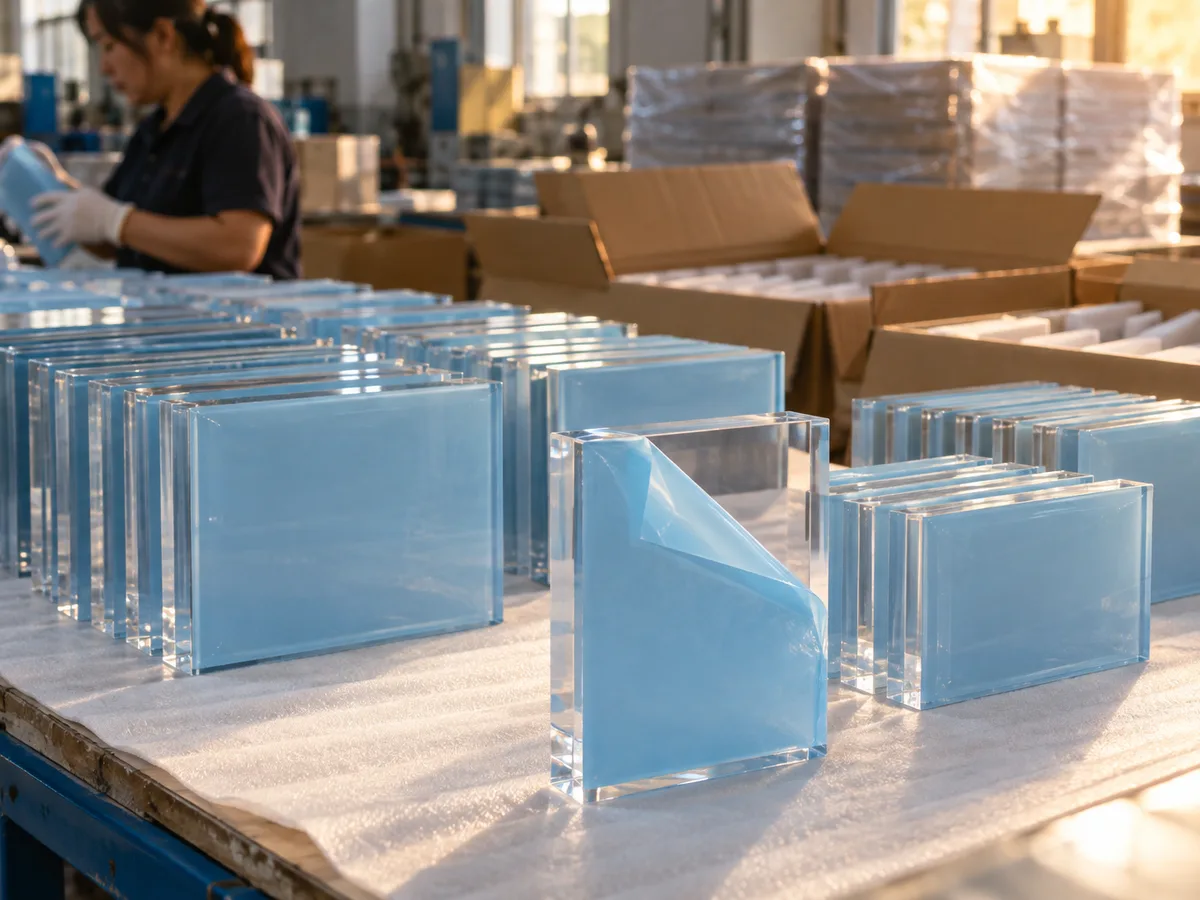
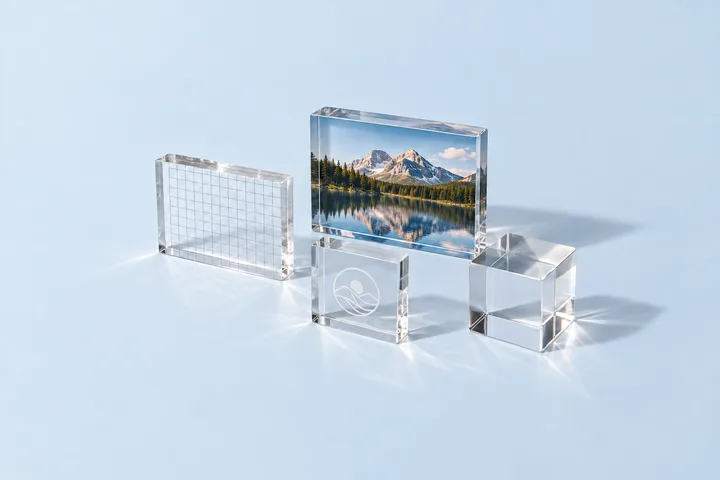
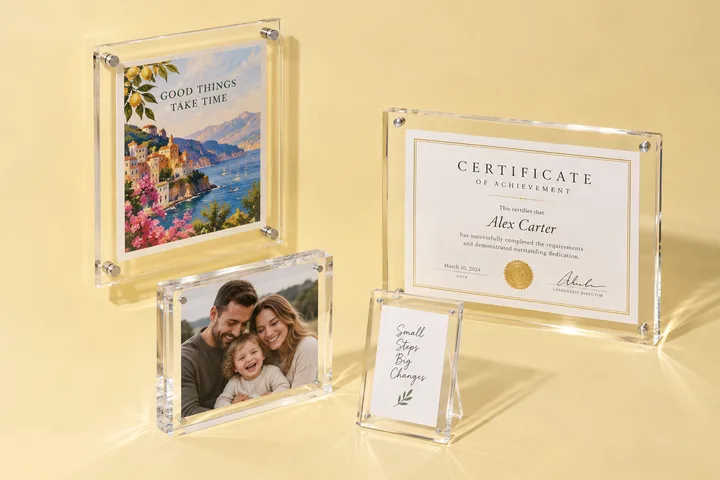
An acrylic photo block is a solid clear cast acrylic panel — typically 1" to 1¼" (25–30mm) thick — that a UV print lab reverse-prints onto the back face to produce a finished photo block for the end customer. Wetop Acrylic supplies the blank substrate to photo print labs, photo POD services, and photo gift fulfillment platforms: pre-cut cast PMMA blanks with diamond-polished edges and low-tack PE film on both faces, engineered to run consistently through your UV flatbed so your color profiles stay calibrated and your substrate reject rate stays near zero. We do not run per-customer photo personalization — that's your workflow, and this page exists to make sure our substrate fits it. MOQ 50 pieces. Sample kit available.
ISO 9001 Certified · ±0.3mm Thickness Tolerance · 92% Light Transmission · PE Film Both Faces · 5-Block Sample Kit
Why Print Labs Source Photo Block Substrate From Wetop
UV print labs, photo POD services, and photo gift fulfillment platforms source acrylic photo block substrate based on four things: batch-to-batch optical consistency (so the color profile doesn't drift), thickness tolerance tight enough to clear the print head, diamond-polished edges that ship direct to the end customer without post-processing, and protective film engineered for the UV printing workflow. Wetop is built around those four inputs. We do not run per-customer photo personalization — that's the print lab's job; our job is to supply a substrate that runs reliably through your flatbed, week after week.
Batch-to-Batch Optical Consistency
92% light transmission, measured per production batch. Same mill grade, same polishing process, every shipment. Your UV flatbed color profile stays calibrated — no re-profiling between Wetop batches.
±0.3mm Thickness Tolerance
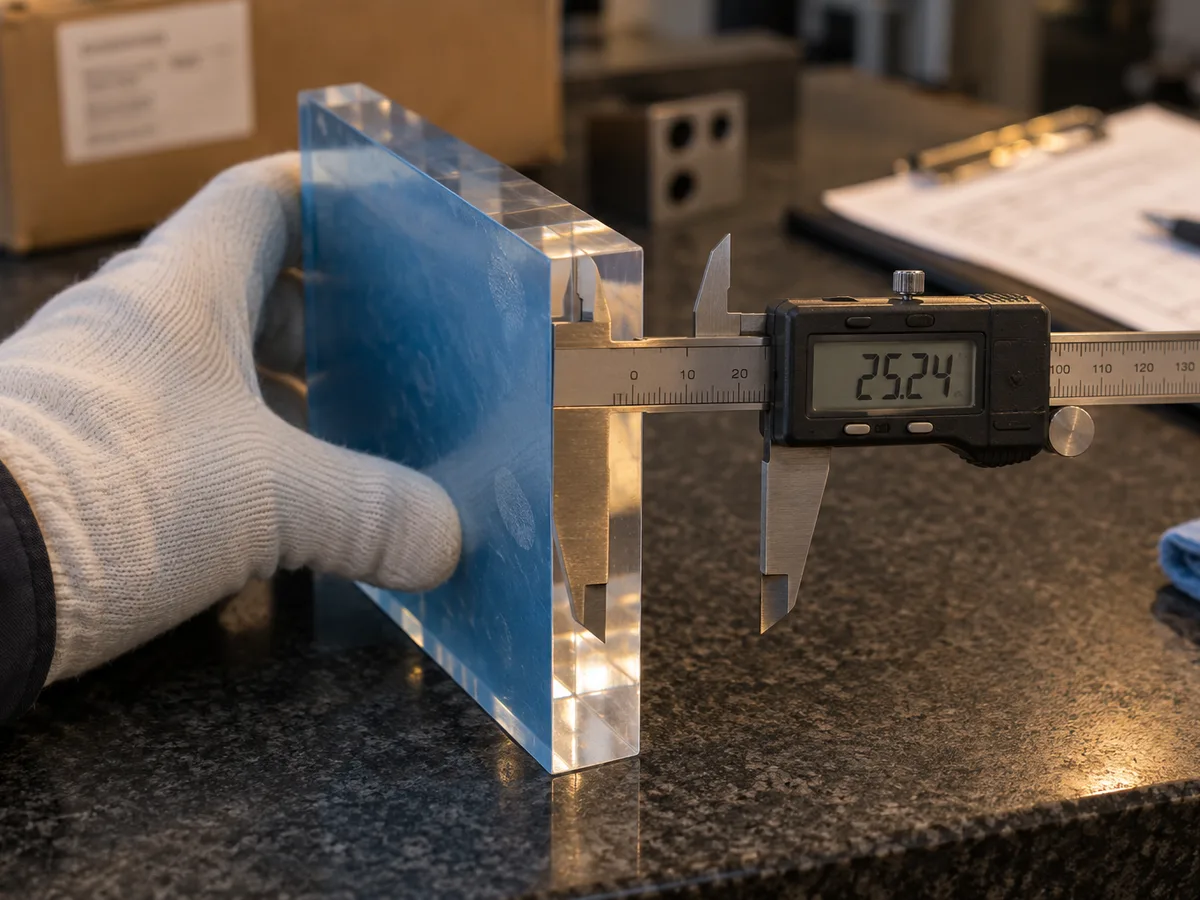
Held across the full sheet and across batches. Gives you reliable UV flatbed print-head clearance on Mimaki UJF, Roland VersaUV, Canon Arizona, or EFI Pro beds — no manual re-measure per piece.
Diamond-Polished, Ship-Direct Ready
All four edges diamond-polished to optical clarity. No post-processing between your UV flatbed and the end customer's unboxing. Print, QC, box, ship — the substrate is finished when it lands on your bed.
UV-Workflow Protective Film
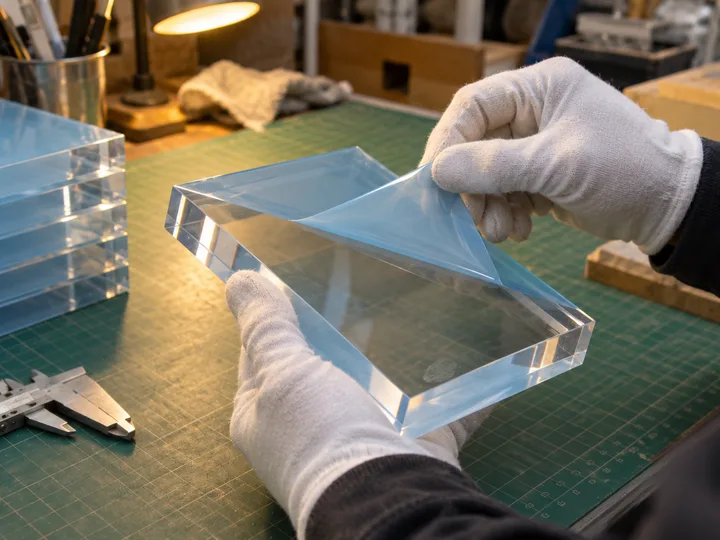
Low-tack polyethylene (PE) film on both faces. Front peels cleanly at load time with no adhesive residue. Back stays on through printing, QC, and the end customer's unboxing — no separate protective sleeve required.
Reverse-Print Layer Structure — Spec Sheet for Print Labs
Wetop supplies the blank substrate (Layer 1 below). Your UV flatbed produces Layer 2 (CMYK reverse image, mirror-printed on the back face at 1440 dpi) and Layer 3 (white ink backing for full opacity). This section exists so you can verify our substrate spec lines up with your printing workflow before placing a sample order — same reverse-print structure you're already producing, same end result for the end customer, just a more consistent substrate feeding into the process.
Layer 1 — Optical-Grade Cast Acrylic (Wetop supplies)
Cast PMMA at 92% light transmission — no yellowing, no cloudiness, no internal stress marks under edge-on inspection. Cast (not extruded) because extruded acrylic shows flow lines that become visible once reverse-printed. Whether you spec acrylic, plexiglass, or perspex, it's the same material: polymethyl methacrylate.
Layer 2 — CMYK Reverse Image (your UV flatbed)
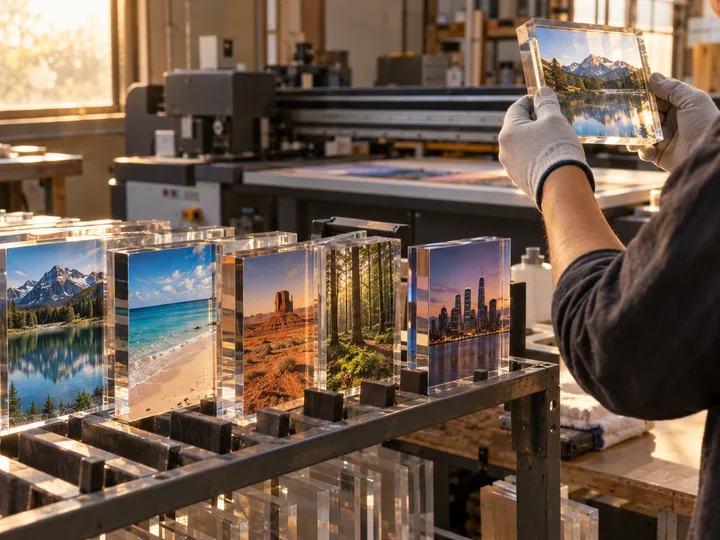
Your UV flatbed prints the image mirror-reversed onto the back face of the blank at 1440 dpi (or whatever DPI your job specs). Viewed through the diamond-polished front, the image reads correctly oriented with a sense of optical depth. No paper, no adhesive, no lamination — the acrylic itself is the protective front layer over your ink.
Layer 3 — White Ink Backing (your UV flatbed)
After the CMYK image, your flatbed lays down opaque white ink on top. The white layer blocks back-side light transmission and pushes color saturation — without it the image reads translucent, like stained glass. It also protects your CMYK layer from scratches on the back face.
Edge Finish — Diamond-Polished (Wetop supplies)
All four edges ship diamond-polished to optical clarity — no post-processing between your print run and the end-customer's unboxing. Polished edges transmit light along the block perimeter, producing the signature photo-block glow the market expects. Flame-polished substitutes look cloudy edge-on and are reject-risk for premium SKUs.
Standard Sizes Print Labs Stock
Most UV print labs stock 3–5 standard photo block sizes between 4"×6" and 11"×14" to cover the full end-consumer photo gift range. Two standard thicknesses — 1" (25mm) and 1¼" (30mm) — create the solid, weighted block feel that distinguishes this product from flat panels and framed prints. Custom thicknesses available on request. The 5"×7" at 25mm is by far the highest-volume SKU across labs we supply.
Standard Photo Block Sizes
| Size (inches) | Size (mm) | Thickness | Weight (25mm) | Best For |
|---|---|---|---|---|
| 4" × 6" | 102 × 152mm | 1" (25mm) | ~580g | Entry-tier photo gift SKU — high unit volume |
| 5" × 5" | 127 × 127mm | 1" (25mm) | ~600g | Instagram-format square — social gifting channel |
| 5" × 7" | 127 × 178mm | 1" (25mm) | ~840g | Highest-volume SKU across print labs — lead your stock here |
| 6" × 8" | 152 × 203mm | 1" (25mm) | ~1,150g | Mid-tier SKU — event photography workflows |
| 8" × 10" | 203 × 254mm | 1" or 1¼" | ~1,530g | Gallery-grade SKU — typically 30mm for premium tier |
| 8" × 12" | 203 × 305mm | 1" or 1¼" | ~1,840g | Panoramic SKU — landscape / wedding albums |
| 11" × 14" | 279 × 356mm | 1¼" (30mm) | ~4,400g | Premium tier — always 30mm, freight-packed |
| Custom | Any dimension | 1" or 1¼" | Varies | Custom thickness available on request |
Weights are approximate for clear cast acrylic. Actual weight varies slightly by manufacturer batch.
Thickness Guide
| Thickness | Visual Feel | When to Use | Cost |
|---|---|---|---|
| 1" (25mm) | Substantial — the print-lab standard | All SKUs 4"×6" through 8"×12". Covers 80%+ of typical print-lab volume. Best balance of substrate cost and end-customer perceived weight. | Standard |
| 1¼" (30mm) | Heavy, gallery-grade | Premium-tier SKUs at 8"×10" and above — used for gallery-grade prints, fine-art labs, and premium photo-gift product lines where the extra heft justifies a higher retail price point | +20–25% |
Why most labs stock only 1" and 1¼"?
Anything under 1" reads as a flat panel to the end customer, not a block — and competes on price with framed prints. Anything over 1¼" adds substrate cost and freight weight without proportional retail-price lift. Photo blocks stand free on any flat surface; the 1"–1¼" thickness acts as a built-in base, so the end-customer gets zero assembly. Need a non-standard thickness for a specific SKU? Custom thicknesses are available — send us your spec.
Not sure which sizes to stock for your market?
Print Lab Supply Program — Sampling, QC, Cadence, Shipping
This section covers the four operational questions every photo print lab asks before switching substrate suppliers: how do we test your blanks first, what QC runs on every batch before it ships, what MOQs and repeat-order cadences make sense for our volume, and how do the blanks land in our facility (carrier, incoterm, 3PL drop-ship). If anything below doesn't fit your workflow, tell us — most print labs we supply are running a slightly different spec, and we'd rather quote what you actually need than sell you our defaults.
5-Block Sample Kit — How the First Test Works
- What's in the kit: 5 blanks in your target size and thickness, PE film on both faces, packaged the way your production order would ship — so the sample tests your UV flatbed AND our packaging spec in one pass.
- What to test: color-profile the substrate against your current supplier's sheet, run your highest-reject SKU through it, pull 1 blank off the bed unprinted and inspect edges under raking light, stress-test the protective film peel.
- Turnaround: ready to ship in 3–5 days from spec lock. Air freight to most print-lab markets in 4–7 days.
- Cost: sample kit is credited against your first production order. If the sample fails your QC, keep the kit — no return, no restocking fee.
QC — What We Check Before Every Batch Ships
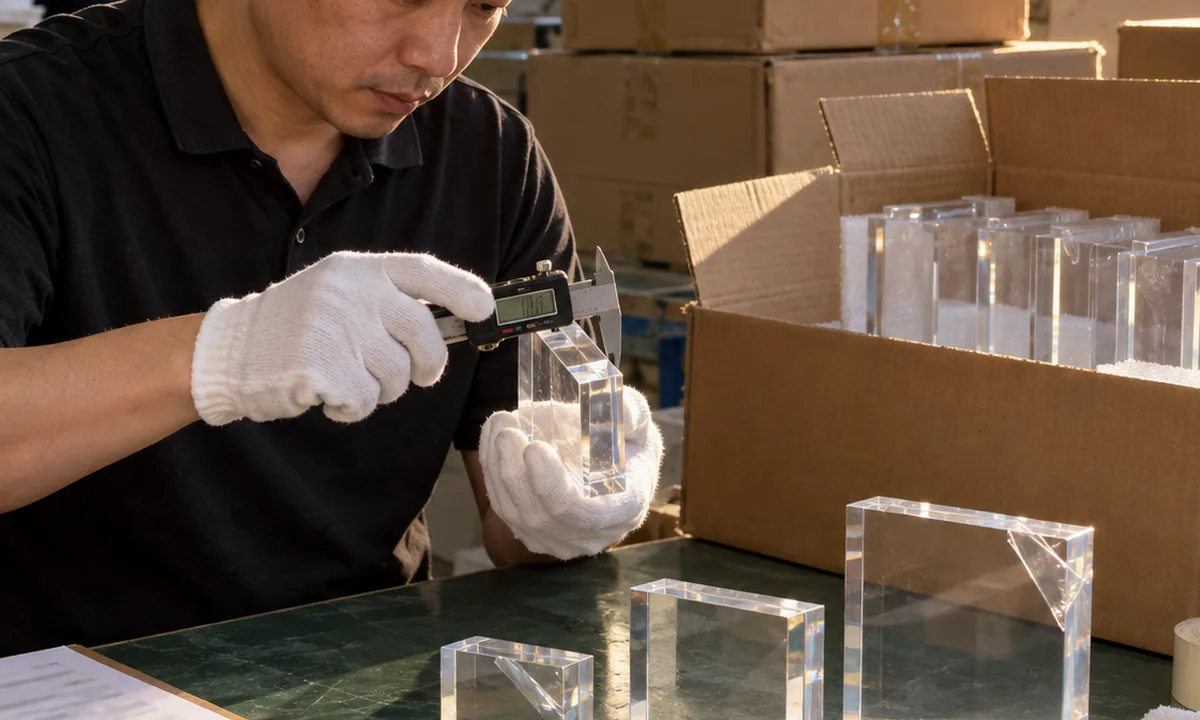
- Thickness: caliper-measured at 4 corners + center on a random sample from each production batch. Any piece outside ±0.3mm is rejected before packaging.
- Light transmission: spectrometer-checked against our 92% baseline on each mill-run lot. Out-of-spec lots don't enter the packaging line.
- Edge polish: 100% visual inspection under raking light for cloudiness, chip, or flame-polish contamination. Polished edges are the highest end-customer-visible spec — zero tolerance.
- Surface: 100% visual inspection for scratches, inclusions, or film-adhesion defects before bagging.
- Batch documentation: each shipment includes a batch slip (mill lot, thickness readings, light transmission reading, QC operator ID). Useful when your end customer escalates a complaint — you can trace to the exact production run.
Protective Film — Included on Request
Most print labs require protective film on both faces of blank photo blocks. The film prevents surface scratches during storage, handling, and UV printer bed loading. Peel the front film before printing, leave the back film on through your customer's unboxing.
- Film type: Low-tack polyethylene (PE) — peels cleanly without adhesive residue even after months of storage
- Coverage: Both large faces (front and back). Edges are left exposed — they're diamond-polished and don't scratch under normal handling
- When to peel: Front film immediately before loading onto your UV printer bed. Back film stays on during printing, QC, packing, and shipping
- Default: Protective film is included at no extra charge on all blank block orders when requested. Specify "with protective film" in your quote request
Print Lab Order Sizes
| Order Size | Pricing | Typical Customer |
|---|---|---|
| 50–299 pcs | Starting price | Print labs testing a new substrate supplier before switching |
| 300–499 pcs | 10–15% off | Established print labs on a quarterly restock cadence |
| 500–1,000 pcs | 20–25% off | High-volume labs, photo POD services, gift-print platforms |
| 1,000+ pcs | Best rate (30%+ off) | Enterprise labs on monthly supply contracts |
Order Cadence & Shipping Terms
- Typical cadence across print labs we supply: monthly restock for high-volume photo POD services (same SKU mix locked), quarterly for mid-volume specialty labs, seasonal bulk (2 waves) for wedding-season and Q4-holiday-driven print partners.
- Lead times: 15–20 days on first production order; 10–15 days on repeat orders once your spec is locked. Sample kit: 3–5 days.
- Incoterms: FOB Shenzhen (you handle freight), CIF to your port (we handle ocean + insurance), or DDP to your warehouse (we handle duties + last-mile). Most print labs on a monthly cadence prefer DDP for predictable landed cost.
- 3PL drop-ship: we can ship directly to your 3PL in the US, EU, or UK if you share receiving spec. High-volume labs often hold a 30–60 day buffer stock near their facility rather than ship each order to their own dock.
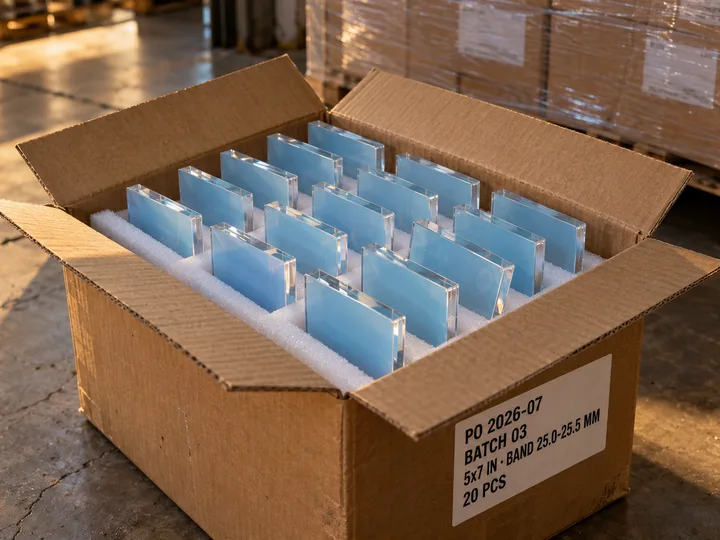
- Packaging: partitioned double-wall cartons with foam dividers; each piece individually film-protected. Carton labels can include your SKU reference and batch lot for direct integration into your receiving workflow.
We tested acrylic blanks from four suppliers. Two had inconsistent thickness that caused print head clearance issues. One had cloudy edges. Wetop's blanks have been running through our Mimaki flatbed for 14 months — zero substrate rejections, zero print failures from material defects.
Print Lab Supply Cases
Representative supply programs we run for UV print labs and photo POD services. Product names and volumes anonymized — reference specs and delivery terms are accurate.

US Photo POD Service — Monthly Supply
2,000 units/mo · 5×7 · 25mm cast acrylic · ±0.3mm tolerance · Diamond-polished · PE film both faces · Partitioned cartons, 3PL drop-ship

EU Photo Gift Platform — Multi-SKU
4 SKUs (4×6, 5×7, 6×8, 8×10) · 25mm clear · Seasonal restock 500–1,200 pcs per SKU · CIF Rotterdam · Locked substrate spec since sample approval

Specialty Photo Lab — Gallery-Grade 30mm
300 units · 8×10 · 30mm premium thickness · Diamond-polished · Individually film-protected · Protective corner packaging for freight

Wedding Print Partner — Seasonal Ramp
500 units · 5×7 · 25mm · Delivered in 2 waves to absorb Apr–Jun peak · Pre-profiled batch (same mill run) for color consistency across the wedding season
The substrate side is the boring-but-critical part of running a photo print lab — if it drifts, we eat the reprint cost. We hold a Wetop spec lock now: same mill grade, same polishing spec, same packaging every month. Our UV flatbed color profile hasn't needed re-calibration between batches in over a year of supply.
Running a photo print lab or photo POD service? Let's talk substrate.
Request a 5-Block Sample KitAcrylic Photo Blocks vs Glass Photo Prints — Substrate Comparison
Print labs evaluating photo block substrates weigh acrylic (PMMA) against glass on five operational inputs: freight weight and breakage rate, UV ink adhesion, edge-finishing cost, end-customer retail price point, and return-rate risk. Acrylic wins on freight (50% lighter), breakage (won't shatter in transit), ink adhesion (direct UV bonding, no intermediate coating), and edge finishing (diamond polishing vs more expensive glass grinding). Glass retains an advantage only on scratch resistance, which matters for permanent gallery installs but not for e-commerce photo gifting.
| Factor | Acrylic Photo Block (PMMA) | Glass Photo Print |
|---|---|---|
| Weight | ~670g (5×7 at 25mm) — 50% lighter | ~1,340g at equivalent size |
| Light transmission | 92% — maximum color vibrancy | 85–90% — slightly muted |
| Shatter resistance | High — won't shatter if dropped | Shatters — unsafe for shipping |
| Edge finish | Diamond-polished to optical clarity | Ground and polished — more expensive |
| UV printing | Direct UV ink bonding — permanent | Requires intermediate coating |
| Shipping cost | Lower weight, simpler packaging | Heavier, reinforced packaging |
| Yellowing | UV-stable — no yellowing 10+ years | No yellowing (advantage glass) |
| Scratch resistance | Moderate — soft surface | Higher — harder surface |
| Custom shapes | Laser-cut or CNC to any outline | Limited — grinding is expensive |
| Cost | Mid-range | Higher (material + processing) |
Related guide: Acrylic vs Glass for Displays — a full comparison across all display and print applications.
What Moves the Substrate Price Per Piece?
Blank acrylic photo block pricing is driven by five substrate inputs: block size, acrylic thickness, edge-finishing spec, packaging spec, and monthly/repeat volume commitment. We don't publish fixed prices because every print lab runs a slightly different SKU mix and cadence — but here's what moves the number in your quote. The biggest lever by far is volume commitment: a fixed monthly supply contract unlocks 20–30%+ vs a one-off order at the same piece count.
Block Size
Substrate area drives material cost. 8×10 uses 3.3× more acrylic than 4×6. Stocking 3–5 SKUs in bands lets you use the same mill lot across multiple end-customer price points.
Acrylic Thickness
30mm uses ~20% more material than 25mm. Most print-lab volume sits at 25mm; 30mm is reserved for premium-tier SKUs where the retail markup covers the substrate delta.
Edge Finishing Spec
Diamond polishing on all four edges is standard and included. Beveled or rounded corners add a secondary machining step — typically 10–15% per unit. Most labs don't use them; they slow end-customer perceived “block-ness.”
Packaging Spec
Partitioned carton with foam dividers is standard. Add-ons: carton labels printed with your SKU reference and batch lot, inner polybags for each piece, palletized pre-built loads for 3PL intake. Small per-piece cost; meaningful receiving-workflow savings.
Volume Commitment
The largest cost lever. Unit price drops 10–15% at 200 pcs, 20–30% at 500 pcs, 30%+ at 1,000 pcs. A fixed monthly or quarterly supply contract unlocks the top tier even at mid-volume piece counts.
Onboarding a New Substrate Supplier — 3 Steps
From first inquiry to monthly supply cadence — the usual path for a photo print lab evaluating a new blanks supplier.
Share Your Substrate Spec
Tell us SKU sizes, thickness, monthly or seasonal volume, UV flatbed model (for clearance math), packaging needs, and incoterm preference. If you're switching from another supplier, share the pain points — we've heard most of them and can tell you upfront whether we fix them or not.
We respond within 24 hoursRun the 5-Block Sample Kit
We ship a 5-piece kit in your exact target spec, packaged the way production would ship. You run it through your UV flatbed, color-profile it, pull one unprinted for edge QC, and stress-test the protective film. What you approve is exactly what scales.
Sample ready in 3–5 daysLock the Spec, Set the Cadence
First production order runs 50–299 pcs (tier 1) or straight to your forecasted monthly volume. Spec is locked by written confirmation — same mill grade, same polishing spec, same packaging every shipment. We ship FOB, CIF, DDP, or direct to your 3PL.
Production in 15–20 days (first), 10–15 days repeatFrequently Asked Questions
How do you guarantee batch-to-batch optical consistency for our color profile?
Every blank is cut from the same grade of cast acrylic (PMMA) — 92% light transmission, no cloudiness, no internal stress marks. Light transmission and surface gloss are measured on each production batch before shipping. Print labs typically re-profile their UV flatbed after a supplier switch; once you're on our substrate, re-profiling between our batches is rarely needed because the optical properties don't drift. We'll send a data sheet with each shipment on request.
What is the thickness tolerance, and will it clear our UV flatbed print head?
We hold ±0.3mm across the full sheet on 25mm and 30mm blanks. For a Mimaki UJF, Roland VersaUV, Canon Arizona, or EFI Pro flatbed running at a 1.5mm head clearance, ±0.3mm leaves you 1.2mm of headroom on the thickest piece in a batch. If you run tighter clearance or a different printer, send us the spec and we'll confirm whether 25mm, 30mm, or a custom thickness fits your bed best.
What protective film do the blanks ship with, and which side do we peel before printing?
Both faces ship with low-tack polyethylene (PE) protective film. Peel the print face immediately before loading onto the UV flatbed bed — the film peels cleanly with no adhesive residue, even after several months of storage. Leave the back face film on through printing, QC, boxing, and your customer's unboxing. Edges are diamond-polished and ship exposed; they don't scratch under normal handling.
Can we test a small sample before committing to a full supply contract?
Yes — we ship a 5-block sample kit in your target size and thickness, with protective film and your specified packaging. Most print labs run it through their UV flatbed for color profile testing, edge QC, and customer-unboxing simulation before scaling. If the sample passes your internal QC, we move to a first production order at 50–299 pcs (tier 1 pricing) and build from there to a monthly or quarterly supply cadence.
What are the lead times, packaging options, and shipping terms for ongoing supply?
Production runs 15–20 days for first orders, 10–15 days for repeat orders on a locked spec. Blocks ship in partitioned double-wall cartons with foam dividers — each piece individually film-protected, no piece contacts another. We quote FOB Shenzhen, CIF to your port, or DDP to your warehouse. High-volume print labs on a monthly cadence often hold a 30–60 day buffer stock in a 3PL near their facility; we can ship directly to your 3PL if you share the address and receiving spec.
Testing a New Substrate Supplier? Start With a 5-Block Sample Kit
Tell us your size, thickness, monthly volume, and current substrate pain points. We ship a 5-block sample kit so you can run it through your UV flatbed, color-profile against your current substrate, and test edge QC before committing. If the sample passes your internal QC, we move to a first production order with volume pricing, packaging spec, and a shipping term (FOB / CIF / DDP / 3PL drop-ship) that fits your fulfillment workflow.