

Plexiglass vs Glass Displays: Weight, Impact, Cost
Choosing between acrylic and glass for your display isn't about which material is better — it's about which tradeoffs your project can actually live with.
Need this made?Custom acrylic display cases →
Key Takeaways
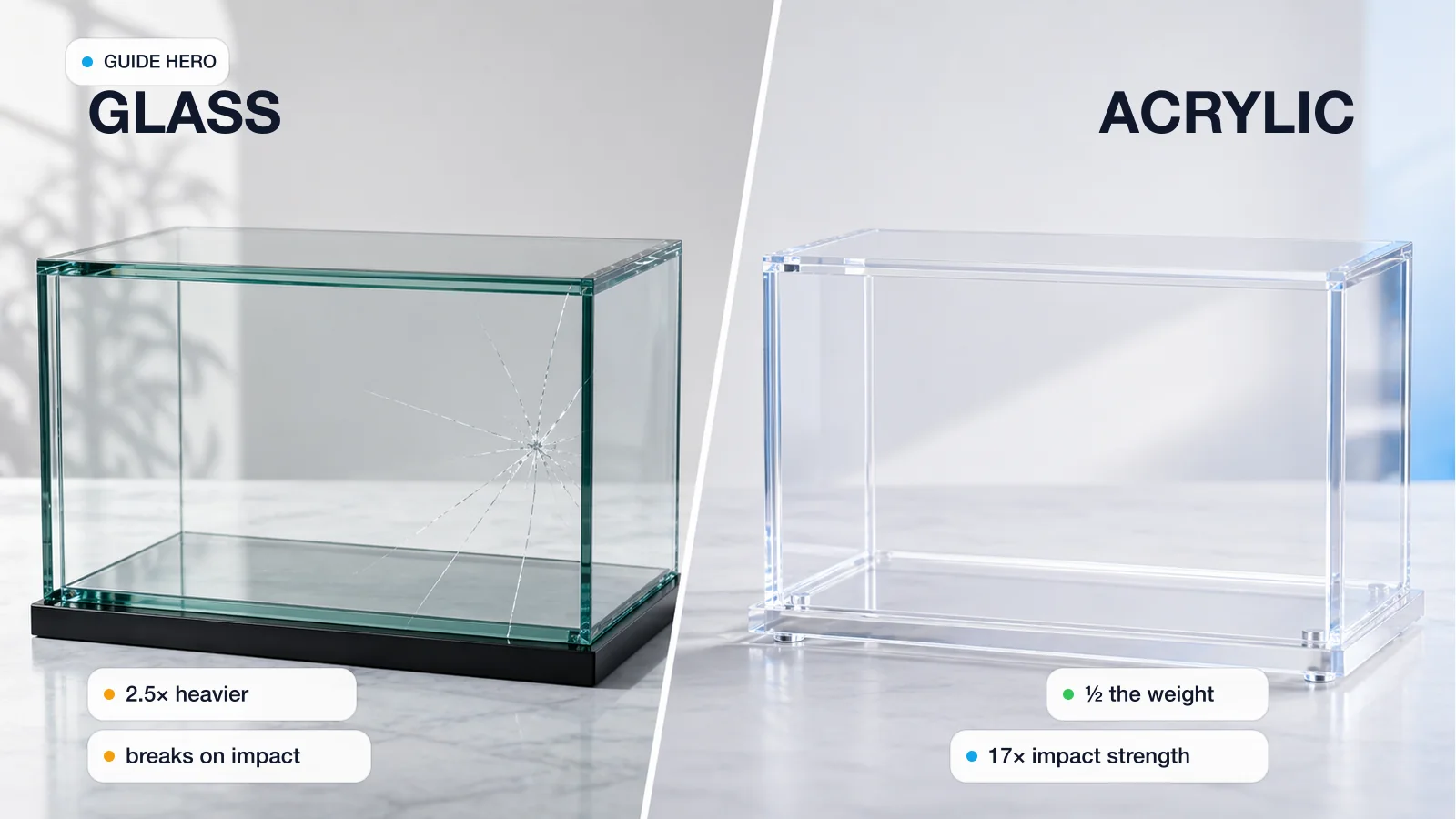
- Acrylic (plexiglass) weighs roughly half as much as glass at equal thickness — a 24" × 36" glass panel runs about 15 lbs; the acrylic equivalent is around 7.5 lbs.
- Cast acrylic transmits 90–92% of visible light, matching or exceeding standard float glass (88–90%) — the "glass is clearer" assumption is usually wrong.
- Acrylic and glass fail differently; the approved grade, thickness, support and applicable safety requirement decide whether either construction is suitable.
- Glass keeps an advantage in surface hardness and higher-temperature applications, while acrylic requires a named grade and measured heat-load review.
- Choose on the complete brief: dimensions, load, clarity, cleaning, heat, fabrication, packing and the buyer's governing safety requirement.
On this page
- Plexiglass vs Glass Displays: What Should a Buyer Compare?
- How Acrylic and Glass Compare on the 5 Specs That Matter
- Where Glass Still Wins
- Weight, Safety, and Breakage: The Practical Gap
- Optical Clarity: Closer Than You Think
- Cost Comparison: What Buyers Actually Pay
- Which to Specify for Your Display Project
Plexiglass vs Glass Displays: What Should a Buyer Compare?
Plexiglass (acrylic, PMMA) is lighter than glass and far less likely to shatter, and it can be cut, bent and bonded into custom shapes; glass keeps the harder, more scratch-resistant surface. For most retail and collectible displays that trade favors acrylic; for heavy daily wiping or abrasive cleaning, glass can still win. “Plexiglass” and “acrylic” name the same material — see the plexiglass vs acrylic terminology guide.
| Published acrylic price reference | Quantity | Single cost point |
|---|---|---|
| 150 × 100 × 100 mm case · 3 mm clear acrylic · magnetic lid | 500 pieces | $6 per unit FOB Shenzhen · published low-end reference, not a quote for this display |
Compare the two materials on the same approved dimensions, load, hardware, cleaning method and packing route instead of treating either name as a complete specification. On our side, acrylic displays run from 100 pieces per design after a paid sample (3–5 days), with production in 15–20 days and a ±0.2 mm standard working tolerance (Wetop acrylic standard).
How Acrylic and Glass Compare on the 5 Specs That Matter
Acrylic and glass differ across five properties that actually drive display project decisions: optical clarity, weight, impact resistance, workability, and scratch resistance. The table below uses real material data — not marketing claims.
For display applications specifically, optical clarity and weight are usually the deciding factors, with impact resistance becoming critical as soon as the product ships by sea freight. Workability matters when your design involves curves, complex cuts, or custom shapes — glass fabrication is slow and expensive compared to laser or CNC acrylic work. Scratch resistance is the one dimension where glass has an unambiguous advantage, and we’ll cover it honestly in the next section.
Plexiglass vs glass: material property comparison
| Property | Acrylic (Cast PMMA) | Standard Float Glass | Winner |
|---|---|---|---|
| Light transmittance | 90–92% (ASTM D1003) | 88–90% | Acrylic (slight edge) |
| Density | ~1.19 g/cm³ | ~2.5 g/cm³ | Acrylic (2.1× lighter) |
| Impact behavior | Cracks or chips according to grade, thickness and support | Breakage mode depends on annealed, tempered or laminated construction | Project-specific |
| Scratch hardness (Mohs) | 2–3 | ~6 | Glass |
| Custom fabrication | Laser, CNC, thermoform | Cut and grind only | Acrylic |
| UV stability (standard grade) | Yellows without UV treatment | Stable | Glass |
| UV stability (specified grade) | Follow the named sheet datasheet | Follow the named glass/coating datasheet | Project-specific |
| Failure mode | Depends on grade, thickness and support | Depends on annealed, tempered or laminated construction | Project-specific |
| Weight per m² at 5mm | ~6 kg | ~12.5 kg | Acrylic |
The transmittance figures for cast acrylic are documented by major PMMA manufacturers, including Plaskolite1 and Evonik PLEXIGLAS2, and measured against the ASTM D1003 haze and luminous transmittance standard3 — the industry method for comparing clarity across transparent plastics.
Where Glass Still Wins
Glass may be the better candidate for higher-temperature environments, abrasive cleaning routines and permanent architectural installations where surface hardness controls the decision. The final choice still needs the named grade, support, safety requirement and cleaning method.
Three questions commonly move a brief toward glass: does the measured heat load exceed the selected PMMA datasheet limit; does the approved cleaner or cleaning frequency conflict with PMMA; or does the installation require an optical coating or safety construction available only in the specified glass system? Answer those questions with project data rather than a universal temperature or service-life threshold.
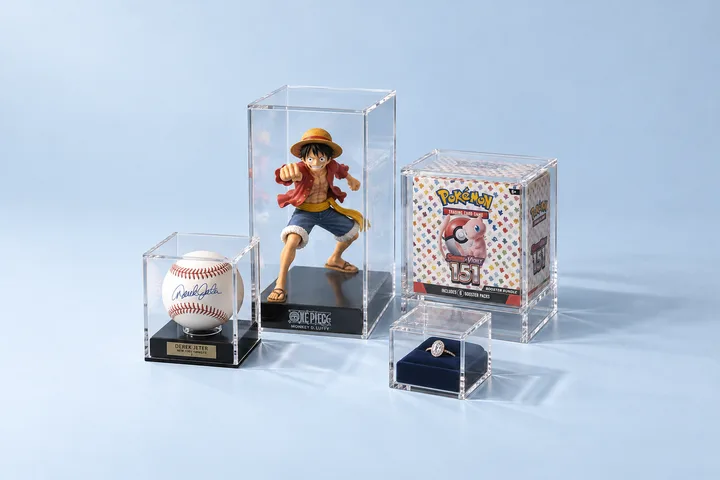
For custom display cases, countertop stands, retail fixtures, POP displays, exhibition booths and trading card displays, acrylic remains a candidate when its named grade, geometry, packing and care plan meet the buyer’s requirements.
Weight, Safety, and Breakage: The Practical Gap
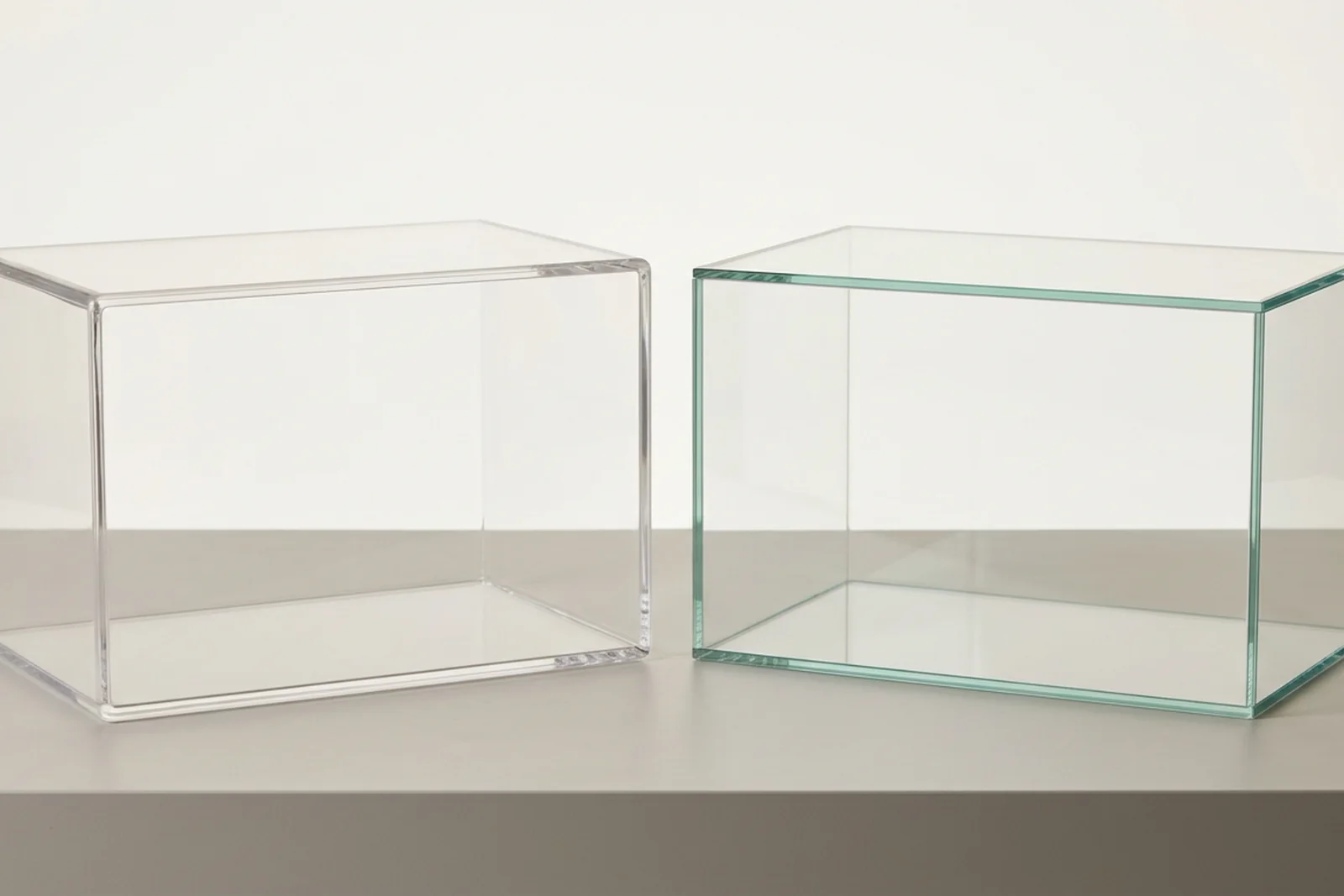
The weight difference between acrylic and glass is not academic — it has direct, measurable consequences for shipping cost, display installation, and product safety. A 5mm acrylic panel weighs approximately 6 kg per square meter; the equivalent glass panel weighs approximately 12.5 kg. For a display case with four panels totaling 1 m² of material, that’s 6.5 kg of weight savings per unit before you add the base and hardware.
Packing must be quoted for the actual material, construction and route. Glass may require a different crate, padding and handling plan from acrylic, while either material can be damaged by poor support; compare packed dimensions, gross weight, protection and acceptance checks on the same delivery term.
For public-facing retail displays, review failure mode against the named grade, thickness, support and required safety construction. Annealed, tempered and laminated glass behave differently, as do PMMA grades and finished assemblies. Use the governing requirement and supplier data rather than a universal material-safety ranking.
Optical Clarity: Closer Than You Think
The assumption that glass is optically superior to acrylic is one of the most persistent misconceptions in display material selection — and it’s usually based on comparing low-grade extruded acrylic against high-quality float glass. Cast acrylic, which is what we use in all Wetop display cases and stands, transmits 90–92% of visible light. Standard float glass transmits 88–90%. The measured difference, per ASTM D1003, is essentially zero for human perception in a display context.
Where acrylic can look inferior is when buyers specify extruded acrylic instead of cast. Extruded acrylic is cheaper and more dimensionally consistent, but its lower molecular weight causes microscopic internal stress lines that scatter light and create a faint haze — particularly visible on thick pieces. Above 6mm, we always specify cast acrylic for displays where optical quality matters. The haze value (measured as the percentage of scattered light) for quality cast acrylic runs below 1%, which matches or beats float glass in side-by-side comparison. If you’ve ever seen acrylic that looked milky or slightly yellow next to glass, that’s a material grade issue — not an inherent property of PMMA.
The one optical area where glass holds a practical edge: anti-reflective coatings. Museum glass with multi-layer AR coatings achieves near-zero surface reflection, which acrylic AR coatings approximate but don’t quite match for the most demanding archival display applications. For standard retail and commercial displays, this difference is invisible to end customers.
Cost Comparison: What Buyers Actually Pay
Cost must be compared from current quotes for the same finished dimensions, grade, thickness, hardware, fabrication, packing, quantity and delivery term. Raw sheet prices alone omit cutting, finishing, assembly, crate design and freight.
Use the published acrylic reference above only for orientation, not as a quote. A decision between acrylic and glass needs two like-for-like supplier quotations and a separate review of weight, handling, cleaning and replacement requirements; no fixed percentage applies across projects.
For an exact cost comparison on your specific display design, send specs via our contact form — we’ll quote both materials if your application genuinely calls for comparison, and we’ll tell you directly which we recommend. We respond within 24 hours.
Before requesting those quotations, make a comparison sheet with one row for each component. Record the finished dimensions, visible edges, opening method, base, fasteners, and replacement access. Ask each supplier to mark any proposed substitution directly on that sheet. Keep packing and delivery terms in separate rows so a lower unit price does not hide a different scope. For sample review, use the same counter location, lighting, displayed objects, and cleaning routine for both candidates. Photograph each sample from the customer viewing position and record the changes required before approving a production drawing.
Which to Specify for Your Display Project
Start with the buyer’s load, span, safety requirement, heat, cleaning and optical criteria; then compare named acrylic and glass constructions against that same brief.
Keep glass in the comparison when the specified glass construction better meets the approved surface-hardness, heat, coating or architectural-safety requirement.
Keep acrylic in the comparison when lower density, sheet fabrication or thermoforming supports the design and the named PMMA grade meets the approved heat, cleaning, optical and safety criteria.
For custom display cases, countertop stands, acrylic risers, and retail display fixtures, we fabricate in cast acrylic as the default — 3mm to 20mm depending on the application. Cosmetic brands and luxury beauty merchandising are among the clearest beneficiaries of the switch: the weight savings and impact resistance matter when floor sets are installed and refreshed seasonally — see our guide on cosmetic merchandising with acrylic displays for how those tradeoffs play out in practice, and our acrylic cosmetic organizers case study for a real production example. If your design brief specifies glass and you want a second opinion on whether acrylic is viable, include that question when you send your RFQ. I review every quote personally and will give you a direct answer, not a sales pitch.
For thickness selection within acrylic — which is often the follow-on question after material selection — see our acrylic thickness guide covering load, span, and cost tradeoffs from 1.5mm to 25mm. The same acrylic-vs-glass math shifts again in habitat applications, where daily handling, moisture, and heat-lamp proximity change the weighting — our acrylic reptile enclosure buyer guide runs the numbers for that vertical. For the product categories where acrylic vs glass comparisons come up most often, see our acrylic display cases and acrylic display stands pages, and for industry context, our point-of-purchase display use cases show where break resistance and transit durability tip the decision toward acrylic.
Food-service counter barriers add cleaning, bracket and multi-site installation constraints; the sneeze guard glass versus acrylic buyer guide keeps that decision separate from general display cases.
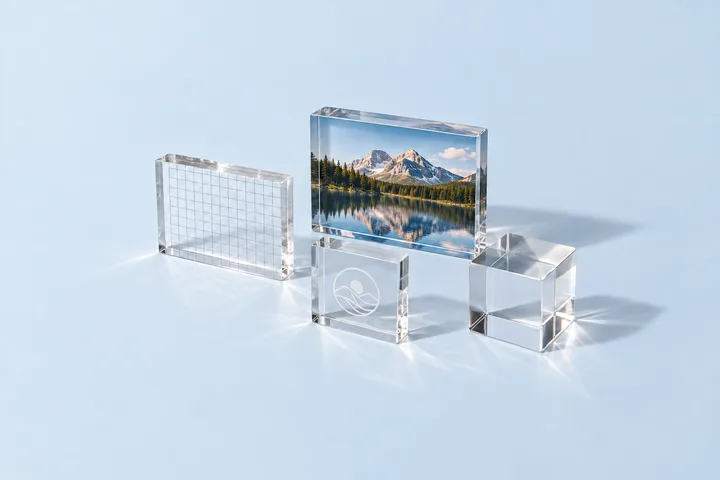
For desktop and reception applications, branded acrylic blocks show a thick-PMMA format; compare its finished weight, packing and optical result with any proposed glass alternative on the actual brief.
Footnotes
-
Plaskolite — Cast and Extruded Acrylic Technical Resources — US-based PMMA sheet manufacturer; publishes optical property data and thickness tolerances for cast and extruded acrylic grades used in display fabrication. ↩
-
Evonik PLEXIGLAS — Acrylic Sheet Products — manufacturer of PLEXIGLAS-brand cast and extruded PMMA; publishes transmittance, haze, and UV stability data for standard and UV-stabilized grades used in outdoor display and signage applications. ↩
-
Cast acrylic sheet visible-light transmittance ~92% (ASTM D1003 luminous-transmittance method) — Röhm PLEXIGLAS technical page documenting the ~92% light transmittance of PMMA sheet used to compare acrylic clarity against glass. ↩
Frequently Asked Questions
Plexiglass vs glass: which is clearer for displays?
2 material grades must be compared by their published datasheets: the quoted acrylic grade and the quoted glass grade. Cast acrylic commonly publishes high visible-light transmission, but haze, coatings, thickness, edge finish and cleaning condition decide the approved display result.
Will acrylic scratch more easily than glass?
1 clear advantage belongs to glass: its harder surface resists abrasive wiping better than acrylic. Approve the cleaning method and any coating on the sample, because grit in a cloth can mark acrylic even when the cleaner itself is compatible.
How much lighter is acrylic than glass?
2 density figures frame the comparison: acrylic is about 1.19 g/cm³ and common soda-lime glass about 2.5 g/cm³. Use the approved panel dimensions and thickness to calculate actual unit and carton weight before selecting hardware or freight.
Can acrylic be used outdoors instead of glass?
3 inputs come before an outdoor substitution: the exact acrylic grade and datasheet, the temperature and UV exposure, and the mounting design. Do not treat the word plexiglass as an outdoor-performance guarantee; approve the named grade and expansion allowance for the installation.
Does acrylic shatter like glass?
2 different failure modes must be evaluated: acrylic can crack or chip, while glass breakage depends on whether the panel is annealed, tempered or laminated. The buyer should specify the governing safety requirement and approve the finished construction rather than infer compliance from the material name alone.
Compare plexiglass and glass against one approved display brief
Send the dimensions, load, quantity, finish, hardware, packing and destination for a line-item acrylic quote and paid-sample plan. Sample fees are paid separately and are not credited to production.