Bakelite Mahjong Tiles vs Bone vs Acrylic: A Buyer Comparison
Separate antique identification from a new production brief, then approve the material, feel and finish on the actual sample.
Need this made?Custom mahjong set configurator →
Key Takeaways
- Color alone does not identify Bakelite, bone or acrylic. Valuable vintage sets require qualified assessment.
- Wetop makes new cast-PMMA tiles; we do not authenticate antiques or manufacture bone or Bakelite tiles.
- Compare dimensions, weight, edges and sound on actual samples under the same playing conditions.
- Heritage-inspired colors are modern acrylic choices; the physical sample determines approval.
- Custom production starts at 50 sets per design; a full custom tile sample is USD 500 including courier, separately paid and never credited.
On this page
- Bakelite, bone-and-bamboo and acrylic: what the names tell you
- Bakelite history: useful context, not an authentication test
- Bone and bamboo: inspect the two-part construction
- Why specify cast acrylic for a new custom set?
- Feel, weight and sound: compare the actual tiles
- Care: match the method to the material and finish
- Turning a heritage reference into a new acrylic brief
Prices in this guide are indicative reference estimates. The final written quote depends on the complete custom specification and order scope.
Bakelite, bone-and-bamboo and acrylic: what the names tell you
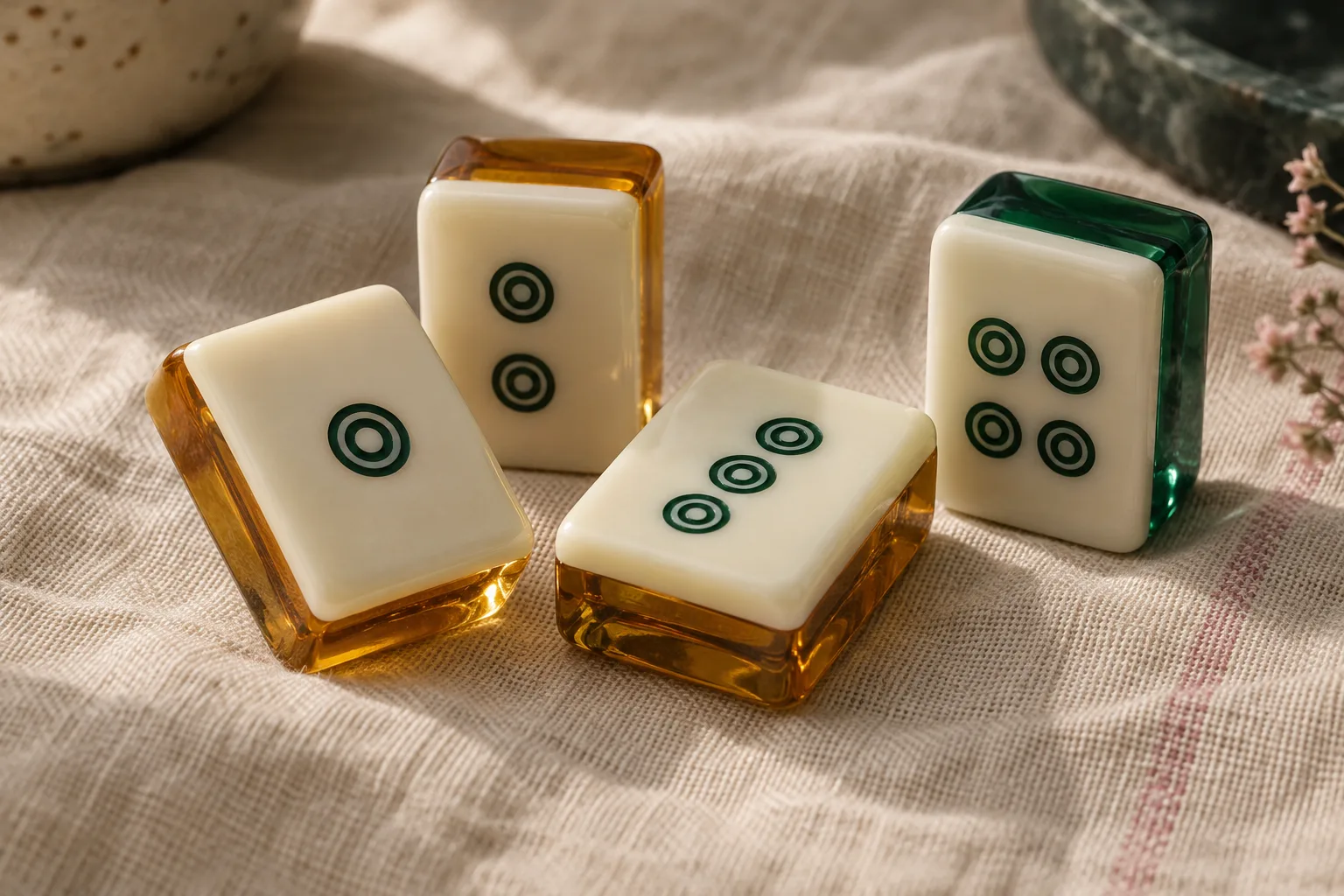
Bakelite mahjong tiles, bone-and-bamboo tiles and modern acrylic tiles are different material categories. A warm ivory or amber color does not identify a tile’s material. For an older set, provenance and specialist assessment matter; for a new custom set, specify the actual material, dimensions, artwork and approved sample.
Wetop manufactures new cast-acrylic mahjong tiles. We do not sell antique Bakelite, authenticate inherited sets or make bone tiles. This comparison helps separate a collector’s question from a production brief, especially when a brand brings a vintage-looking reference for a new American mahjong set.
| Question | Bakelite / vintage phenolic sets | Bone-and-bamboo sets | New cast-acrylic sets |
|---|---|---|---|
| What is being described? | A historical plastic material attribution that needs verification | A tile assembled from a bone face and bamboo back | PMMA body material specified for a new production run |
| What should you examine? | Provenance, markings, condition, repairs and inventory | Face/back construction, joints, condition and inventory | Dimensions, layer order, face process, colors and finish |
| Does a photograph prove material? | No | A visible joint helps describe construction, but does not authenticate it | No; confirm the material in the order and sample |
| What sets the feel? | The individual tile’s material, geometry and condition | Both components, geometry and condition | Chosen body dimensions, construction, finish and playing surface |
| What is the next step? | A qualified vintage specialist if identification or value matters | A qualified specialist for condition or restoration | A complete specification and paid physical sample |
If your goal is a new brand launch, start with custom acrylic mahjong tiles. If your goal is identifying an inherited set, this manufacturing guide cannot establish its age, value or authenticity.
Bakelite history: useful context, not an authentication test
Leo Baekeland developed Bakelite, a phenol-formaldehyde plastic, in 1907. The Science History Institute also distinguishes the later processes used for brightly colored phenolic objects. That history explains why vintage plastic names require care; it does not identify an individual mahjong tile from its color.1
A listing that says “Bakelite” is a seller’s description until its basis is established. Ask what documentation accompanies the set, whether any pieces are replacements, and whether the material has been examined. A complete inventory matters separately from material identity: an old set can be attractive yet lack the tiles required for the game its new owner wants to play.
Avoid treating a material name as a precise date range or an automatic quality grade. Repairs, substituted pieces and storage history can matter more to the practical use of an individual set. We do not assign a resale price or offer a home chemical test through this guide.
Bone and bamboo: inspect the two-part construction
Bone-and-bamboo tiles combine a face and a back. Inspect the individual set’s joins, visible cracks, loose parts and past repairs. Condition varies; it is not reasonable to assume that every old set has failed, or that every surviving set can tolerate the same cleaning or handling.
For an inherited set, photograph the faces, backs, side joints, any maker marks and the full inventory before seeking advice. Keep the original pieces together. A replacement tile made from modern acrylic should not be represented as an original bone component.
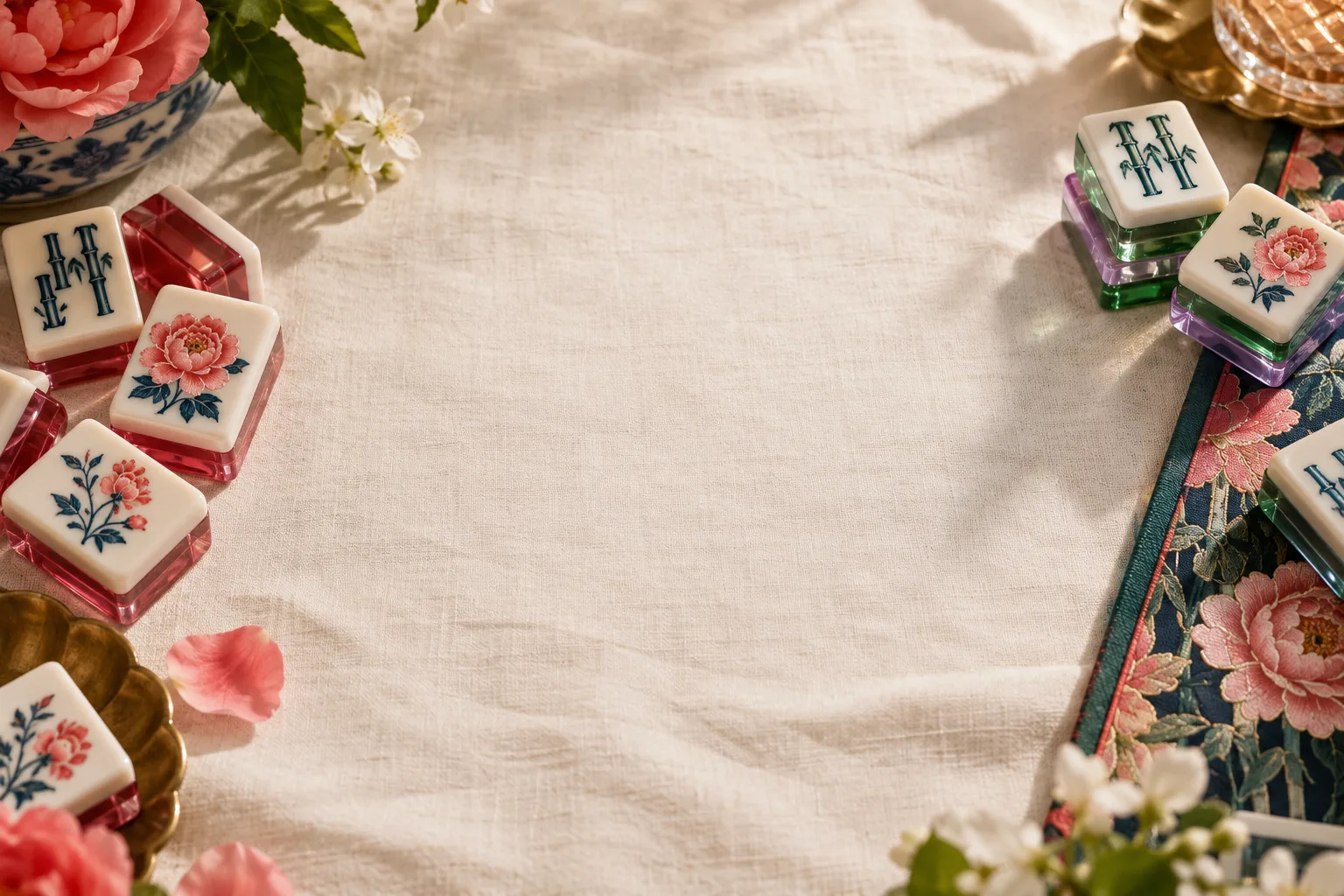
For a new manufacturing project, a two-tone appearance is a design reference rather than a request to reproduce the old materials. An ivory acrylic face and a contrasting back can give a layered appearance, but the construction and hand feel remain those of modern acrylic. Approve that distinction in the product description as well as in the physical sample.
Why specify cast acrylic for a new custom set?
Cast PMMA is Wetop’s current mahjong material. The buyer can specify the body size, one to four layers, stock sheet colors or a made-to-order sheet, and the face decoration. We cut and finish the body to the agreed specification; a drawing and physical sample define the finished product.
Three face routes are available: UV print with surface coating, engraving with UV color fill, and engraving with paint fill. These are separate choices from the body layers. A jade back does not determine whether the face is printed or engraved, and an engraved face does not establish a particular layer count.
The face-process comparison shows what to review. The specification guide collects the body, artwork and inspection decisions. Neither material choice nor an equipment list establishes a universal service life: the finished construction, handling and cleaning matter.
Feel, weight and sound: compare the actual tiles
Material alone does not predict which tile will feel heavier, warmer or louder. Dimensions, edge shape, finish and the table surface change the experience. Do not compare a large vintage tile with a smaller acrylic tile and attribute every difference to chemistry.
Use a repeatable sample review:
| Check | Keep consistent | Record the decision |
|---|---|---|
| Grip and edge feel | Same reviewer and ordinary playing conditions | Whether edges feel comfortable and tiles are easy to pick up |
| Weight | Identified tile body and the same scale | Measured tile or set mass; do not substitute an estimated blank weight |
| Sound | Same mat/table and similar handling | Whether the sample meets your preference; no universal “authentic clack” claim |
| Face reading | Same lighting and normal viewing distance | Contrast, small symbols and distinction between similar faces |
| Rack fit | The rack intended for the finished product | Seating, row capacity, pusher movement and removal |
Dimensions and row-length arithmetic are covered in the tile size guide. If you have a physical reference, explain which attributes matter. “Match this” is less useful than “retain this face size and warm color, but use our artwork and the agreed acrylic construction.”
Care: match the method to the material and finish
For a valuable vintage set, obtain material-specific advice before applying a cleaner, polish or restoration treatment. Advice for bare acrylic is not a care specification for aged phenolic plastic, bone, bamboo, ink or an old repair.
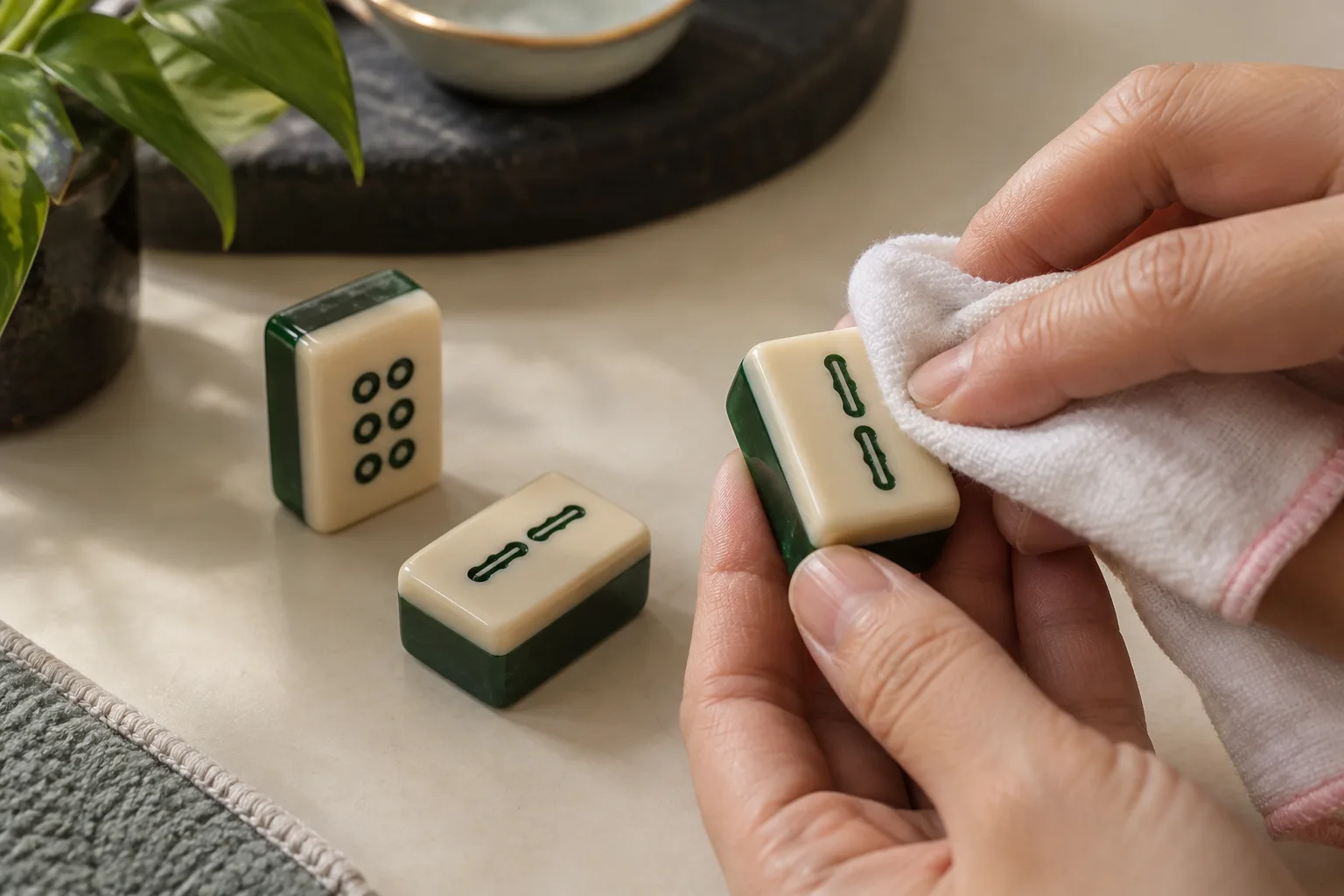
For acrylic, PLEXIGLAS recommends gentle cleaning using water and a soft cloth, with suitable mild cleaning agents where needed.2 A finished mahjong tile also has printed or filled details and possibly a coating. Confirm the finished product’s care instructions rather than assuming every cleaner suitable for raw PMMA is suitable for its decoration.
Start with a soft, lightly damp cloth; avoid abrasive rubbing and do not soak the set. Ask for confirmation before using a solvent, disinfectant or polish on decorated faces. Dry the tiles before storage and keep them separated from objects that can scratch them. Review any cleaning method intended for a club’s repeated use during sample approval.
Turning a heritage reference into a new acrylic brief
Choose the features you actually want to carry forward: a warm body tone, contrasting back, face proportions or a restrained artwork palette. Supply artwork you are entitled to use. An old photograph or a design already offered publicly is not automatic permission to reproduce someone else’s artwork.
The current 199-color sheet board includes solid and effect-sheet choices. Record the supplier code for each layer. If stock does not meet the project, ask about a Pantone-targeted sheet; the current planning allowance is about 15 days for that sheet plus about 10 extra days on the sample. Approve the physical result. Screen colors and pattern placement are not promises of an identical finished appearance.
For the standard tile offer, production starts at 50 complete sets per design. At 100–199 sets, published tile pricing is USD 53–60 for UV print with coating or USD 65–73 for either engraved fill route, depending on layer count, FOB Shenzhen; a published quantity ladder adjusts every other quantity. Standard shrink-wrap export packaging and stock dice are included; racks, mats, cases and printed retail packaging are separate. Check the price book for the itemized scope.
One complete custom tile sample is USD 500 including courier, paid separately and never credited to production. Normal sample making is 15–17 days after payment, ready files and proof approval; transit and buyer review are additional. This is the opportunity to approve the acrylic result, not evidence that it duplicates an antique material.
Send your quantity, body dimensions, layers, face route, color codes, artwork status, accessories and destination through the custom mahjong set configurator. Mark unresolved choices as open. If confidential artwork is involved, reasonable NDA terms can be reviewed before you share it; common manufacturing methods do not become an exclusive customer process.
Footnotes
-
Science History Institute — Leo Hendrik Baekeland. Material history, not authentication of an individual tile. ↩
-
PLEXIGLAS — cleaning and maintenance guidance. General acrylic guidance; decorated mahjong tiles need finish-specific confirmation. ↩
Common questions
Can you identify my vintage Bakelite mahjong set?
No. We manufacture new acrylic tiles and do not authenticate or value antiques. Ask a qualified vintage specialist and provide provenance, photographs and a complete inventory.
Do acrylic tiles feel exactly like Bakelite?
No identical-feel promise is made. Compare the actual dimensions, weight, edges, sound and finish on a physical sample.
Can you make a heritage-styled acrylic set?
Yes, subject to the agreed color, construction and artwork. Supply references and artwork you have permission to use; the resulting product is modern acrylic, not antique Bakelite.
Are marble or pearl acrylic colors available?
The stock color board includes effect sheets. Select supplier codes and approve the physical sample; pattern placement can vary. Made-to-order color has additional lead time.
How much is a custom tile sample?
One complete custom tile set is USD 500 including courier. Making normally takes 15–17 days after payment, ready files and proof approval; transit is additional. The fee is separate and never credited to production.