American Mahjong Tile Prototype: ChatGPT Artwork to Production
Know which decisions belong in the file, on the proof and in your hands before approving production.
Need this made?Custom mahjong set configurator →
Key Takeaways
- Outlined vector AI or PDF artwork needs a matching face inventory; the artboard count depends on your design.
- One complete custom tile sample costs USD 500 including courier, paid separately and never credited.
- Sample making normally takes 15–17 days after payment, ready files and proof approval; transit is additional.
- Classic engraved faces are available when custom artwork is not ready. We do not provide design or redraw services.
On this page
- What a production-ready mahjong tile file contains
- Use ChatGPT to draft vector artwork you can inspect
- Five common file problems to resolve before proofing
- What the digital proof can confirm
- One prototype set before a production run
- Body colors and the physical approval stage
- Confirm the material instead of relying on the word resin
- From the approved sample to production
- The brief that keeps the next reply useful
Prices in this guide are indicative reference estimates. The final written quote depends on the complete custom specification and order scope.
What a production-ready mahjong tile file contains
A mahjong tile prototype starts with a confirmed tile body, face inventory and production method, followed by outlined vector AI or PDF artwork. Repeated tiles reuse the same face file. The number of unique artboards depends on your actual design; there is no universal 35-artboard requirement.
For a custom American mahjong program, keep three documents together: the artwork, a list of faces and quantities, and the specification showing dimensions, layers and colors. A beautiful PDF with no quantity map can still produce the wrong set. A correct inventory with artwork at the wrong scale can still produce unreadable tiles.
Our artwork requirements cover file preparation. This guide explains when each decision is needed, what you approve and what can still change. We manufacture your finished artwork; we do not design, redraw, trace or vectorize it. If custom artwork is not ready, standard classic engraved faces remain an option.
| Item | What to supply | What we check |
|---|---|---|
| Tile body | Height × face width × thickness, in mm | The face layout matches the chosen body |
| Face inventory | Unique face name and number of copies | Total tiles and the artwork count agree |
| Artwork | Outlined vector AI or PDF, clearly named artboards | Paths, fonts, placement and process compatibility |
| Colors | Sheet codes by layer; separate face-color targets | Body material color is not confused with printed color |
| Process | UV print, engraved UV fill or engraved paint fill | Fine details are reviewed for the actual method |
| Revision | One dated file version and one approver | The sample is made from the approved version |
Use ChatGPT to draft vector artwork you can inspect
ChatGPT can help you plan a face inventory and write editable SVG code. Treat that output as a design draft. A generated picture is a visual reference; saving it as SVG or placing it in a PDF does not create the closed vector paths needed for engraving. OpenAI documents image creation and editing in ChatGPT, but that is a different step from checking a manufacturing file.1
The practical route is brief → SVG paths → vector-editor review → full-color vector PDF → proof → physical sample. Keep the original draft, the edited master and the approved export as separate revisions. Do not overwrite the file that was already approved.
1. Define one face before generating a whole collection
Start with a simple original dot or bamboo motif. Set the actual tile height and face width in millimeters, its orientation, the face identifier and its repeat count. Ask us to confirm the usable artwork area for your body and process; leave that measurement TBD until confirmed. The total tile thickness is not the drawing’s face width.
For American mahjong tiles, a face inventory prevents missing winds, dragons, flowers or jokers. A 160-tile set is not 160 unique drawings. Several copies can use one approved face file, and blank replacement tiles have no face artwork. Keep body-layer colors separate from colors used in the symbol.
A useful planning prompt is:
Help me prepare an original American mahjong tile artwork inventory. My confirmed set contains [total] tiles. Here is my face-by-face list and copy count: [list]. Check the arithmetic and flag missing or ambiguous entries. Do not invent a standard composition. Give each unique face an ID and identify repeated artwork, blank faces and any separate back design. Leave unresolved decisions marked TBD.
Ask ChatGPT to check your supplied inventory, not to supply the final game specification from memory. Review the result yourself. Annual play cards and association artwork are separate from the tile design; do not copy a third party’s protected card or motifs into your production files.
2. Ask for SVG code with explicit limits
Use this prompt only after the face dimensions and artwork area are confirmed:
Write SVG source code for one original [motif] on American mahjong face [ID]. The page must be [width] mm wide and [height] mm tall, using a matching viewBox. Keep artwork within this confirmed area: [coordinates or dimensions]. Use simple closed filled vector paths and these face colors: [colors]. Do not use embedded images, text elements, fonts, external links, filters or raster effects. Do not add measurements, labels or a background rectangle to the production artwork. Use editable paths; explain any uncertain geometry outside the SVG code. Do not invent engraving depth, laser settings, minimum line width or manufacturing approval.
Copy the code into a plain-text .svg file, then open it in a vector editor such as Inkscape, Affinity Designer or Adobe Illustrator. A browser preview shows appearance; it does not prove that the file has the correct physical dimensions or manufacturing geometry.
An SVG can still contain an embedded PNG. Inspect the objects and remove unintended image elements. If the motif contains lettering, create outlines in an editor with the correct font installed. Never silently substitute a missing font: it changes the design. Check counters inside letters and small detached shapes after conversion.
3. Review the drawing at actual tile size
Use the editor’s millimeter units to check the page and the artwork’s position. Print a paper proof at 100% scale or use a verified actual-size view. Judge whether the symbol remains recognizable at normal playing distance. A delicate motif that looks good at 800% zoom may not read on a tile.
| Check | What to inspect | What to correct |
|---|---|---|
| Scale and orientation | The page matches the approved face dimensions | Wrong units, rotated faces or automatic fit-to-drawing |
| Shape structure | Closed filled paths and intentional holes | Open paths, duplicate objects and unintended overlaps |
| Text | The actual intended letter shapes remain | Live fonts, substituted fonts or missing characters |
| Small details | Gaps, fine strokes and isolated pieces | Dense detail that needs simplification or process review |
| Color and layers | Face colors are separate from sheet-color references | A screen color treated as an approved physical color |
| Set completeness | Each face ID has the correct repeat count | A missing face, wrong total or accidental printed blank |
Ask the production team to review fine lines and gaps for your chosen face method. Do not treat an AI-generated “minimum line width” as a factory limit. Likewise, a drawing that passes a software check may still need changes for engraving, filling, bonding or polishing.
4. Export a vector PDF without changing the page
Keep the editable SVG master, then export a separate PDF at the same physical page size and origin. Inkscape’s PDF instructions distinguish text outlining from rasterized effects; PDF export can retain vectors, but it can also contain bitmap content.2 Remove unintended effects and inspect the result instead of assuming that the extension proves the file type.
Open the PDF in a second viewer and compare it with the SVG: first the whole face, then close details, then actual size. Check the page dimensions, symbol placement, colors and any clipping. An export that uses “fit page to drawing” can remove your intended margins. A missing font or unsupported effect can change only one face and be easy to miss in a large collection.
Supply one complete full-color vector PDF per unique face, or clearly named artboards in an agreed combined file. Do not split every color into separate files unless the production team specifically requests separations. If native AI files are requested, save them using Illustrator; renaming .svg or .pdf to .ai does not create a native Illustrator file.
5. Submit a version we can check
Include the vector PDF, face inventory, body specification and selected process. Use a clear name such as CollectionA_Dots3_R03.pdf, with the same face ID in the inventory. Mark the revision you want reviewed and keep earlier revisions out of the current submission folder.
For large files, share a Google Drive or Dropbox link, or use WeTransfer addressed to inquiry@wetopacrylic.com. Check that the link permits us to access the files. Add the link and artwork status to your mahjong quote request.
File acceptance, production feasibility and approval to manufacture are separate decisions. We first check the supplied files, then prepare the digital proof for approval. You inspect the paid physical sample before authorizing production. ChatGPT can assist preparation; it cannot approve the actual color, finished surface or manufacturing result.
For undecorated tiles you will print or engrave yourself, start with blank acrylic American mahjong tiles. Confirm your own equipment and decoration process on an agreed sample before committing to a run. The published decorated-tile sample offer does not automatically define the scope or price of a blank-tile sample.
Five common file problems to resolve before proofing
The most useful file check produces a specific correction list. It should identify the affected artboard and the feature that needs attention, so your designer can fix it without guessing.
- A raster image inside a PDF. A PDF container does not turn a PNG into vector paths. Supply original vector artwork for engraving. Any raster content for printing needs a separate production review.
- Fonts left live. Convert text to outlines and inspect the exported file. Do not assume the receiving computer has your fonts.
- Detail judged only while zoomed in. Review faces at actual tile size. Fine strokes, small gaps and dense patterns need proof review for the selected process; we do not publish one minimum stroke that suits every design.
- Body and face colors mixed together. A jade sheet code defines a layer. It does not define the ink or paint in a symbol. Name the two systems separately.
- Artwork crossing the edge without an agreed print area. Show the intended safe area on the face. Edge wrapping is not part of the standard offer; do not add generic print bleed and assume it creates a wraparound tile.
If the faces are unfinished, state that in the inquiry. You can still discuss quantity, layers, accessories and budget. Production-ready files are needed before the proof and sample can be locked.
| Approval stage | Check here | Continue when |
|---|---|---|
| Your finished artwork | Outlined vectors, tile inventory, print areas | File issues are resolved |
| Digital proof | Dimensions, layout, orientation and artwork placement | You approve the proof |
| One complete physical sample set | Color, finish, fit and agreed contents | You approve the sample and specification |
What the digital proof can confirm
The proof records dimensions, layout, face inventory, layer order and color references. Approve one clearly identified revision in writing. It is a production check of your supplied design, not a design service.
- 01 · FilesInventory and dimensions
Check each unique face and its repeat count.
- 02 · ProofApprove one revision
Confirm layout, orientation and placement.
- 03 · SampleInspect the real set
Check physical color, finish and fit.
- 04 · ProductionApprove and pay
Release the run against the agreed sample.
Approve each stage against its own evidence; a screen proof does not replace a physical sample.
Check each unique face against the inventory rather than reviewing only a representative tile. Confirm the common back, special jokers, blanks and any additional faces. Make the total explicit even when several designs look similar.
A screen proof cannot establish the finished weight, edge feel, physical color or fit in your rack. Nor does a render prove that a case will close around a complete set. Those decisions belong to the sample. If several people need to approve the project, consolidate their comments into one marked revision to avoid contradictory instructions.
One prototype set before a production run
The tile sample is one complete custom set at USD 500 including courier. It is paid separately and never credited to production. There are no single-tile, 12-tile or loose-tile sample tiers. Custom tile production starts at 50 complete sets per design.
Allow about 15–17 days to make the sample after payment, production-ready files and proof approval. Courier transit is additional. A custom sheet color adds lead time. This distinction matters when the sample must reach your customer before a launch decision.
The tile sample fee does not include a complete accessory bundle. Published accessory sample fees are USD 200 for a four-player set of four racks and four pushers, USD 50 for a mat and USD 200 per box or bag design, including courier and never credited. A custom acrylic case needs its own confirmed sample scope and quote.
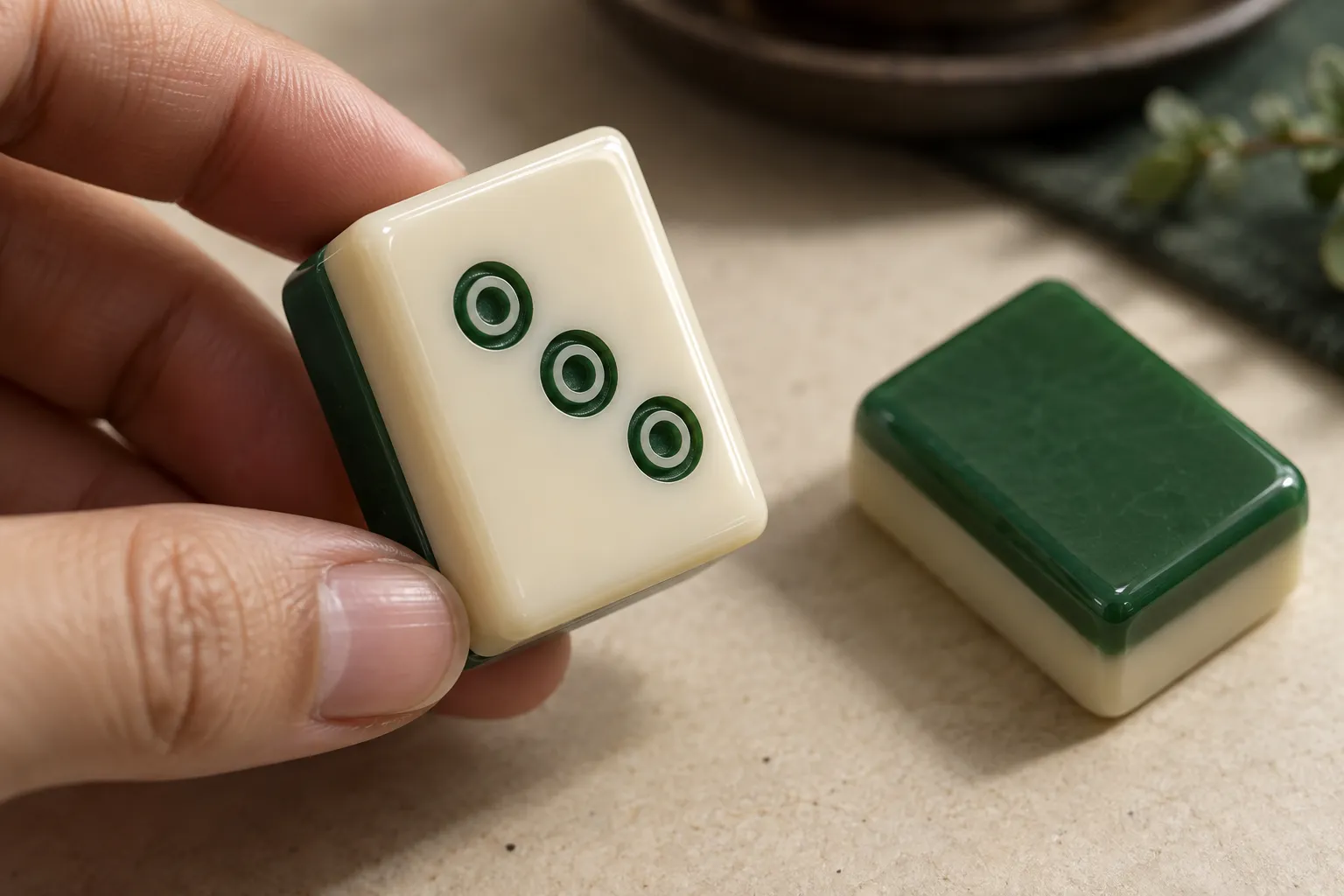
Use the sample to check all of the following before approving production:
- Count the complete inventory, including repeated and special faces.
- Compare small symbols at normal playing distance, not only in a close-up photo.
- Check the face, back and visible layer order against the approved files.
- Check edge feel and the agreed finish under ordinary room light.
- Test the actual ordered rack, case and bag when compatibility is part of the scope.
Body colors and the physical approval stage
Choose body colors from the 199-code stock board or ask for a made-to-order sheet against a Pantone target. Stock codes add no custom-sheet lead time. The custom route takes about 15 days for the sheet plus about 10 extra days on the sample.
Screen photos help shortlist a color; they are not a promise of an exact match. Approve the material on the physical sample. Pearl, marble and fluorescent sheet families are available within the approved color program, at the listed reference price for the same approved set configuration, layer count and face process. Pattern placement can vary in effect sheets.
For multiple colorways, label the face, core and back choice for each design. Do not write “same green everywhere” when the tile back, translucent rack and printed mat use different materials. Review the coordinated appearance without promising that unlike materials will look identical.
Confirm the material instead of relying on the word resin
Our mahjong tiles use cast acrylic, or PMMA. The quote should name the material, layer construction and face process. We do not offer melamine, bone or hand-poured resin tiles in this program.
A broad material name does not prove a finished set’s durability, color or feel. The physical sample and agreed inspection criteria establish what is accepted. Avoid treating an acrylic sheet datasheet as a test report for the finished tile, ink, paint or bonded construction.
From the approved sample to production
Production estimates are about 20 days for 50 or 100 sets, 25 days for 150 or 200 sets, and 30 days for 300–1,000 sets. Other quantities and the complete delivery schedule are confirmed per project. Standard payment: orders of USD 3,000 or less are paid in full before production; above USD 3,000, a 40% deposit before production and the 60% balance before shipment. Freight and your approval time are separate.
Keep the approved proof revision and physical sample tied to the order. A later change to tile size, layer construction or artwork must be assessed before the run continues. An accessory change can also affect fit, packaging and timing; it is not automatically a harmless substitution.
Inspection compares production with the approved sample and specification. QC photos are supplied before shipment. The arrival inspection window is seven days; report discrepancies or transit damage with photos for case-by-case review. A specific laboratory report or packaging test must be agreed separately, not inferred from the existence of a sample.
The brief that keeps the next reply useful
Send the format and tile count, body size and layers, face process, color targets, accessories, packaging, actual quantity and target date, artwork status, and delivery destination. Include the open question you want answered first. Mark unresolved choices TBD rather than inventing specifications.
Use the quote configurator to collect those choices or start with the price book to check the budget. A complete brief can be quoted within 24 hours; missing information is not a reason to claim a final delivered price.
If an NDA is needed, send the proposed agreement for review before confidential files. Reasonable terms can be signed. Your project files are not published or reused for another buyer, and common manufacturing methods do not become exclusive customer property. The confidentiality policy explains that distinction.
Footnotes
Common questions
Can I start before my artwork is finished?
Yes. Share the planned quantity, tile specifications and open questions. State that artwork is unfinished. The proof and sample cannot be locked until production-ready files are supplied, or you choose standard classic faces.
Does one sample include racks, a mat and a box?
No. USD 500 covers one complete custom tile set including courier. Accessories have separate sample fees and scope. Confirm every included item before paying.
How many artboards do I need?
One per unique face plus any separate back artwork. Repeated tiles reuse artwork; the inventory sets the required count. There is no universal 35-artboard requirement.
Can you sign an NDA?
Reasonable NDA terms can be signed after review. Send the proposed agreement before confidential files. The agreement should protect project information without granting exclusive rights to common manufacturing methods.
Can ChatGPT make production-ready vector artwork for my American mahjong tiles?
It can help draft SVG code and a face inventory, but generated output needs vector-editor review, correct millimeter dimensions and a checked vector PDF export. File acceptance, the digital proof and the physical sample remain separate approvals.