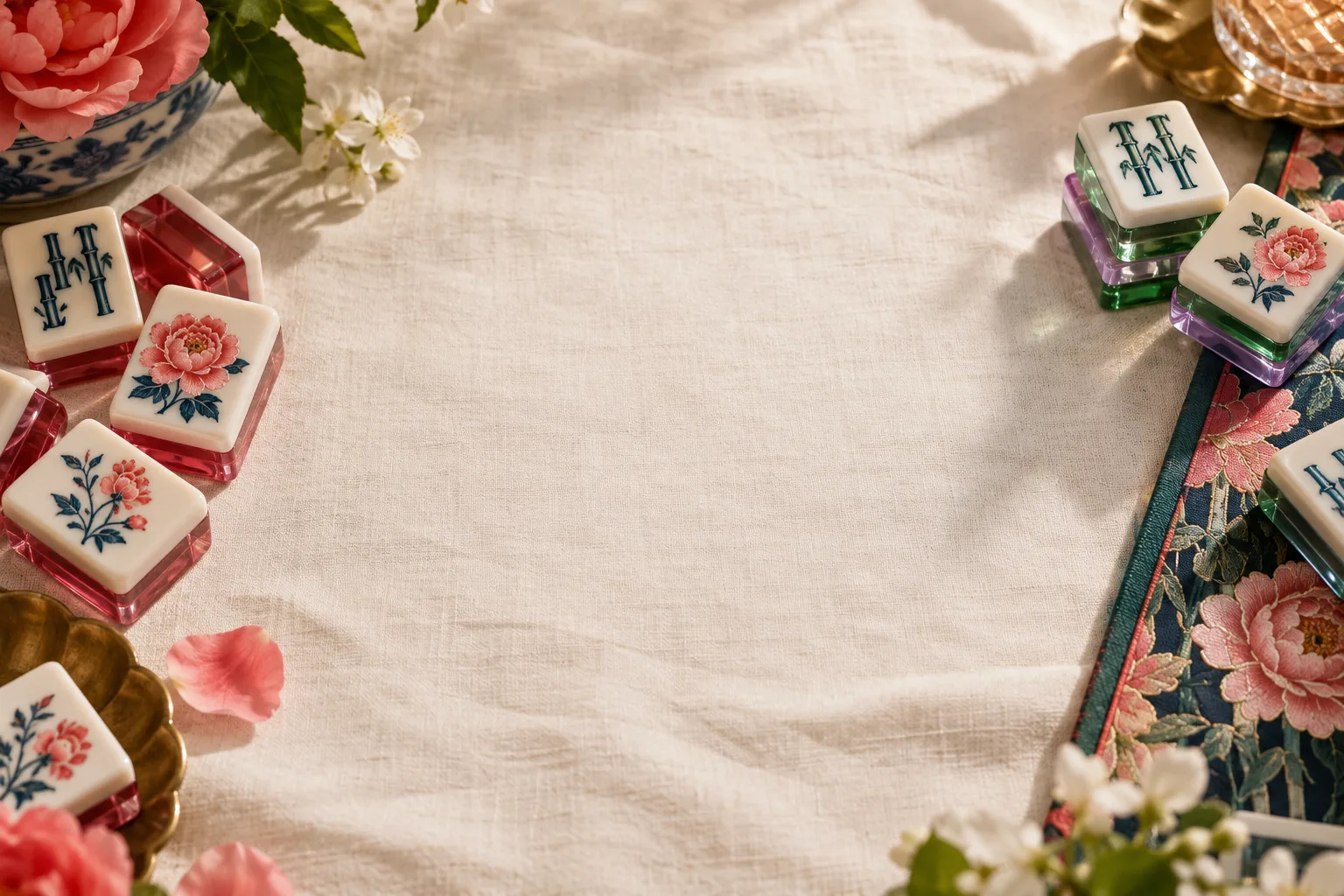
Standard Mahjong Tile Sizes in mm and Inches
Tile size decides rack fit, artwork room, set weight, and freight cost: pin it down before anything else on a custom set.
Need this made?Custom mahjong set configurator →
Key Takeaways
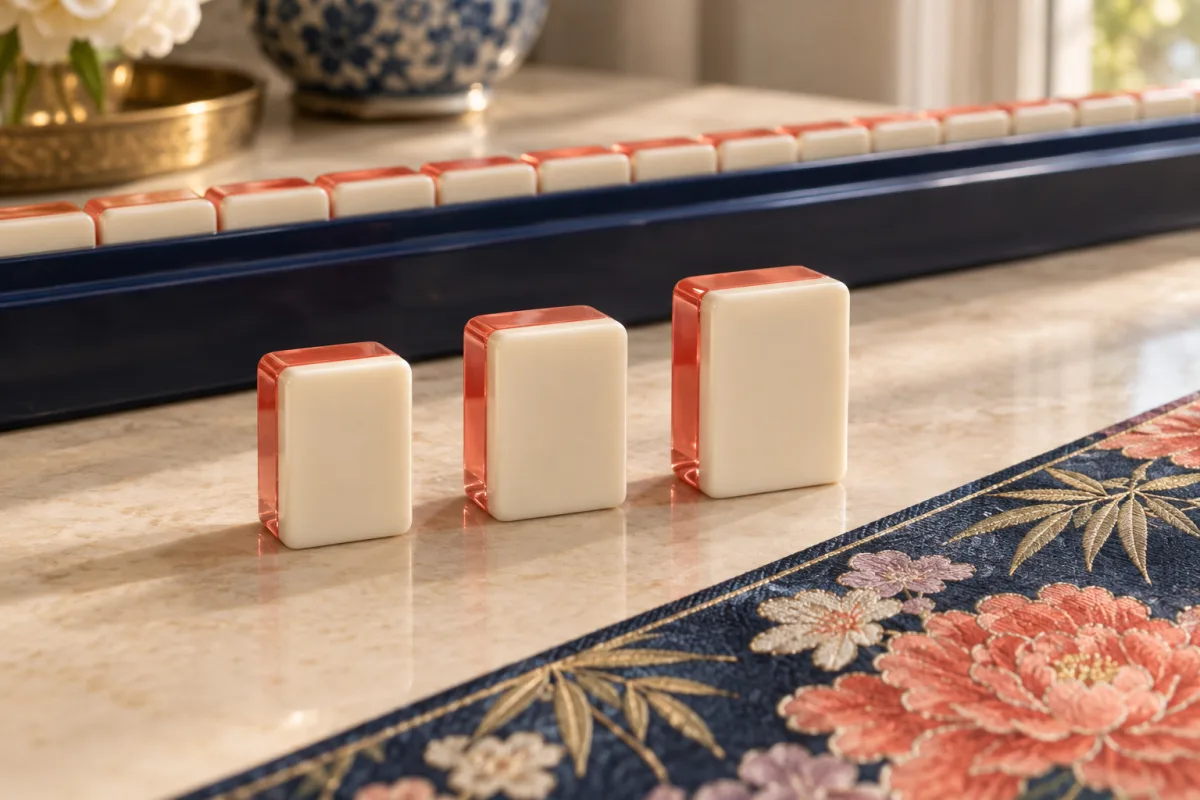
- Three useful planning sizes are 30 x 23 x 13 mm compact, 32 x 23 x 13 mm mid, and 36 x 25 x 15 mm full-size; approve the final dimensions against the intended rack, case, artwork, and sample.
- Some suppliers use nominal height as the size label, but a label alone does not define width or depth. Specify all three dimensions in millimeters.
- Cast acrylic at about 1.2 g/cm³ puts an unrounded 30 x 23 x 13 mm blank near 10.8 g and 152 such blanks near 1.64 kg before edge finishing.
- Tile size caps artwork: a full-size 36 x 25 mm face offers roughly 30% more printable and engravable area than a compact 30 x 23 mm face.
- Custom mahjong tiles start at 50 sets per design with standard shrink-wrap export packaging and stock dice; mats from 50 pcs, rack-and-pusher sets from 50 sets per design, and printed retail packaging from 1,000 pcs per design.
On this page
- The dimension table: standard mahjong tile sizes in mm
- American mahjong tile dimensions: what US set buyers order
- Chinese size conventions: how the numbering maps to millimeters
- Tile weight math: density times volume, per tile and per set
- Tile construction: monolithic vs 2, 3, and 4-layer builds
- Face area vs artwork legibility: how size caps your design
- Tile size vs rack and pusher fit: measure the actual rail
- Choosing a size for an OEM set: a decision framework
- The size spec checklist for your RFQ: five numbers
Prices in this guide are indicative reference estimates. The final written quote depends on the complete custom specification and order scope.
The dimension table: standard mahjong tile sizes in mm
| Tile size | Height | Width | Depth | Where it fits |
|---|---|---|---|---|
| Compact | 30 mm (1.18 in) | 23 mm (0.91 in) | 13 mm (0.51 in) | Compact planning point; verify the intended rack and case |
| Mid | 32 mm (1.26 in) | 23 mm (0.91 in) | 13 mm (0.51 in) | Adds face height; verify the intended rack and artwork |
| Full-size | 36 mm (1.42 in) | 25 mm (0.98 in) | 15 mm (0.59 in) | Larger rack-free planning point; verify the play format |
We make all three sizes, and custom dimensions, as custom acrylic mahjong tiles in your chosen size and layers from 50 sets per design.
That is a practical mahjong tile size comparison in one table: 30 x 23 x 13 mm compact, 32 x 23 x 13 mm mid, and 36 x 25 x 15 mm full-size, with custom sizes quoted from the approved drawing. Published US retail specs cluster in the compact-to-mid band,1 while one published Chinese size-32 example documents the height-based naming convention.2 Rack fit, artwork area, set weight, and freight all depend on the final three-dimensional specification.
Prices, colors, and the set configurator now live on Mahjong @ Wetop. See the mahjong price book, the tile and accessory color board, or configure your set for a live estimate and one itemized quote.
How to read the table: height is the long face dimension, width is the side-by-side dimension, and depth is the front-to-back thickness. The compact and full-size planning points differ by 2 mm in depth, but the intended rack, case, artwork, and play format should control the approved dimensions rather than a regional label alone.
Uniformity belongs on the drawing and inspection plan alongside nominal size. State which dimensions are critical, how they will be measured, the sample size, and the acceptance rule; do not infer a universal tolerance from the nominal tile format.
American mahjong tile dimensions: what US set buyers order
Published US retail examples sit in the compact-to-mid height band.1 A 30 x 23 x 13 mm tile is one compact planning point; 32 x 23 x 13 mm raises the height while keeping the same nominal width and depth. Neither dimension set guarantees compatibility with a buyer’s rack, pusher, case, or travel bag, so approve the complete system together.
American play also shapes the tile count and face set: the game runs on an annually changing card of standard hands and uses jokers, which Chinese sets do not carry.3 The ordered manifest may include additional jokers or spare blanks. Choose the 152, 160 or 166-tile configuration separately from tile dimensions; the American mahjong set component guide explains that distinction. This guide stays on the physical tile; the count question has its own page for a reason.
For an American rack-set brief, begin with the rack and case the tile must fit. Use the compact dimensions only as a planning point, then approve the actual tile width, depth, edge profile, and seating behavior on the intended hardware.
Chinese size conventions: how the numbering maps to millimeters
Some published Chinese sets use a size number that matches nominal tile height; a documented size-32 example measures 32 mm tall.2 A 36 x 25 x 15 mm tile is the larger planning point in this guide, but the actual play format, visibility target, stacking method, and accessory fit should control the selected dimensions.
Depth affects edge-standing stability and rack seating, so it is a functional input rather than a styling label. Check the 13 mm and 15 mm planning points against the intended rack profile, wall-building method, and physical sample; neither should be treated as a universal regional standard.
Treat a size number as starting vocabulary, not a production specification. The approved drawing should state height, width, and depth in millimeters, plus edge geometry and critical tolerances. Full material and construction inputs are covered in the custom acrylic mahjong tile spec guide.
Tile weight math: density times volume, per tile and per set
Cast acrylic (PMMA) has a density of about 1.2 g/cm³,4 which makes tile weight a two-minute calculation instead of a supplier promise. A compact blank at 3.0 x 2.3 x 1.3 cm holds 9.0 cm³, or about 10.8 g of solid acrylic; corner radii, edge finishing and the actual material density change the finished mass, which must be measured on the sample. A full-size blank at 3.6 x 2.5 x 1.5 cm holds 13.5 cm³, about 16.2 g before finishing.
Scale that up and the numbers turn into freight inputs. Multiplying the unrounded blank estimates gives about 1.64 kg for 152 compact blanks and about 2.33 kg for 144 full-size blanks before edge finishing; the actual set, accessories, inserts, and case must be weighed after the approved construction is known. Ask the quote to state measured sample, packed-set, and carton weights rather than treating the calculation as a shipping guarantee.
The same calculation can define a sample check. Record the named PMMA grade, nominal blank volume, edge-finishing allowance, target mass, scale resolution, and acceptance range on the approved inspection plan; material identity cannot be established from mass alone.
If hand feel is part of the brief, compare candidate masses on physical samples with the intended edge profile and table surface. The larger blank also raises packed weight, so approve the tactile choice and freight effect together.
Tile construction: monolithic vs 2, 3, and 4-layer builds
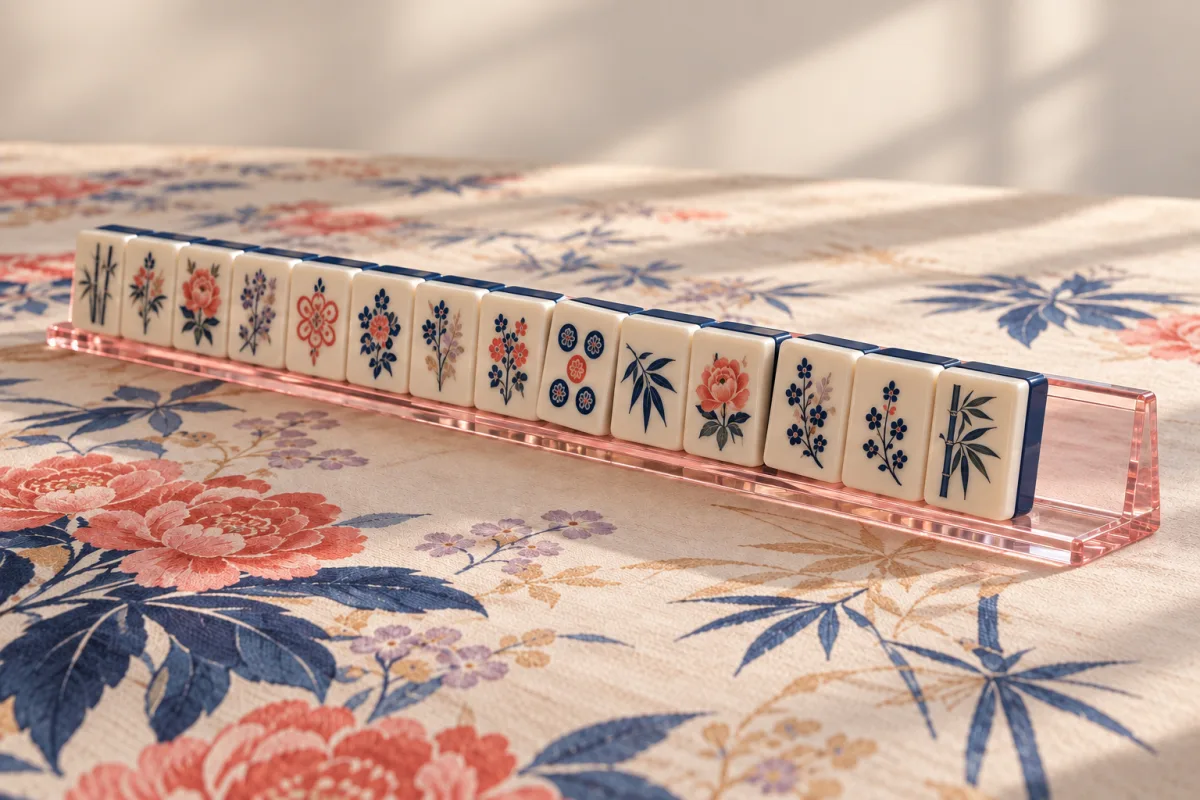
Dimensions say how big a tile is; construction says how the body is built, so an OEM brief should specify both. A monolithic tile uses one acrylic body. A laminated concept may combine face, back, or accent layers, but the layer count, materials, bond route, total depth, and acceptance criteria must be quoted and sampled as one construction.
Layer count and total depth are separate specifications. If a layered look is required, name the face contrast, back color, accent band, total depth, edge appearance, and bond-line acceptance criteria; the production-representative sample should confirm both appearance and construction before release.
Face area vs artwork legibility: how size caps your design
The tile face is your artwork canvas, and it is small: a compact face offers 30 x 23 mm (about 6.9 cm²), while a full-size face offers 36 x 25 mm (9.0 cm²), roughly 30% more area. On a custom set with dense artwork (multi-color suit symbols, brand marks, numbering, and letter indices on one face), that 30% is the difference between comfortable spacing and visual crowding.
Fine linework that renders clearly in a vector file can become crowded after scaling to a 23 mm-wide face. Approve the minimum line, spacing, registration, contrast, and viewing criteria on the relevant sample tier. If the artwork is too dense, the drawing can change the tile size, the artwork, or both. The tile engraving methods guide covers the process choices.
Tile size vs rack and pusher fit: measure the actual rail
Rack length alone does not establish fit. Record the usable rail length, channel width and depth, end stops, pusher geometry, tile count per row, and required handling clearance. A 23 mm-wide tile and a 25 mm-wide tile create different row lengths, while 13 mm and 15 mm depths may seat differently in the same channel.
A simple row-length check catches an incompatible size before sampling:
| Tile width | 14 tiles side by side | What the rack must provide |
|---|---|---|
| 23 mm | 322 mm / 12.68 in | More than 322 mm of usable support, plus agreed clearance |
| 25 mm | 350 mm / 13.78 in | More than 350 mm of usable support, plus agreed clearance |
| 30 mm | 420 mm / 16.54 in | More than 420 mm of usable support, plus agreed clearance |
These are geometric examples, not a claim that every hand or exposed arrangement uses 14 positions. Overall rack length includes end features: a nominal 14 in rack is 355.6 mm long and cannot support fourteen 30 mm-wide tiles. Check the actual support length and the intended play arrangement.
Supply the actual rack or a controlled drawing when third-party compatibility matters. The sample plan can then check seating, tilt, row capacity, removal, and pusher movement against that named hardware. If the program includes matching acrylic racks and pushers, quote the tile and accessory dimensions as one approved system. If the tiles will be stored or shown in a matching acrylic mahjong display case, size the case interior from the same approved tile drawing.
Choosing a size for an OEM set: a decision framework
Begin with the intended play format and accessory system, then challenge the planning size only when the audience, artwork, or handling requirement justifies it:
- Programs tied to an existing rack and case: start with the measured hardware. A 30 x 23 x 13 mm tile is a compact planning point, not a compatibility guarantee.
- Programs considering a 32 mm-tall face: test the mid planning point. The nominal width and depth remain 23 x 13 mm, but the intended rack, case, artwork, and handling still require sample approval.
- Programs with a buyer-defined visibility target: compare the face sizes. Approve the viewing distance, artwork, rack or rack-free format, and handling on physical samples rather than assigning a user group without evidence.
- Heritage or mainland-style sets: full-size (36 x 25 x 15 mm), rack-free. Commit to the thicker depth and design the whole product around edge-standing play.
- Anything else: custom sizes on request, but sample first. Shrinking or stretching a tile changes its artwork and its hand feel together; outside the standard band, every millimeter must be justified in hand, not on paper.
The custom mahjong set configurator walks you through locking tile count, dimensions, artwork, and accessory fit before sampling. A size decision is complete only when the drawing, artwork, rack, case, mass target, and physical sample agree.
The size spec checklist for your RFQ: five numbers
Five measurement fields make the size portion of a tile RFQ reviewable:
- Tile dimensions: height x width x depth, in millimeters, not a size label alone.
- Tolerance: ask your factory what dimensional tolerance they hold tile-to-tile and confirm it is stated on the quote; uniformity is what your players’ hands will judge across a full set.
- Corner radius or chamfer: the edge treatment that decides both hand feel and how tiles slide in a rail.
- Engraving or print area: the artwork zone on the face, so design and size are agreed as one spec.
- Target per-tile weight: computed as tile volume × 1.2 g/cm³ (cast PMMA density), as a blank estimate; approve the finished mass after edge finishing.
Send those five inside the mahjong quote request. Custom mahjong tiles start at 50 sets per design with standard shrink-wrap export packaging and stock dice. Listed tile configurations have reference prices of USD 53–73 per set FOB Shenzhen at 100–199 sets per design, with a published quantity ladder that adjusts every other quantity. The quote confirms the exact count, body, layers and process; unlisted configurations require a separate quote. A full custom tile sample is USD 500 including courier, paid separately and never credited; making normally takes 15–17 days after payment, ready files and proof approval, with transit additional. Engraved paint fill is available alongside engraved UV fill and UV print with coating. Choose stock sheet codes or discuss a made-to-order color; custom sheet preparation adds time and the physical sample controls acceptance. Production estimates are about 20 days for 50 or 100 sets, 25 days for 150 or 200 sets, and 30 days for 300–1,000 sets. Other quantities and the complete delivery schedule are confirmed per project. Accessories and packaging have their own units, minimums and prices in the price book.
Download the fillable mahjong OEM spec worksheet (PDF) to record the complete eight-item brief: format, tile size, decoration route, colors, packaging, accessories, quantity and date, and artwork status.
If the brief needs a nonstandard layered construction or accessory-fit review, use the mahjong cooperation process to agree the drawing, paid sample scope and production approval.
Footnotes
-
What Size Are the Tiles?: GammonVillage Mahjong FAQ: publishes American retail tile heights in the same compact-to-mid band: a roughly 30 mm standard height and an enhanced 1-1/4 in (32 mm) premium option, the published reference behind the US-market height range. ↩ ↩2
-
Chinese Mahjong Set of 146 Standard Size 32 Tiles: Yellow Mountain Imports: a published Chinese professional set spec: size 32 tiles measuring 1.26 inches (32 mm) tall, the documented example behind the size-number-to-millimeter mapping. ↩ ↩2
-
The Game: National Mah Jongg League: the League’s own description of how American mahjong differs: the annually changing card of standard hands and the use of jokers and additional tiles. ↩
-
PMMA (Acrylic) material properties: MakeItFrom: displays the 1.2 g/cm³ density used in the per-tile and per-set weight calculations. ↩
Put your tile dimensions in one brief
Choose a reference body or enter your own dimensions. Add the tile count, layers, artwork status and destination in the mahjong quote form.
Configure & Get a QuoteCheck the sample scopeCommon questions
What size are American mahjong tiles?
Published US retail examples sit in the compact-to-mid height band. Use 30 x 23 x 13 mm and 32 x 23 x 13 mm as planning points, then confirm the chosen width, depth, edge profile, mass, rack seating, and case fit on the intended hardware and physical sample.
What size are Chinese mahjong tiles?
One documented size-32 Chinese set measures 32 mm tall, showing how a size number can map to nominal height. Use 36 x 25 x 15 mm as a larger planning point, then approve the actual height, width, depth, stacking behavior, accessory fit, artwork, and handling on the intended physical sample.
How much do acrylic mahjong tiles weigh?
Cast acrylic's density of about 1.2 g/cm³ puts a compact tile (30 x 23 x 13 mm) near 10–11 g and a full-size tile (36 x 25 x 15 mm) near 16 g before edge rounding. Multiply the blank estimate by your actual tile count. For example, 152 compact blanks are about 1.64 kg before finishing; packaging and accessories add weight.
Will oversized tiles fit a standard mahjong rack?
Measure the actual rack rail, slot depth, and end clearance before upsizing. A 25 mm-wide or 15 mm-deep tile must be checked against the intended rack rather than assumed to fit a rail designed around a 23 mm-wide or 13 mm-deep tile. Approve the fit with the production-representative rack and tile sample.
What tile size should I choose for a custom OEM mahjong set?
Use 30 x 23 x 13 mm as a compact planning point, 32 x 23 x 13 mm when the intended rack accepts the extra height, or 36 x 25 x 15 mm for a larger rack-free format; confirm the final choice on the actual rack, case, artwork, and physical sample. Custom mahjong tiles start at 50 sets per design with standard shrink-wrap export packaging and stock dice; mats from 50 pcs, rack-and-pusher sets from 50 sets per design, and printed retail packaging from 1,000 pcs per design. The relevant physical sample is paid separately and never credited to production.