Size and layer questions
What size tiles are best for mahjong?
+
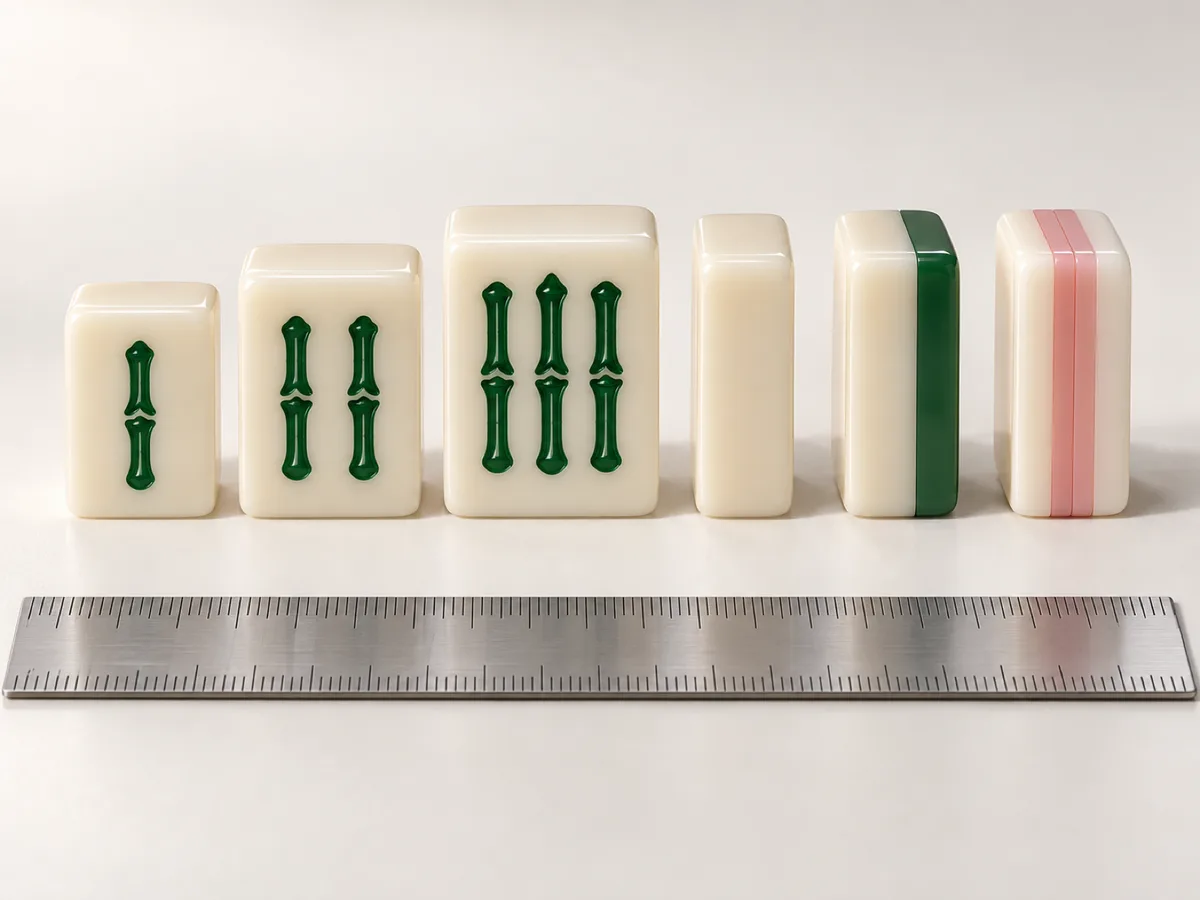
Choose the body for readability, handling and the accessories you plan to use. Our standard reference bodies are 30 × 23 × 13, 32 × 23 × 13 and 36 × 25 × 15 mm. These are factory reference sizes, not universal regional standards. Check the usable rack ledge, depth and case layout with the physical sample.
Are 36 mm tiles "large" or "jumbo"?
+
Labels such as large and jumbo vary by seller. On this site the 36 × 25 × 15 mm body is the large reference body at the published price; other dimensions are quoted per project. Compare millimeters and approve the physical sample.
Why do buyers ask for mahjong with large tiles?
+
A larger face can provide more room for readable artwork and a different feel in the hand. The 36 × 25 mm face has about 30% more area than a 30 × 23 mm face, but readability still depends on the artwork. Larger dimensions affect the rack, case and packed weight, so approve them together.
Do large tiles fit standard racks?
+
Measure before assuming fit. Fourteen tiles at 25 mm face width occupy 350 mm before clearance. The overall length printed on a rack listing is not its usable ledge length. Check the ledge depth, end stops and back support as well as length; the physical sample should be tested with the rack you intend to use.
Can you make 40 mm tiles, or a travel mahjong set?
+
Both ends of the range are custom and quoted per project. For an extra-large 38–40 mm body, compare the complete dimensions rather than a label such as champion size. A travel set needs the same fit checks at smaller dimensions. Tile volume affects weight, and the actual tile width determines usable rack length; confirm the case and packed dimensions too. Either way we ask you to approve the size on the physical sample, not on paper.
What is a standard mahjong tile size in inches?
+
The three standard bodies we make are 1.18 × 0.91 × 0.51 in (30 × 23 × 13 mm), 1.26 × 0.91 × 0.51 in (32 × 23 × 13 mm) and 1.42 × 0.98 × 0.59 in (36 × 25 × 15 mm). These are our reference bodies, not universal American or Chinese dimensions. Any custom size is open — send L × W × H in either unit.
Can I have a 0.5 mm colored core, or any layer thickness?
+
No. Each layer is cut from cast acrylic sheet, so layer thickness follows standard sheet thicknesses — 3, 4, 5, 6 and 8 mm are the usual ones — and the stack must add up to the tile thickness. A 13 mm three-layer tile is 5 + 3 + 5; a 16 mm four-layer tile is 5 + 3 + 3 + 5. These are construction examples, not a requirement to change the overall body. We confirm the feasible sheet pairing and finished thickness on the drawing.
Do the layer colors have to come from in-stock sheet?
+
By default, yes — every layer color is a code from the in-stock sheet board and adds no lead time. A layer can also be a Pantone-matched sheet made to order, about 15 days for the sheet plus about 10 extra days on the sample, with final pricing confirmed for the full specification. Either way the color is approved on the physical sample and a 100% exact match is never promised. UV-printed artwork on the face follows your file and the approved proof, separately from sheet color.
Does size or layer count change the price?
+
Tile dimensions, tile count, layer construction and finish all belong in your quote. The published matrix covers listed configurations at 100–199 sets, not every possible variant. Prices shown are for 100–199 sets; 50–99 sets add USD 2 per set, 200–299 sets save USD 1 per set, 300–499 sets save USD 2 per set, 500 sets save USD 2.50 per set, 501+ sets save USD 3.50 per set. Each added layer moves the published price by the steps in the price book: USD 53 / USD 55 / USD 58 / USD 60 per set for 1 / 2 / 3 / 4 layers with UV print + surface coating, USD 65 / USD 67 / USD 70 / USD 73 with engraving + UV color fill or engraving + paint fill. A body outside the three standard sizes is quoted per project.
Will my tiles fit the racks and pushers I already use?
+
Only if the rail was measured. A rack channel made for a 23 mm wide, 13 mm deep tile will not seat a 25 × 15 mm tile the same way, and a 32 mm face changes the row height. Send the rack or its drawing, or order racks and pushers with the tiles so the two are approved as one system.