Mahjong Set Manufacturing Cost: FOB Price Guide
A line-by-line budget for your first custom run, using the published tile and accessory price book.
Need this made?Custom mahjong set configurator →
Key Takeaways
- Listed tile configurations have reference prices of USD 53–73 per set FOB Shenzhen at 100–199 sets per design, with a published quantity ladder that adjusts every other quantity; unlisted variants require a quote.
- Published figures are indicative estimates for reference configurations; your final quote depends on the complete custom specification. The quote confirms the tile count, body, layer construction and face process; unlisted variants require a quote.
- Accessories have separate quantities and minimums. Printed folding and magnetic gift boxes start at 1,000 pcs per design.
- Samples are separate and never credited. Freight and import charges are not included in the product subtotal.
On this page
- Compare the same scope before comparing a price
- What the published FOB tile price contains
- Material and layers: compare the quoted construction
- Engraved or printed: the price difference you can calculate
- Does a higher tile count increase this price?
- MOQ and quantity: where the price actually changes
- The costs to separate before approving the order
Compare the same scope before comparing a price
A mahjong set manufacturing cost quote is useful only when the quantity, tile body, layers, face process and included items are clear. A marketplace headline price is not evidence that a custom branded set with your artwork, accessories and packaging costs the same amount.
Wetop’s published tile prices are USD 53–73 per complete set, FOB Shenzhen, for the listed configurations at 100–199 sets per design, with a published quantity ladder that adjusts every other quantity. Your exact tile count and body are confirmed in the quote. The price changes with layer count and face process. Standard shrink-wrap export packaging and stock dice are included. Racks, mats, cases, bags, printed boxes, samples and freight are separate.
Use the live price book as the current reference. This article explains how to read it, compare a supplier’s scope and build a first-order budget without confusing the sample invoice with production.
Before comparing two offers, ask whether both cover the same number of complete sets, the same face inventory and the same manufacturing method. “Acrylic,” “engraved” and “full set” can each conceal a different specification. Check the line items rather than filling missing details with assumptions.
What the published FOB tile price contains
For the listed configurations at 100–199 sets per design, the reference price table is below; other quantities take the published ladder. Confirm tile count, body and construction on your quote; unlisted variants are quoted separately:
| Layers | UV print + surface coating | Engraving + UV color fill | Engraving + paint fill |
|---|---|---|---|
| 1 | USD 53 | USD 65 | USD 65 |
| 2 | USD 55 | USD 67 | USD 67 |
| 3 | USD 58 | USD 70 | USD 70 |
| 4 | USD 60 | USD 73 | USD 73 |
These are published prices for the listed complete-set configurations, not an estimate of factory labor or raw-material costs. The reference bodies are 30 × 23 × 13, 32 × 23 × 13 and 36 × 25 × 15 mm. A non-standard body is quoted per project.
For example, 100 sets at the listed two-layer engraved UV reference price total USD 6,700 for the tile line, subject to confirmation of the complete configuration. The same quantity and layers with UV print cost USD 5,500. That USD 1,200 difference compares the face processes at an otherwise identical specification; it does not pay for accessories or shipping.
FOB is a sea-freight term: delivery occurs on board the nominated vessel at the named port. It does not mean every cost through arrival at your warehouse is included. Air and courier shipments require a suitable agreed term. The ICC explanation of FOB distinguishes delivery on board from other port handover arrangements.
Material and layers: compare the quoted construction
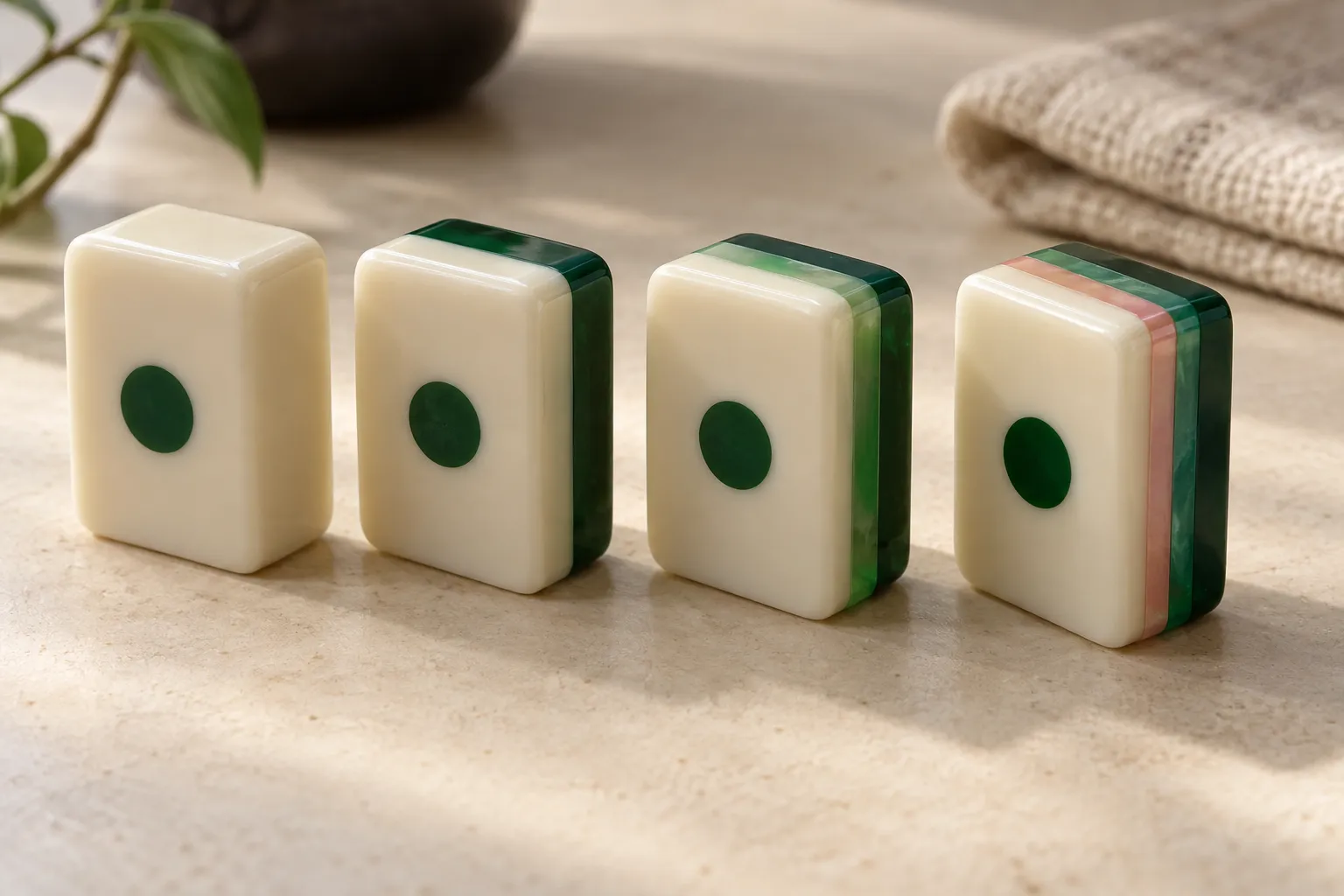
Our tile program uses cast acrylic, or PMMA. We do not offer a lower-priced melamine, bone or hand-poured resin alternative. State the face, core and back construction in the quote; a two-layer tile and a printed back on a single-layer tile are different specifications.
Within the approved stock-color program, pearl, marble, fluorescent and solid sheet families use the listed reference price for the same approved set configuration, layer count and face process. The table is a planning reference; the quote confirms your particular sheet materials and colors. Choose from the 199 stock sheet codes, or discuss a made-to-order Pantone-matched sheet with added lead time and physical approval.
Do not infer a finished tile’s lifetime from a sheet-material description. If a supplier promises a specific abrasion result, color tolerance or years of use, ask what finished product was tested and under which agreed conditions. A generic acrylic datasheet does not answer those questions.
Engraved or printed: the price difference you can calculate
There are three approved face routes: UV print with a surface coating, engraving with UV color fill, and engraving with paint fill. The two engraved routes share the same published prices. Hand paint fill is available.
A two-layer engraved set costs USD 12 more than a two-layer UV-printed set at the same quantity. A four-layer engraved set costs USD 13 more than its UV-printed counterpart. Compare the physical sample for the tactile result, fine detail and appearance your customers need.
CNC machining belongs to body fabrication and geometry decisions; it is not a third face-price column to substitute for engraved paint fill. The face-process comparison explains what each step does.
Does a higher tile count increase this price?
Tile counts describe different complete-set configurations. Do not assume 136, 144, 152, 160 and 166 tiles all cost the same. The published table is not a price for every variant: send the complete tile list, dimensions and finish for a written quote. Published tile references use a 160-tile American mahjong set. For another tile count, divide that reference by 160, multiply by the requested tile count and round the per-set estimate up to the next whole US dollar. Custom dimensions, materials, artwork, packaging and labels may change the final quote.
The inventory still matters. More or differently sized tiles can change the case layout, packed weight and shipping estimate. A total count alone also does not define the playable set: list the number of each face, flowers, jokers and blanks. Confirm the agreed inventory before sampling.
Use the custom acrylic mahjong tiles page to separate tile count from body size. If a retailer’s listing includes extra blanks or special jokers, that is a contents decision to record, not a reason to assume a different manufacturing price without checking the price band.
MOQ and quantity: where the price actually changes
Custom tile production starts at 50 complete sets per design. The published tile price is the 100–199-set reference; every other quantity takes its row on the published quantity ladder: 50–99 sets add USD 2 per set, 200–299 come down USD 1, 300–499 come down USD 2, 500 comes down USD 2.50 and 501+ come down USD 3.50. Two designs require two qualifying runs; combining their quantities does not satisfy the minimum for each design.
For two-layer engraved tiles, 50 sets are USD 69 each (USD 3,450) and 100 sets are USD 67 each (USD 6,700); 200 sets come to USD 66 each and 300 sets to USD 65. Quote the quantity you actually plan to order: the ladder row for that quantity sets the price.
Accessories use separate minimums and price tiers. A 100-set tile order does not automatically qualify for 1,000 printed boxes, and ordering fewer accessories than tile sets changes the accessory tier. Use the actual quantity for every line.
| Example line at 100 units | Unit price | Line total |
|---|---|---|
| 100 two-layer engraved tile sets | USD 67 | USD 6,700 |
| 100 sets of four 20-inch magnetic racks and pushers | USD 38 | USD 3,800 |
| 100 standard 3 mm printed mats | USD 7.30 | USD 730 |
| Product subtotal | USD 112.30 per bundle | USD 11,230 |
This worked example excludes case, bag, printed box, samples, freight and import costs. The rack line means 100 sets of four; it is not a price for 100 individual racks. Custom mat dimensions need confirmation rather than automatically inheriting the reference price.
The costs to separate before approving the order
The remaining costs are easier to manage when they are explicit. They should not appear as an invented percentage added to the tile price.
Samples. One complete custom tile sample is USD 500 including courier, paid separately and never credited. Published accessory samples are USD 200 for a four-player set of four racks and four pushers, USD 50 for a mat and USD 200 per box or bag design. A case sample is quoted to its specification. Ordering the tile, rack and mat samples in the example adds USD 750 to the initial sample budget; it does not reduce the later USD 11,230 production subtotal.
Retail packaging. Printed folding boxes and magnetic gift boxes start at 1,000 pcs per design. Reference estimates are USD 0.50 and USD 1.35 respectively for the stated standard-size scope, confirmed on the quote. There is no paid exception below the printed-box minimum. Standard shrink-wrap export packaging is already included with the tiles.
Cases and bags. Acrylic cases depend on dimensions, construction, closure and lining. The drawstring/carry-bag reference is an estimate from 500 pcs and must be confirmed for size and print. It is not a blanket price for every zippered tote or padded bag.
Freight and delivered terms. Supply the complete destination and ZIP code. Packed dimensions, weight, service and shipment date are needed for a freight estimate. A DDP quote must identify the named delivery destination and scope. Do not add an old freight-per-set figure from another order and call the result a current landed cost.
Payment and schedule. Standard production terms: orders of USD 3,000 or less are paid in full before production; above USD 3,000, a 40% deposit before production and the 60% balance before shipment; the quote confirms the agreement. Samples are separate. Budget time for the digital proof, sample making, courier transit, your review, production and bulk freight. None of these stages is replaced by a larger deposit.
When requesting a quote, send one real target quantity per design and identify any remaining uncertainty. The custom mahjong set configurator produces a structured brief and a product estimate. The itemized quote confirms the specification, exceptions and freight; the website estimate is not a final delivered total.
Common questions
Do 100 sets cost less per set than 50?
Yes. The published tile price is the 100–199-set price; 50–99 sets add USD 2 per set. For two-layer engraved tiles that is USD 69 per set at 50 sets and USD 67 at 100. Accessories have their own tiers, based on their actual quantities.
Is engraving with paint fill available?
Yes. Engraving with paint fill and engraving with UV color fill share the same published tile prices: USD 65, 67, 70 or 73 for one through four layers within the standard-body matrix at 100–199 sets; other quantities take the published ladder.
Does the sample payment reduce my production invoice?
No. Every sample fee is paid separately and never credited. One complete custom tile sample costs USD 500 including courier.
Is the configurator estimate delivered to my door?
No. It is a product estimate using the published price book. Freight, import charges, special specifications and any DDP scope must be confirmed on the quote.