American Mahjong Tile Engraving, UV Print and Paint Fill Compared
Choose the finished face and confirm it on a sample. Machine names alone do not define the product.
Need this made?Custom mahjong set configurator →
Key Takeaways
- The three face routes are UV print with coating, engraving with UV fill, and engraving with paint fill.
- CNC describes body machining rather than a third face-price option.
- The two engraved routes share the listed reference prices for the same approved set configuration.
- Approve detail, color, edge feel and the full inventory on the physical sample; no fixed service-life promise is included.
On this page
- The three face processes available for custom mahjong tiles
- Compare the finished result
- Laser engraving: the recess and its filled color
- UV printing: separate surface print from recessed fill
- Engraved UV fill or engraved paint fill?
- CNC machining and edge finishing have a different job
- How to choose without commissioning unnecessary variants
- Sampling, timing and the final production decision
Prices in this guide are indicative reference estimates. The final written quote depends on the complete custom specification and order scope.
The three face processes available for custom mahjong tiles
Choose among UV print + surface coating, engraving + UV color fill, and engraving + paint fill. The first places artwork on the face without a recess; the other two place color in engraved paths. All three are available for Wetop cast acrylic mahjong tiles.
The older “laser vs UV vs CNC” shorthand mixes a face-making method, a printing method and a machining method. They are not three interchangeable products. Laser engraving creates recessed artwork; UV printing can be used on the surface or within an engraved design; CNC machining contributes to the tile body and geometry.
Your decision is the finished face you want customers to handle. Review a physical sample for detail, color placement and touch, rather than choosing only by a machine name. The custom acrylic mahjong tiles page connects the face choice with body size, layers and the inventory for your set.
Compare the finished result
| Buyer decision | UV print + coating | Engraving + UV fill | Engraving + paint fill |
|---|---|---|---|
| Surface | Printed artwork, no engraved recess | Recessed artwork with UV color | Recessed artwork with paint fill |
| Useful starting point | Artwork where printed detail and color are central | A recessed face with printed color | A recessed face with painted color |
| What needs review | Small detail, edge placement and coating appearance | Path detail and fill alignment | Path detail and paint-fill appearance |
| Two-layer reference price | USD 55 per set | USD 67 per set | USD 67 per set |
| Physical approval | Required | Required | Required |
These reference prices apply to listed configurations at 100–199 complete sets per design; a published quantity ladder adjusts every other quantity. Confirm the exact tile count, body and construction; unlisted configurations require a quote. Other layer counts are in the price book. There is no separate surcharge for the painted route in that table. No process is sold with a promised number of years of use.
A process comparison is only fair when the artwork and body are comparable. If one sample has a much larger symbol or a thicker stroke, it can appear clearer for reasons unrelated to the production method.
Laser engraving: the recess and its filled color
The engraved route cuts the approved artwork into the acrylic face, then adds color by UV fill or paint fill. The standard engraving reference is 0.3 mm; the actual artwork and finished appearance are checked during proofing and sampling.
A recess changes the feel of the symbol. It does not make every fine line manufacturable or remove the need to approve color. Tiny isolated marks, tight gaps and crowded borders should be reviewed at the chosen tile’s actual face size. Enlarging the artwork on a screen can conceal details that disappear at normal playing distance.
Provide outlined vector AI or PDF files for the engraved paths. Keep each unique face named and map it to the number of copies in the set. Repeated faces reuse the file; the inventory determines the required artboards.
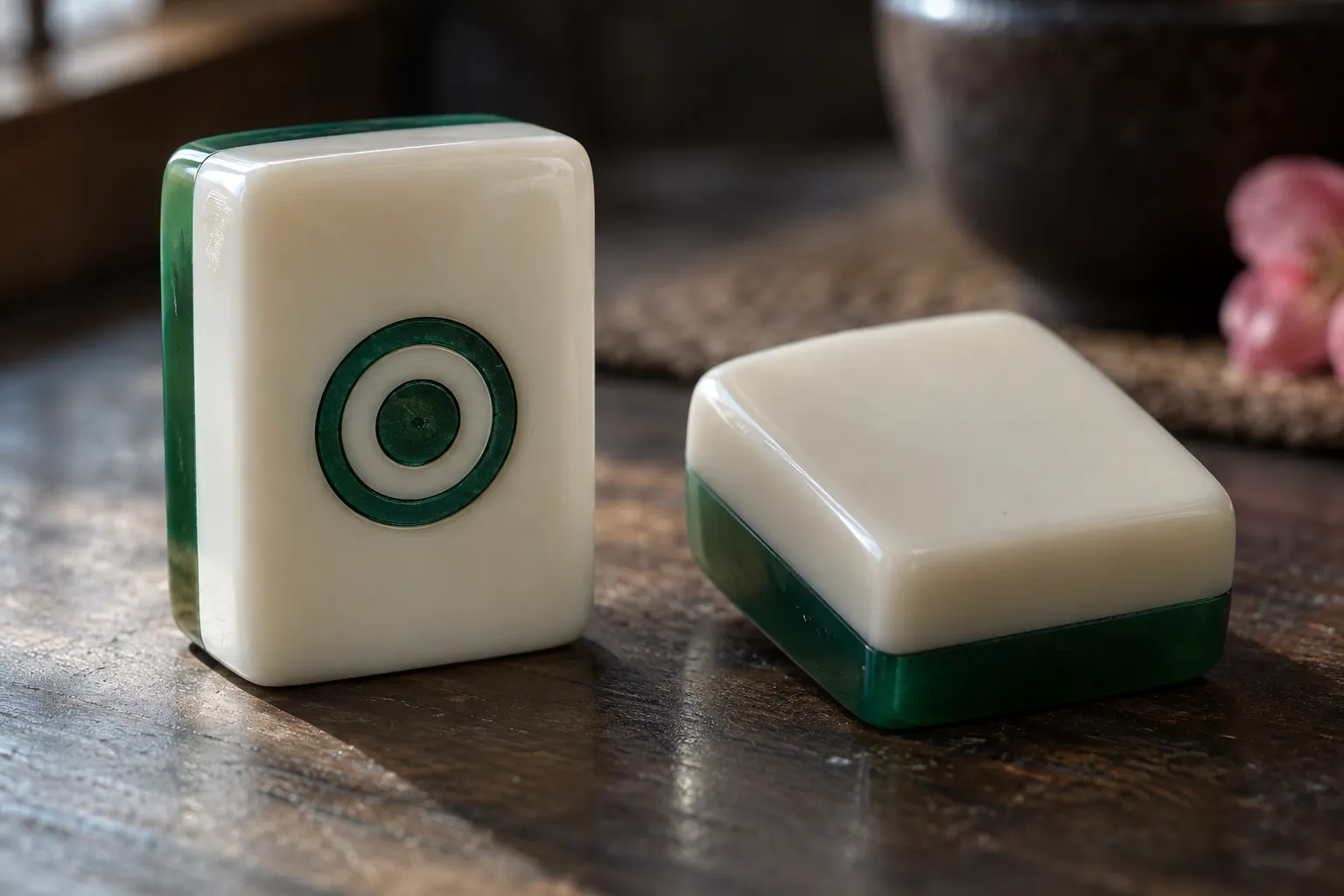
For a sample review, look for a clean symbol outline, consistent intended fill and readable spacing. Discuss the acceptance criteria against the approved physical sample. An illustrative photograph on a website does not establish a measured depth, registration tolerance or abrasion result for your design.
UV printing: separate surface print from recessed fill
UV print with a surface coating is the non-recessed face option. Engraving with UV color fill uses printing as part of a recessed construction. Both involve UV printing, but they have different finished surfaces and different price lines.
For artwork with several colors or fine graphic detail, review whether the desired result works as a printed face before assuming it needs engraving. The final decision depends on the supplied design, approved sample and intended appearance. We do not promise that every graphic will reproduce identically across different processes.
Name the face colors separately from the body sheet colors. A printed jade motif, a jade tile back and a translucent jade rack do not use the same material. A screen hex value can communicate intent, but the physical sample is the approval reference.
The surface coating is part of this printed route. It is not a basis for inventing a five-year life, a guaranteed scratch resistance or a universal coating thickness. If you require a specific performance test, identify it before the quote so scope, method and acceptance can be agreed.
Engraved UV fill or engraved paint fill?
Both routes begin with recessed artwork. The difference is how color is placed in that design: UV color fill uses printed color in the engraved area; paint fill uses paint. Choose from a physical sample of your own demanding faces, not a machine label alone.
A flower with closely spaced color areas asks a different question from a simple one-color dot. Check the edges of each filled shape, small gaps, color boundaries and consistency across repeated faces. Discuss whether a simplified version of a dense motif would read more clearly at playing distance. Neither process automatically reproduces every detail in an enlarged digital image.
Keep one proof revision and one selected face route attached to the approved sample. If you switch from paint to UV fill, or from a flat printed face to engraving, confirm the new file review, sample scope and timing before production. Do not assume the earlier sample has approved a different construction.
The vector artwork workflow explains how to move from a draft motif to a checked PDF. The acrylic vs melamine comparison separates these face choices from the body material.
CNC machining and edge finishing have a different job
The tile body, layer construction and edge geometry are separate decisions from the face process. CNC machining may be used in body fabrication; finishing determines the edge and surface result you approve. Do not compare “CNC” with “UV fill” as if the terms describe equivalent finished faces.
State the complete body dimensions—height, face width and thickness—alongside the layer order. The three reference bodies are starting points, not universal American or Chinese size standards. Non-standard dimensions need a project quote.
Ask to check the edge in hand. A comfortable edge cannot be specified by an invented universal bevel number. Likewise, the rack fit depends on the actual tile width and usable rack ledge, not simply on whether a tile is described as American size. The size and layer page explains those dependencies.
How to choose without commissioning unnecessary variants
Start with your main requirement: a flat printed face, a recessed tactile face, or a particular painted appearance. Then review the most demanding artboard for that choice. A detailed joker or dense flower often exposes a production issue sooner than a simple circle.
Use this decision sequence:
- Confirm the body and actual face area.
- Choose one of the three approved face routes.
- Check the smallest details, gaps and color boundaries on the proof.
- Approve one complete physical sample set.
- Record the selected route and sample revision on the production order.
The word “hybrid” should not conceal a specification. If you want different methods on different faces or additional back artwork, identify that combination and request confirmation. Do not assume a mixed-process set is automatically covered by a single reference price.
Standard classic engraved faces are available without custom artwork. For original graphics, your designer supplies finished files; Wetop does not redraw or vectorize them. The artwork page explains the file handoff.
Sampling, timing and the final production decision
One complete custom tile sample costs USD 500 including courier, paid separately and never credited to production. Allow about 15–17 days for sample making after payment, production-ready files and proof approval. Courier transit and your review are additional. A custom sheet color adds lead time.
The sample establishes the combined result: face process, tile body, layers, color and finish. Approving a photographed engraving detail alone does not approve the full set inventory or the fit of accessories. Order any required accessory samples separately and test them together.
Production estimates are about 20 days for 50 or 100 sets, 25 days for 150 or 200 sets, and 30 days for 300–1,000 sets. Other quantities and the complete delivery schedule are confirmed per project. Inspection compares the run with the approved sample and specification. Report arrival discrepancies within the seven-day inspection window with photos for case-by-case review.
When you configure your custom mahjong tile set, state the actual quantity, body, layers and face route. If the process is still undecided, say what appearance or feel you are trying to achieve and which artwork is ready. That gives us a concrete question to answer without pretending the final manufacturing specification is already settled.
Common questions
Is engraving with paint fill available?
Yes. It is one of the three approved face processes and has the same published price as engraving with UV color fill for the same listed configuration. Unlisted configurations need a quote.
Does UV printing always mean a flat face?
No. Surface UV print with coating has no recess, while the engraved UV-fill route combines recessed artwork and UV color. Specify the complete route.
Can you guarantee the graphics will last five years?
No fixed service-life warranty is offered. Acceptance is based on the approved sample and agreed inspection criteria. Specific performance tests need separate confirmation.
Can I send PNG artwork for engraving?
Engraving requires production-ready vector AI or PDF artwork with outlined text. A PNG placed inside a PDF is still raster artwork. We do not provide tracing or vectorization services.