



Acrylic Edge Finishing: Laser vs Diamond vs Flame vs CNC
Four methods produce four different edges, and most spec sheets pick the wrong one because they treat 'polished' as a single instruction.
Need this made?Acrylic laser cutting service →
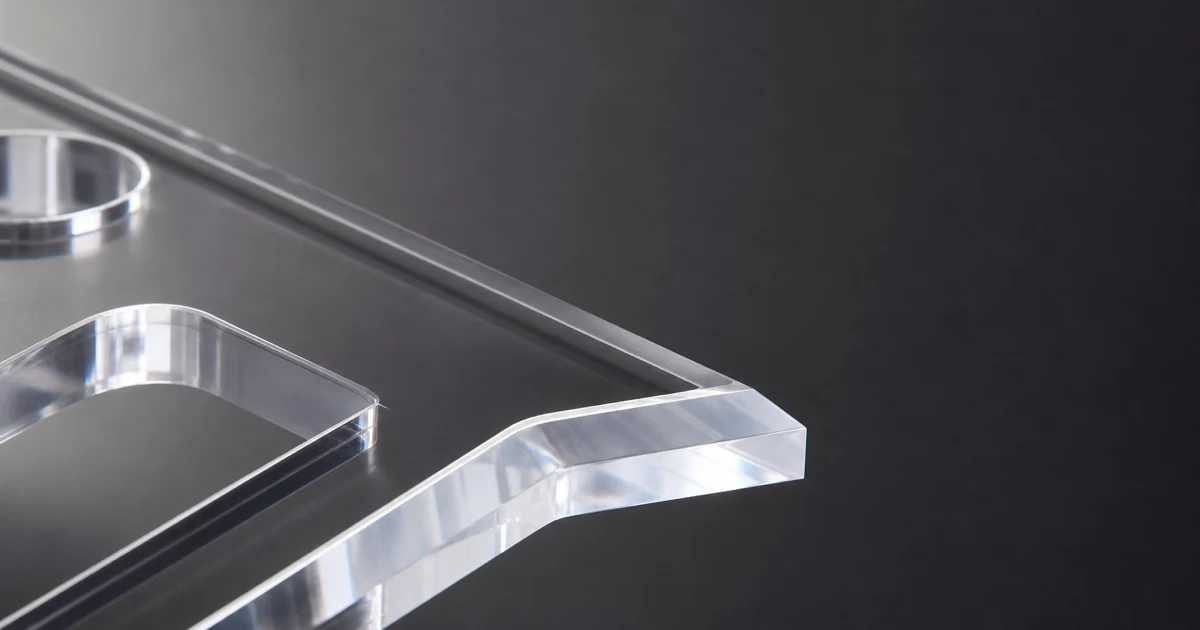
This is the side-by-side that lets you spec correctly the first time.
Key Takeaways
- Four edge methods, four different edges. CO2 laser flame-polishes itself on cast PMMA at low single-digit haze; diamond polish hits mirror-flat optical finish on any thickness; flame polish handles tight curves no other method can; CNC leaves a matte edge that always needs a follow-up polish step.
- No single method wins everything. Acrylic edge finish selection depends on three variables — substrate (cast vs extruded), thickness, and geometry — not on which method 'sounds premium' on a spec sheet.
- Cost ranking at typical retail-display volume (200 pcs, 6mm cast, 800mm visible edge per piece): CO2 laser ~$0.40/m of edge labor (cast only) < diamond polish ~$0.80/m of edge < flame polish ~$1.20/m of edge < CNC + diamond polish ~$2.50/m of edge.
- Geometry overrides cost. Tight inside curves (radius below 10mm), internal cutouts, and irregular profiles can only be flame polished — diamond tooling cannot follow that path. Designs with 3D operations (chamfers, pockets, angled faces) must be CNC machined regardless of edge cost.
- RFQ language matters. 'Polished edges' is ambiguous and almost always under-specs the job. Write the method per edge — 'CO2 laser cut, no polish' or 'diamond polish to mirror finish, all visible edges' — and your fabricator can quote and produce what you actually want.
On this page
- Acrylic edge finishing — the four methods at a glance
- CO2 laser edge — flame-polished by the cut itself
- Diamond polished edge — mirror-flat, mechanically precise
- Flame polished edge — glass-clear on any geometry
- CNC machined edge — for thick stock and 3D operations
- Decision tree — pick the right edge finish for your scenario
- Wetop’s edge finish workflow + how to write the RFQ
Acrylic edge finishing — the four methods at a glance
Acrylic edge finishing on a custom B2B job is a four-method decision: CO2 laser cut, diamond polished, flame polished, or CNC machined (usually paired with a follow-up polish). Each produces a different edge, costs different money, and works on different geometry. Picking the wrong method is the #1 reason a custom display ships looking cheaper than the spec sheet promised. This guide covers the edge itself; for the cutting service and the files to send, see our acrylic laser cutting service.
A dozen years running laser, polishing, and CNC lines on this floor, and I still watch buyers default to the same two mistakes: writing “polished edges” on the RFQ as if that were a single instruction, and assuming “more expensive = better edge” when the math is rarely that simple. This guide breaks the four methods down so you can spec each edge on your design correctly the first time, with the cost and geometry trade-offs spelled out.
The seven sections below cover each method in detail (mechanism, cost, geometry, when to spec it), then end on a buyer-scenario decision tree and how to write the RFQ language so your acrylic fabricator quotes what you actually want.
CO2 laser edge — flame-polished by the cut itself
CO2 laser cutting on cast PMMA is the only acrylic edge finish method that produces an optical-grade edge as a side-effect of the cut — no secondary polish step required. The cast substrate “flame-polishes itself” because polymer chains in cast PMMA are isotropic with no residual stress to release at the heat-affected zone. The cut edge comes off the laser at low single-digit haze, indistinguishable from a freshly polished surface to the naked eye.
This is the method that wins on cost when the substrate, thickness, and geometry all line up. For a 2D 6mm cast PMMA shape under 12mm thick, CO2 laser is ~$0.40 per linear meter of edge labor — roughly half of any polished alternative — and the edge ships as-is. For retail signage, sign holders, display risers, and most countertop organizer work, this is why CO2 laser dominates production-line economics.
How CO2 laser produces an optical edge
A CO2 laser at 80-150 watts cuts cast PMMA by bringing the substrate to its glass transition temperature (~110°C) and then to its decomposition temperature (~280°C) along a programmed path. The cut leaves a heat-affected zone (HAZ) of approximately 0.1 to 0.3mm width on either side of the kerf, depending on cut speed and laser power.
In the HAZ, the substrate exists momentarily as a molten layer before re-solidifying as the laser moves past. On cast PMMA, that molten layer flows smoothly because the polymer chains have no orientation-induced stress to release — the result is a flame-polished surface with optical clarity. On extruded PMMA, the same heat releases residual stress from the extrusion process, producing micro-bubbles and visible clouding that requires secondary polishing to recover. For the underlying material distinction, see our cast vs extruded acrylic guide.
Thickness performance and tuning
Cast PMMA’s flame-polish behavior holds across the typical signage and display thickness range, with cut speed dropping roughly in half each time thickness doubles.
| Thickness | Cast post-laser edge clarity | Cut speed | Polish required |
|---|---|---|---|
| 3mm | Low single-digit haze1 | 35 mm/sec | No |
| 6mm | Low single-digit haze | 18 mm/sec | No |
| 12mm | Slightly elevated but acceptable | 8 mm/sec | No (visible but acceptable) |
| 20mm | Heat haze visible | 3-4 mm/sec | Yes — often switch to CNC |
Above 12mm thickness, the cut runs near the laser’s clean-cut limit and the edge starts losing optical clarity from heat input. For thicker stock or any visible-edge work above 15mm, CNC machining + diamond polishing is the better-engineered combination — see the CNC section below. For the broader cutting-method decision tree across the full thickness range, see CNC vs laser cutting acrylic.
The most common operator mistake on CO2 laser is running cut speed too fast on thicker substrate to push throughput. A 6mm cast panel cut at 25 mm/sec instead of 18 produces an under-fused edge that needs polishing — wiping out the throughput gain and adding a finishing operation that wasn’t in the cost quote. In our production experience, matching cut speed to substrate thickness is the single discipline that keeps a laser-cut edge shippable straight off the bed, which is why we hold cut speed to the thickness rather than pushing it for throughput.
When CO2 laser is the right edge finish
Specify CO2 laser cut (no secondary polish) when: the substrate is cast PMMA, the thickness is 12mm or under, the geometry is 2D, and the visible edge is the cut perimeter. This combination covers roughly 70% of the retail-display, signage, and countertop-organizer work that runs through our shop. The 3D acrylic letter component project shows how the released artwork, named material, edge finish, inspection, and sample were defined before the process was approved.
Do not specify CO2 laser on extruded PMMA for any visible-edge work — the edge will come off cloudy and require 4-6 minutes per linear meter of secondary diamond polishing to recover, which erases the substrate cost saving and still doesn’t match cast clarity. If your supplier quotes “acrylic” without specifying cast, assume they mean extruded and ask explicitly.
Diamond polished edge — mirror-flat, mechanically precise
Diamond polishing is the acrylic edge finish method that produces the flattest, most optically precise edge available — the “mirror finish” you see on premium award blocks and high-end display cases. A CNC-controlled cutting head fitted with a diamond-tipped tool skims the acrylic edge at high speed, removing 0.1 to 0.3mm of material in a single pass. The result is a mechanically flat, optically clear surface with no heat-affected zone, no surface stress, and no thermal artifacts.
This is the method that wins on quality when the geometry allows it. For straight or gently curved edges on any thickness from 3 to 50mm+, diamond produces a result that no other method matches. For acrylic awards, brand blocks, premium display cases, and any product where the edge is itself a design feature, diamond is the standard spec.
How diamond polishing differs from heat-based methods
Diamond polishing removes material mechanically rather than thermally. The diamond tool rotates at high RPM against a programmed edge path, shearing surface irregularities away in a controlled cut. Because no heat enters the polymer, there is no molten layer, no re-solidification, and no residual surface stress. The edge geometry that comes off the diamond cutter is exactly what was programmed — flat at the molecular level in a way that flame and laser methods cannot match.
The downstream consequence: diamond-polished edges resist solvent crazing in a way flame-polished edges do not. Isopropyl alcohol (IPA) is the most common cleaning agent in retail environments, and it acts as a plasticizer on stress-bearing acrylic surfaces.2 On a flame-polished edge with residual thermal stress, IPA contact triggers crazing — a network of fine surface cracks visible within 72 hours of exposure. On a diamond-polished edge without thermal stress, IPA cleaning does not produce crazing in normal retail-cleaning conditions.
For display cases that will be cleaned repeatedly with alcohol-based products — jewelry display cases, premium cosmetics stands, collectible card cases — this is not a minor spec detail. It is the difference between a product that lasts three years of retail deployment and one that begins crazing within the first six months. For the full breakdown of the IPA crazing mechanism and which polishing method to spec on cleanable cases, see diamond vs flame polishing acrylic.
Geometry constraints
The diamond tool head requires straight or gently curved edge access with enough clearance for the cutter housing. Tight inside curves with a radius below approximately 10mm are typically inaccessible to the tool, and internal cutouts (a window punched through the middle of a panel) usually cannot be diamond polished at all because the tool cannot enter the geometry.
For designs with these geometry constraints, the realistic options are flame polishing (which follows any path the operator can torch) or design changes that give the diamond tool room to run. On mixed-geometry parts, the standard practice on our floor is to spec diamond on all the straight panel edges and flame polish only the curves or cutouts where diamond cannot reach.
Cost economics
Diamond polishing is mid-range on cost — roughly $0.80 per linear meter of edge at typical retail-display volume (200 pcs, 6mm cast, 800mm of visible edge per piece). The CNC tooling carries higher capital cost than a flame torch, but the machine runs at a programmed, consistent speed across hundreds of pieces, which makes diamond cheaper per linear inch than flame at any volume above ~100-200 pieces with substantial polished edge per part.
At low volumes (sample orders, prototype runs of 5-50 pieces), the per-piece tooling setup cost makes diamond more expensive than flame for short runs. At high volumes (500+ pieces), diamond’s machine-paced consistency wins on both speed and quality control. The other quiet cost factor: rejects. Flame polishing variability produces a small percentage of haze-defect rejects across any run; diamond produces near-zero defect rejects because the process is mechanically deterministic.
When diamond polishing is the right edge finish
Specify diamond polishing when: the geometry is straight or gently curved, the application is a visible-edge design feature, the thickness is 8mm or above (where flame heat haze becomes a risk), or the product will see regular IPA cleaning. For a product family where diamond polishing is the default on visible-edge premium builds, see our acrylic display pedestals.
For thick stock above 15mm, the standard pairing is CNC machining (to cut the perimeter and any 3D features) followed by diamond polishing on all visible edges. This is the combination behind every premium award block, trophy base, and reception-desk brand piece in our portfolio.
Flame polished edge — glass-clear on any geometry
Flame polishing is the acrylic edge finish method that wins on geometry — it is the only practical way to get a polished finish on tight inside curves, internal cutouts, and irregular profiles that diamond tooling cannot reach. A hydrogen-oxygen torch tuned to approximately 2,000°C passes along the edge at controlled speed (3 to 8 inches per minute), melting the top 0.1 to 0.2mm of polymer. Surface tension pulls the molten layer smooth as it re-solidifies, producing a glass-clear edge.
This is the method that wins on accessible geometry when no other method physically can. For cosmetics display stands with curved top rails, organizers with rounded interior compartments, signage with internal letter cutouts, and any design where an inside corner needs a polished finish — flame is often the only option.
How flame polishing produces a clear edge
The torch passes over the cut edge (whether laser, CNC, or saw cut) at a calibrated speed. The acrylic surface heats above its softening point and the top 0.1-0.2mm becomes molten. Surface tension acts on the molten layer the way it does on a water droplet — pulling it into a smooth, low-energy shape that re-solidifies as a transparent edge. When done correctly, the result is glass-clear on cast PMMA from 1.5mm through 6mm.
The critical word is “when done correctly.” Flame polishing is operator-dependent in a way diamond polishing is not. Torch distance, travel speed, and dwell time at any given point must all be calibrated to the specific acrylic thickness. Move too fast and the edge remains matte in patches; move too slow and the surface overheats, bubbling and turning white — a defect called “blushing” that cannot be reversed without re-cutting the edge. In our production experience, the failure mode buyers notice first is exactly this: faint cloud patterns at the corners where the operator hesitated, on an assembly that looked fine until it was viewed under raking light. It is the reason flame quality has to be judged on the finished part, not assumed from the process.
Solvent-crazing risk
Flame polishing introduces residual thermal stress into the polymer immediately beneath the polished surface. The stress is compressive on the outer face and tensile just below, stable under normal conditions but primed to release on contact with certain chemicals. IPA is the most common trigger, and it is also the most common cleaning agent on acrylic display cases in retail environments.
When IPA contacts a flame-polished edge, it penetrates the surface and acts as a plasticizer, relieving the residual stress. The polymer re-organizes along stress lines, forming a network of fine surface cracks called crazing — visible within 72 hours of first IPA contact and irreversible without re-cutting and re-polishing the edge. For any acrylic display case that will be cleaned regularly with alcohol-based products, this is the reason to spec diamond rather than flame on the visible edges.
Thickness and material limits
Flame polishing performs reliably on cast PMMA from 1.5mm to 6mm. From 6mm to 10mm, flame polishing is technically achievable but requires tighter process control and carries elevated risk of heat haze and micro-bubbles. Above 10mm thickness, we do not recommend flame polishing for any application where edge clarity is a design requirement — the risk of visible thermal defects is high enough that diamond polishing or sanded-and-buffed finish is the more honest recommendation.
Flame polishing on extruded PMMA produces poor results across all thicknesses. The extrusion process leaves polymer chains with a preferred orientation and higher internal stress than cast sheet; when the flame heat softens the surface, that locked-in stress releases unevenly, causing the surface to pucker, warp, or develop a mottled finish. The rule: specify cast acrylic for any flame-polished application.
When flame polishing is the right edge finish
Specify flame polishing when: the geometry includes tight curves or internal cutouts that diamond cannot reach, the thickness is 6mm or under, the substrate is cast PMMA, and the product will not see regular IPA cleaning. For acrylic organizers with curved interior compartments and standard signage with simple curved profiles, flame polishing is the standard finish.
For mixed-geometry parts, spec the methods per edge: diamond on all straight panel edges, flame on the curves or cutouts where diamond cannot follow the path. We routinely write the RFQ this way on our internal travelers — the operator handling the diamond pass and the operator handling the flame pass both work to a clear specification.
CNC machined edge — for thick stock and 3D operations
CNC machining is the acrylic edge finish method that handles geometry and thickness that no other method can. CNC routing uses a rotating carbide bit (or diamond bit on a precision machine) to mechanically mill material away. The cut path can be 2D perimeter cuts, 3D operations like chamfers and pockets, multi-face machining on a 4-axis system, or any combination — the only method that can produce angled faces, countersunk holes, scalloped pockets, and chamfered edges on solid acrylic stock.
This is the method that wins on capability when the design requires features no other method can produce. For acrylic awards above 20mm thick, trophy blocks with chamfered edges, structural display bases, and any solid block work — CNC is not optional, it is the only path to that geometry.
What a CNC edge looks like off the machine
A freshly CNC-routed acrylic edge is matte and slightly scored from the carbide bit. It transmits light poorly and looks unfinished — the opposite of what most B2B buyers picture when they see “CNC machined” on a spec sheet. The reason is mechanical: the rotating bit removes material in small chips, leaving a series of parallel tool marks across the cut face. The marks are too fine to see at arm’s length but coarse enough to scatter rather than transmit light, which produces the matte appearance.
For the CNC edge to become commercially acceptable on a visible face, it must be polished — either by diamond polishing (for mirror-flat optical finish) or flame polishing (for glass-clear curved edges) as a second operation. Buyers who spec “CNC machined edges” without specifying the polish step often receive matte edges and are surprised by the result; the spec is incomplete.
Why CNC wins above 20mm thickness
Laser cutting speed drops roughly in half with every thickness doubling. A laser that cuts 5mm cast PMMA at 30 mm/sec runs at around 8 mm/sec on 12mm and effectively zero by 25mm. On thick stock, the laser also accumulates heat in the bulk of the cut, which introduces stress near the cut edge that can cause edge cloudiness or cracking at assembly joints.
CNC removes material mechanically rather than thermally. There is no heat input into the bulk of the part, no stress accumulation, and the cut speed does not degrade with thickness the way laser does. By 25mm thickness, CNC routing is faster than laser cutting on a per-piece basis even after factoring in the post-routing polish step. By 40-50mm, laser is not a realistic option at all and CNC is the only practical method.
3D operations laser cannot do
A CO2 laser is a 2D process — it cuts vertically through a flat sheet along a programmed XY path. Chamfered bases, countersunk holes, scalloped pockets, angled faces on award blocks, multi-face machining on solid stock — none of these can be produced by a laser, and a flame torch cannot do them either. CNC routing on a 3- or 4-axis machine handles all of them.
I run award base programs where we machine five faces of a 40mm cast block on a 4-axis CNC: front face, back face, two beveled sides, and a chamfered top. A laser cannot touch that geometry. Once the machining is complete, the part goes to diamond polishing for the final mirror finish on the visible faces. The total cost is higher per unit than a 2D laser-cut equivalent, but the geometry is what the buyer ordered.
When CNC machining is the right edge finish
Specify CNC machining when: the thickness is 15mm or above (where laser performance degrades), the design includes any 3D operation (chamfers, pockets, counterbores, angled faces), or the tolerance requirement is tighter than ±0.1mm. The follow-up polish is almost always diamond on visible edges and flame on any curved cutouts.
For a thickness-versus-method decision tree across the 2-50mm range, see CNC vs laser cutting acrylic — the cutting method decides the edge state that polishing starts from, and the two decisions interlock.
Decision tree — pick the right edge finish for your scenario
Acrylic edge finish selection follows three variables in order: substrate, thickness, geometry. The decision tree below walks the most common buyer scenarios through to a recommended method per edge.
Scenario 1 — Retail signage, thin cast PMMA, 2D shapes (e.g., 5mm clear cast sign holders, display risers, brochure stands). Method: CO2 laser cut on cast PMMA, no secondary polish. Cost: lowest. Why: the laser flame-polishes the edge as a side-effect of the cut, and the geometry is 2D. This is the default for the bulk of retail-display work and where production-line economics favor laser most strongly.
Scenario 2 — Premium display case for retail beauty or jewelry, mid-thickness, IPA-cleaned. Method: CO2 laser cut on cast PMMA followed by diamond polish on all visible edges, OR direct diamond polish on a CNC-machined perimeter for thicker panels. Cost: mid-range. Why: IPA cleaning will craze flame-polished edges within months, so flame is off the table; the diamond polish converts the as-laser or as-CNC edge into a mirror finish that survives repeated cleaning. For acrylic display cases destined for cosmetics or jewelry retail, this is the standard combination.
Scenario 3 — Cosmetics display stand with curved top rail and internal cutouts. Method: CO2 laser cut on cast PMMA for the perimeter, flame polish on the curves and internal cutouts (where diamond cannot reach). Cost: mid-range. Why: the geometry forces flame on the curved features; the straight edges either ship as-laser (if not the visible spec) or get a diamond polish pass for premium finish.
Scenario 4 — Award block, 30-50mm thick cast PMMA, with chamfered base and engraved face. Method: CNC machined perimeter (cuts the block to shape and produces the chamfer), diamond polish on all visible faces. Cost: highest per unit, justified by the thick stock and 3D geometry. Why: laser cannot cut the thickness or produce the chamfer; flame cannot reach the geometry; the matte CNC edge needs diamond polish to read as premium.
Scenario 5 — Internal structural panel hidden inside a multi-panel assembly. Method: any cutting method, no edge polish required. Cost: lowest possible. Why: the edge is not visible, so spending money on polish is waste. Specify “sawn edge, no polishing required” on the RFQ to save the cost line.
Scenario 6 — Prototype or sample order (5-20 pieces) with mixed straight and curved edges. Method: CO2 laser cut for any cast PMMA features under 12mm, flame polish on accessible geometry, skip diamond setup cost. Cost: lowest at low volume because diamond’s CNC tooling setup is amortized poorly across small runs. Why: at sample volume the per-piece tooling overhead dominates; flame is faster to set up and produces acceptable quality on cast PMMA at 1.5-6mm.
For the broader question of which acrylic grade to spec before deciding the edge method, see cast vs extruded acrylic — the substrate decision precedes the edge decision and constrains which methods are even viable.
Wetop’s edge finish workflow + how to write the RFQ
We run all four edge methods in-house at our 5,000 m² Shenzhen facility — 8 CO2 laser cutters, 4 CNC routing machines (including one 4-axis), a dedicated diamond polishing line, and 2 flame polishing stations. We have no financial incentive to push one method over another, which means our recommendation on any quote reflects what the part actually needs.
Standard practice when an RFQ arrives without method specification: we assess substrate, thickness, geometry, and end-use environment, then quote with method recommended per edge and a brief explanation of why. For premium-finish work or any order over $5K, we send physical edge samples in the relevant methods before production starts so the buyer can confirm the finish before committing to a 200-piece run.
How to write your RFQ so the fabricator quotes correctly
The most common acrylic edge finish mistake on incoming quotes is an RFQ that says “polished edges” and nothing else. That instruction is ambiguous enough to mean anything from a $0.10 hand-buff to a $1.20-per-inch diamond pass — and the fabricator’s interpretation is anyone’s guess. The language below removes the ambiguity.
| What you want | How to write it on the RFQ |
|---|---|
| Best cost on cast PMMA, 2D shape, 12mm or under | “Cast PMMA, [thickness]mm, CO2 laser cut, no secondary polish required” |
| Mirror finish on straight panel edges | “Diamond polished to mirror finish, all straight visible edges” |
| Glass-clear finish on curved cutouts | “Flame polished, clear edge, [specify which features or all internal cutouts]” |
| Mixed: straight diamond, curved flame | “Diamond polished on all straight perimeter edges; flame polished on [describe curved feature or cutout]” |
| Thick award block with chamfer | “CNC machined perimeter and chamfer, diamond polished all visible faces” |
| Edge hidden in assembly | “Sawn edge, no polishing required” — saves cost |
Two additional spec notes that affect edge finish selection:
Specify cast PMMA explicitly. Several edge methods (CO2 laser, flame polishing) require cast for acceptable results. If your RFQ says only “acrylic,” many fabricators will fulfill with extruded because it is cheaper to source — and the edge will come off cloudy on laser or mottled on flame. Write “cast acrylic sheet, [thickness]mm” in the material spec.
Flag IPA cleaning exposure. If your product will be cleaned with alcohol-based retail products, note it on the RFQ: “display case — will be cleaned with IPA in retail environment.” A fabricator who knows this will recommend diamond polishing without you having to ask, and you will avoid the 3-6-month crazing failure mode that flame-polished edges fail at under repeated alcohol contact.
For new B2B inquiries where the spec is not finalized and you want a second opinion before committing to a method, send the brief to our team — we will return a method recommendation per edge, sample edges in the relevant methods, and a cost-per-finished-part comparison so you can see the math before the order goes to production. For a related view on how the cutting decision and the polishing decision interlock across the full custom-display workflow, see our custom acrylic fabrication and capabilities overview.
Footnotes
-
Cast acrylic haze <2% and 92% light transmission, measured per ASTM D1003 (Plaskolite OPTIX datasheet) — Plaskolite OPTIX product datasheet showing <2% haze and 92% transmission under ASTM D1003. This is the published base-material clarity for cast PMMA sheet; a correctly tuned CO2 laser cut on cast leaves the edge reading at low single-digit haze against that baseline rather than the mirror-flat zero of a diamond pass. ↩
-
Evonik Industries. PLEXIGLAS Technical Information — Chemical Resistance and Stress Crazing. https://www.plexiglas-polymers.com/en/technical-support — manufacturer documentation of the IPA-induced surface crazing mechanism on flame-polished cast PMMA edges, including the 72-hour first-contact failure timeline used in the diamond-vs-flame discussion. ↩
Frequently Asked Questions
Which acrylic edge finish is best for thick acrylic above 12mm?
Diamond polishing on a CNC-machined edge. Above 12mm, CO2 laser cut speed drops sharply (under 8 mm/sec at 12mm, near zero at 20mm) and the cut edge starts losing optical clarity from heat input. Flame polishing above 10mm carries elevated risk of heat haze and micro-bubbles. CNC machining handles any thickness up to 50mm+ at consistent speed, and a follow-up diamond polish converts the matte CNC edge into mirror-flat optical finish. For acrylic awards, thick trophy blocks, and thick display bases, this is the standard combination.
What's the cost ranking of the four acrylic edge finish methods?
From cheapest to most expensive at typical retail-display volume (200 pcs, 6mm cast, 800mm of visible edge per piece): CO2 laser cut on cast PMMA at ~$0.40 per linear meter of edge labor (no polish required); diamond polish on a CNC-machined or laser-cut edge at ~$0.80/m; flame polish at ~$1.20/m (manual, operator-paced); CNC machined plus diamond polish at ~$2.50/m for thick stock or 3D geometry. CO2 laser on cast wins on cost when the geometry is 2D and thickness is 12mm or under — which covers most retail signage and display work.
Which acrylic edge finish suits high-volume mass production?
CO2 laser on cast PMMA for 2D shapes under 12mm — the laser cycles at 30-35 mm/sec on 3-5mm sheet and produces a flame-polished edge straight off the machine, so no secondary polish station bottlenecks the production line. For thicker stock or designs requiring mirror-flat edges, diamond polishing scales next-best because the CNC diamond cutter runs at programmed, consistent speed across hundreds of pieces. Flame polishing is the slowest at scale because it depends on operator pace per linear meter; reserve it for low-volume runs or geometries the other methods cannot reach.
What does each acrylic edge finish actually look like under store lighting?
CO2 laser on cast PMMA produces a clean transparent edge at low single-digit haze — reads as optical glass under most retail lighting, with a slight rounded profile from the heat-affected zone. Diamond polishing produces a mirror-flat, optically precise edge that catches light cleanly at 90 degrees — the most premium look, especially under directional spot lighting. Flame polishing produces a glass-clear edge with a faint thermal wave visible under raking light at thicknesses above 6mm. CNC machined edges (without polishing) are matte and translucent — they scatter light rather than transmit it, which reads as unfinished on visible faces.
How should I specify acrylic edge finish on my RFQ?
Write the method per edge, not as a blanket instruction. For a typical custom display: 'Cast PMMA sheet, [thickness]mm. Visible perimeter edges: CO2 laser cut, no polish required. Internal cutouts (curved): flame polished, clear finish. Mounting holes: CNC drilled, edge polish not required.' This level of specificity lets the fabricator quote accurately and produce the right edge per face. Vague language like 'polished edges' produces variable quotes and a high chance of getting an edge that doesn't match what you imagined. We send physical edge samples on request before production for any order over $5K.
Still not sure which acrylic edge finish your project needs?
Send us geometry, substrate, thickness, visible-edge percentage, and unit volume. We'll come back with a recommended edge method per face, sample edges in the methods that apply, and a cost-per-finished-part comparison so you can see the math before committing.