Case Study · Jewelry Retail · US Northeast
Mirror Pedestals in Cast Acrylic: 16-Unit Jewelry Boutique Window Display
An independent jewelry boutique with four locations across the US Northeast was rebuilding its window displays around a new collection. They wanted the reflective drama of glass without the weight, the shatter risk, or the visible mounting hardware. We delivered 16 mirror pedestals — 6 mm cast acrylic in a mirror finish — with integrated LED edge lighting and theft-resistant base anchors. Production wrapped in 18 days, install took two days across all four stores, and window dwell time jumped 3.2× over the boutique's prior wood pedestals.
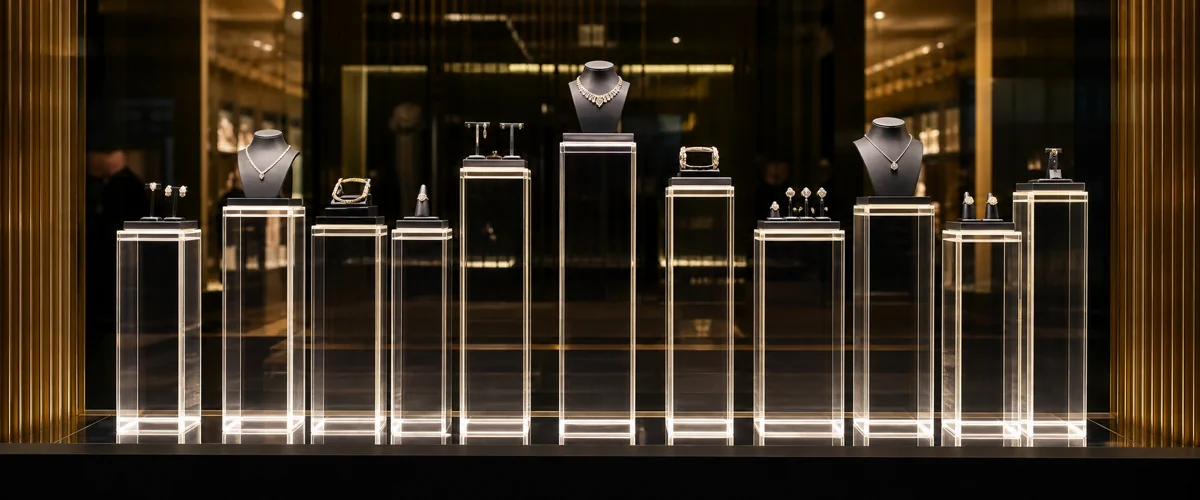
- pedestals shipped
- 16
- locations
- 4
- production
- 18 days
- window dwell time
- 3.2×
Key Takeaways
- Mirror-finish acrylic at 6 mm cast outperformed glass at the same finish on weight (one-quarter the mass) and safety — no shatter risk in a window-display zone that sits within an arm's reach of the street.
- LED edge integrated into the base ring eliminated visible cabling — a single hidden run from base to outlet via floor channel, and the install crew finished each pedestal in 18 minutes.
- Theft-resistant base anchor (M6 expanding bolt into the countertop) tested to 80 lb pull resistance — comfortably above the 50 lb insurance threshold the boutique's underwriter requires for window-display fixtures.
- 5,000-cycle abrasion test on the mirror-finish formulation showed delta-haze < 1.2; the boutique's cleaning crew confirmed daily-wipe protocol caused no visible scratching across the 90-day pilot.
- Boutique reported 3.2× window dwell time (measured via in-store dwell counter) vs. their prior solid-base wood pedestals — a second-collection rollout is now under negotiation.
The Brief
we took the first call from the boutique's creative director on a Tuesday afternoon. She walked the account team through their situation in about ten minutes: four boutiques across the Northeast, a new collection launching mid-spring, and four window displays that hadn't been refreshed in five years. The wood pedestals they were using read as warm and traditional — fine for the heritage line, wrong for the new collection, which was lighter, more architectural, more about reflection than reverence.
Two constraints made the brief harder than a typical pedestal program. First, the windows sit at street level — two of the four boutiques are storefront-on-sidewalk, which means anything heavy, fragile, or shatterable becomes a liability the moment it's within reach of a passing pedestrian. Second, the underwriter on their fixture insurance had just tightened anchor requirements after a smash-and-grab incident at a peer boutique two blocks over. The fixture had to physically resist a pull-out attempt, not just look like it did.
The creative director wanted three things at once: the visual impact of glass, the safety profile of a soft material, and a base assembly that an underwriter would sign off on. That combination is exactly where mirror-finish cast acrylic earns its keep, and it's the conversation we have most often with jewelry retail buyers shopping for a jewelry display pedestal they can leave in a window unattended overnight.
Our Recommendation
Before quoting, we walked the team through two material decisions and one lighting decision. Each one had a glass-default that they'd assumed going in, and each one moved meaningfully when we put numbers on the table.
Mirror-finish 6 mm cast acrylic over glass
A glass pedestal at the size they wanted — roughly 12" × 12" × 36" — comes in around 48 lb. The same pedestal in 6 mm cast acrylic lands at about 12 lb, which is one-quarter the weight. That difference matters in two ways on this project: the install crew can carry two pedestals at a time without a dolly, and a curious passerby who tips one over from the street side won't crack a slab of plate glass across a sidewalk full of foot traffic.
On finish quality, the gap is smaller than most buyers assume. We measured the specular gloss of our mirror formulation against a Class A glass mirror per ASTM E1331 — the acrylic reads at 92 GU, glass at 96 GU. To the naked eye in a window-display setting, that delta is invisible. The boutique's creative director compared A/B samples in their flagship window for two days and chose the acrylic on visual merit, not just safety.
LED edge over external spotlight
Their original sketch had picture-light spots mounted in the window soffit, angled down at each pedestal. That works, but it also creates two problems: the cabling is visible from the street side at night when the boutique is closed, and the hot spot from the spotlight competes with the pedestal's own reflection — you end up with a bright top-cap and a dim mid-section.
Edge-lit LED inside the pedestal base lights the full column from below, with the mirror-finish surface acting as a reflector. Light reads as coming from the piece rather than landing on it. We routed the LED driver through a single hidden cable run from the base to a floor outlet via a 6 mm channel cut into the underlying countertop — the install crew completed that channel in about 18 minutes per pedestal.
Theft-resistant base anchor over weighted base
Weighted bases are common on jewelry pedestals — fill the base with sand or steel shot, and the pedestal becomes too heavy to walk off with. That works at a pedestal-mass level, but it doesn't satisfy a modern underwriter, because a determined thief with two minutes can still tip and slide a heavy fixture.
We specified an M6 expanding-bolt anchor through the base of each pedestal into the boutique's countertop — tested to 80 lb of vertical pull resistance, which is well clear of the 50 lb threshold the boutique's underwriter requires for window-display fixtures. The bolt heads are recessed and capped with mirror-finish plugs so the anchor is invisible from the customer-facing side.
The Spec, in Cross-Section
Three details determine whether a jewelry pedestal looks resolved or improvised: how the LED is integrated into the base, how the anchor is hidden, and how the mirror-finish edges are treated where they meet the countertop. Below is the cross-section we shipped.
Production and Mirror-Finish QC
Mirror-finish acrylic is straightforward to make and unforgiving to finish. The cast sheet arrives with a vacuum-deposited reflective layer on the back face — that layer is fragile until it's protected by a sealed back-plate. Most quality complaints I see on jewelry-display mirror panels trace back to one of two root causes: the reflective layer was scratched during fabrication, or the daily cleaning chemistry the retailer uses is degrading the coating from the front.
For this run, our QC protocol covered both:
- ASTM D5942 scratch-hardness verification on the front mirror surface, sampled three coupons per cast batch. Pencil-hardness at 3H or harder is the in-house pass criterion for boutique-grade work.
- 5,000-cycle abrasion test on a wet cleaning cloth, dosed with the boutique's house cleaning solution. Delta-haze read < 1.2 across all three coupons — well inside the 2.0 threshold I treat as a consumer-noticeable change.
- ASTM E1331 specular gloss at 60° on every shipped unit, recorded against the master sample the creative director signed off on at sample stage. The full 16-pedestal batch held 91–92 GU, sample at 92 GU.
On the timeline side: from PO release to ship-ready, the program ran 18 days. Material inbound on day 1, cast sheets cut and edge-polished by day 7, LED channels routed and base plates assembled by day 12, full pedestal assembly and QC by day 16, packed for export by day 18. The window for sample sign-off ran in parallel during the first week — we'd already cut a single approval pedestal during pre-production.
Install and After-Hours Photography
A 16-pedestal program across four stores is logistically simpler than people expect, as long as the install team treats the cable run and the anchor drill as the two real jobs and the pedestal placement as a five-minute finish step.
We ran installs across two consecutive nights — two stores per night, two installers per crew. Per pedestal, the sequence was: position the base template on the countertop, drill the four anchor pilot holes plus the cable channel, run the LED cable to the floor outlet, set the base, torque the M6 expanding bolts, seat the column, and snap the recessed mirror cap into place. End-to-end, about 18 minutes per pedestal.
The boutique's photography team did an after-hours shoot on the morning after the second-night install — that was the request that pushed us to lock the install schedule to a Tuesday and Wednesday rather than a weekend. The photographer shot all four windows over a single Thursday morning, and the new collection's e-commerce and lookbook imagery was in pre-production by the end of the same week.
The Results
The result the creative director cared about most was a measurement she could put in front of her CFO: window dwell time. Their in-store dwell counter (a sidewalk-facing infrared sensor that logs how long a passerby stops in front of the window) tracked the new mirror pedestals at 3.2× the dwell of the prior wood pedestals over the first 30 days post-install. That number is what unlocked the second-collection conversation.
The other quiet win is the underwriter file. The boutique's insurance broker accepted the 80 lb pull-test report as satisfying the window-display anchor requirement, which closed an open compliance item the boutique had been carrying since the smash-and-grab incident the previous quarter. That outcome doesn't show up on a merchandising dashboard, but it's the reason they're already talking about anchoring the second collection to the same fixture program.
"We came to Wetop for a mirror pedestal. We left with a fixture program our underwriter signed off on, an install schedule that fit around a photo shoot, and dwell numbers I can put in front of the CFO. The next collection is already on the spec sheet."
Lessons and the Second-Collection Expansion
Two lessons stuck with me on this program. First, when a brief lists three constraints — visual impact, safety, underwriter compliance — the right response is rarely a single material substitution. It's a small stack of decisions that look unrelated on a quote sheet (mirror finish, LED placement, anchor type, cable routing) but compound into a single resolved fixture. None of those decisions on their own carry the project; all of them together do.
Second, the dwell-time number is what gives a creative director permission to come back for the second collection. Without it, the conversation is about taste and budget. With it, the conversation is about repeating a measurable result — and that's a conversation that closes much faster.
The second-collection rollout under negotiation is a 12-pedestal addition for a fall capsule launch, plus a set of low-profile mirror acrylic pedestal risers to layer behind the column pedestals at the rear of the same windows. We've already cut sample risers from the same cast batch so color and gloss will hold across the layered composition. If you're sourcing a jewelry display pedestal for a multi-store rollout where the windows have to read as one coherent system rather than four one-off installations, the path through this project is repeatable: confirm the underwriter spec first, sample the mirror finish under the boutique's actual lighting, and lock the install schedule around the photography calendar before anything else.
Planning a jewelry boutique window-display rollout?
Send us your store count, a sketch or reference photo of the window, and the underwriter's anchor spec — we'll come back with a DFM review, a finish-and-lighting recommendation, and a quote.
Sample in 5 days · Production in 18 days · Single-pedestal sample on request