
Delivered Project · Footwear Retail
Mirror-Finish Acrylic Shoe Display Program
A luxury footwear house needed mirror-finish shoe risers in several heights for its boutiques.
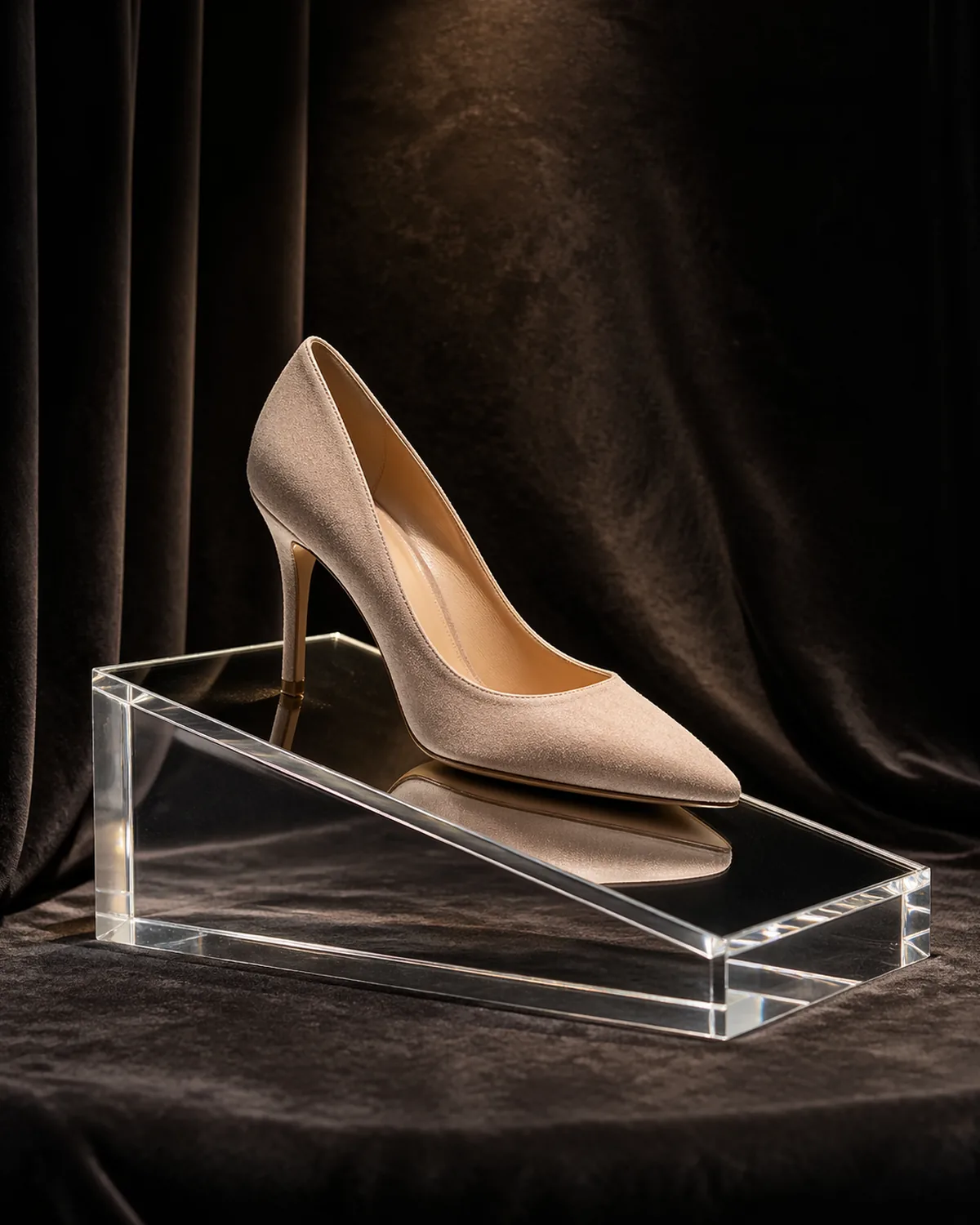
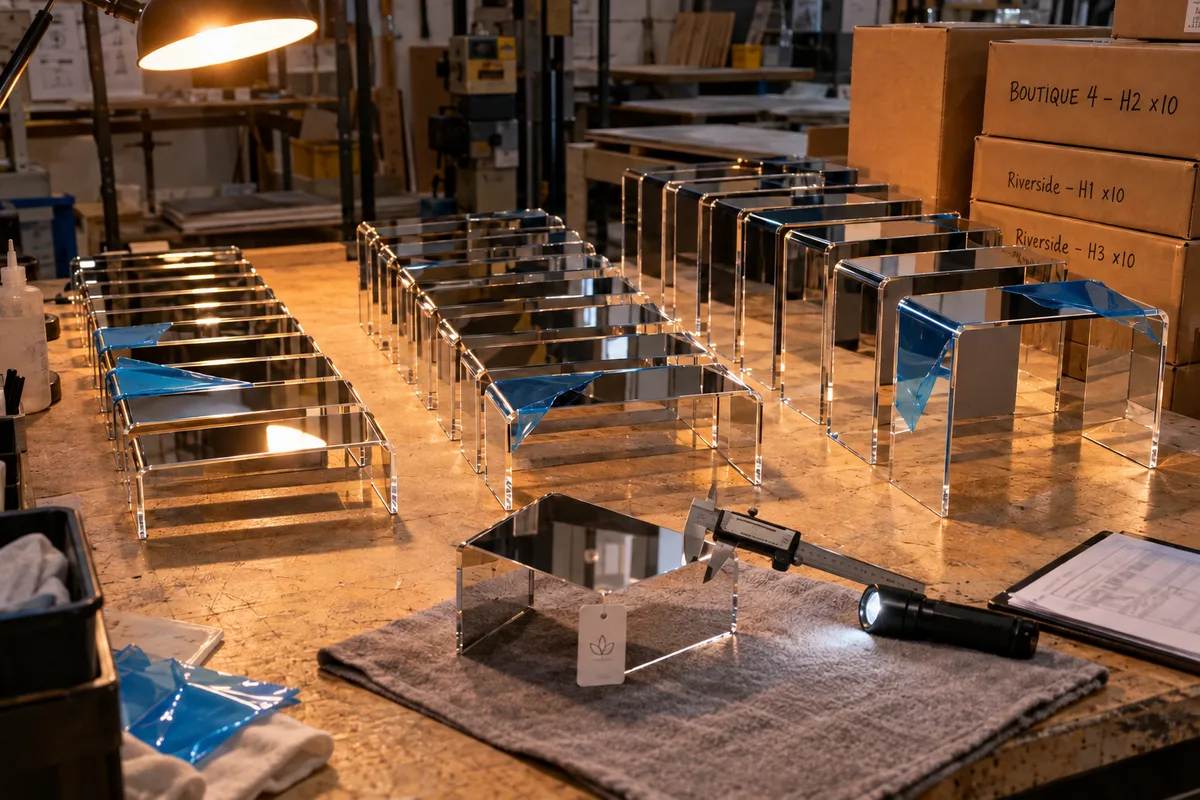
We made them in reverse-mirrored cast acrylic, approved finish and shoe support on a paid sample under boutique lighting, and moved into production once dimensions, finish and packing were signed off. Delivered: mirror-finish shoe risers, one drawing per height, approved on a physical appearance-and-fit sample.
Ordering a similar project
The minimum order is 100 pieces per design. Paid samples normally take 3–5 days; sample fees are paid separately and never credited. Standard production takes 15–20 days after the drawing, material, finish, inspection method, packing, and sample are approved. Wetop responds to a complete brief within 24 hours.
Closest published price: this order was quoted per riser design. The nearest public reference on the acrylic display manufacturer page is a two-tier countertop stand 250 × 180 × 220 mm, 5 mm clear, one-color UV logo: $28 each at 100 pcs, $16 at 500, $12 at 1,000 (FOB Shenzhen, published reference). Mirror-coated cast acrylic prices above clear stock.
Key Takeaways
- A luxury footwear house asked us for mirror-finish shoe risers in several heights for its boutiques; we approved a named reverse-mirror cast acrylic on a physical sample.
- We set incline, footprint, height, edge treatment and shoe contact points from the buyer’s brief and its actual shoes.
- We tested the sample under the boutique lighting and the store cleaning method before bulk production.
- Production inspection checked dimensions against the drawing, and finish, shoe support and packing against the approved sample.
- We kept the released drawing, finish reference, sample record and packing file together for the buyer's reorders.
The Challenge
A luxury footwear house came to us for mirror-finish acrylic shoe risers for its boutiques. It wanted several riser heights that shared one mirror finish and one visual language. Each height still needed its own drawing, because footprint, incline, shoe support, edge treatment, lighting, cleaning and packing change with each design.
The buyer sent the shoes to be displayed, viewing direction, shelf and light conditions, a mirror reference, the store cleaning method, quantity by design, store allocation and destination.
- Mirror appearance: we approved a named sheet and coating construction under the boutique lighting.
- Surface care: we tested the store cleaning method on the production material and edge finish.
- Shoe support: we verified contact points, stability and viewing angle with the actual shoes.
Our Approach
We compared mirror constructions, substrates and geometry on a production-built sample. The buyer approved appearance and shoe support on that sample before we released bulk production.
Reverse-mirror coating, not top-surface
We put the reflective layer behind the visible acrylic face. A top-surface film, a coated sheet and a reverse-coated part each behave differently at the edge, under cleaning and in repair, so the quote and drawing named the reverse-mirror construction the buyer approved.
- Visible face: we inspected scratches, haze, distortion and color under the buyer-approved light.
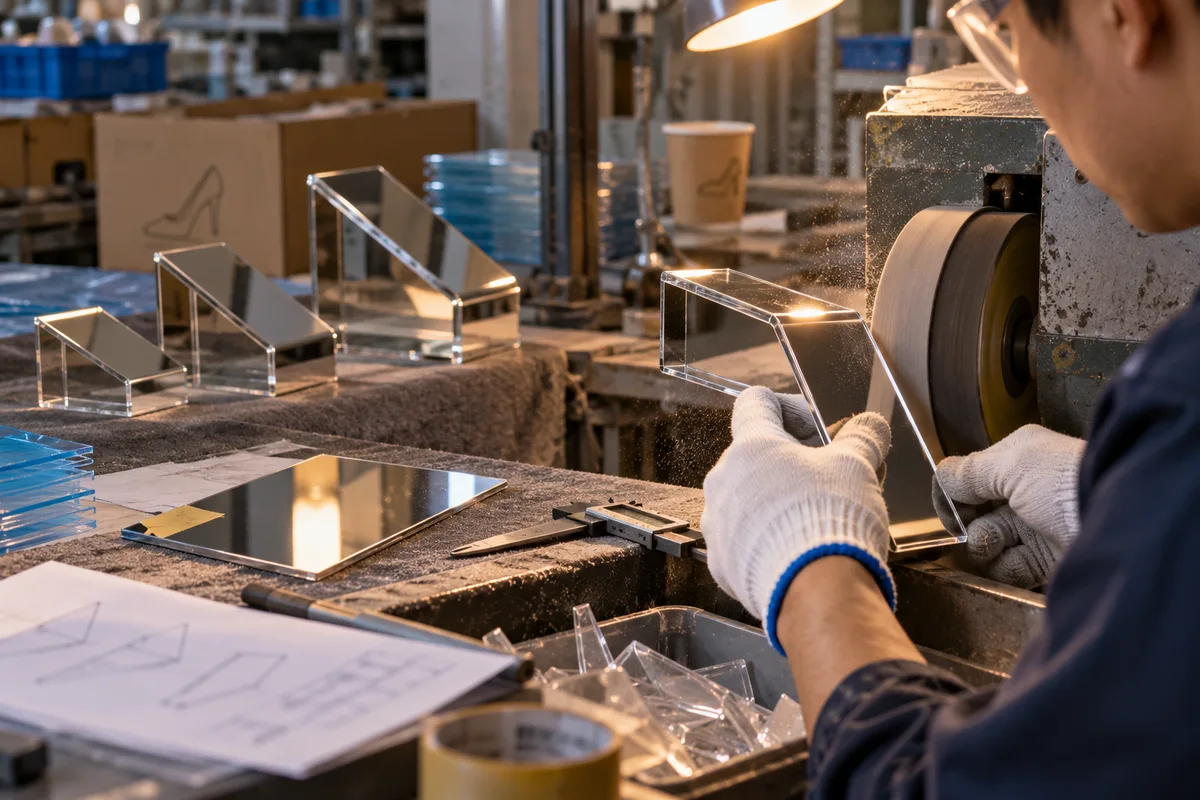
- Edges: we recorded how cutting and polishing affected the reflective layer and backing.
- Cleaning: we approved the cleaner, cloth, contact time and test method on the physical sample.
Named cast acrylic, compared side by side
We set material grade and thickness from the part span, machining, coating process, load, lighting and appearance. The buyer compared the options side by side under the boutique light and viewing distance, and approved a named cast grade from its supplier documentation.
| Material | Role on this order | Approval input | Inspection focus |
|---|---|---|---|
| Mirrored glass (benchmark) | Benchmark the buyer compared against | Buyer reference sample and handling | Appearance, edge safety, weight, and packing |
| Extruded acrylic, surface-mirrored | Compared on sample, not chosen | Named material and coating specification | Surface, edge, backing, and cleaning compatibility |
| Cast acrylic, reverse-mirrored | Approved and produced | Named grade, coating stack, and lighting | Flatness, reflection, edge finish, and sample match |
Incline and edge finish approved on the shoe
We set the incline, edge chamfer and feet from the buyer’s shoes, shelf, viewing direction and a stability test, and named a polishing method that suited the cast acrylic and reverse coating.
Each riser released as a complete retail fixture
We built the variant matrix from the actual footwear. For every riser we recorded the shoe envelope, contact points, footprint, incline, height, viewing direction, mirror construction, edge finish, feet, quantity, destination and carton label. One finish tied the family together, but a low plinth and a steep heel support were still two manufactured designs.
We reviewed the sample under the lighting it would sit in, from the shopper’s eyeline, the staff side and the reflected shelf surface. The buyer approved face, backing and edges together and recorded the viewing light and distance.
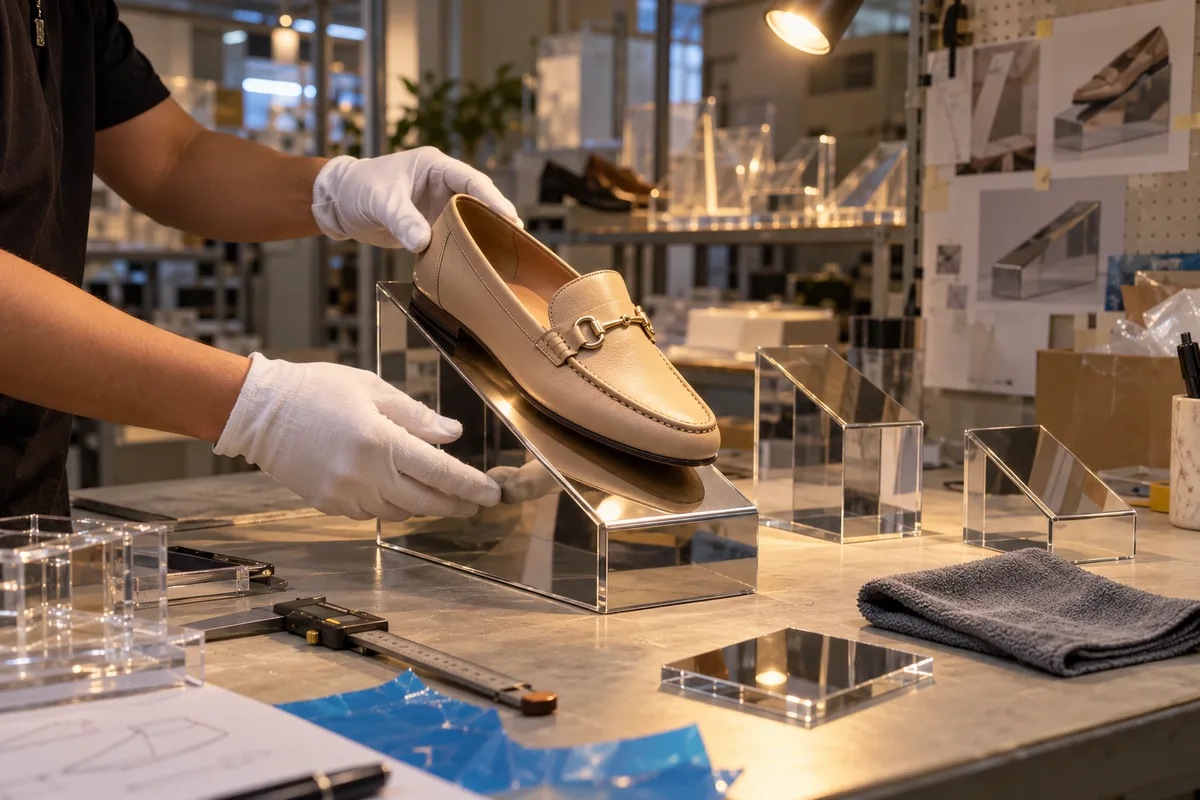
Fit review protected the shoes. We placed them on the sample and checked balance, sole contact, heel support, toe clearance, the removal path and whether an edge or foot could mark the shelf. Where several shoe styles shared a riser, we tested the largest and smallest the buyer named. Those contact conditions became the inspection references.
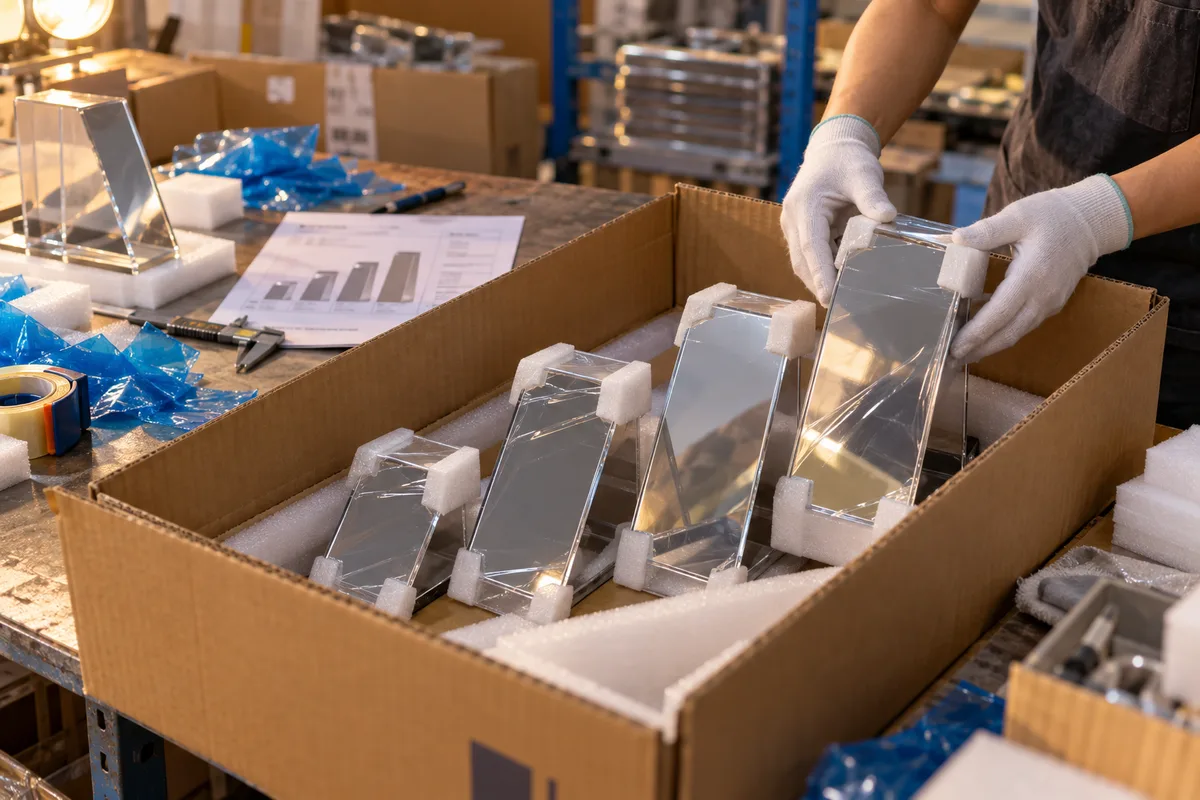
We treated packing as part of the finish: a set film-removal sequence, interleaving that left no texture, protected corners and a carton orientation that kept feet off the mirror face. We unpacked the packing sample in the order store staff would, so the buyer could check labels, handling and the first unit out.
Store allocation sat in the same release. Every riser geometry was mapped to its quantity, destination, shelf zone and carton label, with spares listed separately, so a shared finish could not hide a height mismatch at receiving.
The Results
Production ran 15–20 days after approval. Each geometry shipped with its own drawing, named material and coating, approved appearance-and-fit sample, inspection record and carton layout. We inspected dimensions against the drawing and finish, shoe support and packing against the approved sample.
For reorders we keep the file set on record and reuse it once the buyer confirms the shoes, lighting, cleaner, quantity and packing are unchanged. A new shoe type, height, incline or lighting setup goes back to sample review.
Release rule on this order: we approved the mirror finish, shoe support, lighting, cleaning method and edge treatment on the same physical sample.
If You're Planning Something Similar
Settle the mirror construction, shoe contact points, incline, edge, lighting and cleaning method before you price several heights. Each geometry carries its own 100-piece MOQ; we can run several approved designs in one production window and shipment, but one sample does not release a different height or footprint. The acrylic shoe display guide covers merchandising and mounting inputs, and custom acrylic risers shows the product.
Need mirror-finish shoe risers for your stores?
Send the shoe or gauge, geometry list, quantities, material or mirror reference, lighting, cleaning method, store allocation, packing, and destination. We will return a drawing review, sample scope and quote.
Paid samples in 3–5 days, separately paid and never credited