Acrylic Mirror Sheet for Cosmetics Display: A Buyer's Guide
Cosmetics buyers ask for mirror because it sells lipstick. What they rarely ask is which mirror-finish coating tier survives nine months of cotton wipes — and that coating decision is the whole ballgame.
Key Takeaways
- Acrylic mirror sheet is roughly half the weight of glass and shatter-safe, but the mirror coating is the weak link — scratch survival depends on the coating tier, not the PMMA substrate.
- Premium hardcoated mirror finishes hold their surface hardness far better than budget-coated sheet under repeated cotton-and-microfiber wiping; standard mirror sheet hazes at the wipe contact line first.
- Warmer counter LEDs (2700K–3000K) render warm-tone lipstick and foundation truer than 4000K neutral white — the color shift between temperatures is real and above the perceptibility threshold, which is why luxury beauty retail rarely uses cool LEDs.
- CNC-routed and diamond-polished edges with a clear sealing pass protect the coating; flame polishing's heat compromises the silver bond at the edge — never spec flame on a visible mirror edge.
- Use isopropyl alcohol or pH-neutral soap. Ammonia-based glass cleaner and any abrasive pad strip the mirror coating; one wrong wipe protocol can ruin an expensive riser.
On this page
- What Acrylic Mirror Sheet Is, and Why Cosmetics Asks for It
- Mirror Finish vs Glass: The Durability Comparison That Actually Matters
- Scratch Resistance Math: Mohs + Cycle Test Data
- Color Fidelity Under Counter LED: 2700K vs 4000K
- Edge Finish for Mirror Sheet: What’s Safe to Handle
- Cleanability and Safe Cleaning Agents
- Why Wetop on Mirror-Finish Cosmetics Programs
- Related guides
What Acrylic Mirror Sheet Is, and Why Cosmetics Asks for It
Acrylic mirror sheet is cast PMMA with a vacuum-deposited aluminum or silver mirror coating bonded to one face and a protective backing layer over the coating. The mirrored face reflects like glass; the substrate is half the weight, shatter-safe, and accepts laser cutting, CNC routing, and thermoforming. For cosmetics retail this combination is genuinely useful — mirror finish doubles the visual density of a lipstick or fragrance display, and the lightweight, non-shatter substrate is what risk-averse retail ops teams require for permanent in-store fixtures over glass.
The cosmetics category has used mirror finish for decades because it does one specific job: a tube of lipstick on a mirrored riser reads as two tubes, and overall counter density looks expensive without being expensive to produce. Across the mirror-finish risers, podiums, gondola headers, and tester bars we produce for beauty programs, the same five questions come up at sample stage every time: how durable is it, does the mirror scratch, does it shift product color under counter LEDs, what edge finish is safe for staff handling, and what cleaning agents do not destroy the coating. This guide is the engineering answer to those five questions.
Mirror Finish vs Glass: The Durability Comparison That Actually Matters
For any high-touch mirror finish display fixture in cosmetics retail, acrylic mirror sheet is the correct spec over glass mirror in nearly every case. The two reasons are weight and shatter behavior, and both come down to what happens when a counter fixture gets bumped, dropped, or leaned on by a customer. Glass mirror at 5mm weighs roughly 12.5 kg per square meter; acrylic mirror sheet at the same gauge weighs about 5.9 kg. On a tester bar that needs to be moved between bay layouts twice a season, that weight difference is the difference between a one-person task and a two-person task.
The shatter behavior is the bigger argument. When glass mirror fails on a cosmetics counter — from thermal shock, a dropped fragrance bottle, or aggressive cleaning — it sheds sharp shards across product, sometimes into open lipstick tubes. Acrylic mirror under the same impact deforms or cracks in place but doesn’t shed; in retail risk terms, that’s the difference between a fixture replacement and a customer-injury incident report. For a deeper comparison across the full display category, see our acrylic vs glass displays breakdown.
Mirror Performance Spec Table
The comparison below lines up three options a cosmetics buyer typically weighs — standard mirror-finish acrylic (the budget tier most factories quote when asked for “mirror acrylic”), premium hardcoated mirror-finish acrylic (the coating tier we default to for permanent retail), and 5mm float glass mirror as the reference baseline. The figures are published/typical values from material databases and producer datasheets, not a Wetop measurement; treat them as directional for spec discussions, and confirm the exact number against your chosen supplier’s datasheet.
| Spec | Standard Mirror-Finish | Premium Hardcoated Mirror-Finish | 5mm Glass Mirror |
|---|---|---|---|
| Substrate scratch hardness (Mohs, cast PMMA) | ~2.5–3.0 | ~2.5–3.0 | 5.5 (soda-lime glass) |
| Surface hardness driver | uncoated / thin coating | scratch-resistant hardcoat | glass surface |
| Relative haze resistance after repeated wiping | hazes early at contact line | holds clarity far longer | no change |
| Perceptible color shift, 2700K → 4000K LED | present (>ΔE 1, above threshold) | present (>ΔE 1, above threshold) | present (>ΔE 1, above threshold) |
| Safe edge finishes | CNC-sealed / diamond (never flame) | CNC-sealed / diamond (never flame) | N/A — glass edge ground |
| Specific gravity | ~1.19 | ~1.19 | ~2.5 |
| Shatter behavior under drop | Cracks, no shed | Cracks, no shed | Shatters, sheds shards |
Two takeaways from the table: mirror finish quality is a coating decision, not a substrate decision (both acrylic options have the same PMMA underneath, rated around Mohs 2.5–3.0 per material databases such as MakeItFrom and MatWeb), and the gap between standard and premium coating only shows up after sustained wiping. A four-week sample test won’t surface the problem; a nine-month retail rotation will.
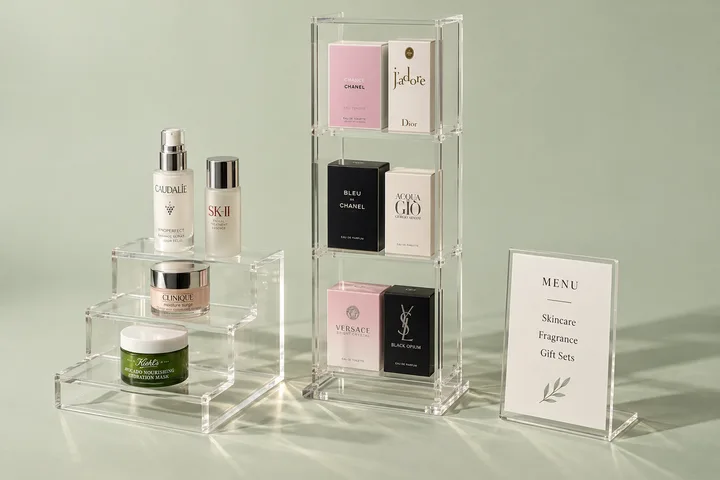
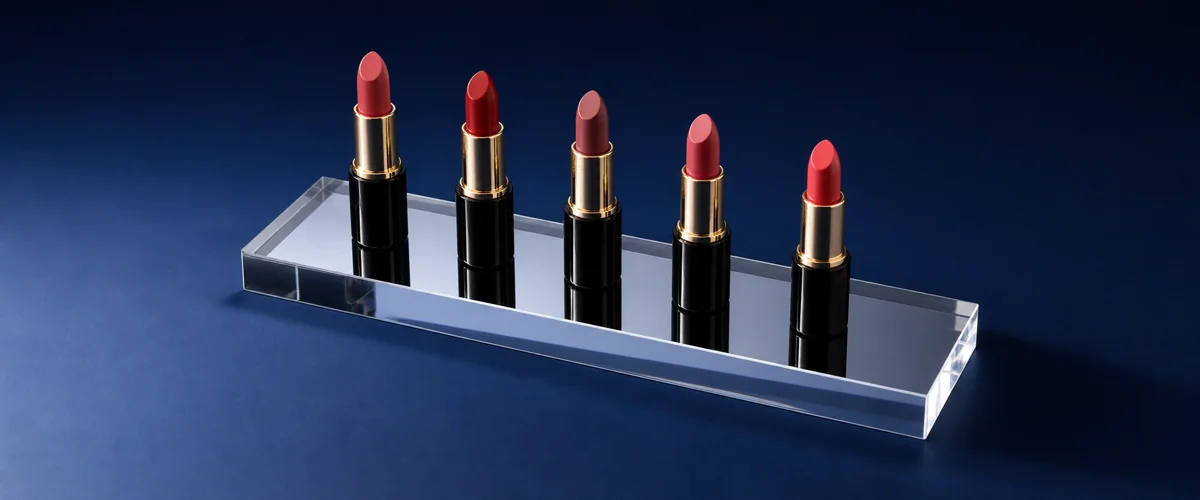
Mirror-acrylic riser hosting a lipstick presentation under 2700K counter LED. The mirror doubles visual product density without doubling unit count — the core reason cosmetics buyers spec mirror finish.
Scratch Resistance Math: Mohs + Cycle Test Data
Scratch resistance on acrylic mirror sheet is a coating property, not a substrate property. The PMMA underneath rates around Mohs 2.5–3.0 (a value published across material databases like MakeItFrom and AZoM) and is largely beside the point — what staff and customers actually touch is the protective topcoat over the mirror layer. Specifying “acrylic mirror sheet” without specifying the coating tier is the single most common spec mistake we see on cosmetics RFQs, and it’s the reason the same fixture program can run great for one brand and fail for another off the same drawing.
The mechanism is straightforward. Abrasion resistance of a coated surface is governed by the topcoat, not the base polymer: this is why the industry rates it with dedicated coating tests such as ASTM D1044 (Taber abrasion, measuring haze increase after a set number of abrasion cycles) and ASTM D3363 (pencil hardness of a coating)1, and why premium optical-grade acrylics carry a distinct abrasion-resistant (AR) hardcoat grade — Röhm’s PLEXIGLAS and Evonik’s ACRYLITE lines, for example, publish separate coated and uncoated grades precisely because the coating, not the PMMA, sets scratch life. A budget mirror sheet with a thin or no hardcoat softens and hazes at the wipe-contact line first; a proper AR hardcoat holds clarity through far more wiping. In beauty retail terms, a permanent counter fixture might see a business associate (BA) wipe the riser two or three times per shift — a level of repeated contact that separates a real hardcoat from a cosmetic one within the first year.
The cycle math is what convinces buyers. A 500-piece program with the wrong coating tier looks identical at sample sign-off, identical at first install, and identical at the eight-week retail review. The failure surfaces at the nine-month BA rotation report — at which point the brand has already paid for replacements, BA training, and a credibility hit with the visual merchandising team. The cost delta between standard and premium hardcoat at our factory is roughly 12–18% on the substrate price; the cost of a mid-program replacement run is 100% of the substrate plus freight plus install labor. Spec the premium coating once, save the warranty argument later.
For the broader scratch-resistance discussion across acrylic finishes, our clear vs frosted vs colored acrylic guide covers how surface treatment interacts with handling — most of the same logic applies to mirror finish, with an added penalty because mirror coatings are thinner and more delicate than pigmented or frosted treatments. Mirror is one branch of the decorative-sheet family — if the counter design calls for color-shifting sheet instead, our iridescent acrylic sheet buyer guide covers grades, batch consistency, and cost for that material.
Color Fidelity Under Counter LED: 2700K vs 4000K
The mirror coating itself is neutral — it doesn’t add color. What changes when you put a lipstick on an acrylic mirror sheet under counter LED is the way the reflected color reads back to the customer’s eye, and that effect is dominated by the LED color temperature, not the mirror. It matters here because most cosmetics brands carry a color-accuracy spec, and the reflected image on a mirror riser is subject to the same color cast as the product itself.
The physics is well established in color science and lighting engineering. Perceived color difference is quantified as delta-E (ΔE), and a difference around ΔE 1 is roughly the threshold at which an average observer starts to notice a shift; a ΔE of 2 or more is plainly visible on a saturated shade. Moving a counter from warm white (2700K) to neutral white (4000K) changes the illuminant’s spectral power distribution, which shifts how a pigment renders — warm-tone reds, corals, and nudes lose warmth under cooler light, while cool berry and plum shades read sharper and more saturated. Because the mirror simply returns whatever the LED produces, the reflected image shifts the same way the product does. Lighting-quality metrics like the IES TM-30 fidelity and gamut indices, and the LM-79 measurement method for SSL luminaires, are the reference frameworks brands and their lighting suppliers use to pin down these effects.
Translated for the buyer: at 2700K the warm-tone lipstick reads true and rich, and the cool-tone lipstick reads slightly muddy; at 4000K the warm-tone reads slightly washed-out, and the cool-tone reads sharp and saturated. This is why luxury beauty retail almost universally runs 2700K–3000K LED — warm tones are what sells lipstick, foundation, and fragrance, and warm-tone product reads truer under warm light. The acrylic mirror sheet is reflecting whatever the LED is producing, including any color cast. If the brand’s planogram specifies 4000K (which shows up on some younger / clean-beauty positioning), the color shift is real, and the merchandising team should color-correct the lipstick photography in the planogram book to match what shoppers actually see at the counter. For broader cosmetics merchandising context, our cosmetic display design guide covers how lighting interacts with riser geometry and product placement.
Edge Finish for Mirror Sheet: What’s Safe to Handle
Edge finish on acrylic mirror sheet is where most fabrication shops get it wrong — and it’s where I personally spec-check every drawing before it hits production. The mirror coating sits on the back face of the substrate, and the edge of the sheet is where the coating layer is exposed to air, moisture, cleaning chemicals, and customer fingertips. The wrong edge finish creates a slow-motion failure that the brand’s ops team won’t notice for months but every BA at the counter will see eventually.
The three edge finishes rank in a predictable order, and it comes down to the coating bond at the edge rather than any single number. Flame polishing melts the surface with an open flame or hot air; that heat reaches the silver-coating bond at the edge boundary and weakens it, so the edge fogs early and silver-mirror oxidation creeps in from the perimeter under normal counter cleaning. CNC routing followed by a clear sealing pass leaves a crisp edge and, more importantly, a sealer film over the exposed coating boundary that keeps moisture and cleaning solvents from migrating behind the mirror layer — that is the finish we treat as the workhorse for permanent retail. Diamond polishing gives the same protection plus an optical-clear edge for premium hero positioning, at roughly 2.5 times the labor cost. Flame polishing’s failure mode is simply thermal: once the flame’s heat compromises the silver-coating bond at the edge, normal counter cleaning chemicals do the rest.
The rule we ship to every cosmetics buyer: never spec flame polishing on visible mirror-acrylic edges. Use CNC routing with a clear sealing pass for permanent retail fixtures, or diamond polishing for premium hero-display positioning. Flame polishing remains the right choice for clear acrylic edges where there’s no coating to compromise — it’s a process-finish mismatch, not a process problem. Our diamond vs flame polishing acrylic guide has the broader edge-finish decision tree; the mirror-sheet rule is the one application where flame polishing is categorically wrong.
Cleanability and Safe Cleaning Agents
Cleanability is the single biggest delta between a mirror riser that ships great at install and a mirror riser that looks like a fixture replacement candidate at the eight-month review. The substrate and coating I described above are durable when treated correctly; they fail fast when treated like glass. Glass mirror cleans with ammonia-based glass cleaner and a paper towel — that’s the muscle memory of every retail BA who has ever cleaned a fixture, and it’s exactly the wrong protocol for acrylic mirror sheet.
The two safe cleaning agents are 70%+ isopropyl alcohol with a clean microfiber cloth, and pH-neutral soap diluted in water (Dawn or equivalent, applied with microfiber, rinsed and dried). Both clean fingerprints, lipstick smears, and counter dust without compromising the coating.2 The banned list, which we print on a one-page card and ship with every cosmetics fixture order: ammonia-based glass cleaner (Windex), any abrasive pad (Scotch-Brite, magic eraser, even some “non-scratch” sponges), paper towels (the wood fibers scratch the coating over time), acetone, MEK, and any solvent more aggressive than isopropyl alcohol. In our production experience, the wrong cleaning protocol is the single most common reason mirror risers get replaced mid-program — a cleaning crew defaulting to ammonia glass cleaner and paper towels can strip an otherwise-fine installation, and that avoidable replacement run is exactly what a one-page BA cleaning card is there to prevent.
The other cleanability rule is dry-wipe direction. Mirror coatings show wipe-marks more than clear acrylic, so the BA’s cleaning motion matters: always wipe in one direction (left-to-right or top-to-bottom), never circular. Circular motion deposits microfibers and shows reflection artifacts under counter LED. Linear wiping leaves the surface looking like a freshly polished glass mirror; circular wiping leaves a halo pattern that’s visible at every viewing angle on the counter. Brand the cleaning card with the brand’s logo, hand it to the BA at install, and the riser stays in spec for the full program.
Why Wetop on Mirror-Finish Cosmetics Programs
Cosmetics is one of the categories where we run the most mirror-finish work across our acrylic displays line, and the engineering above is how we actually think about the material — coating tier, edge finish, and cleaning protocol, in that order. We bring those three decisions to the buyer at sample stage so the spec discussion is engineering-driven, not photo-driven, and we can run a simple in-house drop-check and a caliper measurement on a loaded sample case before it ships. For program-level context on how we structure cosmetics fixture orders, see our acrylic cosmetic organizers with velvet inserts case study and the broader acrylic organizers product line.
If you’re scoping acrylic mirror for retail at scale — risers, podiums, gondola headers, tester bars, or a full counter refit — the conversation we want at RFQ stage is which coating tier (standard vs premium hardcoat), which edge finish (CNC-sealed vs diamond), and which cleaning protocol the BA team will be trained on. Those three answers determine whether the fixtures hit the brand’s nine-month ops review or get added to the warranty line. Send us your program brief with the store count, fixture list, and any existing planogram references, and we’ll come back with a coating-tier recommendation, a sample plan, and the engineering reasoning behind the choice.
Related guides
- Is Plexiglass Heat Resistant? Engineering Limits & Real Use-Case Math
- Is Plexiglass Heat Resistant? Engineering Limits & Real Use-Case Math
Footnotes
-
ASTM D1044 — Standard Test Method for Resistance of Transparent Plastics to Surface Abrasion (Taber Abraser) and the related coating-hardness method ASTM D3363 (Film Hardness by Pencil Test) are the industry frameworks for rating how well a coated surface resists abrasion and scratching. These are the tests behind the abrasion-resistant (AR) hardcoat grades that acrylic producers publish separately from their uncoated sheet. ↩
-
Evonik Industries. ACRYLITE / PLEXIGLAS — Care and Cleaning of Acrylic Sheet. Manufacturer cleaning guidelines specify isopropyl alcohol and pH-neutral soap as safe agents for PMMA surfaces, with ammonia-based cleaners and abrasive media on the banned list. See the producer’s technical-support / care-and-cleaning literature for the current guidance. ↩
Frequently Asked Questions
Is acrylic mirror sheet durable enough for a cosmetics counter?
Yes, when you spec the right coating tier. Premium hardcoated mirror-finish acrylic holds its surface hardness under repeated cotton-and-microfiber wiping and resists the hazing that shows up at the wipe contact line. Budget-coated mirror sheet softens and hazes far sooner in the same duty cycle — it works for a 4–6 month seasonal display but fails for permanent counter fixtures. The substrate (cast PMMA) is fine; the coating tier is what determines whether the riser survives nine months of staff cotton wipes. When in doubt, spec a scratch-resistant hardcoat rated to a published abrasion-resistance standard such as ASTM D1044 (Taber abrasion) rather than an unspecified 'mirror acrylic.'
What thickness of mirror acrylic do I need for a cosmetics riser?
5mm is our default for tabletop cosmetics risers carrying lipsticks, fragrances, and small skincare. 8mm if the riser holds heavier products (foundation glass bottles, gift sets) or spans more than 300mm unsupported. We steer clients away from 3mm mirror in permanent retail: thin sheet is prone to warping under the sustained heat of overhead halogen counter lights, and a mirrored surface makes any bow far more visible than it would be on clear acrylic.
Does acrylic mirror finish distort more than glass mirror?
Slightly, but not in a way cosmetics buyers reject. Glass mirror has near-perfect specular reflection; acrylic mirror has a tiny waviness from the coating-to-substrate bond and, on thinner or unsupported sheet, from any slight bow in the substrate. At normal viewing distance on a counter (40–80cm), customers don't see it — what they see is the lipstick reflected back at roughly twice the visual density, which is why the format sells. If reflection quality is critical to the program, ask your supplier for the coating's specular gloss spec — specular gloss is measured per ASTM D523 (60° geometry) — and specify a rigid enough gauge that the sheet stays flat under counter lighting.
How do I clean acrylic mirror sheet without damaging the coating?
Use isopropyl alcohol (70% or higher) with a clean microfiber cloth, or pH-neutral soap diluted in water. Wipe gently, never scrub. Banned: ammonia-based glass cleaner (Windex), abrasive pads, paper towels, and any solvent stronger than IPA — these strip the mirror coating in days. We provide a one-page cleaning card with every cosmetics fixture order so the BA team has the rules at the counter.
What edge finish should I spec for acrylic mirror sheet?
CNC-routed with a clear sealing pass, or diamond-polished. Both leave the coating boundary sealed against moisture and cleaning solvents, so the edge holds up under repeated retail handling. Never spec flame polishing on a mirror edge — the flame's heat is high enough to compromise the silver coating bond at the edge boundary, and once that bond is broken, normal counter cleaning lets fogging and silver oxidation creep in from the perimeter. Flame polishing is fine for clear acrylic edges; it is the wrong process for mirror sheet.
Planning a cosmetics refit with mirror risers?
Send your fixture list, store count, and the mirror finish you have in mind. We'll quote both the substrate and the coating tier, recommend a safe edge finish and cleaning protocol, and send a physical mirror sample so you can check the finish before you commit to production.