

LED Light Box Frames — Spec Guide for Brands & Signage
A powered panel hides nothing. Here is what to spec — stack, swap system, driver, lead time — before you order a batch.
Need this made?Custom acrylic frames →
Key Takeaways
- Edge-lit LED frames run LEDs along the edge of an acrylic light-guide panel and stay slim, around 25 mm deep; backlit boxes place LEDs behind a diffuser and trade depth for brightness. Choose by mounting depth and ambient light.
- Cast acrylic is the standard light-guide and diffuser material: clear grades transmit up to 92% of visible light, and a diamond-polished edge is what lets that light couple in cleanly.
- Custom LED light box frames are made to order: plan on 3–5 days for a sample and 15–20 days for production at a 100-piece MOQ. Marketplace 'in-stock' light boxes are fixed sizes with no branding.
- The frame is customs-simple; the electronics are not. Confirm the LED driver's certification for your destination market and the input voltage before you import.
On this page
- LED light box frame specifications at a glance
- Inside an edge-lit frame — the panel stack
- Acrylic light box construction — why cast PMMA is the light guide of choice
- Backlit poster frame vs edge-lit frame — which fits which use
- Graphic swapping — magnetic fronts, snap frames, and film types
- Power and safety specs for import — drivers, certification, wiring questions to ask
- Lead time reality for made-to-order LED frames — no stock, and why
- How to spec your LED light box frame order
LED light box frame specifications at a glance
An LED light box frame is an acrylic display frame that lights a printed graphic from inside. Its specification comes down to seven choices: edge-lit or backlit, overall size, single or double-sided, graphic swap system, LED edge count, driver certification for the destination market, and input voltage.
| Specification | Typical edge-lit frame | Typical backlit box |
|---|---|---|
| Overall depth | About 25 mm | 80 mm or more |
| Front panel | 3 mm clear acrylic | Acrylic diffuser |
| Light source | LED strip on 1, 2 or 4 edges of an 8 mm light-guide panel | LED array behind the diffuser |
| LED supply | 12 V or 24 V DC from a driver | 12 V or 24 V DC from a driver |
| Faces | Single or double-sided | Usually single-sided |
| Graphic change | Magnetic front or snap rails | Snap rails or hinged front |
| Driver listing | Per market (UL 48 context in North America, CE in the EU) | Same |
These values are generic starting points; the approved drawing and sample set the actual build. The acrylic fabrication underneath is the same cutting, polishing, and bonding that goes into our custom acrylic frames, with light and power added.
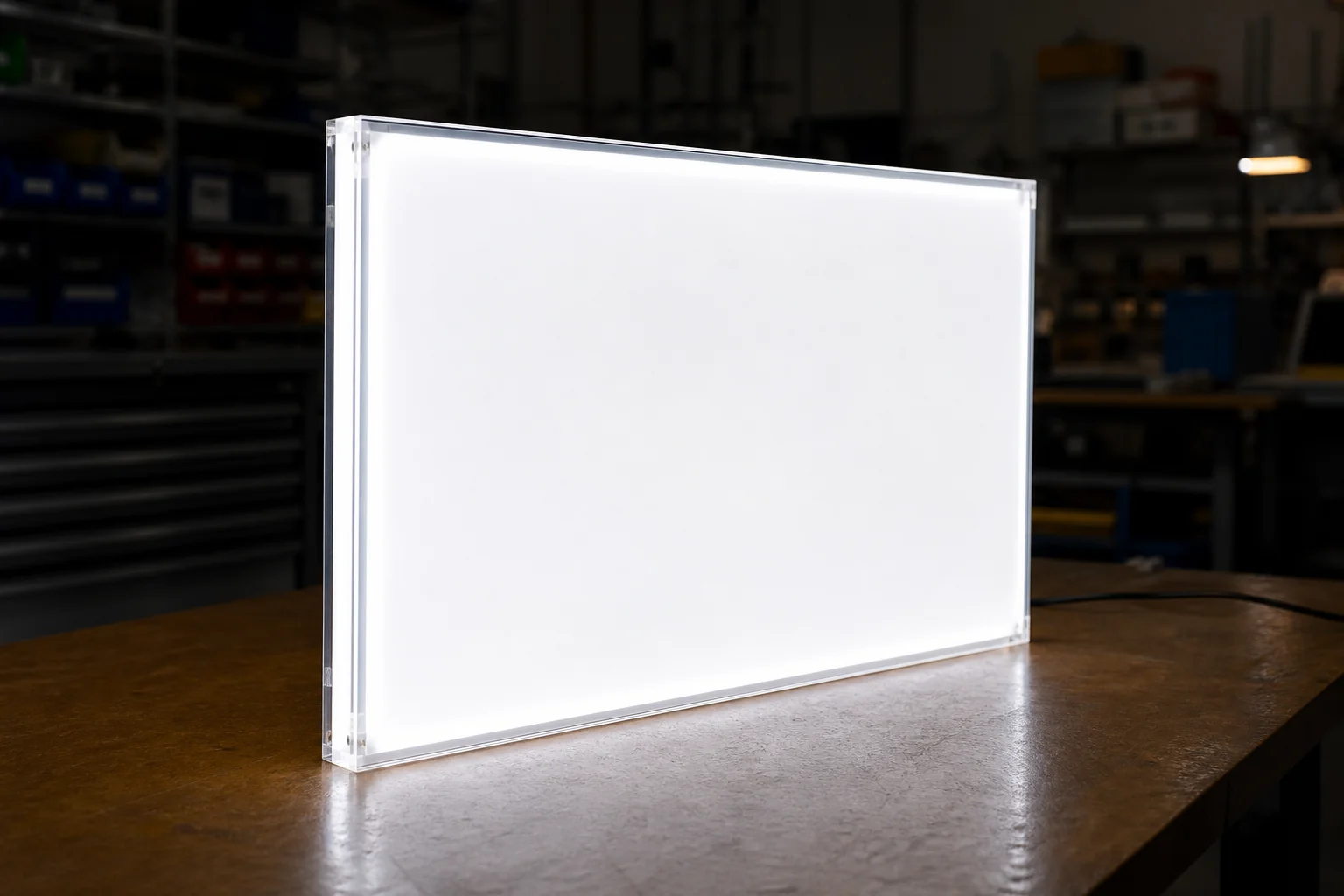
The last stop on my bench yesterday was a lit panel in the darkest corner of our workshop, first-article inspection for an LED light box frame batch. I check three things before releasing production: light bleed at the corners, hotspots along the LED edge, and brightness uniformity across the face. A powered panel hides nothing. The spec you order against shouldn’t either.
Inside an edge-lit frame — the panel stack
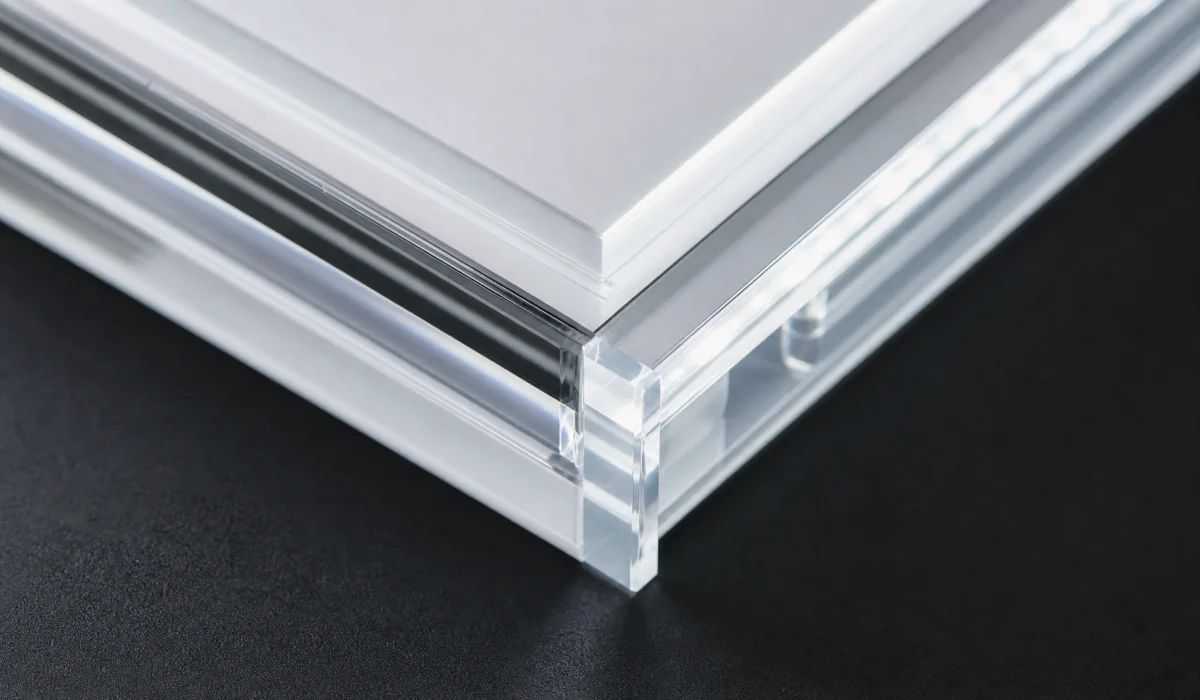
An edge-lit LED light box frame is a sandwich of five functional layers: a clear acrylic front panel, the printed graphic film, an acrylic light-guide panel (LGP) with an etched extraction pattern, a white reflector sheet, and a rear housing that carries the wiring and back plate. The LED strip runs along one or more edges of the light-guide panel, firing light into it sideways.
Each layer earns its place. The light-guide panel does the optical work: its etched pattern is designed to redistribute light across the face. The reflector returns backward-directed light toward the viewing surface, while the front panel protects the graphic and squares up the face. Require a finished-unit luminance and uniformity report for the actual size, LED layout, graphic stack, and dimming setting rather than treating the layer diagram as performance proof.
The layer buyers never ask about is the one my team spends the most time on: the light-guide panel’s entry edge. When my operators polish that edge, they are not chasing cosmetics: a diamond-polished edge couples light into the panel cleanly, while a rough saw-cut edge scatters it at the entry point and shows up later as a bright band near the LEDs and a dim center. Ask any light box supplier how they finish the LGP edge; the answer says a lot. When I sign off a first article, that entry edge is the first thing under the loupe.
Two spec decisions live in this section of the order: single-sided or double-sided (a double-sided, sometimes called double-layer, frame carries a graphic on both faces with the light-guide panel in the center), and how many edges carry LEDs. Small frames run fine on one edge; large formats usually need two or four for uniformity.
Acrylic light box construction — why cast PMMA is the light guide of choice
Acrylic light box construction standardized on cast PMMA for one reason: light budget. Clear cast acrylic transmits up to 92% of visible light1, takes a diamond-polished edge that couples LED output into the panel with minimal loss, and machines cleanly on laser and CNC lines. Glass is heavier and won’t take an etched extraction pattern economically; cheaper plastics yellow and haze. The cast vs extruded acrylic guide covers the sheet choice.
We fabricate every layer of the acrylic light box in-house (laser and CNC cutting, diamond polishing, bending and thermoforming for wrapped profiles, then assembly), which is why we can hold the edge quality that edge-lighting depends on. The same fabrication chain runs our acrylic display pedestals, where polished edges have to read cleanly on a retail counter. For the frame-format version of that work, see the LED light box frame kits we built for a signage OEM. For permanent logo and wayfinding signs rather than poster frames, see our edge-lit acrylic signs.
Backlit poster frame vs edge-lit frame — which fits which use
A backlit poster frame puts an LED array behind a diffuser panel and the graphic in front of it; an edge-lit frame feeds light in from the side through a light-guide panel. Backlit wins on raw brightness and very large formats. Edge-lit wins on depth, weight, and the clean slim look brands ask for at eye level.
| Factor | Edge-lit frame | Backlit poster frame |
|---|---|---|
| Typical depth | Slim, around 25 mm | Deeper, often 80 mm+ |
| Face brightness | Moderate to high | Highest — suits bright retail halls |
| Uniformity driver | LGP etch pattern + edge polish | LED spacing vs diffuser distance |
| Graphic format | Thin film print | Backlit film or duratrans-style print |
| Weight per m2 | Lower | Higher (housing + more panels) |
| Best fit | Corridors, elevators, fitting rooms, brand walls | Window displays, menu walls, large-format ads |
The honest rule we give buyers: pick by mounting depth and ambient light, not by catalog photos. We build both architectures on the same lines, so we have no horse in this race; the recommendation follows the wall, not the product list. In a bright storefront window competing with daylight, a backlit box earns its depth. In a corridor or beside a doorway where the frame must sit nearly flush, edge-lit is the only comfortable answer. The LEDs themselves are the least of the problem either way. LED sources run efficient and long, producing light up to 90% more efficiently than the incandescent lamps they replaced and lasting far longer2, so the architecture choice is really about optics and installation, not lamp life.
One more variable I flag on every RFQ: ambient heat. Backlit arrays concentrate more diodes per frame, and in an enclosed housing that means more thermal load on the driver. It rarely matters in normal retail interiors, but for enclosed outdoor pylons or sun-facing windows, flag it in the RFQ so we spec the driver and housing for the load.
Graphic swapping — magnetic fronts, snap frames, and film types
How the graphic comes out of the frame matters more over the product’s life than how the frame looks on day one. Three swap systems dominate: magnetic front panels that lift off without tools, snap-open rail frames that hinge along each side, and fixed fronts that require partial disassembly, acceptable only for permanent graphics.
Magnetic fronts are what we recommend for campaign-driven retail programs. The front acrylic panel seats on concealed magnet pairs; store staff pull it off, swap the film, and reseat it in under a minute, with no tools touching the polished face. Snap rails suit larger poster formats where a full lift-off panel would be unwieldy: the aluminum or acrylic rails hinge open one side at a time.
The film itself is a consumable, so spec it with the hardware. Edge-lit frames take thin translucent film prints; backlit boxes usually run heavier backlit film that diffuses the denser light behind it. Two rules I give every film order: buy spares with the first batch (we print them alongside the frames for a fraction of a separate later run), and confirm the film’s trim tolerance against the frame’s graphic pocket, because a film cut loose rattles and a film cut tight bubbles. If a program needs the graphic printed directly on the acrylic instead of on swappable film, that’s a different product decision, and it trades away every future campaign change.
Power and safety specs for import — drivers, certification, wiring questions to ask
The acrylic frame clears customs as a plastic article. The LED driver, strip, and plug are electrical components, and they carry the compliance burden of the destination market. Before production starts — not at the port — get written answers on four points: driver certification, input voltage, plug type, and low-voltage wiring layout.
Here is the checklist we walk buyers through:
- Driver certification for your market. North American signage falls under safety standards such as UL 48 for electric signs3; EU/EEA-bound electrical components need CE marking under the applicable directives4. Ask your supplier, including us, to state in the quote which listings the driver and power supply carry, and ask for the certificate documents with the pre-shipment paperwork.
- Input voltage and plug. 110 V and 220–240 V regions need different drivers and plugs. A frame wired for the wrong region is not a defect an adapter fixes on-site.
- Low-voltage layout. Most LED light box frames run the strips at 12 V or 24 V DC off an external or bay-mounted driver. Confirm where the driver sits (in-frame bay vs inline brick), cable exit position, and cable length against the mounting plan.
- Serviceability. Ask whether the strip and driver are replaceable without destroying the frame. On our builds the wiring channel is accessible from the back plate for exactly this reason.
I won’t list component brand names or certification claims here that I can’t put on your specific quote. LED sourcing shifts, so this section is a set of questions any supplier, including us, must answer in writing per order and per market. A supplier who resists putting driver certification in the quote is telling you how an after-sales problem will go.
Lead time reality for made-to-order LED frames — no stock, and why
We do not keep LED light box frames in stock, and since 2014, production runs 15–20 days, and our MOQ is 100 pieces per design. Samples take 3–5 days. Anyone quoting “in stock, ships tomorrow” is selling a fixed-size catalog unit.
The reason is that almost nothing on an LED light box frame order is generic. Size sets the light-guide panel cutting program and the LED edge count. Single vs double-sided changes the whole stack. Your graphic format sets the pocket depth and swap hardware. Your power region sets the driver and plug. Building those combinations ahead of demand would mean warehousing the wrong frames, so the industry builds to order, and a straight quote says so.
Buyers still email us the same message every month: “Do you have 150 of these available — what’s the earliest you can ship?” The useful answer is a real timeline, so here it is. Day 0: confirmed spec and deposit (30% down, with the 70% balance due before shipment). Days 3–5: sample in hand. Power it on a real wall, check uniformity and edge bleed, approve the swap system (what sample approval covers). Days 5–25: production and 100% inspection, every unit powered on before packing. The default term is FOB Shenzhen. If the deadline is tighter than the roughly 4–6 week door-to-door sea lane (3–5 weeks port-to-port) allows, air freight or an air-first split shipment closes the gap; that costs real money, and we will price it straight rather than promise stock that doesn’t exist. The production lead time guide breaks the calendar down further.
The one shortcut that works: approve the sample fast. Sample approval is the gate production waits behind, and in my experience it is where deadline orders lose the most days, not on the cutting tables. The pre-production sample approval checklist lists what to check.
How to spec your LED light box frame order
A complete LED light box frame spec fits in ten lines, and a factory that gets all ten can quote accurately in one pass. Send us these ten lines (they are the exact intake I quote from) and we skip two rounds of clarification email:
- Overall frame size (visible graphic area, or outside dimension — say which)
- Edge-lit or backlit — or the mounting depth limit, and we’ll recommend
- Single-sided or double-sided
- Graphic swap system: magnetic front, snap rails, or fixed
- Graphic count per frame per year (drives spare-film order)
- Quantity, and whether this is a pilot for a larger rollout
- Power region and plug type
- Mounting: wall, ceiling-hung, or freestanding
- Branding: printed logo, engraved mark, or none
- Deadline — the real one, so we can tell you exactly what fits
Send the list with your frame drawing and lighting spec through our project inquiry form, and you’ll get a spec-level answer, not a catalog link. We build the frame and its lighting to your drawing; we don’t design it. If the choice between an illuminated frame and another custom build is still open, our custom acrylic fabrication page shows what the same fabrication lines can do beyond light boxes.
For a non-illuminated alternative with removable panels, use our magnetic picture frame buyer guide to compare the frame construction and photo-swap requirements.
Footnotes
-
Light transmission — PLEXIGLAS (Röhm) — manufacturer data showing clear-transparent PMMA transmits up to 92 percent of light in the visible range, the value behind this guide’s light-budget statements. ↩
-
Learn About LED Lighting — ENERGY STAR — ENERGY STAR reference stating LED lighting products produce light up to 90% more efficiently than incandescent bulbs and last far longer, supporting the lamp-efficiency and lifetime statements in the edge-lit vs backlit comparison. ↩
-
UL 48 — Standard for Electric Signs (UL Standards & Engagement) — the safety standard covering electric signs, cited where this guide discusses the certification questions importers must ask about LED drivers and sign electricals for the North American market. ↩
-
CE marking — European Commission, Internal Market — the official EU page on CE marking requirements, supporting the statement that electrical components bound for the EU/EEA must carry CE marking. ↩
Frequently Asked Questions
Do you have LED light box frames in stock for immediate shipment?
No — every LED light box frame we build is made to order, because size, graphic format, single or double-sided layout, and power region all change the build. Samples ship in 3–5 days and production runs 15–20 days at a 100-piece MOQ. Marketplace stock frames exist, but only in fixed sizes with no branding.
What is the difference between an edge-lit and a backlit light box frame?
Edge-lit frames run an LED strip along the edge of an acrylic light-guide panel, keeping the profile slim at roughly 25 mm. Backlit boxes mount LED arrays behind a diffuser panel, which needs more depth — often 80 mm or more — but delivers higher face brightness for bright retail environments.
What certifications should the LED driver have before I import light box frames?
The required LED driver certification depends on the destination market. For North America, ask for the driver's safety listing against recognized standards such as UL 48 for electric signs; for the EU/EEA, the electrical components need CE marking. Also confirm input voltage (110 V vs 220–240 V) and plug type in writing before production starts.
What is the minimum order quantity for custom LED light box frames?
Our MOQ is 100 pieces per design. We recommend ordering 1–2 samples first: they ship in 3–5 days and costs USD 200–500 depending on complexity, paid separately and never credited to production. Power it on your own wall, check brightness uniformity and edge bleed, and approve the graphic swap system before the batch.
Are LED light box frames UL certified?
The listing sits on the electrical parts, not the acrylic. Ask which component carries which mark: the LED driver or power supply, the LED strip, and, where the buyer or local code requires it, the finished sign under UL 48. Get the listing numbers in the quote and the certificates with the shipping documents; a general 'UL certified' statement is not enough.
What is a double-layer (double-sided) LED light box frame?
A frame that shows a graphic on both faces, with the acrylic light-guide panel in the center and a front panel plus film on each side. It suits hanging signs and window displays seen from both directions. Frame profile color, such as a black edge, is a specification choice confirmed on the sample.
Can I swap the graphic in an LED light box frame myself?
Yes, if you spec the swap system for it. Magnetic front panels lift off without tools and suit weekly campaign changes; snap-open rails work well for larger poster formats. Backlit film graphics are the consumable — order spares with the frames so store staff can rotate campaigns without a service call.
Have specs in hand? Get a quote for your specific project.
Send us your drawings, reference photos, or a description of what you're making. We reply within 24 hours with a material recommendation, thickness, fabrication method, and a per-unit quote.