



Delivered project · Signage OEM · Component Supply
400 Light Box Frame Kits, Built to Another Factory's Tolerances
A German manufacturer of illuminated poster frames needed the acrylic half of its product: frame body, opal diffuser and clear face in A1 and A2 formats.
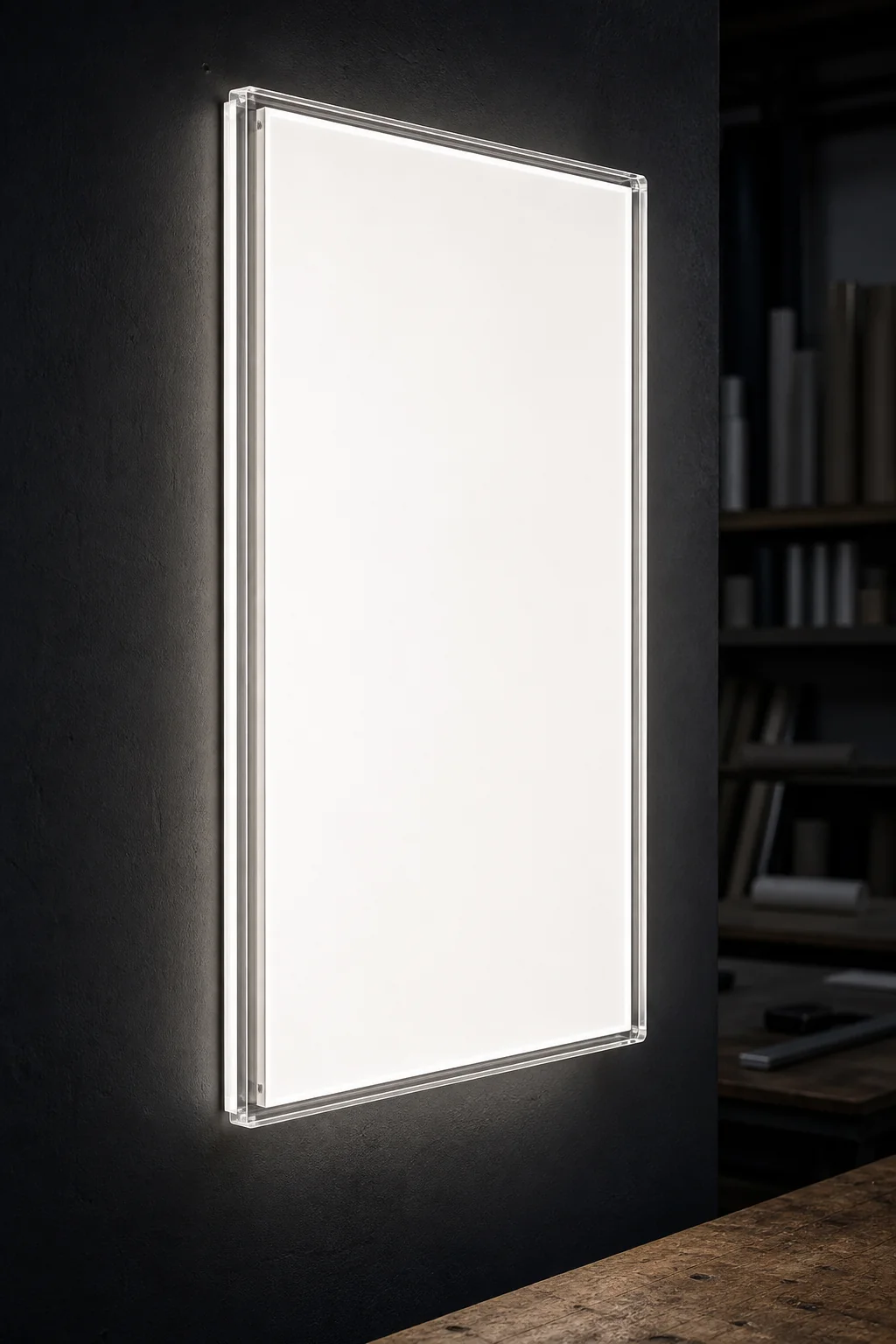
Each kit had to be ready to drop into its assembly line. We machined the LED channels to its module drawing, proved fit on first articles, paired the diffuser to its actual LEDs and hotspot-checked every kit. Production of the 400 kits ran 20 days. Delivered: 400 flat-packed frame kits, format-sorted cartons, first-article measurement reports and an archived reorder file.
- program kits
- 400
- poster formats
- 2
- channel tolerance
- ±0.2 mm
- production run
- 20 days
Ordering a similar project
New orders start at 100 kits per design. Samples ship in 3–5 days. Standard production takes 15–20 days after first-article or sample approval. Pricing is FOB Shenzhen with DDP available for European delivery, on 30% deposit / 70% balance before shipment.
Key Takeaways
- A German maker of illuminated poster frames needed its acrylic parts delivered as finished components. We shipped 400 three-part kits in A1 and A2 formats after a 20-day production run.
- The buyer’s LED modules were already tooled, so our CNC channels held the ±0.2 mm spec their assembly line was built around. First articles for both formats were measured and signed off before the run.
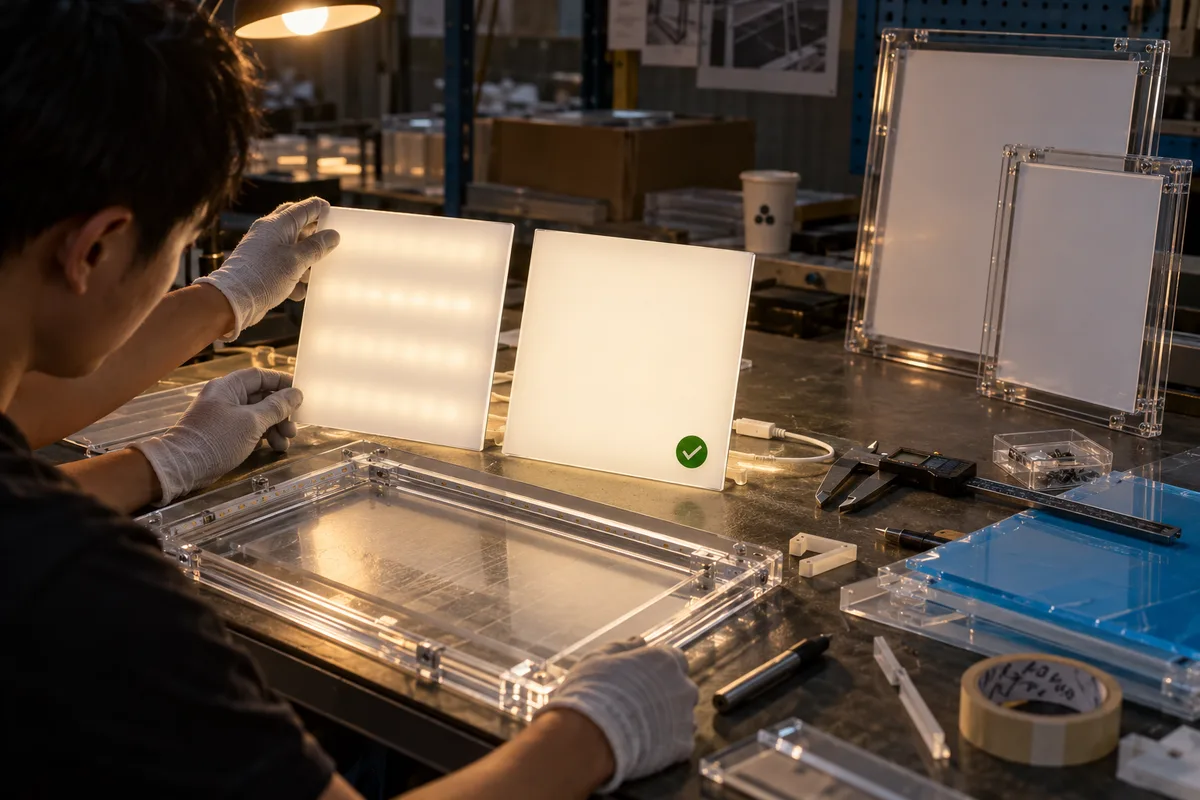
- We sampled two opal grades against the buyer’s own LED module and picked the pairing with no hotspot striping. Every diffuser was lit against that approved sample at final QC.
- Each kit split into frame body, opal diffuser and snap-off clear face, which kept poster-swap serviceability with no added hardware. Kits shipped flat with film on both faces, peeled only after the OEM’s assembly.
The Challenge
The buyer was a manufacturer, not a brand. They design and assemble illuminated poster frames for European retail chains — the LED modules, drivers, aluminum extrusion, wiring, and final assembly all happen in their own plant. Acrylic fabrication was the piece of their bill of materials that had stopped working, and they came to us to fix it.
Local cutting shops could hold their tolerances but at a per-part price that ate the product's margin, and with lead times that swung with every larger customer ahead of them in the queue. Imported sheet stock went the other way: cheap, but it arrived as generic panels that their own staff then had to machine for LED module seats, which put a fabrication step back inside an assembly plant that was never set up for it. What they actually needed was a supplier who could ship the acrylic as finished components: cut, machined, polished, and ready to drop into the line.
Three constraints defined the job. The first was dimensional. Their LED modules and extrusion profiles were already tooled and already in the field, so the drawings came to us with tolerances attached and no room for renegotiation. A channel machined 0.5 mm too shallow does not produce a slightly worse frame; it produces a part their assembly line rejects, and a rejected acrylic panel from China cannot be reworked economically in Germany.
The second was optical. These frames hang in retail environments where shoppers stand within arm's reach. At that distance, uneven backlighting reads as a defect: bright striping over each LED, dim bands between them. Their previous sheet stock needed a separate diffuser film to manage this, and the film brought its own problems: wrinkling during assembly, edge lift over time, one more component to inventory.
The third was landed cost. Ocean freight from Shenzhen to Germany adds weeks and packaging engineering that a local supplier never has to think about. The parts had to arrive undamaged, assembly-ready, and still price in below local fabrication once freight and duty were counted. If any of those three failed, the program made no sense for them.
There was a product-design constraint riding on top of all three: serviceability. The OEM's frames are sold on the promise that store staff can swap a poster without tools and without calling anyone. Whatever form the acrylic components took, the finished frame still had to open and close by hand, hundreds of times over its service life, without the face panel loosening or the diffuser shifting off the modules. The acrylic supplier does not get to break the product's core feature while hitting its tolerances.
Our Approach
We treated this as component manufacturing to another factory's print, which is a different discipline from building a finished product. Three decisions carried it: pairing the right opal diffuser grade to their LED pitch, machining the LED channels on CNC to their tolerance sheet, and engineering the kit for the journey through their assembly line — not just the journey across the ocean.
Opal diffuser grade and thickness pairing
Diffusion is not a property of "opal acrylic" as a category; it is the interaction between the sheet's pigment load, its thickness, the LED pitch behind it, and the depth of the air gap. Change any one and the light changes. A diffuser that looks flawless over one module layout will stripe over another.
So we refused to pick the grade from a datasheet. The OEM couriered us a working sample of their actual LED module and extrusion assembly, and we sampled two opal grades at 2 mm and 3 mm candidate thicknesses against it, viewing each pairing at the distance a shopper would stand from the finished frame. One pairing showed faint striping directly over the diodes; the other held a uniform glow across the full panel face. The uniform pairing became the spec, and the approved sample assembly became the QC reference for the production run.
The sampling step is where this kind of program is won or lost, and it costs almost nothing against the alternative. A diffuser grade picked from a datasheet that stripes over the buyer's actual modules is not discovered in Shenzhen; it is discovered in a German store aisle, on a wall, in front of the OEM's customer. Sampling against the real module moved that discovery to a workbench, before a single production sheet was cut.
| Build | Hotspot control | Assembly complexity | Suited to |
|---|---|---|---|
| Clear acrylic + diffuser film | Depends on film quality; film can wrinkle at assembly and lift at edges over time | Extra component to buy, inventory, and apply | Budget builds, short-life promotional frames |
| Opal (diffusing white) acrylic | Diffusion is in the material — uniform when grade and thickness match the LED pitch | Single panel, nothing to laminate or apply | Retail-distance viewing, serviceable OEM product |
| Frosted (surface-textured) acrylic | Softens glare but scatters at the surface only — hotspots stay visible close up | Single panel | Decorative glow, edge-lit effects |
Moving diffusion into the material itself also deleted a line item from the OEM's inventory. No film, no film application step, no film failure mode in the field. For the selection logic in full (grades, thicknesses, and when film still makes sense), our LED light box frame spec guide walks through the same decision tree we ran here.
CNC-machined LED channels at ±0.2 mm
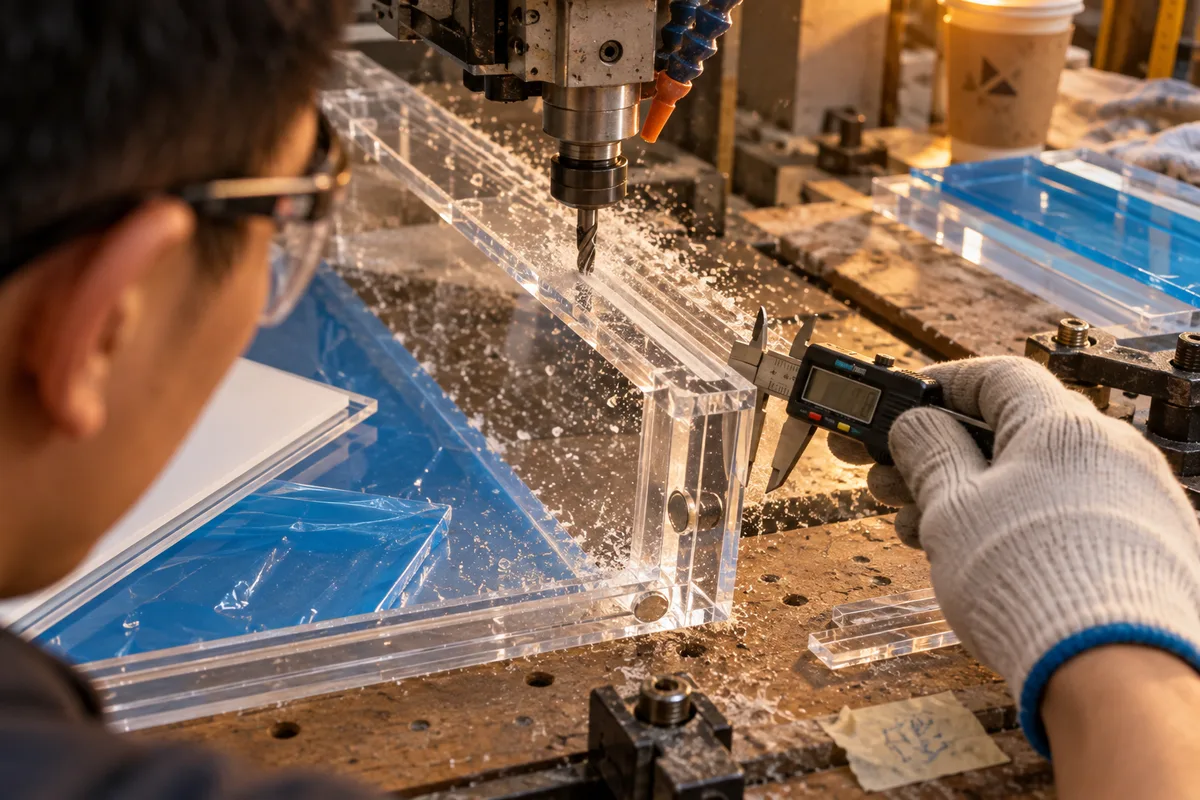
The frame bodies carry machined channels where the OEM's line seats their LED modules. Their drawings specified channel width, depth, and position at ±0.2 mm, because that is what their module clips and extrusion joints were tooled around years before we entered the picture.
That spec dictated the process. Laser cutting, our default for many display parts, was the wrong tool here: a laser cuts through material cleanly but does not control pocket depth, and its kerf taper works against a snug module seat. The channels went to CNC, where depth is a programmed axis and the cutter leaves a square-walled channel the module clips into positively. Channel programs were written from the OEM's drawings, not from a sample part, so the dimensional authority stayed with their engineering documents at every step.
The two formats made this a four-program job, not two. A1 and A2 frame bodies each carry their own channel layout, and each format's diffuser and face panels are cut to their own fit dimensions against the frame rebate. Treating the formats as separate engineering items, with separate programs, separate first articles, and separate QC references, is slower to set up than scaling one program, and it is the only way both formats seat the same module family correctly.
Before the run, we produced first-article parts for both formats and inspected them against the OEM's own tolerance sheet, dimension by dimension, then sent the parts and the measurement report together for their sign-off. First-article inspection is standard practice in machined-component supply and rarer than it should be in acrylic. It cost the program a few days at the front and removed the scenario every OEM buyer actually fears: a container of 400 kits that fails on the first station of the line.
Flat-pack kit engineering
Each kit was three parts (frame body, opal diffuser, clear snap-off face), and we treated the kit structure as a design decision. The clear face lifts off without tools so retail staff can swap posters in seconds; the diffuser stays seated over the modules; the frame body does the structural work. Serviceability came from part geometry, not from added hardware, which kept the kit's component count at three and its assembly time inside the OEM's existing line takt.
Edge finish got the same component-level treatment. The frame body's outer edges are visible product on a wall-mounted frame, so they run through diamond polishing after machining; the diffuser and face panels, whose edges sit hidden inside the frame rebate, take a clean saw-finish edge instead. Polishing every edge on every panel would have added cost the finished product never displays — knowing which edges the end customer actually sees is part of reading another factory's product correctly.
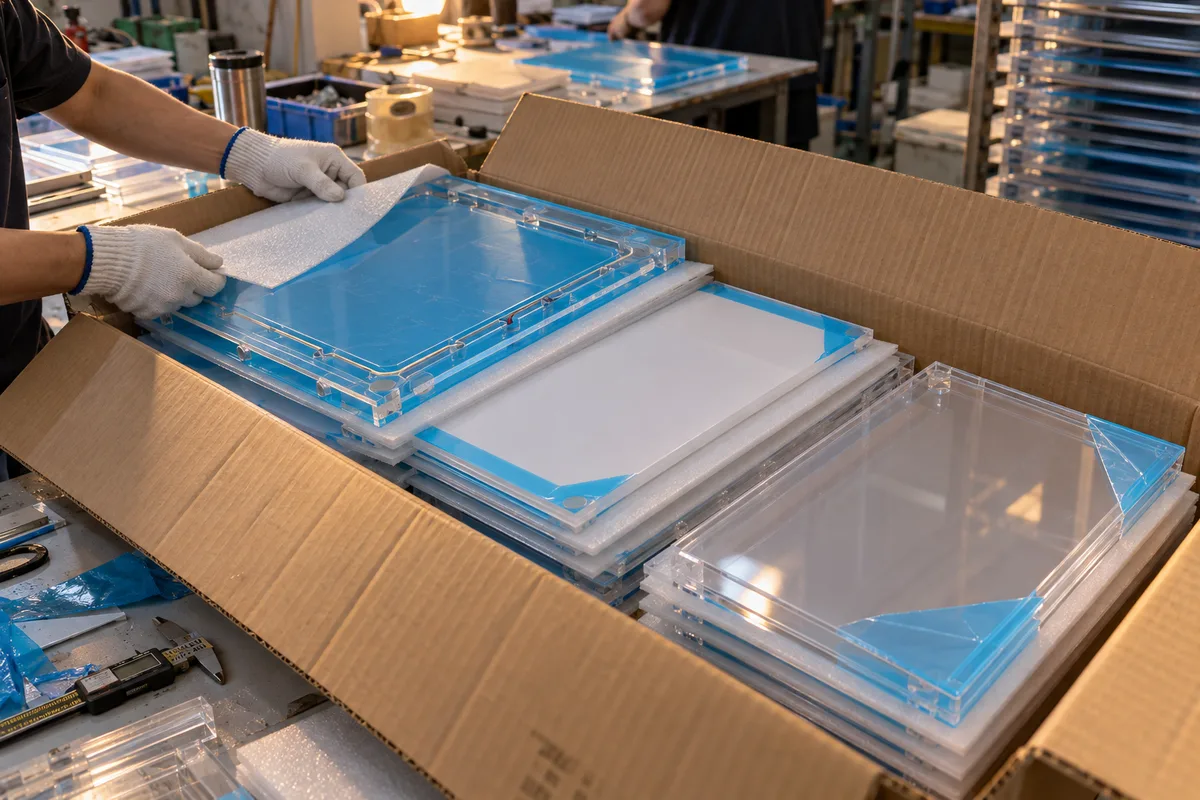
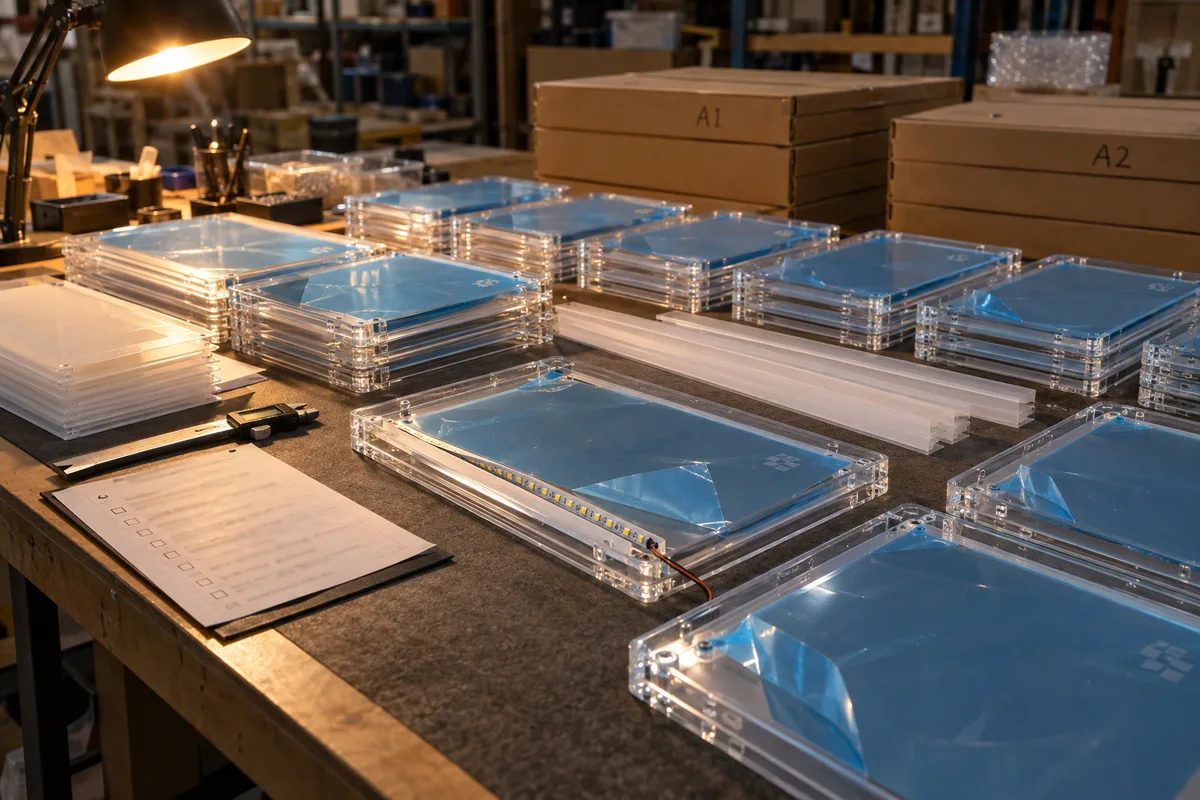
Packaging was engineered backward from their receiving dock. Every panel ships with protective film on both faces, and the instruction, agreed with their production planner and printed on the cartons, is that film comes off after their assembly, not before. The film protects the parts through our polishing line, through ocean freight, and through their own handling, which is where most "transit damage" on acrylic components actually happens. Kits packed flat, sorted by format into separately marked cartons matching their line-side logistics, so an A2 build day pulls A2 cartons without sorting through mixed stock.
The Results
We delivered 400 kits across the A1 and A2 formats, released from signed first articles. Two controls carried the order: drawing-defined channel fit and the hotspot check against the approved diffuser-and-LED pairing.
The signed first articles settled the tolerance question on two parts before it could become a problem on 400; the production run inherited the approved dimensions rather than gambling on them. And the 100% hotspot check means every diffuser that shipped was individually lit against the approved sample pairing at final QC, because a diffuser is the one component in this kit whose failure is invisible until the frame is on a wall in a store.
On the landed-cost question, the honest answer is that the math is the buyer's, and we will not publish their numbers. What we can say is structural: the order replaced per-part local fabrication pricing with Chinese component manufacturing plus ocean freight, moved a machining step out of their assembly plant, and deleted a diffuser film from their bill of materials. We built the kits to reorder against the same drawings, the shape a component-supply relationship takes once the first container works.
The 20-day production window mattered in that context. Component supply lives or dies on rhythm: the OEM plans assembly weeks around container arrivals, and a supplier whose production time drifts turns their planning into guesswork. Because the channel programs, QC references, and packing layout are all archived from this run, a repeat order re-pulls the archive the same way the first-article parts did — there is no re-engineering step left in the cycle to introduce delay.
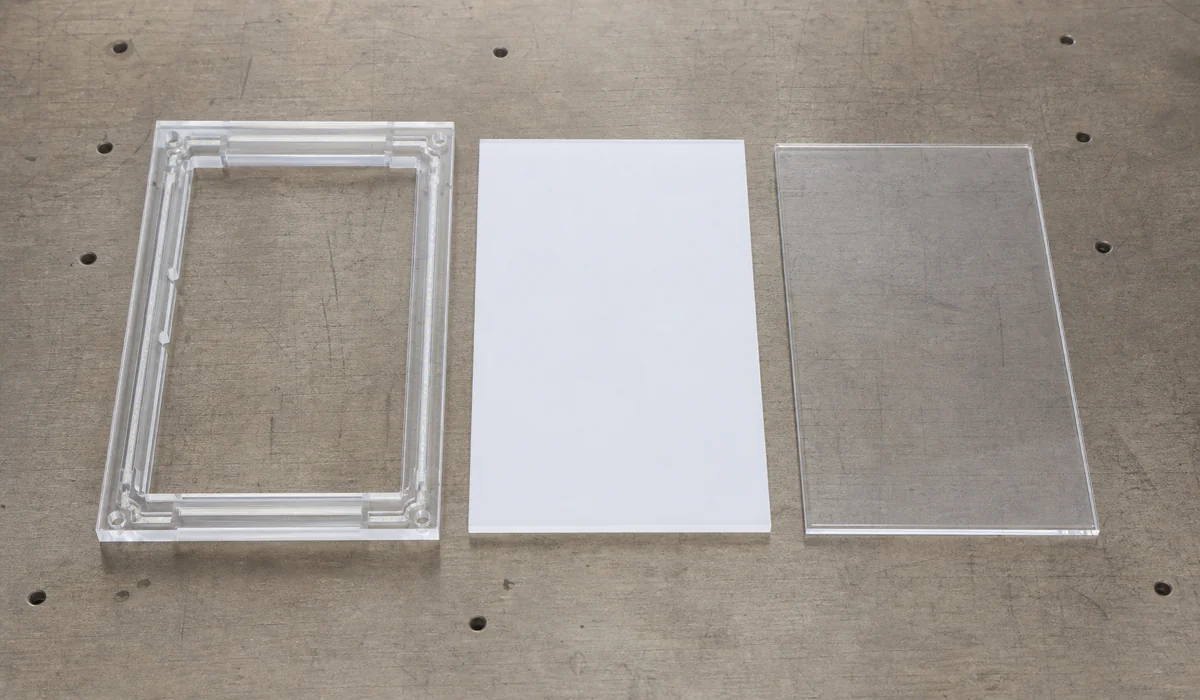
Project notes: We released the 400-kit batch only after the first articles fitted the buyer’s actual LED modules and passed the agreed hotspot check.
If You're Planning Something Similar
If you make an illuminated product and buy the acrylic as a component, send module drawings and a tolerance sheet, not a sheet spec. "3 mm opal acrylic, A1 size" describes a panel, not the machined seats and fits your line depends on. Ask for first-article inspection against your own tolerance sheet, with parts and a measurement report before the run; third-party pre-shipment inspection (SGS or Bureau Veritas) is available on request. Courier a working LED module so the diffuser grade is sampled against your real light source.
We run acrylic frame and panel orders like this one as ongoing component supply for OEMs who keep electronics and assembly in-house: drawings on file, first articles before each new run, and cartons sorted the way your line consumes them.
Sourcing acrylic components for an illuminated product line?
Send us your module drawings and tolerance sheet — we'll come back with a first-article plan, a diffuser sampling proposal against your actual LEDs, and a per-kit quote.
This order: 400 kits · 20-day production run · FOB Shenzhen, DDP available