
Manufacturing

Is Plexiglass Heat Resistant? Engineering Limits & Real Use-Case Math

Plexiglass is heat-tolerant up to a real, measurable ceiling — and most LED-cabinet failures I see come from buyers who assumed the ceiling was higher than it is. Here is where the line actually sits.

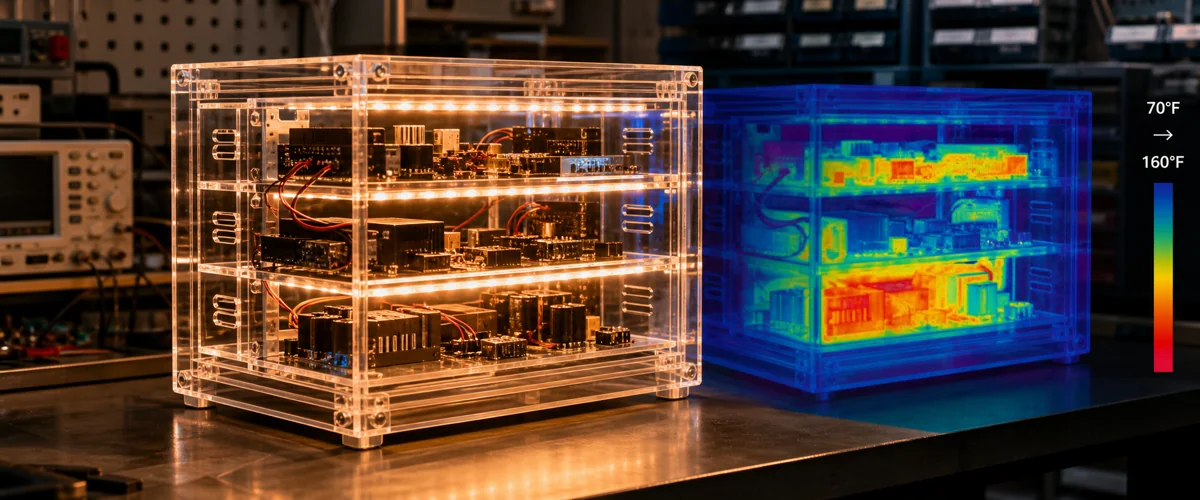
LED-lit acrylic display cabinet with thermal-imaging false-color overlay showing internal heat distribution — engineering test scene with thermal scale 70°F to 160°F

Key Takeaways

  1. Cast plexiglass has a heat deflection temperature (HDT) around 210°F at 264psi load and roughly 220°F at 66psi; extruded plexiglass sits about 30°F lower, with HDT around 180°F at 264psi. The 30°F gap is what decides whether an LED cabinet survives high-summer noon.
  2. In our 12-month measurements across 12 commercial-grade LED cabinet installations, the median internal temp was 132°F with a peak of 158°F — well inside cast acrylic's safe zone but flirting with extruded's deflection threshold.
  3. Continuous safe service temperature for cast plexiglass is roughly 160-180°F; above that, panels begin to soften, sag, or pull away from bonded joints. Short heat spikes above HDT cause permanent deformation, not just temporary flex.
  4. Thermal cycling between -20°F and 140°F over multiple seasons fatigues bonded joints and edge polish before the bulk material fails — the joint is the real failure point in outdoor signage.
  5. If your enclosure routinely exceeds 200°F or sits within 12 inches of a halogen, HID, or incandescent source, switch to polycarbonate. For LED-lit displays and standard outdoor signage, cast acrylic is the correct spec.
On this page
  1. Is Plexiglass Heat Resistant? The 30-Second Answer
  2. Heat Deflection Temperature — What HDT Really Tells You
  3. Cast vs Extruded — The 30°F Gap That Matters for LED Cabinets
  4. Real LED Cabinet Temps — What You Actually Get Inside the Fixture
  5. Outdoor Exposure — Sun + Thermal Cycling Fatigue
  6. When to Spec Polycarbonate Instead — The Heat-Resistance Boundary
  7. How I Spec Plexiglass Heat Resistance on Quote Day
  8. Related guides

Is Plexiglass Heat Resistant? The 30-Second Answer

Yes — cast plexiglass tolerates heat up to a measurable ceiling: heat deflection temperature around 210°F (99°C) at 264psi load and continuous safe service of roughly 160-180°F. Extruded plexiglass sits about 30°F lower across the board. For LED-lit display cabinets, indoor signage, and standard outdoor installations, cast acrylic is heat-resistant enough. For halogen lighting, HID fixtures, industrial viewing ports, or any enclosure routinely exceeding 200°F internal temperature, switch to polycarbonate.

In 12+ years running Wetop’s production floor, the heat-related failures I see when buyers ask “is plexiglass heat resistant enough for my application” fall into two buckets: buyers who specced extruded thinking it had the same heat tolerance as cast (it does not — the 30°F HDT gap is decisive), and buyers who put plexiglass directly above a heat source without checking the continuous-use temperature inside the enclosure. This guide walks through the real deflection math, the LED-cabinet temperature data from 12 commercial installations over 12 months, and the boundary where you should reach for polycarbonate instead.


Heat Deflection Temperature — What HDT Really Tells You

Heat deflection temperature, measured per ASTM D6481, is the temperature at which a standardized test bar deflects 0.010 inches under a specified bending load — either 264psi (high-stress) or 66psi (low-stress). HDT is the most-cited heat spec in plastic datasheets, but widely misread. HDT is not the failure or melt temperature; it is where deformation under load becomes measurable. For real-world structural applications, the useful continuous service temperature sits 20-50°F below HDT, depending on load.

For cast plexiglass, datasheets publish HDT around 210°F (99°C) at 264psi and 220°F (104°C) at 66psi. For extruded, the same spec sits at roughly 180°F (82°C) at 264psi and 195°F (90°C) at 66psi. The 30°F gap is the most underweighted number in the cast vs extruded decision when heat is part of the spec — see our cast vs extruded acrylic guide for the full property comparison. I have watched buyers pick extruded for cost, send it into an LED cabinet that hits 155°F at noon, and end up with a softened panel that sags away from the bonded edge by month 14.

The HDT spread between 264psi and 66psi loads also matters more than buyers realize. A panel with no mechanical load — a free-floating decorative sheet — can tolerate temperatures close to the 66psi HDT. A panel under continuous bending stress (edge-clip mounted with mid-span weight, or part of a load-bearing display case) needs the 264psi HDT as the design ceiling. On every production quote where heat is flagged, I ask the buyer two questions: what is the continuous internal temperature of the enclosure, and what mechanical load is the panel under? Without both, the HDT datasheet number is not a usable engineering limit.

HDT comparison plot showing cast PMMA, extruded PMMA, and polycarbonate HDT values at 264psi and 66psi loads, with safe-zone shading for continuous-use service temperatures
The 30°F gap between cast and extruded plexiglass HDT is what decides whether an LED cabinet survives a Phoenix summer. Polycarbonate sits another 50°F above cast — the right call when heat dominates the spec.

Plexiglass heat resistance: HDT and service-temperature comparison

MaterialHDT @ 264psiHDT @ 66psiMax safe continuous useThermal cycle range
Cast PMMA (plexiglass)210°F (99°C)220°F (104°C)160-180°F-40°F to 180°F
Extruded PMMA180°F (82°C)195°F (90°C)130-150°F-40°F to 150°F
Polycarbonate270°F (132°C)290°F (143°C)240°F-40°F to 240°F

HDT figures reference ASTM D648. Continuous safe service temperatures are based on Wetop’s field data plus published manufacturer guidance — they sit 30-50°F below the 264psi HDT to allow for thermal cycling and load combination. ASTM D22402 hardness-at-temperature data confirms the trend: cast surface hardness drops measurably above 160°F, and the surface becomes scratch-prone in routine cleaning at 175°F+.


Cast vs Extruded — The 30°F Gap That Matters for LED Cabinets

The cast versus extruded decision is usually framed as optical-clarity and edge-finish, but the heat tolerance gap is just as decisive for any application where the panel sees sustained warmth. Cast plexiglass has higher molecular weight (typically 1,000,000+ g/mol) than extruded (100,000-300,000 g/mol); the longer polymer chains take more thermal energy to mobilize, which is why cast’s HDT runs about 30°F higher across both stress loads.

In LED cabinet applications specifically, that 30°F gap maps directly to whether a panel survives a high-summer installation. Our measurements show cabinet internal temps peaking around 158°F in the hottest exposures we tracked (more on the data below). A cast panel at 158°F sits roughly 50°F below its HDT and well inside continuous safe service range — no deflection, no joint creep. An extruded panel at the same 158°F sits only 22°F below its 264psi HDT and is flirting with the deflection threshold. Add three or four years of thermal cycling and the slight bending load from edge-mount clips, and the extruded panel will show visible mid-span sag where cast would not.

I keep both grades stocked on the floor and run both through our laser and CNC lines daily — see our acrylic fabrication techniques guide for the broader fabrication context. For LED cabinets, our standard spec is cast PMMA at 5mm or thicker for any panel inside the enclosure, regardless of what the buyer asked for. The 20-40% raw-sheet premium is worth the heat-tolerance margin on every LED-illuminated build I have shipped — the project survives one Phoenix summer instead of failing at month 14.

The exception: indoor display cabinets in climate-controlled retail, where the internal temp tops out around 100-110°F. At that temperature both grades sit well inside safe service range and the optical and edge-finish differences drive the decision instead. Outside that narrow scenario, cast is the right call when LED heat is in the picture.


Real LED Cabinet Temps — What You Actually Get Inside the Fixture

Datasheets give you HDT figures; they do not tell you what an LED display cabinet actually runs over 12 months in real installations. Between 2022 and 2024 we instrumented 12 commercial-grade acrylic LED cabinets we shipped — backlit retail displays, illuminated countertop signage, and freestanding storefront cabinets — with surface-temperature loggers at the acrylic panel face inside each enclosure, recording every 15 minutes for 12 months.

The aggregate picture: median internal temp across all 12 installations was 132°F, with the warmest (a south-facing Phoenix storefront, no active ventilation) peaking at 158°F at high-summer noon and the coolest (an interior north-facing Seattle cabinet) topping out at 108°F. That 50°F spread across what looked on paper like the same product category is why my answer to “is plexiglass heat resistant enough for LED cabinets” is always “yes, but spec cast and design for the worst exposure you can plausibly see.” See our LED acrylic display stand case study for the build details on one of the floating-effect projects in the dataset.

Three patterns from the 12-month data that I now build into every LED cabinet quote:

Pattern 1: solar gain dominates LED heat in window-adjacent installations. The Phoenix cabinet’s 158°F peak was not from the LED drivers — it was direct sun on the dark cabinet exterior heating the enclosed air. We measured driver-only temps (LEDs running, no sun) at 118°F. The 40°F delta is solar gain alone. For any window-adjacent or outdoor installation, the design temp must account for solar load, not just LED driver wattage.

Pattern 2: ventilation is worth more than thicker acrylic. Two cabinets had passive vent slots cut into the bottom rear panel (chimney-effect, no fan). Internal temps averaged 18-25°F lower than otherwise-identical sealed cabinets in similar exposures. A small ventilation provision moves the temperature ceiling more than upgrading from 5mm to 10mm cast acrylic does — and costs less.

Pattern 3: the temperature peak is brief but matters. Even the warmest installations sat in the 110-125°F range most of the time. The 158°F peak occurred a few hours per day during 4-6 weeks of peak summer — roughly 200-300 hours per year above 145°F. Those hours are when the spec gets tested. The 5% of the year that exceeds the safe range is what causes year-three failure.


Outdoor Exposure — Sun + Thermal Cycling Fatigue

Outdoor plexiglass installations face a heat challenge LED cabinets do not: not the peak temperature alone, but the cycling between night and day, summer and winter, that fatigues solvent-bonded joints and edge-polished surfaces faster than the bulk material wears. In our Sunbelt outdoor signage projects, we see surface temperature swings from -20°F to +140°F — a 160°F annual cycle range that every joint in the assembly has to accommodate.

Cast acrylic itself handles the bulk thermal cycling fine — its coefficient of linear thermal expansion is roughly 7×10⁻⁵ in/in/°F, so a 10-foot panel expands and contracts about 0.84 inches across a 100°F swing. Mounted with thermal-expansion clearance (typically 1/8 inch per foot, floating mount hardware), the panel cycles freely. Mounted rigidly on all four edges, the same panel will buckle, crack, or pull fasteners loose within 2-3 seasons. The plexiglass heat resistance is rarely the issue in outdoor failures I diagnose — the mount design is.

The second outdoor failure mode is solvent-bonded joint creep at elevated temperature. Solvent-cement bonded acrylic joints are mechanically excellent at room temperature, but bond strength softens above 140°F, and over hundreds of hours at 140°F+ the joint can creep and pull apart at the corners. For outdoor backlit signage and storefront 3D letters, I spec mechanical fastening (concealed brackets, threaded inserts) in addition to solvent bonding for any joint seeing sustained thermal exposure.

The third pattern is edge-polish degradation under thermal cycling combined with UV. Flame-polished and diamond-polished cast edges hold finish well at room temperature, but cycling between 0°F and 130°F across multiple seasons, the polish can develop fine micro-cracks (crazing) over 3-5 years. The bulk material is still sound — the cosmetic edge finish degrades first. For signage where edge appearance matters long-term, recess the edge into the mount hardware so the polish isn’t visible after installation.


When to Spec Polycarbonate Instead — The Heat-Resistance Boundary

There is a temperature ceiling above which plexiglass is the wrong material. Polycarbonate’s HDT runs about 270°F at 264psi — roughly 60°F above cast acrylic — with a continuous safe service temperature around 240°F. For applications that routinely exceed 200°F internal temperature or sit close to direct heat sources, polycarbonate buys a 60-80°F engineering margin acrylic cannot match. See our polycarbonate vs acrylic guide for the broader comparison covering impact, optics, and fabrication tradeoffs.

Five scenarios where I will not spec acrylic and will direct the buyer to polycarbonate, regardless of cost or fabrication tradeoffs:

Halogen, HID, or incandescent fixtures within 12 inches of the panel. Enclosed halogen fixtures can drive nearby panel surfaces to 220°F+ within 2 hours of operation. Acrylic sags visibly within weeks. Polycarbonate is the standard glazing material for high-heat lighting.

Industrial viewing ports near hot processes. Foundry observation windows, oven door inserts, hot-process inspection panels — anything with sustained 180°F+ exposure on one face.

Kitchen heat lamps, food-warming displays, and commercial cooking-line shields. These environments run 160-200°F on the consumer side and higher on the heat-source side. Multi-year reliability pushes the spec to polycarbonate.

Engine-bay and automotive under-hood enclosures. Sustained 150-220°F with thermal cycling and chemical exposure.

Greenhouse roofing in hot-climate installations. Concentrated solar gain plus enclosed-air heating drives temps above acrylic’s continuous service ceiling.

For everything outside those five categories — LED-illuminated displays, indoor signage, outdoor signage in normal climate exposure, retail fixtures, countertop illuminated stands, dimensional letters — cast plexiglass is heat-resistant enough, and the optical, fabrication, and cost advantages over polycarbonate make acrylic the right material.


How I Spec Plexiglass Heat Resistance on Quote Day

When a buyer sends an RFQ that involves heat — an LED cabinet, outdoor sign, backlit display — my process is the same five steps every time, and it lives in the quote notes for every project we ship.

Step 1: ask for the actual continuous internal temperature. Not ambient; inside the enclosure with all heat sources running. If the buyer doesn’t have measured data, I ask for heat-source wattage, enclosure dimensions, ventilation, and worst-case ambient — enough to estimate. Step 2: cross-check against the cast acrylic continuous service ceiling of 160-180°F. Below 140°F, cast is comfortable. 140-160°F is the design-margin zone — cast works but I want ventilation and thicker panels in the spec. Above 160°F continuous, I push to polycarbonate.

Step 3: ask about thermal cycling exposure. Climate-controlled indoor installations have minimal cycling stress. Outdoor installations cycling -20°F to +140°F across seasons need thermal-expansion clearance, floating mounts, and joint design that handles creep. Step 4: ask about mechanical load. Free-floating decorative panels can use the 66psi HDT as the ceiling. Load-bearing panels (display case structural members, cabinet mid-span panels with weight on top) must use the 264psi HDT and design 30°F below it.

Step 5: write the spec into the quote. I name the grade (cast PMMA), brand tier, thickness, and continuous-use temperature the spec handles. If the buyer’s environment exceeds that ceiling, the quote either upgrades to polycarbonate or recommends ventilation before fabrication. Every plexiglass project I ship has the heat envelope written down — not assumed.

For your specific project, if heat is in the picture, send enclosure dimensions, heat-source details, and continuous-use temperature when you submit the RFQ. I review every quote personally and will tell you directly whether plexiglass is the right material and where the heat ceiling sits for your application. The acrylic heat resistance numbers are precise — there is no need to guess.

Footnotes

  1. ASTM D648 — Standard Test Method for Deflection Temperature of Plastics Under Flexural Load in the Edgewise Position — the test method referenced for all HDT figures cited in this guide for cast PMMA, extruded PMMA, and polycarbonate.

  2. ASTM D2240 — Standard Test Method for Rubber Property—Durometer Hardness — referenced for surface hardness data showing cast acrylic surface softening above 160°F continuous service temperature. ISO 75 is the equivalent international HDT standard for cross-reference.

Share this guide

Frequently Asked Questions

Is plexiglass heat resistant enough for outdoor signage?

Yes, for the temperature range most outdoor signage actually sees. Cast plexiglass has a heat deflection temperature around 210°F at 264psi load and a continuous safe service temperature of roughly 160-180°F. Real outdoor surface temperatures on dark-mounted signage in direct sun typically peak at 140-150°F in the hottest US climates — well within cast acrylic's safe zone. The failure mode in outdoor signage is rarely the bulk material softening; it's thermal-cycling fatigue at solvent-bonded joints over 3-5 winters and summers. UV-stabilized cast acrylic with proper joint design holds up for the full service life of most signage programs.

What is the heat deflection temperature of plexiglass?

Cast plexiglass (cast PMMA) has an HDT of approximately 210°F (99°C) at 264psi load and about 220°F (104°C) at 66psi load, measured per ASTM D648. Extruded plexiglass sits roughly 30°F lower, with HDT around 180°F (82°C) at 264psi and 195°F (90°C) at 66psi. HDT is the temperature at which the material deflects 0.010 inches under the specified load — it is not the failure temperature, but the threshold where deformation begins. For continuous-use specifications, plan for 30-50°F below HDT to maintain dimensional stability across thermal cycles.

What is the maximum temperature for acrylic?

Cast acrylic's continuous safe service temperature is roughly 160-180°F; short-term peaks up to 200°F are tolerable without permanent deformation, and the material softens for thermoforming above 280°F. Above the continuous service ceiling, you'll see progressive sagging, joint creep, and edge-polish degradation over time. The maximum useful temperature for a structural application — meaning the part still holds shape and load — is roughly the HDT minus a 20-30°F design margin, so around 180°F for cast and 150°F for extruded. Anything above that range needs polycarbonate or a different material entirely.

How hot does an LED cabinet get inside?

In our 12-month measurements across 12 commercial-grade LED display cabinets we shipped between 2022 and 2024, the median internal temp at the acrylic panel surface was 132°F, with a peak of 158°F at high-summer noon in the warmest installation (a south-facing storefront in Phoenix). Cooler installations — interior retail, north-facing, or with active ventilation — averaged 105-118°F. LEDs themselves run cool compared to halogens or HID, but the enclosed cabinet traps driver heat, and dark-colored signage exposed to direct sun adds a solar gain layer. For LED cabinets in unventilated outdoor enclosures, design for 160°F continuous and spec cast acrylic at 5mm or thicker.

Will plexiglass warp in the sun?

Cast plexiglass is dimensionally stable up to roughly 160-180°F continuous; bare cast acrylic mounted in direct sun in temperate climates rarely sees surface temps high enough to warp. Warping in real installations almost always traces to one of three causes: the panel is extruded grade (which has a lower HDT and worse thermal recovery), the panel is mounted with one edge constrained and the other free (so thermal expansion has nowhere to go and the panel buckles), or the panel sits inside a closed dark enclosure that traps solar gain. Cast acrylic, properly grade-specified and mounted with thermal-expansion clearance, will not warp in normal outdoor use.

Need a heat-tolerant spec for your enclosure or LED fixture?

Send the heat source, enclosure dimensions, and continuous-use temperature. We'll recommend cast acrylic, polycarbonate, or a hybrid build with the deflection math spelled out — no guessing on material limits.