Acrylic Sneeze Guard Specs — Healthcare & Restaurant Buyer Guide
Most acrylic sneeze guards on the market in 2026 are still spec'd from 2020 panic orders — too thin, with the wrong edge finish, mounted with brackets that flex on every wipe-down. Here's what healthcare and restaurant guards actually need in the specs that hold up past year two.
Key Takeaways
- 3mm cast acrylic flexes past a usable limit on any unsupported span beyond 16 inches — deflection under load scales inversely with the cube of thickness, so a thin panel bows and can take a permanent set. 5mm is the right default for most counter-mounted guards.
- Diamond-polished edges resist repeated quaternary ammonium and 70% IPA wipe-downs far better than flame-polished ones, which carry residual edge stress and are prone to environmental stress crazing under alcohols and cleaners. Edge finish is a sanitation spec, not a cosmetic one.
- Counter-clamp mounts suit 5mm panels up to roughly 32 inches wide; wider or suspended designs need 6mm minimum and a calculated load — a 24x36 6mm cast PMMA panel weighs roughly 4.4 kg before hardware at PMMA's ~1.18 g/cm³ density.
- USDA 9 CFR 416 and FDA Food Code 4-203.11 don't name acrylic, but they do name the cleanability standard that matters — your spec sheet should call out smooth, non-absorbent, sealed-edge construction in those exact words.
- Plan a 50-to-500-unit rollout around the design-review step, not just the build — locking the spec sheet and approving the first-article sample fast is what keeps a custom sneeze guard order on its published lead time.
On this page
- 3mm is the wrong default — when 5mm earns its 40% material premium
- Edge finish is a sanitation spec, not a cosmetic one
- Counter-mount vs ceiling-suspended — the load and flex math
- What your spec sheet needs to say to satisfy USDA and FDA cleanability rules
- Custom cutouts — transaction windows, microphone slots, and the tolerances that matter
- Lead time and bulk pricing tiers — the math at 50, 100, and 250+ units
- Related guides
An acrylic sneeze guard is not a display panel, and specs borrowed from display work fail fast on these guards. A display panel sits on a shelf and gets wiped twice a week. A healthcare sneeze guard gets sprayed with disinfectant a dozen times a day by tired staff, gets bumped by gurneys, and has to look the same at month 36 as it did on day one. That difference in duty cycle drives every spec decision below.
The lesson from the pandemic-era acrylic guard market, in one sentence: most of it was spec’d from panic, not from engineering, and the units that survived to year three were the ones that had been over-spec’d on thickness, edge finish, and mount geometry.
This guide is the spec sheet a buyer should want on day one. It’s organized the way a healthcare facility manager or a restaurant chain operations director should think about a 50-to-500-unit acrylic sneeze guard order — by the six decisions that drive ship-quality and 36-month durability, in the order they need to be locked.
3mm is the wrong default — when 5mm earns its 40% material premium
The first question every buyer asks me on a sneeze guard call is “what thickness?” The honest answer for almost every B2B context is 5mm, and the reasoning is structural, not cosmetic.
3mm cast PMMA flex begins to show at unsupported spans of 16 inches under typical hand-pressure load. The reason is in the beam mechanics: for a panel loaded across an unsupported span, deflection scales with the cube of the span and inversely with the cube of thickness. Going from 3mm to 5mm cuts deflection under the same load by roughly a factor of four — the difference between a panel that springs back and one that flexes far enough, often enough, to take a permanent bow. Cast PMMA’s flexural modulus sits around 3.0–3.3 GPa and its flexural strength around 100–115 MPa per published material data, which is what makes a well-supported 5mm panel feel rigid under hand pressure where a 3mm panel does not.1 The practical result is the difference between “the guard still looks like it did on day one” and “the guard now looks like a hand-me-down.”
The cost premium is roughly 40% on material, but material is only 35-45% of total unit cost on a custom sneeze guard — so 5mm adds about 14-18% to the finished unit price, not 40%. For an order at our 100-unit tier, that’s the difference between a unit that survives to year three and one that needs replacement at month 18. The replacement order is always more expensive than the upgrade.
Here’s the rule we actually use when quoting:
- 3mm — only for narrow desktop dividers under 14 inches wide, fully framed lab partitions, or portable shields that get stored between uses
- 5mm — default for counter-mounted sneeze guards 16 to 32 inches wide; covers ~75% of the rollouts we quote
- 6mm — required for any panel above 32 inches wide, any ceiling-suspended design, or any high-traffic pharmacy/nursing-station application
- 8mm or thicker — specialty cases (bullet-resistant pharmacy windows, transaction security guards) — different product category, requires separate engineering review
If you’re sourcing an acrylic sneeze guard program for a restaurant chain or a multi-site healthcare rollout, this single decision drives more of your year-3 replacement budget than any other spec. We’ve now standardized our acrylic display product range on 5mm minimum for any free-standing application, and we won’t quote 3mm for counter use without a written spec exception from the buyer.
Edge finish is a sanitation spec, not a cosmetic one
This is the section that deserves the most attention on a buyer call, because it’s where 2020-era specs failed most often.
Acrylic edges come off the saw rough — they need to be finished. The three mainstream finishes are flame-polishing (a propane flame melts the surface to a gloss), diamond-polishing (a precision diamond-tipped tool cuts the edge optically clear), and CNC-routed (a router bit cuts a clean square or chamfered edge). All three look acceptable on day one. They diverge fast under daily disinfection.
The differences come down to residual stress and surface finish, and they show up under the three disinfectants common in healthcare and food service: quaternary ammonium (typical Cavicide-class wipes), 70% isopropyl alcohol, and a 1:10 sodium hypochlorite (bleach) solution. PMMA is well documented to be susceptible to environmental stress cracking when a stressed surface meets certain alcohols and cleaning agents, which is precisely the condition a flame-polished edge creates.23 Here is how the three finishes rank under daily disinfection:
- Flame-polished edges carry residual thermal stress from the melt, and that locked-in stress is what makes them the first to craze — a hairline cloudy ring around the perimeter — under repeated alcohol and quat-ammonium wiping, with bleach the harshest of the three. Once crazing starts, soil collects in the micro-cracks and no amount of wiping recovers the original clarity.
- Diamond-polished edges are cut, not melted, so they carry little residual stress and hold up best — resisting quat ammonium and IPA with only faint surface dulling under bleach over time. They wipe clean without harboring soil.
- CNC-routed edges sit between the two — low residual stress, but a slightly rougher surface that can collect detectable soil under aggressive bleach cleaning. Acceptable for back-of-house, but not recommended for patient-facing or food-zone-adjacent applications.
The takeaway for any healthcare sneeze guard or restaurant sneeze guard spec: diamond-polished is the floor, not the ceiling. Flame-polished saves the manufacturer roughly $1.20 per linear meter of edge in production cost. It costs the buyer a guard that needs replacement at month 18 instead of month 36 — and a sanitation audit finding if the inspector knows what to look for.
For ICU, pharmacy compounding rooms, and any restaurant front-of-house guard within 6 feet of food prep, we add a sealed-edge urethane top-coat as a second line of defense. It adds about $4-6 per linear meter of edge and substantially extends the edge’s usable life under repeated disinfection, because the coating shields the cut surface from direct chemical contact. Worth it on premium spec; optional on standard.
If you’re cleaning existing acrylic guards in the field, our acrylic cleaning guide covers the disinfectants that won’t accelerate edge failure on the units you already own.
Counter-mount vs ceiling-suspended — the load and flex math
You have two real mount geometries for a B2B sneeze guard: counter-mounted (clamped or through-bolted to a horizontal countertop) and ceiling-suspended (cabled or rod-hung from above). The choice is driven by the counter dimensions, the lateral-force environment, and the lease terms — and each geometry has a different thickness floor.
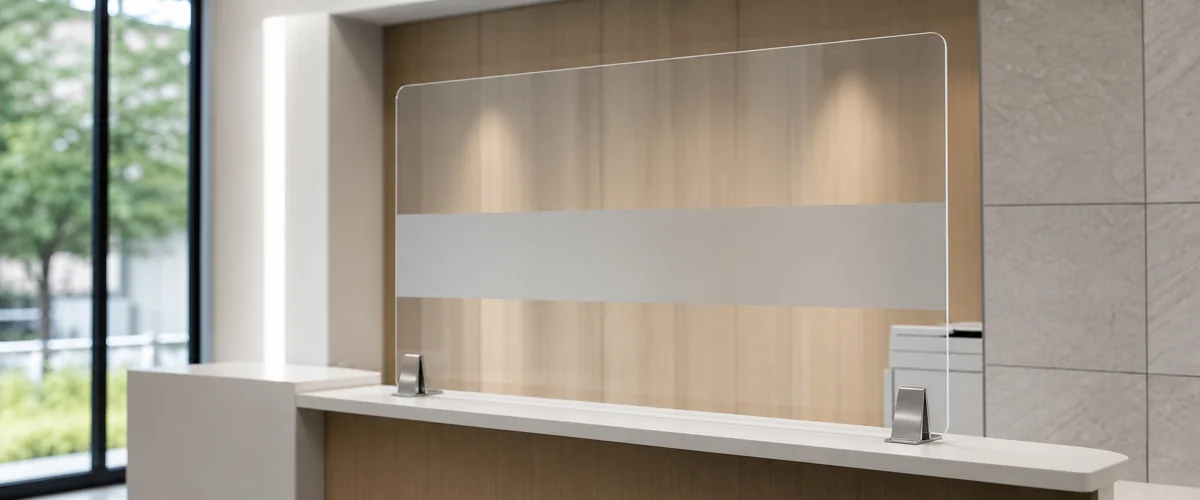
Counter-clamp mounts. This is the workhorse for chain rollouts and lease-restricted spaces. A pair of stainless or brushed-aluminum clamps grip the panel at the base and clamp to the countertop edge. Install time is under five minutes per unit, no drilling, and the clamps come off cleanly when the lease ends. As a practical rule, a 5mm panel up to about 32 inches wide stays within a few millimeters of flex under hand-pressure load (roughly 8 kgf at the panel center); because deflection climbs with the cube of the unsupported span, widening the same 5mm panel to 36 inches roughly doubles that flex into naked-eye-visible territory. We push customers above 32 inches wide to 6mm and we won’t ship a 5mm panel beyond 34 inches on counter-clamp without a written exception.
Through-counter mounts. A pair of threaded studs pass through pre-drilled countertop holes with rubber gaskets above and below, then fasten with stainless cap nuts. This handles 6mm panels up to 48 inches wide cleanly, survives accidental cart impacts that would dislodge a clamp, and is the right choice for nursing stations, pharmacy windows, and any guard that sees daily lateral force. The trade-off is countertop damage — the holes are permanent, which makes this a non-starter for short-term leases.
Ceiling-suspended designs. Cable or rod hangs from a ceiling track or anchor point. The math here is gravity, not flex: a 24x36 inch 6mm cast PMMA panel weighs roughly 4.4 kg before hardware, and the cable rating needs to be 5x that load minimum, anchored into a ceiling joist or a properly rated drop-ceiling track (most acoustic tile grids are not rated and will fail). 6mm is the minimum thickness for any suspended design — 5mm flexes too much under the cable tension and develops a permanent bow at the cable-attachment points within 6-9 months. Suspended concepts for dental clinics, food-court kiosks, or restaurant counters need a site-specific structural review when through-counter mounts are not possible; the engineering review can take longer than fabrication.
For new buyers I always start with the counter dimensions and the lease terms — those two facts narrow the choice to one geometry within five minutes.
What your spec sheet needs to say to satisfy USDA and FDA cleanability rules
Here’s the part that buyers most often get wrong on the PO, and where the wrong wording can cost you a sanitation audit finding.
USDA 9 CFR 416 (Sanitation) and the FDA Food Code 2022 Chapter 4-203.11 don’t mention acrylic by name. They define performance requirements for food-contact and food-zone surfaces — smooth, non-absorbent, durable, easily cleanable, free of cracks and crevices that can harbor soil45. A diamond-polished cast PMMA panel with a sealed edge meets the spirit of those rules cleanly. The problem is that “we used acrylic” doesn’t satisfy an inspector — the spec sheet on the PO needs to use the rule’s own language so the inspector reads it and checks the box.
The exact language we put on every restaurant sneeze guard quote is:
Material: Cast polymethyl methacrylate (PMMA), 5mm minimum thickness, smooth and non-absorbent surface throughout. Edge finish: diamond-polished and sealed, free of cracks, crevices, and stress fractures that could harbor soil. Compatible with quaternary ammonium, 70% isopropyl alcohol, and 1:10 sodium hypochlorite disinfection at minimum daily frequency. Construction conforms to the cleanability standard of USDA 9 CFR 416 and FDA Food Code 2022 Chapter 4-203.11.
That paragraph appears verbatim on every spec sheet we ship to a food-service buyer, and we back it with the material’s published cleanability and chemical-compatibility data referenced to the relevant standards. When a buyer’s facility gets audited and the inspector asks about the guards, the spec sheet plus that referenced material data is what passes the audit on the first pass.
For healthcare sneeze guards, the regulatory landscape is messier — there’s no single federal rule that names acrylic for patient-care surfaces. We default to the same FDA cleanability language, plus compatibility documentation for the disinfectant the facility actually uses (Cavicide, PDI Super Sani-Cloth, etc.). If a buyer’s infection-prevention team has a written disinfectant list, we check PMMA’s published chemical compatibility against their specific products before quoting.
The buyers who have the easiest time with audits aren’t the ones who paid the most — they’re the ones whose spec sheet read like the inspector’s checklist.
Custom cutouts — transaction windows, microphone slots, and the tolerances that matter
Every healthcare sneeze guard at a reception counter and every restaurant sneeze guard at a host stand needs a transaction window. Many also need a microphone slot, a card-reader pass-through, or a document slot. These are the highest-value customization points on a sneeze guard and the most common source of spec mismatch on the production floor.
The CNC tolerances we hold on cutout work, in production:
- Cutout width and height: ±0.3mm on widths up to 200mm, ±0.5mm above. Tighter than this is technically possible but doesn’t help — the human eye doesn’t resolve it and the matching hardware has its own tolerance stack.
- Corner radius: 5mm minimum. Sharp inside corners are stress concentrators — a near-zero radius drives the local stress up sharply and lets a crack initiate and propagate under daily use, which is a well-known failure mode for notched acrylic. A generous fillet (5mm or larger) spreads that load and is the single cheapest way to keep a cutout from cracking in service.
- Edge finish on cutouts: diamond-polished, same spec as outside edges. Inspectors check this — a polished outer edge with a rough inner cutout edge is an audit finding.
- Cutout placement: ±1mm from the spec drawing. The matching counter hardware (microphone, card reader) won’t tolerate more, and the staff using the guard daily will notice anything off.
For transaction windows, I push buyers toward a horizontal slot 75-90mm tall and 200-280mm wide — that’s the sweet spot for handing across documents, cards, and small receipts without compromising the guard’s protective function. Anything taller starts to defeat the purpose of the guard; anything narrower frustrates staff and creates a workaround (people start handing items around the guard, which is the worst possible outcome).
For microphone slots, the dimension is dictated by the microphone hardware — we ask for the model number on the spec call and pull the manufacturer drawing. A vertical slot 8-12mm wide and 60-80mm tall works for most lapel-style and gooseneck microphones. We add a 2mm clearance on each side and a 5mm corner radius.
The custom-cutout pricing tier on our quotes is flat per cutout type, not per unit — once we’ve programmed the CNC for one cutout pattern, every unit in that batch runs at the same per-unit cost. The first cutout adds roughly $8-12 per unit at the 100-unit tier; the second cutout on the same panel adds about $3-5. Buyers planning multi-cutout designs save real money by consolidating to one or two cutout patterns across the rollout rather than designing per-location.
Lead time and bulk pricing tiers — the math at 50, 100, and 250+ units
Here are the three numbers buyers actually need to plan a rollout, based on our standard production scheduling and current as of 2026.
50-unit tier. Standard counter-mount acrylic sneeze guard, 5mm cast PMMA, diamond-polished edges, single cutout: 12 working days from approved spec sheet to FOB Shenzhen. This tier is the entry point — most B2B sneeze guard manufacturers won’t quote below 25 units at custom spec, and the 25-50 range is where pricing per unit is highest because tooling cost amortizes across fewer units. At 50 units, our tooling cost spreads to roughly $4-6 per unit on first order; at repeat orders we re-use the tooling library and that cost drops to near zero.
100-unit tier. Same spec: 16 working days to ship, with the difference being polishing-line capacity. We can run 50 units in a single shift on the polishing line; 100 units fits in a two-day polish window with our standard staffing. Per-unit cost drops 12-18% versus the 50-unit tier — most of the saving comes from material yield (we cut more efficiently from full sheets at higher volumes) and from amortizing QC setup time.
250+ unit tier. Same spec: 21 working days to ship for 250 units, 28 days for 500, 35-40 days for 1000. The constraint at this tier shifts from polish-line capacity to material lead time — we hold roughly 6 working days of cast PMMA inventory and beyond that we’re scheduling against material arrivals. Per-unit cost drops another 8-12% versus the 100-unit tier. Above 500 units we typically negotiate a phased shipment schedule (250 units week 4, 250 units week 7) which lets the buyer install in waves and cuts the warehouse bottleneck on their end.
Custom cutouts and edge upgrades. Re-tooling for a custom cutout pattern adds 4-6 working days to whichever tier you’re in — we run the CNC programming, fixture fab, and first-article QA in parallel with material cutting where possible, but the design review and approval step is human and gates everything. Sealed-edge urethane top-coat adds 2-3 working days at any tier (it’s a separate cure step). Rush production at +25% premium can compress total lead time by roughly 25% but we hold a hard floor at material lead time — we don’t take rush orders we can’t actually deliver.
I’ll be direct on what I tell new buyers about this math: the worst rollout schedule is the one that compresses the design-review step. Buyers who lock the spec sheet on a single 90-minute call and approve the first-article sample within 48 hours reliably hit our published lead times. Buyers who iterate on cutout placement across three weeks of email threads slip every published lead time by the same amount. The lead-time number I quote is real — it’s also a partnership.
If you’re sourcing a 50-to-500-unit rollout and want a quoted spec sheet that includes the thickness recommendation, edge-finish spec, mount geometry, cutout dimensions, and lead time for your unit count — send the counter dimensions and target install date to our team and we’ll come back within two working days. Spec sheets are free; bad specs are expensive.
Related guides
- Acrylic Mirror Sheet: How Mirror Finish Performs in Cosmetics Display
- Acrylic Mirror Sheet: How Mirror Finish Performs in Cosmetics Display
For a healthcare reception application, see the integrated dental sneeze-guard case study.
Footnotes
-
MakeItFrom. PMMA (Acrylic, Cast) — Mechanical Properties (flexural modulus, flexural strength, density). Material property reference. https://www.makeitfrom.com/material-properties/Polymethylmethacrylate-PMMA-Acrylic ↩
-
AZoM (The A to Z of Materials). Polymethyl Methacrylate (PMMA, Acrylic) — Properties and Chemical Resistance / Environmental Stress Cracking. https://www.azom.com/article.aspx?ArticleID=788 ↩
-
Spartech. How to Clean Acrylic Sheets — Compatible Cleaners and Chemicals That Cause Crazing in PMMA. Technical data sheet. https://www.spartech.com/media/tds/How-to-Clean-Acrylic-Sheets.pdf ↩
-
U.S. Department of Agriculture, Food Safety and Inspection Service. 9 CFR 416 — Sanitation. Code of Federal Regulations, Title 9, Chapter III, Part 416. Current as of 2025. https://www.ecfr.gov/current/title-9/chapter-III/subchapter-E/part-416 ↩
-
U.S. Food and Drug Administration. FDA Food Code 2022 — Chapter 4 (Equipment, Utensils, and Linens), Section 4-203.11 Cleanability. Published 2022-12. https://www.fda.gov/food/fda-food-code/food-code-2022 ↩
Frequently Asked Questions
Is 3mm acrylic ever the right thickness for a B2B sneeze guard?
Yes, but rarely — and almost never for a counter-mounted unit. 3mm holds up well for narrow desktop dividers under 14 inches wide, lab partition windows that sit fully captured in a frame, and lightweight portable shields stored between uses. For any free-standing counter guard wider than 16 inches, the math fights you: 3mm cast PMMA hits its practical flex limit under typical hand-pressure load, and a thin panel that flexes repeatedly can take a permanent bow at the top edge. We treat 5mm as the default and only spec down to 3mm when the application clearly justifies it.
What edge finish is required for healthcare sneeze guards that get wiped down daily?
Diamond-polished or CNC-routed edges, sealed flush. Flame-polished edges look glossy on day one, but melting the surface with a flame leaves residual stress on the edge, and repeated exposure to quaternary ammonium or 70% IPA drives environmental stress crazing — a hairline cloudy ring around the perimeter that develops over months of daily wipe-downs. Once crazing starts, organic soil collects in the cracks and the edge becomes a contamination harbor that no wipe-down can recover. For any healthcare sneeze guard or food-contact-adjacent restaurant guard, we spec diamond polishing as a minimum and recommend a sealed-edge urethane top-coat for ICU and pharmacy applications.
How do I match acrylic sneeze guard specs to USDA and FDA requirements?
USDA 9 CFR 416 and FDA Food Code 4-203.11 don't name acrylic specifically — they require that food-contact and food-zone surfaces be smooth, non-absorbent, durable, and easily cleanable. Cast PMMA with a diamond-polished edge meets the spirit of those rules, but the spec sheet on your PO needs to say so. We add the words 'smooth, non-absorbent, sealed-edge construction, compatible with quaternary ammonium and 70% IPA disinfection per USDA 9 CFR 416' to every restaurant sneeze guard quote, and we cite the material's published cleanability and chemical-resistance data for buyers who get audited. That language is the difference between passing an inspection and arguing one.
Counter-clamp mount or permanent through-counter mount — which one for a restaurant chain rollout?
Counter-clamp for any rollout where you need flexibility, permanent through-counter for any guard that will see daily lateral force from staff or carts. Counter-clamps install in under five minutes per unit with no countertop damage, which matters when a chain rolls out 200+ locations and lease terms forbid drilling. They handle 5mm panels up to 32 inches wide cleanly. Through-counter studs with rubber gaskets are stronger, support 6mm 36-inch-plus panels without flex, and survive accidental cart impacts that would pop a clamp. We default to clamps for QSR and counter-service rollouts, through-counter for nursing-station and pharmacy installations.
What's the realistic lead time for a 100-unit custom sneeze guard order with a transaction window cutout?
16 working days from approved spec sheet to ship for the standard 100-unit tier with a transaction window cutout, plus 3-4 working days of design review on the front end if the cutout dimensions aren't already engineered. The cutout itself doesn't add lead time once we have the CNC program — what adds time is the back-and-forth on cutout placement, microphone slot dimensions, and corner radii. We push for one consolidated spec call to lock those choices, and from that point 100 units ships on schedule reliably in our production experience. Rush production at +25% can compress this to 11 working days but we hold a hard floor at material lead time, which is typically about 6 days for cast PMMA.
Need a sneeze guard spec that holds up past year two?
We'll walk you through the thickness, edge-finish, mount, and USDA-aligned cleanability language we use to spec every project. Send a counter dimension and target unit count and we'll come back with a quoted spec sheet within two working days.