Open-Front Cube Cases
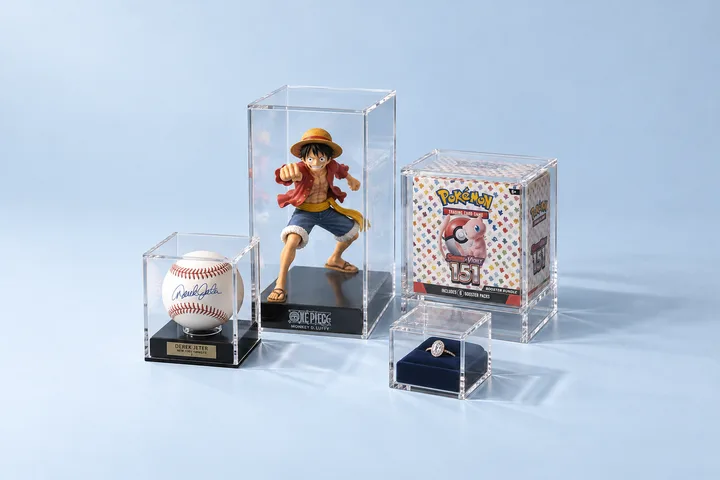
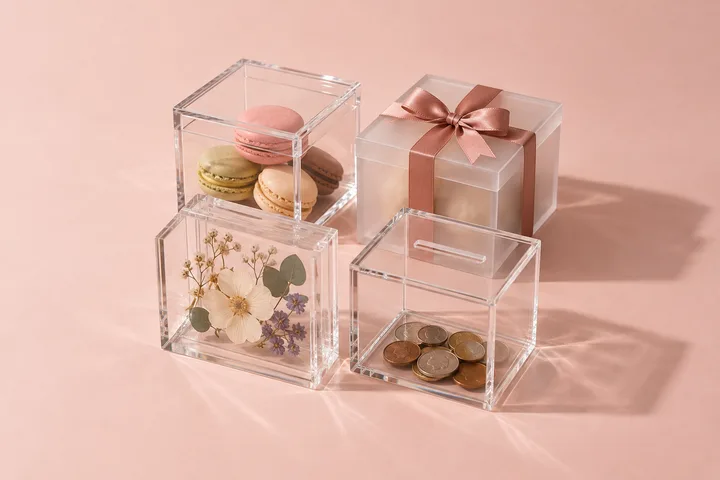
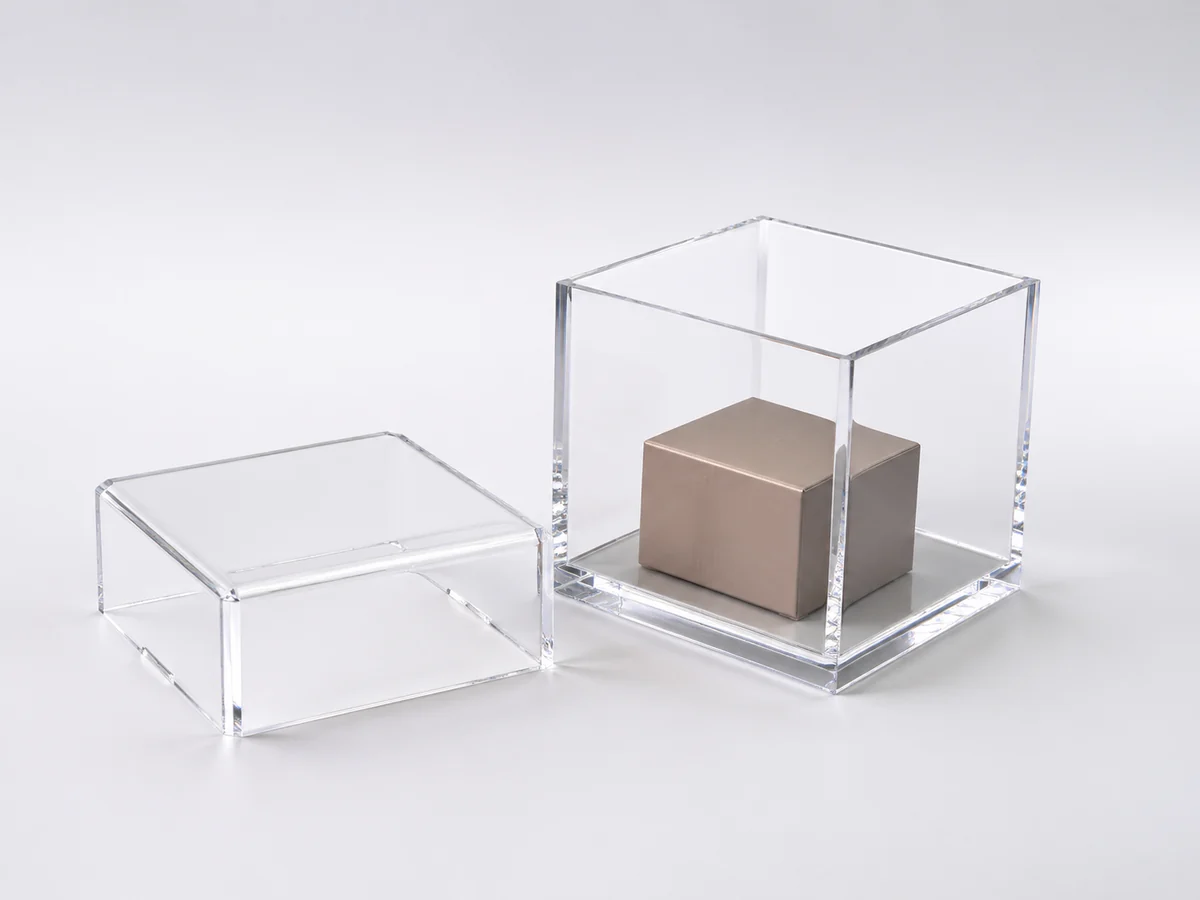
Lift-off acrylic cover sits on a base; the simplest format, easiest to merchandise. Most popular for jewelry, bakery, and cosmetics counters.
Small-footprint cases built for the counter you have, for retail, bakery, jewelry and showroom programs from 100 pieces per design.
Reference price Counter case from $6–12 at 500 pcs See prices
Get a Countertop Case Quote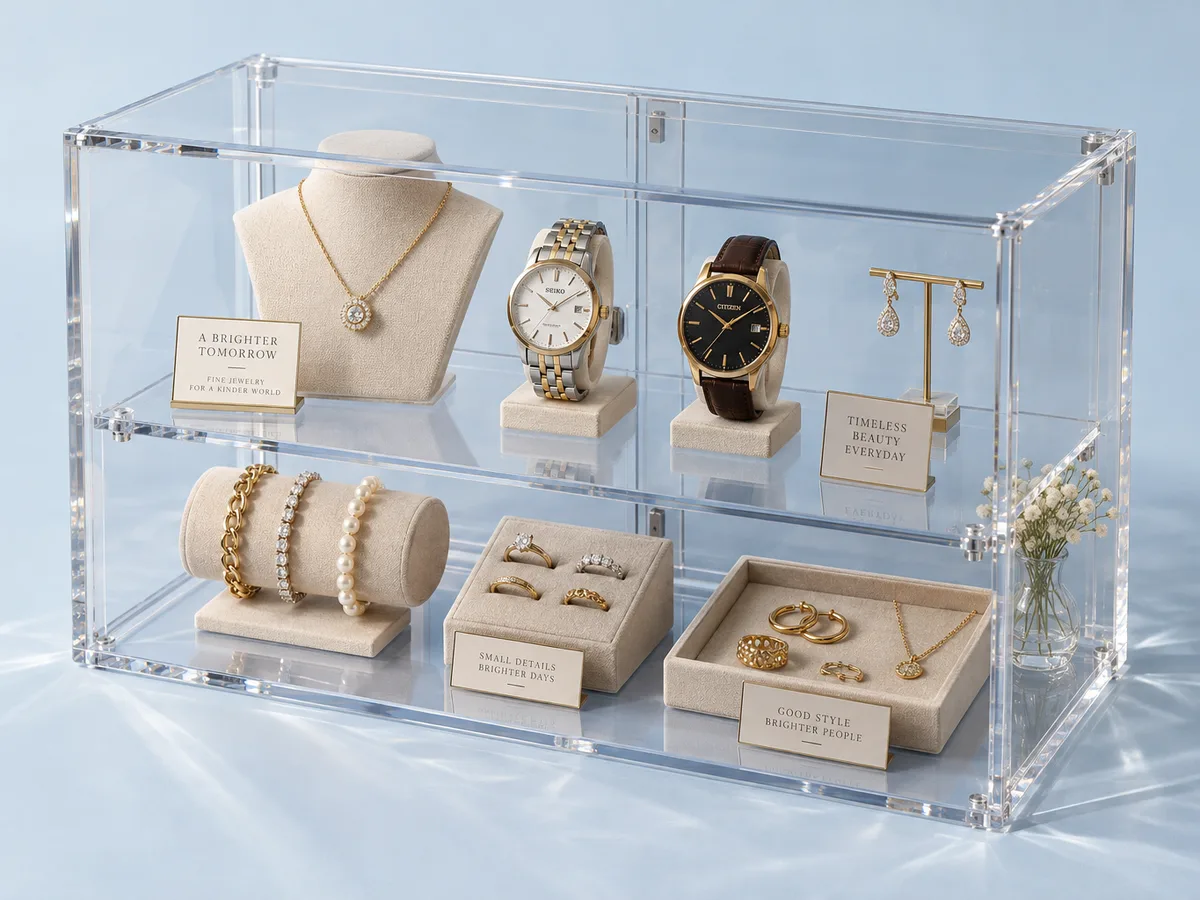
An acrylic countertop display case is a small-footprint enclosed acrylic box that sits on a retail counter, point-of-sale station, or tabletop to protect and showcase merchandise. Wetop builds custom counter acrylic display cases — also called acrylic countertop display boxes or plexiglass countertop cases — for cosmetics counters, jewelry retailers, bakery cafes, electronics retail, convenience impulse-buys, and hotel front-desk merchandising. Six format families, every one custom sized to your counter footprint and product mix.
ISO 9001 Certified · Diamond-Polished Edges
Paid samples cost US$200–500 per design and are never credited to the order; production runs from 100 pcs per design.
Built to the measured item and approved drawing.
Lift-off acrylic cover sits on a base; the simplest format, easiest to merchandise. Most popular for jewelry, bakery, and cosmetics counters.
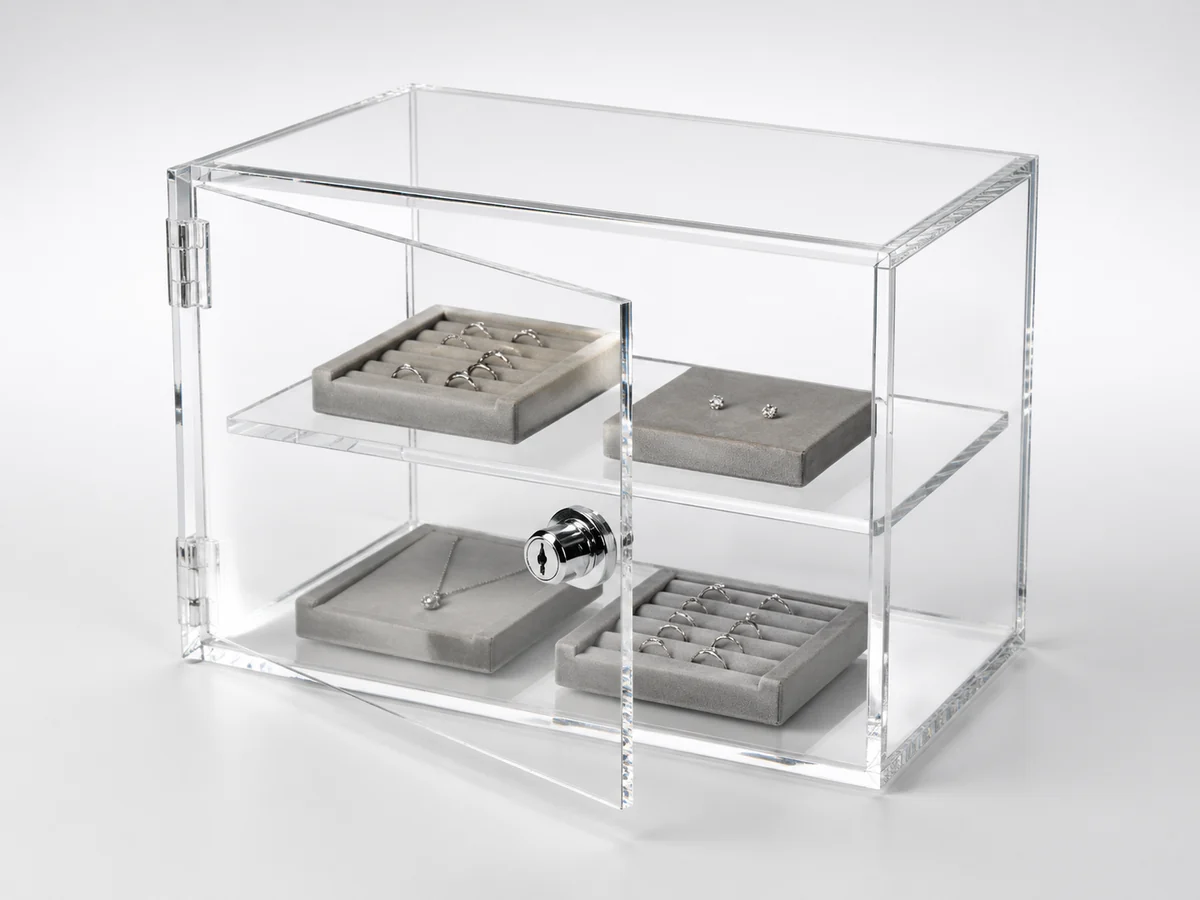
Cam-lock hinged front door; staff opens the case to restock or change merchandise. Standard for cosmetics and jewelry counters.
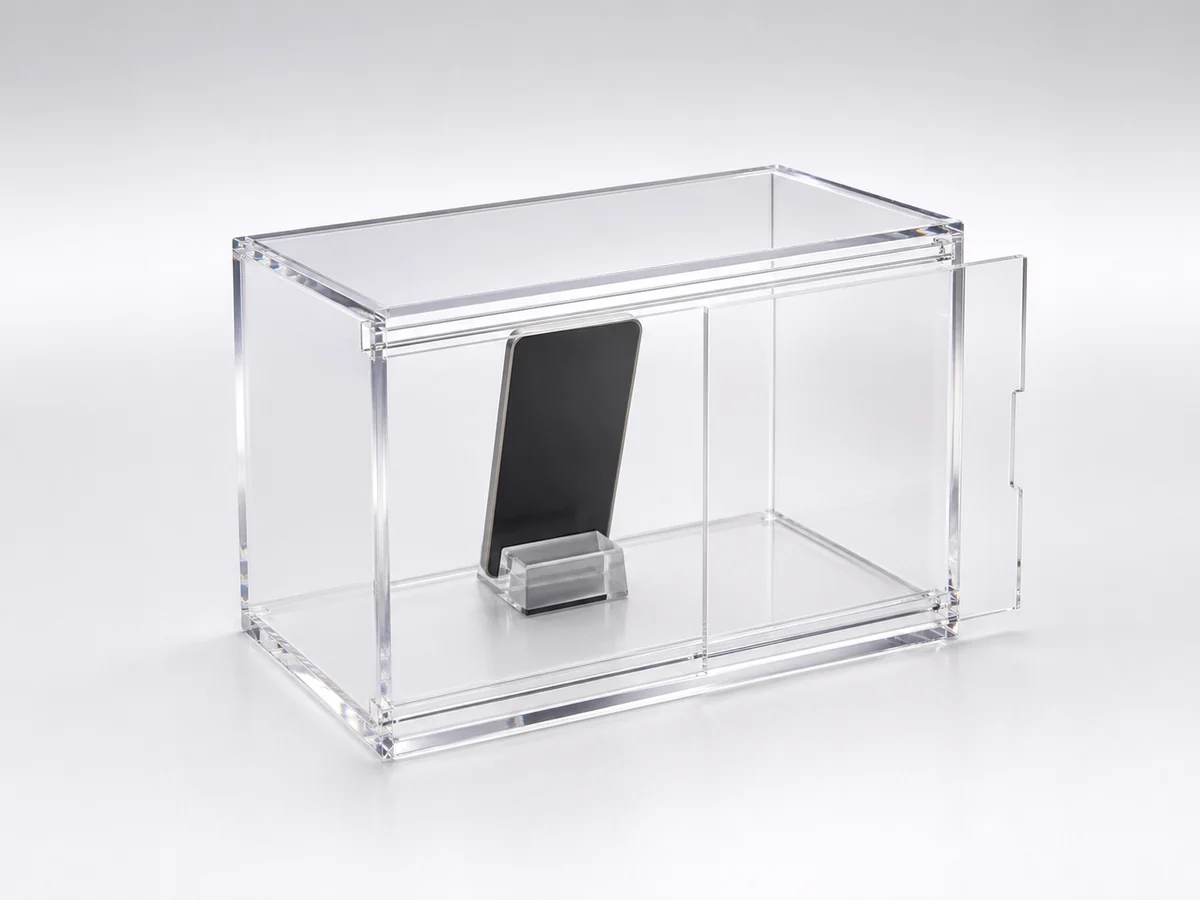
Back-access sliding panel; clean front face for buyers, easy restock for staff. Popular at electronics and accessory counters.
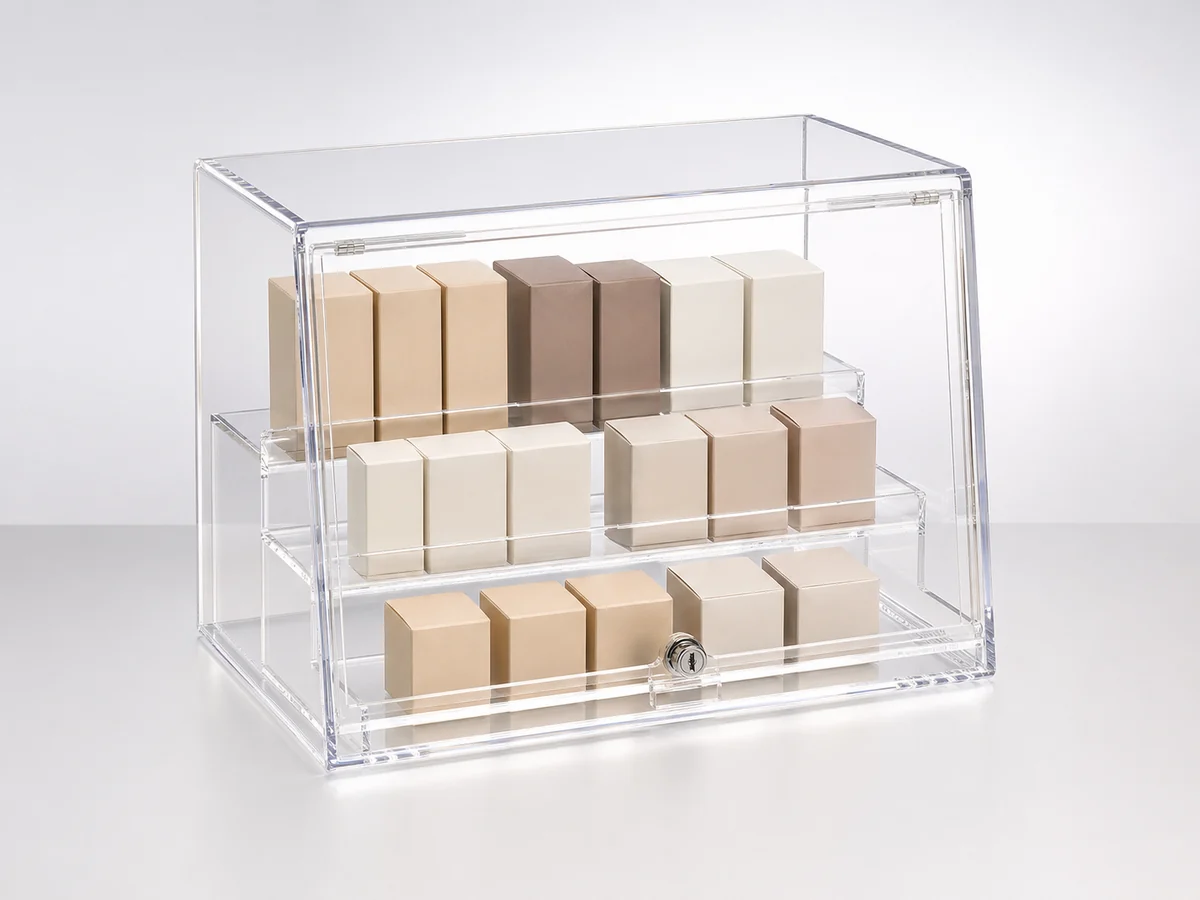
Stepped internal levels; the back row sits higher than the front. Standard for bakery, jewelry, and gift-set displays.
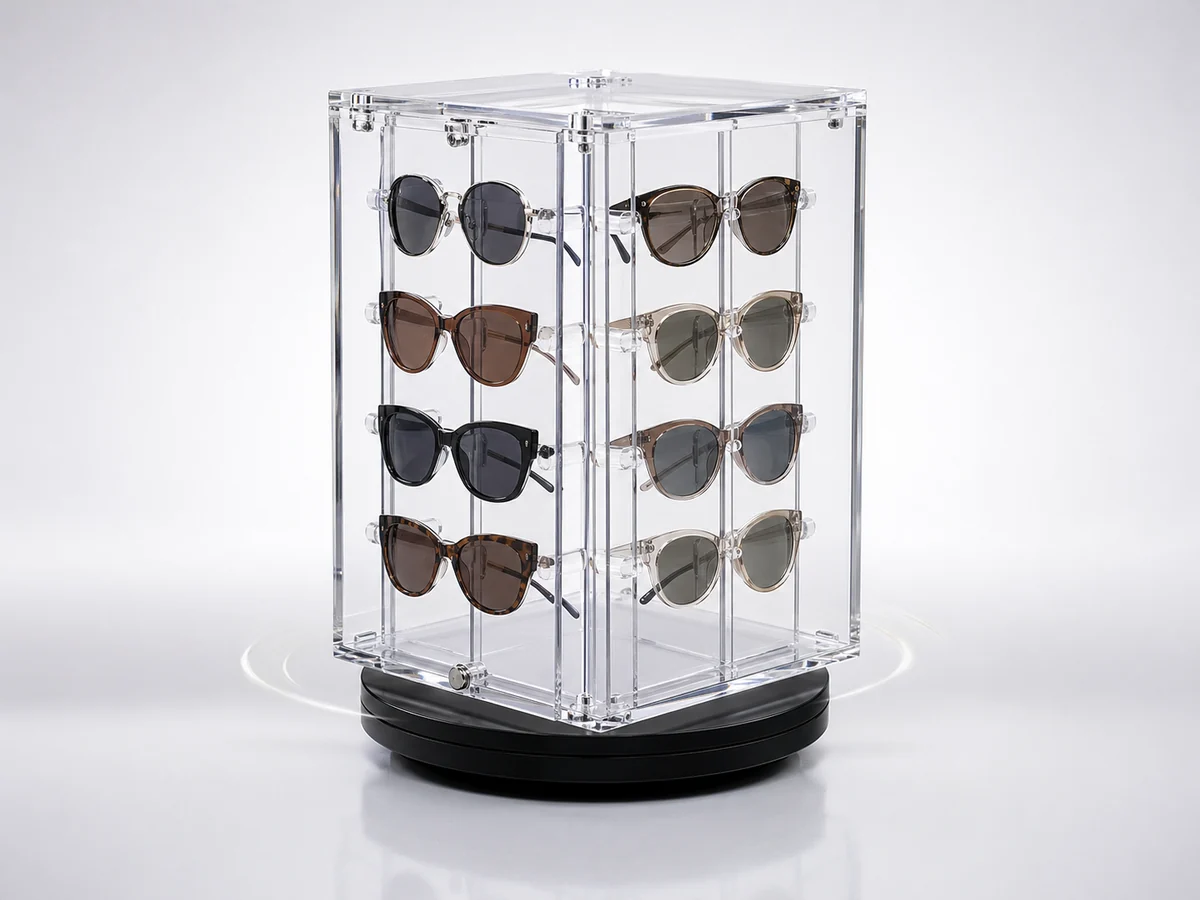
Turntable base lets buyers spin the case to browse. 360-degree jewelry, 4-sided sunglasses, 3-sided cosmetics formats.
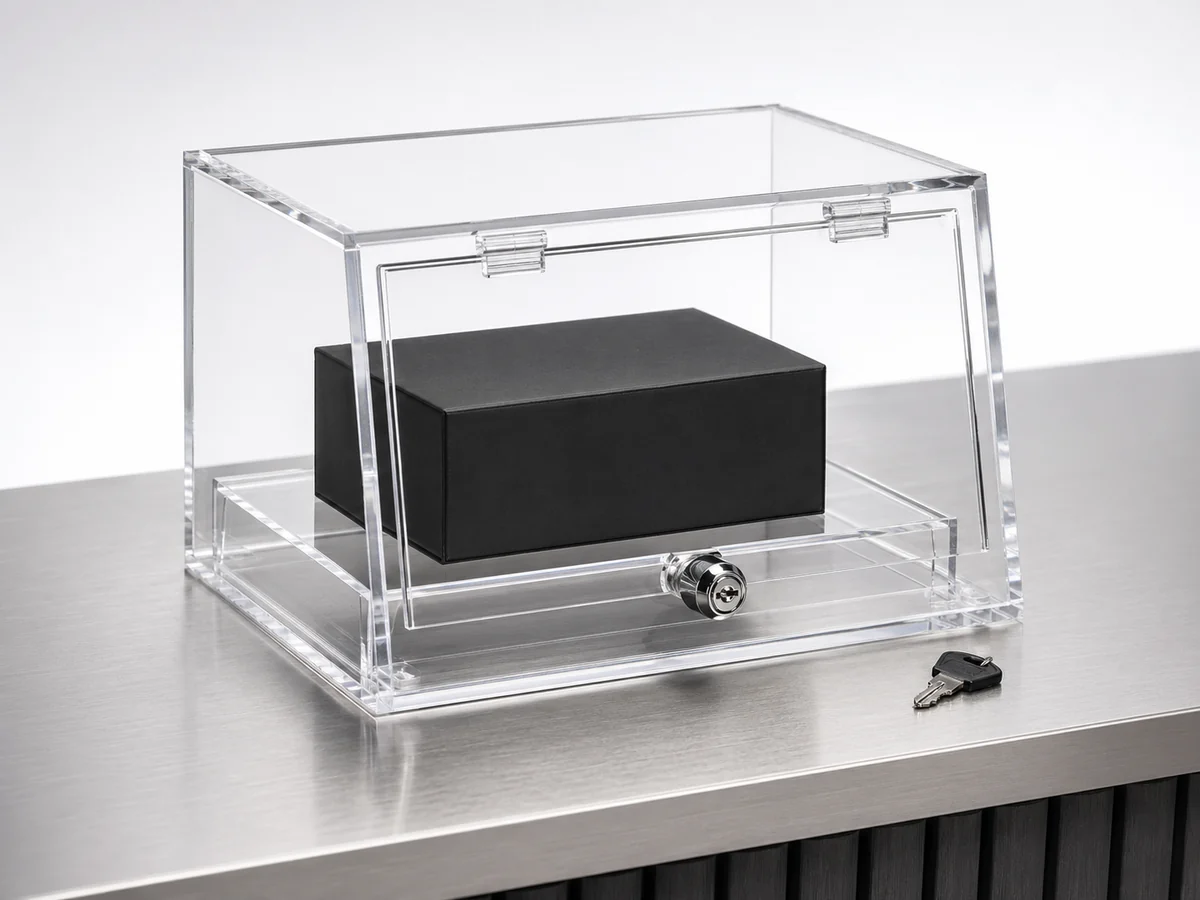
Keyed cam-lock for impulse-buy security at checkout — phones, watches, premium SKUs. Keyed alike across an order.
Choose the specification that fits the object, access, and installation.
Published reference from the display case price table. An open-front cube costs less than a lockable, lit or rotating counter format at the same size.
| Reference case | Specification | Quantity | FOB Shenzhen |
|---|---|---|---|
| Countertop case | 150 × 100 × 100 mm, 3 mm clear, magnetic lid | 500 pcs | from $6–12/unit |
Published reference price, not a quote. Send the counter footprint and product sizes for your price. See all case reference prices.
Delivered project
A European automotive brand ordered branded countertop displays for its showroom sales desks: a 22 mm CNC-machined base with the logo machined in and filled, and a magnetic insert so staff swap campaign cards in under 10 seconds. A Phase 2 order of 180 units followed six months later for new dealerships.
“The previous holders lasted one campaign season before edges scuffed and logos peeled. These have been on our sales desks roughly eight months with no replacements. The magnetic swap is quick enough that consultants actually change inserts on launch day now.”
There is no single standard size — countertop display case footprints depend on the products inside and the counter space available. As a directional guide: small countertop cases run 250–400mm wide (10–16 inches) for jewelry, single-cosmetic SKUs, and impulse buys; mid-size cases run 400–600mm wide (16–24 inches) for multi-product retail merchandising; large cases run 600–900mm wide (24–35 inches) for tiered bakery, electronics, or POS displays. We custom-build to your counter footprint and product mix — send us your products and the counter space and we size the case to fit.
Yes. Lockable countertop cases are one of our highest-volume sub-categories — keyed cam-locks on hinged front or back doors, keyed alike across an order so one key opens every case in your installation. We also offer hidden magnetic catches with a release key for cases where the lock should be invisible, and tamper-evident security seals as a low-cost alternative for short-term campaigns. For deeper security treatment, see our dedicated lockable display case sub-page.
Yes. Rotating (spinner) countertop cases sit on a low-friction turntable bearing rated for retail handling — buyers can spin the case to browse without lifting it. Common formats include 4-sided sunglasses spinners, 3-sided cosmetics displays, and 360-degree jewelry showcases. The acrylic case sits on top of the turntable; the bearing is rated for hundreds of thousands of rotations. MOQ is 100 pieces.
Yes — three formats, all sized to the frames you actually carry. Rotating spinners let shoppers browse the whole assortment unassisted; our reference build is a 4-sided turntable unit roughly 280mm wide × 380mm tall holding 16 pairs. Stepped tiered displays are for back-bars and wall runs where a spinner has no room to turn, with each row angled so the front pair doesn't block the one behind it. Locked eyewear cabinets sit at the dispensing counter for designer frames, with keyed cam-locks that can be keyed alike across a chain. Slot pitch is set to the widest frame in your assortment, so send frame dimensions with your RFQ. MOQ is 100 pieces per design. Full detail in the sunglasses and eyewear counter displays section below.
Our MOQ is 100 pieces per design. That's our standard B2B minimum — it lets retail chains test a fixture in a few stores before rolling out to 200+ locations, and lets cosmetics brands run a counter program with one design across multiple counters. Mixed designs can share one purchase order and shipment, but each unique case size or configuration must reach 100 pieces.
Yes. Three branding methods on countertop cases: UV printing for full-color logos and graphics directly on the acrylic, silk-screen printing for one or two solid-color logos at the lowest per-unit cost, and laser engraving for a permanent frosted-white mark. Frosted-acrylic logo plates bonded to the case face are also popular for cosmetics counters where the look needs to feel premium. Branding location is usually the case front face, lower edge, or a dedicated header strip.
Yes. Internal shelving is one of the most-requested options for countertop merchandising. Three configurations: fixed shelves bonded into the case walls (most rigid, cleanest look), adjustable shelves on slot tracks (lets retail teams re-merchandise without ordering a new case), and stepped riser shelves (fixed multi-tier levels for bakery, jewelry, and cosmetics displays where the back row should sit higher than the front). Shelves can be clear acrylic, white opaque, or glass — confirmed during sample approval.
A display case is an enclosed acrylic box that protects a product inside — five or six sides, often with a hinged or magnetic lid. A sign holder is an open stand that presents a printed insert (price card, menu, promo graphic) at eye level — no enclosure, no lid. They solve different jobs: cases protect physical merchandise, sign holders display printed messages. If you need an open countertop sign holder instead of an enclosed case, see our acrylic sign holders sub-page.
Yes. We build seven bakery and pastry case formats on the same MOQ as any countertop case: single-tier counter cases (donuts, cookies), multi-tier tiered cases (pastry boutiques), self-serve hopper cases (bagels, cookies with hinged lid), bread and loaf cases (long horizontal with sliding back), single-item pedestal cases (signature cake feature), cube and cake-pop cases (small enclosed cubes for macarons, truffles), and large hotel breakfast / buffet cases. All formats are non-refrigerated and built for dry pastries, breads, cookies, and donuts. See the bakery and pastry counter cases section below for full format details. For general bakery industry merchandising context, see our bakery and food displays application page.
No on both counts. Acrylic cases are non-refrigerated — they have no cold chain, no insulation, and no condensation drainage. Use them only for dry-goods bakery and pastry display: breads, biscotti, donuts, cookies, dry cakes, macarons, truffles. Hot food is also a no — acrylic deforms above 80°C / 180°F and will cloud or warp from heat exposure. For refrigerated dairy or cream-filled pastry display, you need a commercial refrigerated case from a refrigeration vendor — outside our scope. Food-grade acrylic with FDA-compliant material certificates is available on request — specify food-contact requirement at RFQ.
It's terminology, not product. Bakery typically means larger, multi-product cases for breads, donuts, and bagels — used in independent bakeries and supermarket in-store bakeries. Pastry typically means smaller, often tiered cases for fine-pastry retail like macarons, eclairs, and signature cakes — used in pastry boutiques and high-end cafes. We build both on the same MOQ; the case format depends on what you're displaying, not the word you use to describe your store.
A factory. Wetop has manufactured in Shenzhen since 2008 — today a 5,000 m² ISO 9001 certified plant, with 65+ people on the floor. Cutting, bonding, polishing, printing, and the 100% inspection against your approved sample all happen under one roof. For a counter program that matters at rollout scale: when store 40 of 120 reports a lock that binds, the fix goes to the people who fitted it rather than through a broker. It's also why samples come back in 3–5 days.
The honest answer is that the shelf span sets the limit long before the material does, so we spec it rather than publish a number. Wall and shelf gauge is the main lever: a small cube around 250mm runs fine in 3mm acrylic, while larger tiered cases and premium retail builds go to 5mm panels. The wider a shelf spans without support, the heavier the gauge it needs — a 3-tier cosmetics riser holding tester bottles and a bakery shelf carrying a full tray of dry cakes are very different loads at the same footprint. Two things work in your favor on the counter itself: acrylic is roughly 50% lighter than glass at the same dimensions, so the fixture contributes far less dead weight, and shelves are removable as standard, so a heavy reset can be staged rather than lifted as one piece. Tell us the heaviest item, the shelf span, and how the case gets restocked, and we set the gauge — then confirm it on the sample loaded with your actual merchandise before production.
Send us the counter footprint, the products you're merchandising, and the quantity. Tell us if you need a lock, a tiered riser, internal shelves, or branded printing. We respond within 24 hours with a detailed quote covering construction, finishing, and timeline. No commitment required. Sample before you commit to production.