Case Study · Automotive · Europe
600 Custom Countertop Displays for an Automotive Showroom Rollout
A European premium automotive brand needed custom countertop displays across their sales-desk network.
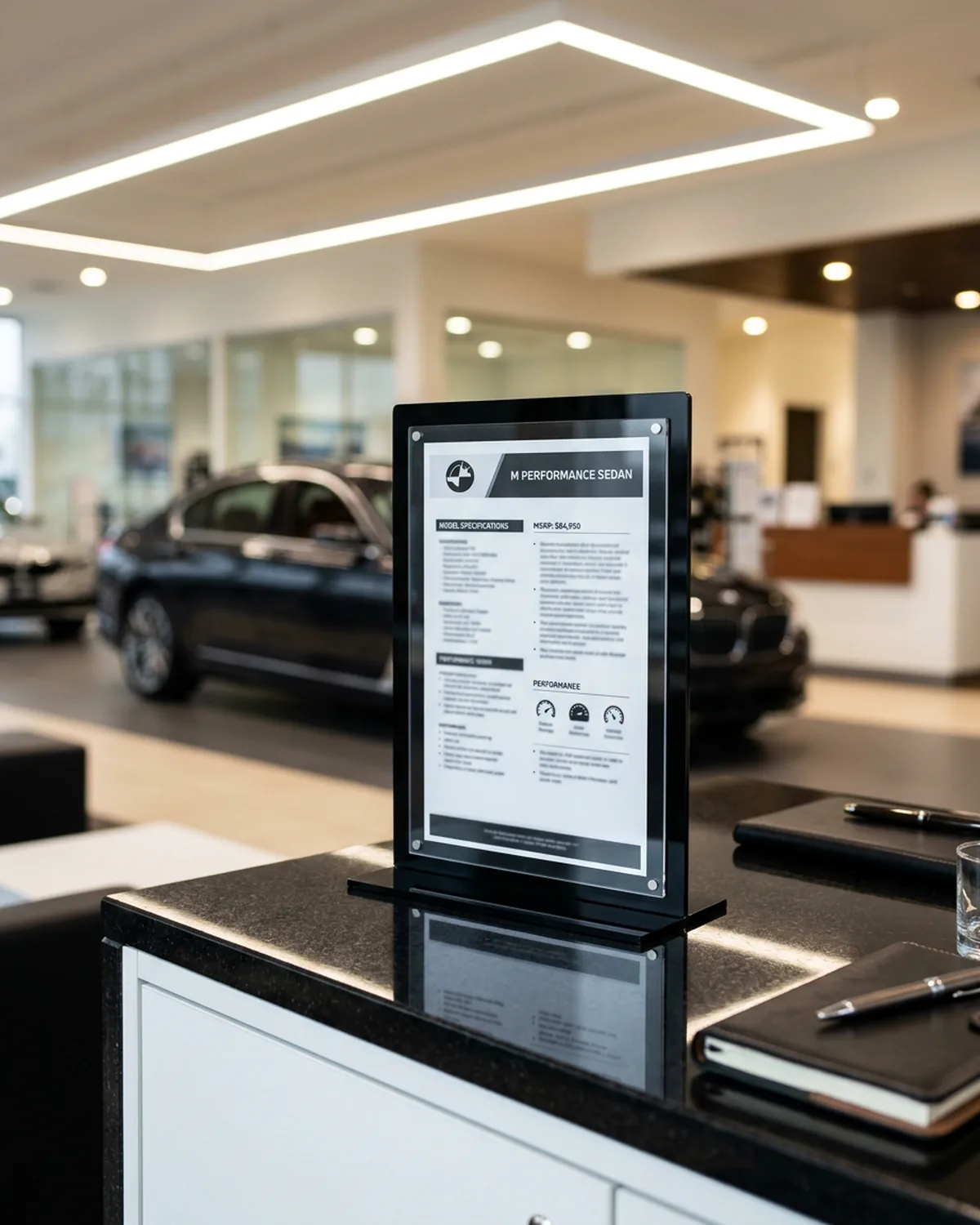
Each has a CNC-machined weighted base with a recessed logo inlay, magnetic clear-acrylic insert layers for weekly campaign swaps, and optical-grade PMMA so high-resolution print stayed distortion-free. We shipped 600 units in 22 production days. Six months later, they reordered 180 more for a second market.
- units shipped
- 600
- production time
- 22 days
- SKUs
- 2
- Phase 2 reorder
- +180
Key Takeaways
- A 22 mm CNC-machined base (3x the thickness of a standard acrylic flyer holder) drops the center of gravity and keeps the display stable when a customer leans on the sales desk to sign paperwork.
- The brand logo is machined directly into the base and filled with a polished inlay — not printed. This survives daily microfiber cleaning across a 4–6 year showroom fixture life.
- A two-layer magnetic insert system (rare-earth N42 magnets) lets sales staff swap seasonal campaign cards in under 10 seconds without tools; paper stays flat and protected.
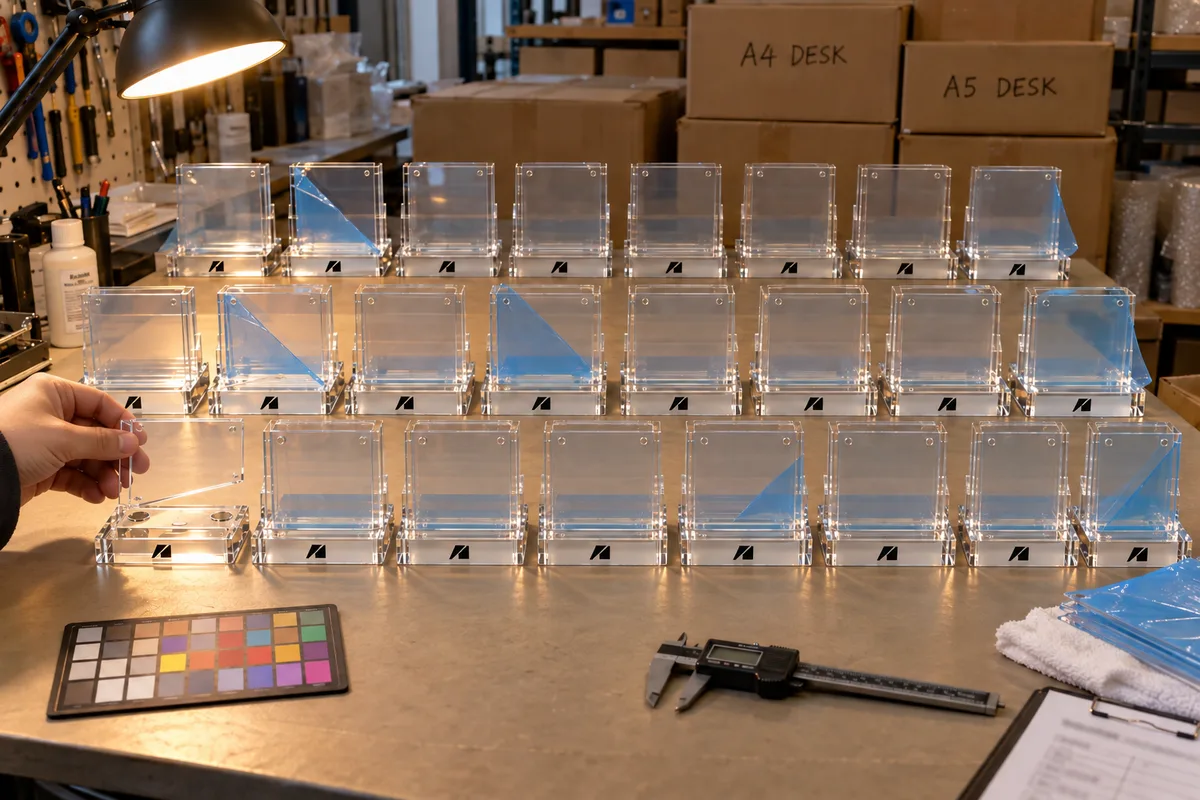
- 600 units across 2 SKUs delivered in 22 production days, every unit inspected before packing; color deviation on the black inlay held to ΔE 1.1.
- Phase 2 reorder of 180 units placed 6 months later to cover newly opened dealerships in a second European market.
The Challenge
The client — a European premium automotive brand — ran seasonal campaigns (finance offers, trade-in bonuses, model launches) across dozens of dealerships. Each showroom was handing out campaign leaflets in the same injection-molded countertop flyer holders the brand's agency had shipped out years earlier. The holders scratched within months, wobbled when customers leaned on the sales desk, and the self-adhesive brand decal peeled at the edges.
Retail Experience wanted a fixture-grade display that could sit on a sales desk for four to six years and still look like part of the showroom, while the paper insert inside it rotated every few weeks. Three constraints made this harder than a typical point-of-sale piece:
- Weight conveys quality. A lightweight display that tips when a customer slides a contract across the desk signals the opposite of the brand's engineering story. Stability had to be designed in, not added later.
- Daily handling by non-technical staff. Sales consultants — not merchandisers — swap the inserts. The swap mechanism had to work in under 10 seconds, with no tools, no lifted adhesive, and no visible hinge or clip.
- Brand treatment without printed decals. Printed logos on desk-top fixtures scratch and fade in direct desk lighting. The brand mark needed to be permanent and tactile — part of the material, not a sticker on top of it.
Our Approach
We redesigned the piece around three engineering decisions — base weight, insert mechanism, and logo treatment. Each decision moved the fixture from "marketing accessory" toward "showroom hardware." For buyers sourcing custom countertop displays at this quality tier, these three calls are where cost and perceived value diverge.
CNC-machined 22 mm base (not 10 mm bent stock)
A typical countertop flyer holder uses 3–5 mm bent acrylic, welded at the base — the cheapest way to make the shape, and the reason they tip. We specified a solid 22 mm cast acrylic block as the base, CNC-machined to final profile, then edge-polished. The extra mass lowers the center of gravity; the machined profile doesn't rely on a stressed weld joint; the polished edges read like the brushed-aluminum detailing in the showroom itself.
The insert pocket sits above the base as a separate 3 mm clear component, bonded with UV adhesive into a rebate machined into the top face. Separating structure from pocket means a scratched pocket can be swapped during a mid-life refresh without replacing the whole unit.
Magnetic insert sandwich vs traditional slot
The client's existing holder used a slot — insert the paper, slide it down, hope it stays flat. In practice, A4 paper curls, and slot holders show a visible edge at the top that breaks the flyer's bleed. We specified a two-layer "sandwich" held closed by four N42 rare-earth magnets recessed into the top and bottom acrylic layers. The two layers pull flat against the print on both sides; inserts swap in seconds.
| Insert mechanism | Swap time | Paper flatness | Desk-side durability |
|---|---|---|---|
| Injection-molded slot holder | ~5 seconds | Curls after 1–2 weeks | Scratches visible inside 6 months |
| Hinged clip frame | 15–20 seconds | Flat, but hinge shows | Hinge loosens over 12–18 months |
| Magnetic acrylic sandwich | Under 10 seconds | Flat both sides, no visible hardware | 4+ years in accelerated wear testing |
Setup cost on the magnetic system is higher than a slot — the rebate pockets for the magnets add a CNC step and the magnets themselves cost roughly USD 1.20 per set at this volume. On a fixture with a 4–6 year service life, that premium pays back the first time the piece avoids a warranty replacement.
Machined logo inlay, not printed
The brand mark sits centered on the front face of the base. We machined the logo shape 1.5 mm deep into the acrylic, then filled the recess with a color-matched cast acrylic inlay — bonded flush with the surrounding clear, then diamond-polished across the whole face so the logo reads as part of the material. There is no adhesive layer, no printed ink, no edge to lift.
We matched the inlay color to the brand's black spec with a ΔE tolerance of ≤ 2.0 under D65 daylight. The 600-unit run used a single cast batch of the inlay stock so color stayed uniform across every piece — measured variance held within ΔE 1.1. This is the same technique we use on permanent reception-counter branding, not on promotional runs.
Buyer acceptance pack for a showroom fixture
Approve the display as equipment, not as a print holder. The signed drawing should state the base footprint, total weight, centerline, insert opening, magnet position, logo master, and viewing face. Test tip stability with the final campaign insert fitted and place the sample on the same desk surface used in the showroom. Glossy stone, timber veneer, and fabric desk pads create different slip conditions.
Your physical sample should also confirm insert swap force, logo color under showroom lighting, edge finish, and the approved cleaning method. Record one golden sample per size, then use its drawing revision and finish photos during pre-shipment inspection. Thecountertop display buyer guide gives procurement teams a practical checklist for dimensions, material, branding, packaging, and sample signoff before the order moves into bulk production.
The Results
Phase 1 cleared pre-shipment inspection against the acceptance level set by the buyer's European quality team. Inlay color variance came in at ΔE 1.1 against a ≤ 2.0 spec, so the dealership network received a visually uniform set regardless of which pallet the piece came from.
Six months after install, the Retail Experience team came back for a Phase 2 run of 180 units — this time for dealerships in a second European market added to the rollout. For a permanent fixture like this, a reorder at six months is the real outcome: it means the piece survived the first two campaign cycles, daily cleaning, and customer handling without the brand team wanting to change anything.
"The previous holders lasted one campaign season before edges scuffed and logos peeled. These have been on our sales desks roughly eight months with no replacements. The magnetic swap is quick enough that consultants actually change inserts on launch day now."
What This Means for Your Project
If you're specifying custom countertop displays for a showroom, dealership, or flagship retail environment, the decision tree collapses to two questions. First: is this a one-season promotional piece, or a multi-year fixture? If it's a fixture, cost per unit is the wrong number to compare — cost per year of service is. A USD 28 injection-molded holder replaced every 12 months costs more over four years than a USD 60 machined piece that lasts the cycle.
Second: is the brand mark carrying more weight than the insert? In a luxury retail or automotive showroom setting, yes — the permanent surface (base, logo treatment) tells the customer about the brand even when the paper inside is rotated out. That's the case for machined inlay over printed decal, and for a weighted base over a bent-stock one. In a transactional POS setting where the flyer itself is the point, a simpler acrylic flyer holder is often the right answer — don't over-spec.
Planning custom countertop displays for your showroom?
Send us your brand guide, a sketch or reference of the desk footprint, and your dealership count — we will come back with a DFM review, a spec recommendation, and a quote.
Sample in 5–7 days · Production in 18–25 days · Single-unit sample on request