Frosted Acrylic vs Sandblasted Glass for Spa & Hospitality
Most spa and boutique-hotel buyers default to sandblasted glass for the etched, calming look — and pay 3× the unit cost plus 4× the freight.
Need this made?Hotel signage and hospitality displays →
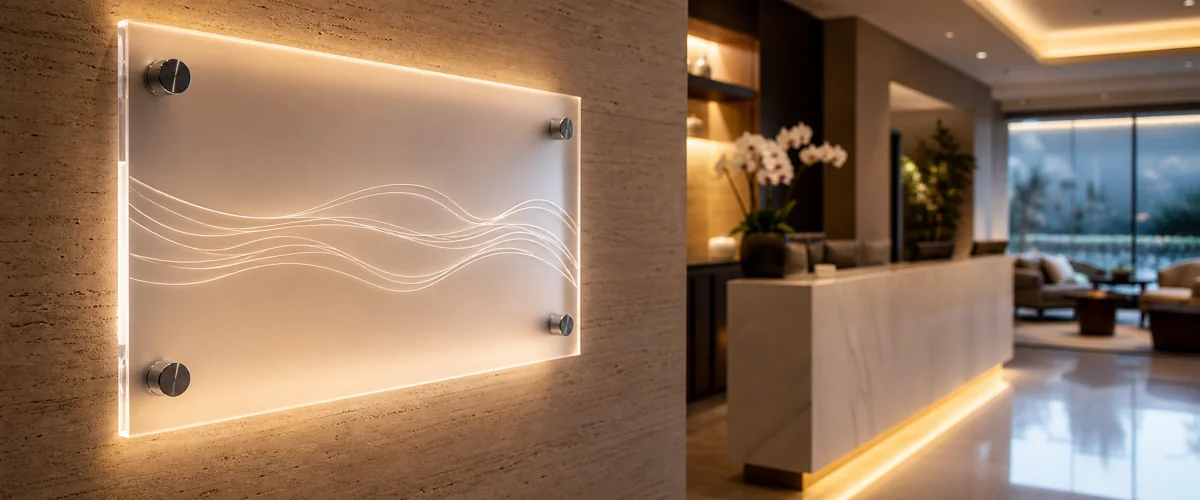
Frosted acrylic, specified correctly, lands the same finish at a fraction of the landed cost.
Key Takeaways
- Frosted acrylic vs sandblasted glass for hospitality signage — chemical-frost acrylic delivers more uniform light diffusion than sandblasted glass because a chemical etch produces a fine, even micro-texture while abrasive blasting chips irregular micro-pits, so acrylic reads as a cleaner, speckle-free glow under spa downlighting.
- Acrylic weighs roughly 1.18 g/cm³ versus 2.50 g/cm³ for soda-lime glass — an A2-format frosted acrylic panel ships at about 47% the weight of equivalent sandblasted glass, which translates to roughly one-quarter of the air-freight cost on small palletized hospitality orders.
- Cleanability comes down to surface micro-geometry: a shallow, uniform chemical-frost releases quaternary-ammonium cleaner residue on a wipe, while the deeper irregular pits of sandblasted glass trap residue and skin oils — which is why field maintenance crews report sandblasted-glass spa signage streaking within 18–24 months of daily wipe-downs.
- Frosted acrylic sheet supports CNC-routed shapes, internal LED routing, and tight-radius wayfinding curves that sandblasted glass cannot accommodate without expensive waterjet plus laminated edge work.
- Unit-cost spread on equivalent 6mm panels — chemical-frosted acrylic typically lands at 30–40% of the price of sandblasted tempered glass once labor, edge polishing, and breakage allowance are included.
On this page
- What Spa Buyers Actually See: Three Frost Methods Side by Side
- Cleanability Under Hospitality Maintenance Regimes
- Weight, Freight, and Why Acrylic Ships at One-Quarter the Cost
- Custom Shapes, Sizes, and the Fabrication Flexibility Gap
- Cost Spread: Why Frosted Acrylic Lands at 30–40% of Glass
- When Sandblasted Glass Is Still the Right Spec
- Related guides
What Spa Buyers Actually See: Three Frost Methods Side by Side
Frosted acrylic vs sandblasted glass is rarely a tie when buyers see the panels under real spa lighting. Chemical-frosted acrylic gives the most uniform diffusion because the etch works chemically across the whole surface; sandblasted acrylic sits in the middle; and sandblasted glass is the coarsest because abrasive media strikes and chips the surface unevenly — so glass reads slightly speckled up close while chemical-frosted acrylic reads as a clean, even glow.
In our production experience running Wetop’s finishing lines, I’ve watched the same pattern at every hospitality finish review. We send a four-panel sample box — chemical-frosted acrylic, sandblasted-frosted acrylic, sandblasted glass, and back-printed acrylic — and the spa designer almost always picks one of the two acrylic options once they see them lit from behind. The reason is surface texture, which the eye reads as “premium” or “industrial” before the brain names the difference. Chemical-frosted acrylic is etched in a chemical bath that produces a microscopically uniform surface, so a backlit logo reads as a single soft glow with no speckle. Sandblasted glass is the opposite: aggregate strikes the surface and chips out micro-pits, which scatter light in an irregular pattern that reads granular at arm’s length — exactly the distance a guest stands at a treatment-room nameplate. Specifying the frost finish before production prevents the resampling that costs both sides a week of lead time. (For a deeper primer on frosted acrylic against clear and colored options, see our clear vs frosted vs colored acrylic guide.)
Material Comparison Spec Table
The table below is the version we walk every hospitality buyer through before locking the spec. It compares the three frost methods plus back-printed acrylic — the four options that show up in 95% of spa and boutique-hotel signage RFQs.
| Spec | Chemical-Frosted Acrylic | Sandblasted Acrylic | Sandblasted Glass | Back-Printed Acrylic |
|---|---|---|---|---|
| Visual uniformity | Most uniform — fine, even chemical etch | Slightly textured — abrasive but on softer PMMA | Coarsest — reads granular up close | Fully uniform — smooth front, frost simulated by ink |
| Cleanability | Best — shallow frost releases residue on a wipe | Good — shallower pits than glass | Streaks over time — deep pits trap residue | Best — smooth front face wipes clean |
| Weight per square foot (6mm) | 0.71 lb / sqft | 0.71 lb / sqft | 1.50 lb / sqft (soda-lime) | 0.71 lb / sqft |
| Air-freight cost (1.2 × 0.6 m panel, China to US) | Baseline | Baseline | ~4× baseline (weight + breakage crating) | Baseline |
| Unit cost (6mm, 1.2 × 0.6 m) | 30–40% of glass | 30–40% of glass | 100% (baseline reference) | 35–45% of glass |
Cleanability Under Hospitality Maintenance Regimes
Hospitality cleanability is decided by surface micro-geometry, not material category. Chemical-frosted acrylic stays clean longer than sandblasted glass in a spa because the chemical-etched surface is shallower and finer, so quaternary-ammonium cleaner residue wipes off cleanly. Sandblasted glass has deeper, irregular pits that trap cleaner residue and skin oils, which is why sandblasted glass signage in commercial spas typically shows visible streaking within 18–24 months of daily wipe-downs.
For a hospitality buildout, approve frosted-acrylic sample panels in the actual environment and have the maintenance team test them with the cleaners they intend to use before locking the spec. The mechanism is what matters: PMMA itself has low haze to begin with (clear cast/extruded acrylic is published at roughly 1–2% haze per ASTM D10031), while the finished surface determines how readily residue shows. Cleaning behavior varies with finish depth, chemical exposure, and wipe method, so do not promise a maintenance outcome without a site test. For signage mounting and replaceable-insert options, see our wall-mounted sign holder page.
What gets wiped daily in a spa
| Panel location | Daily wipe count | Cleaner used | Frosted acrylic behavior | Sandblasted glass behavior |
|---|---|---|---|---|
| Treatment-room door sign | 4–6 | Quat-ammonium | Frost stays even; residue wipes off | Prone to streaking as residue lodges in pits |
| Pool-deck wayfinding | 2–3 | Chlorine-tolerant cleaner | Resists chlorine-residue buildup | Chlorine residue etches and clouds pitted surface |
| Lobby reception logo | 1–2 | Glass cleaner / IPA | Smooth-frost front wipes clean | Streaking builds up over time |
| Wet-area amenity signs | 6–8 | Quat-ammonium + IPA | Holds up under high wipe frequency | Streaks plus edge clouding in wet zones |
Weight, Freight, and Why Acrylic Ships at One-Quarter the Cost
Frosted acrylic vs sandblasted glass on logistics is not a small difference — acrylic weighs roughly 47% of soda-lime glass per panel, and the breakage-crating overhead on glass typically doubles the effective freight cost again. For a typical hospitality signage order of 50–200 panels shipped China-to-US air freight, the acrylic landed cost is usually around one-quarter the glass landed cost.
Here’s the math we run with hospitality buyers at quote stage. PMMA acrylic density is 1.18 g/cm³; soda-lime glass is 2.50 g/cm³. A 1.2 m × 0.6 m × 6mm panel comes out to roughly 5.1 kg in acrylic versus 10.8 kg in glass — a 5.7 kg per-panel weight gap. On a 100-panel order, that’s 570 kg of saved gross weight, which on a typical China-to-US air-freight tariff at $5–8 per kg works out to a freight saving of roughly $2,800–$4,500 before crating. Glass also requires foam-lined wood crates with corner protection because edge chips during transit are common; acrylic ships in standard pallet cartons with film-wrap separators. Combined, the freight + crating differential for hospitality signage orders typically lands at 4× cost for sandblasted glass versus frosted acrylic. Multiply that across a multi-property hotel chain rolling out signage to 12 locations and the freight savings alone usually pay for the design fee. (This is the same logic our buyers run on custom acrylic fabrication signage packages — material cost gets the headline, but freight is what turns a tight budget into an approved one.)
Per-panel weight + freight, frosted acrylic vs sandblasted glass
| Panel size | Acrylic weight (6mm) | Glass weight (6mm) | Air-freight gap (China → US, $6/kg) |
|---|---|---|---|
| 30 × 20 cm (room number) | 0.42 kg | 0.90 kg | $2.88 per panel |
| 60 × 40 cm (treatment-room) | 1.70 kg | 3.60 kg | $11.40 per panel |
| 120 × 60 cm (lobby wayfinding) | 5.10 kg | 10.80 kg | $34.20 per panel |
| 240 × 120 cm (back-bar logo) | 20.40 kg | 43.20 kg | $136.80 per panel |
Custom Shapes, Sizes, and the Fabrication Flexibility Gap
Custom shapes are where frosted acrylic vs sandblasted glass stops being close. Frosted acrylic sheet supports CNC-routed contours, laser cutting, internal LED channels, edge polishing, and direct UV printing — all in one fabrication pass. Sandblasted glass requires waterjet cutting, separate edge grinding, tempering, and lamination for any non-rectangular shape, which usually doubles the per-panel labor cost and adds 2–3 weeks of lead time on shaped pieces.
The hospitality signage I see most often — curved spa wayfinding, logo-shaped reception panels, room numbers with internal LED edge-glow, treatment-room labels with raised typography — are cases where frosted acrylic sheet is essentially the only economically viable material. Glass can be waterjet-cut to any shape, but cannot be tempered after cutting, and lamination for safety glass adds further cost. Frosted acrylic, by comparison, is single-pass: 6mm chemical-frosted sheet onto the CNC, contour-route the shape, route the LED channel into the back, edge-polish, UV-print the room number on the back, ship. The same job in glass is six suppliers and a month of coordination. For boutique-hotel buyers with custom branding and tight openings, fabrication flexibility is usually the deciding factor. (For the gallery-side application of similar finish work, see our case study on colored acrylic floating frames for art galleries.)
Shape and feature support, frosted acrylic vs sandblasted glass
| Feature | Frosted Acrylic | Sandblasted Glass |
|---|---|---|
| Rectangular signage | Yes — laser cut | Yes — straight-line score / cut |
| Curved wayfinding shapes | Yes — CNC routed in one pass | Yes, but requires waterjet + grinding (2–3× cost) |
| Internal LED edge-glow channels | Yes — routed on the same CNC pass | No — would compromise glass integrity |
| Logo-shaped contour panels | Yes — single-pass fabrication | Waterjet only; cannot be tempered after cut |
| UV-printed back graphics | Yes — direct flatbed UV print | Yes, but requires ceramic frit firing or vinyl applique |
| Edge polishing on shaped pieces | Yes — flame or diamond polish | Specialist labor; expensive on contours |
| Drilled mounting holes | Yes — drilled or routed | Possible only before tempering |
Cost Spread: Why Frosted Acrylic Lands at 30–40% of Glass
Once everything is added up — sheet cost, fabrication labor, crating, freight, and breakage allowance — chemical-frosted acrylic typically lands at 30–40% of the equivalent sandblasted tempered glass cost on hospitality signage orders. The cost gap isn’t only material density. It’s the cumulative effect of fabrication paths that combine into a single pass for acrylic and split into multiple suppliers for glass.
The bill-of-materials math we run on a typical 100-panel boutique-hotel signage package looks like this. Sheet material runs roughly 25–35% of total cost for frosted acrylic and 35–45% for sandblasted glass — so the gap on raw sheet alone is meaningful but not dramatic. Where the spread widens is in fabrication: chemical-frosted acrylic is routed, etched, edge-polished, UV-printed, and packed in one factory pass, where every step is on equipment we run daily. Sandblasted glass typically routes through three suppliers — glass cutter, sandblaster, edge grinder, and a fourth if tempering is required — each adding handling, transport, and breakage risk. Add 8–12% breakage allowance industry-standard on glass shipments versus 1–2% on acrylic, and the freight + breakage line item alone often closes the rest of the gap. For hospitality buyers running tight signage packages across multiple properties, the cost spread is usually the line that gets the project approved — but the cleanability, freight, and shape-flexibility gains are what make it the right call long-term, not just the cheap call.
Cost line items, 100-panel hospitality signage order
| Line item | Chemical-frosted acrylic | Sandblasted tempered glass |
|---|---|---|
| Sheet material | 25–35% of total | 35–45% of total |
| Fabrication labor | 25–30% (single-pass CNC) | 30–40% (multi-supplier) |
| Edge finishing | Included in CNC pass | 8–12% (separate grinder) |
| Freight (China-to-US air) | 8–12% | 25–35% (weight + crating) |
| Breakage allowance | 1–2% | 8–12% |
| Total landed cost | 30–40% of glass total | 100% baseline |
When Sandblasted Glass Is Still the Right Spec
Frosted acrylic wins most hospitality signage decisions, but sandblasted glass is still the correct spec in three specific environments. Heat-adjacent zones above 158°F (70°C) — sauna interiors, steam-room walls, hot-tub adjacencies — exceed PMMA’s heat deflection temperature2, so glass is the only safe material. Outdoor signage exposed to direct UV plus mechanical impact (parking-lot wayfinding, beachside resort signage with sand-blast wear) survives longer in tempered glass. And spec-matching renovations — where a 2010s-era property is adding signage to existing sandblasted glass partitions — should generally stay in glass to maintain visual consistency.
Outside those three cases, the spec defaults to frosted acrylic. I’ve shipped one sauna-interior sign in glass and several thousand frosted acrylic panels into spa, boutique-hotel, gallery, and pool-area work — the full ledger from specifying hospitality signage materials since 2014. The acrylic-default position isn’t a sales pitch — it’s what the cleanability, freight, and fabrication math force when buyers walk through it line by line. If your project is genuinely heat-adjacent or matching existing glass, glass is right. Otherwise, frosted acrylic is the spec and the budget difference funds the rest of the buildout. To pressure-test your spec against your actual environment, you can send us your design and we’ll come back with a panel-by-panel material recommendation, including which (if any) panels should stay in glass.
Frosted acrylic vs sandblasted glass — final decision matrix
| Application | Recommended Spec | Why |
|---|---|---|
| Spa treatment-room signage | Frosted acrylic | Cleanability + uniform finish |
| Hotel lobby wayfinding | Frosted acrylic | Weight + custom shapes |
| Boutique-hotel room numbers | Frosted acrylic | LED edge-glow + low MOQ |
| Pool-deck signage (chlorine exposure) | Frosted acrylic | Resists chlorine residue better than glass |
| Sauna interior labels | Sandblasted glass | PMMA softens above 158°F (70°C) |
| Steam-room wall graphics | Sandblasted glass | Heat + humidity beyond PMMA range |
| Renovation matching existing glass | Sandblasted glass | Visual continuity |
| Outdoor parking signage with mechanical wear | Sandblasted glass | Tempered glass survives impact better |
| Multi-property signage rollout | Frosted acrylic | Freight + cost across properties |
Related guides
For standard frosted acrylic sign holders and display formats, see our acrylic sign holders product page.
Footnotes
-
Acrylic haze measured per ASTM D1003 — Plaskolite OPTIX datasheet — manufacturer datasheet listing clear cast/extruded PMMA haze at 2% (Light Transmission – Haze, ASTM D1003), establishing the low baseline haze that lets a fine chemical frost stay optically even under repeated cleaning. ↩
-
Acrylic heat deflection temperature per ASTM D648 — AZoM PMMA cast-sheet data — materials reference listing cast PMMA HDT at 96 °C (1.80 MPa) and 107 °C (0.45 MPa) per ASTM D648, the property that disqualifies acrylic from sauna and steam-room signage above its thermal limit. ↩
Frequently Asked Questions
Is frosted acrylic a real alternative to sandblasted glass for spa signage?
Yes — frosted acrylic is the standard sandblasted glass alternative across hospitality buildouts above 200 panels per year. Chemical-frosted PMMA matches sandblasted glass on visual diffusion and outperforms it on cleanability, weight, and shape freedom. The only place glass still wins is heat-adjacent zones above 158°F (70°C) — sauna interiors, steam-room walls — where PMMA softens. For lobby, corridor, treatment-room, and pool-deck wayfinding, frosted acrylic is the correct B2B spec.
Will frosted acrylic look as premium as sandblasted glass under spa lighting?
Under warm 2700K–3000K spa downlighting, chemical-frosted acrylic reads slightly more uniform than sandblasted glass because the chemical-etched surface is finer and more even, eliminating the speckle that abrasive-blasted glass shows up close. Buyers who order side-by-side samples typically pick the acrylic finish for new installations and only specify glass when matching an existing 2010s-era buildout.
How does frosted acrylic vs glass compare on cleaning durability in a hotel environment?
Cleanability is a function of surface micro-geometry, not the material category alone. The shallow, uniform micro-texture of chemical-frosted acrylic releases quaternary-ammonium cleaner residue and skin oils on a normal wipe, so the frost stays even over years of daily cleaning. Sandblasted glass has deeper, irregular pits that trap residue and streak, which is why field crews commonly replace sandblasted-glass spa signage every 18–24 months — a maintenance line item in hospitality FF&E budgets that frosted acrylic largely eliminates.
What's the freight cost difference shipping frosted acrylic vs sandblasted glass internationally?
Frosted acrylic sheet at 1.18 g/cm³ ships at roughly 47% the gross weight of soda-lime glass at 2.50 g/cm³ for the same panel area and thickness. On a typical 1.2 m × 0.6 m × 6mm panel, that's about 5.1 kg of acrylic versus 10.8 kg of glass. Combined with reduced breakage-crating overhead, hospitality buyers usually see roughly one-quarter the landed air-freight cost when switching from sandblasted glass to frosted acrylic on small palletized orders.
What's the MOQ and lead time for hospitality frosted acrylic signage?
Our production MOQ is 100 pieces per design; separate sizes or artworks do not combine into one MOQ. Paid finish samples ship in 3–5 days, and standard production takes 15–20 days for chemical-frosted acrylic with CNC-routed edges and UV-printed back graphics. Pre-frosted sheet is stocked in 3mm, 5mm, 6mm, and 8mm; thicker custom-etched panels may add time.
Explore Custom Acrylic Products
Browse product categories to compare formats, materials, and customization options before choosing the closest fit for your project.