Laser Engraving vs UV Printing Acrylic
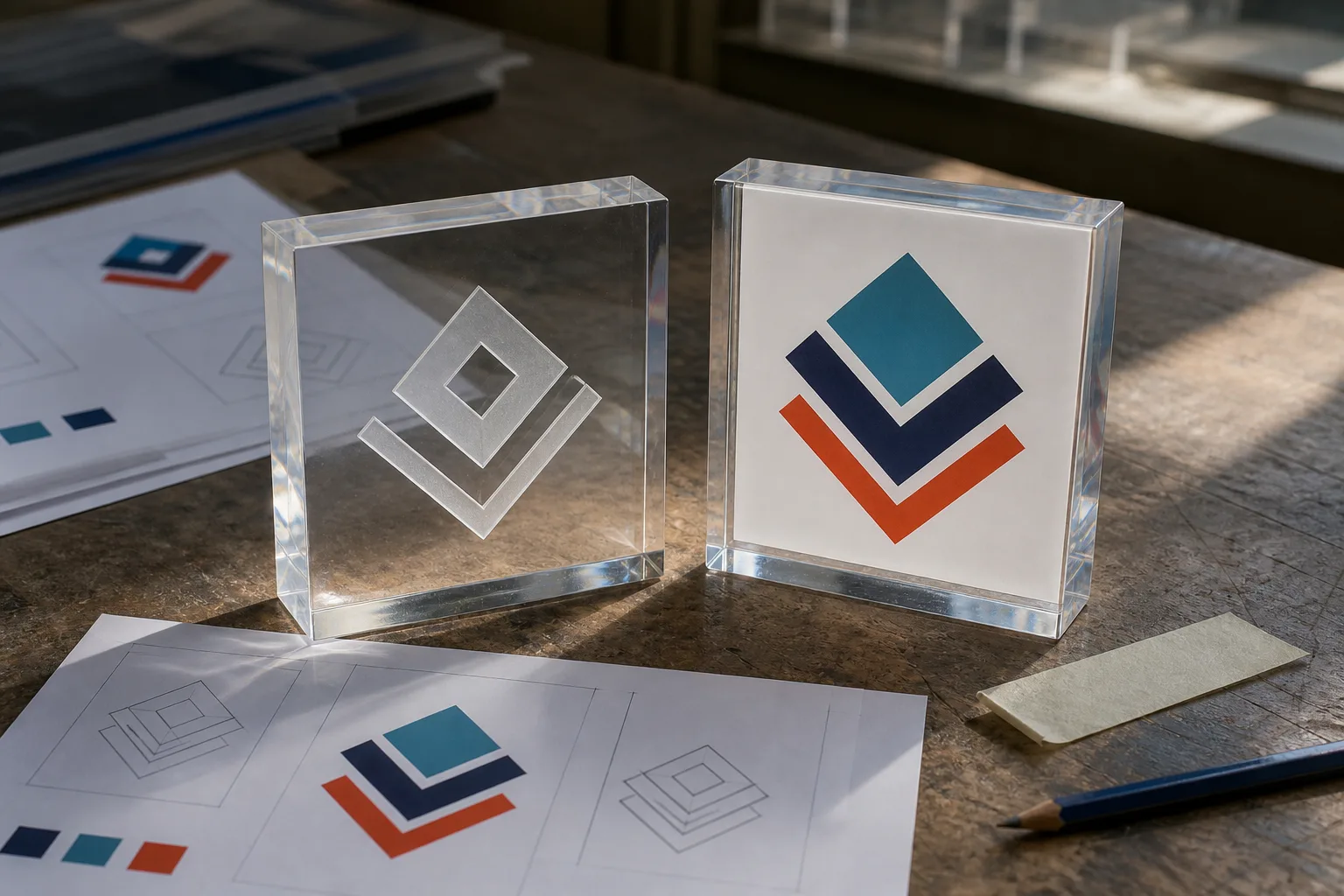
Engraving changes the acrylic surface; UV printing adds controlled color. The right method follows the artwork and the approval evidence you need.
Key Takeaways
- Laser engraving creates a frosted recessed or surface mark; UV printing places color and fine artwork on the acrylic.
- Use engraving for line art, names, serial marks, and a material-led look; use UV print for logos, gradients, photographs, and brand color.
- Approve the actual acrylic, artwork scale, placement, viewing side, and finish in a paid sample.
- Artwork versions can create separate setup and inspection paths even when the block size stays unchanged.
- Production MOQ is 100 pieces per design; paid samples take 3–5 days and are never credited.
On this page
- Choose from the artwork, not the machine
- Use engraving for a material-led mark
- Use UV printing for controlled color
- Prepare the artwork for the selected process
- Compare visible depth, color, and viewing side
- Price setup and versions separately
- Approve a sample and inspection reference
- Keep the repeat-order file production ready
- Send the block and artwork brief together
Choose from the artwork, not the machine
Laser engraving vs UV printing acrylic is a choice between a material mark and a color image. Engraving removes or modifies a shallow area so the design reads through texture and light. UV printing places cured ink on the surface, which supports spot color, gradients, small text, and photographs.
I start with the artwork file. A single-color line logo, name, serial number, or restrained commemorative mark can suit engraving. A brand logo with specified colors, a tonal image, or artwork that must read from across a counter points toward UV printing. The block shape comes next because the viewing side and print plane affect placement.
The process name does not approve the result. Ask which face receives the mark, whether the artwork reads through the block or from the printed surface, where white ink sits, and how the factory protects that face during packing. Approve those choices on the production drawing and sample.
The acrylic logo blocks page shows common block formats. Use it to select the physical product, then use this guide to route the branding.
Use engraving for a material-led mark
Laser engraving works well when the buyer wants the logo to feel part of the acrylic. The mark can read as frosted, pale, or light-catching depending on the material, focus, speed, power, artwork, and viewing condition. It does not create a controlled brand color by itself.
Line art, names, dates, simple icons, serial information, and restrained logos fit the process. Fine reversed type, dense tonal artwork, and color gradients need a different route or a sample-led review. Keep line weights and small gaps visible at the finished artwork size. For grid-marked acrylic stamp blocks used by craft and stationery brands, see the stamp block page.
Engraving position matters on a thick block. A front-face mark reads directly. A rear-face mark can read through the acrylic and gains visible depth, but the artwork orientation must be mirrored in the production file. State the viewing side and engraving face on the drawing.
Epilog’s laser guidance explains that acrylic can be engraved and cut with process settings selected for the material and desired result.1 Your production sample remains the acceptance evidence because the finished block, artwork scale, and surface treatment are order specific.
Use UV printing for controlled color
UV printing suits logos with spot colors, gradients, photographs, fine type, or variable images. The printer cures ink on the surface. On clear acrylic, the file may need a white layer behind selected color areas so the image does not become transparent.
Ask the factory to show the print order: white, color, clear, or a selected combination. State whether the image is viewed from the printed face or through the acrylic. A reverse print can protect the ink behind the block, but it also changes file orientation and the way the image interacts with the block depth.
Mimaki describes UV-LED printers as systems that cure UV ink on supported substrates and can use white ink for transparent media.2 That capability does not guarantee a Pantone result. Approve the named acrylic, ink setup, white layer, artwork file, and viewing light on a physical proof.
UV print surfaces need packing protection. Identify the printed face on the packing drawing and prevent a bag seam, interleaf edge, or neighboring block from rubbing it. Inspection should cover position, registration, visible defects, and the approved color reference.
Prepare the artwork for the selected process
Engraving artwork should use vector paths or clean high-resolution monochrome art at final scale. Outline fonts, remove hidden objects, and state which areas engrave. Show the block outline and safe area on a proof so no one guesses the placement from a cropped logo file.
UV artwork should identify color mode, spot references, white-ink objects, bleed, cut or block outline, and print side. Keep variable fields in a controlled data file. If ten retailer names share one block design, assign each version a code and proof rather than sending ten files named final.
The artwork readiness guide covers fonts, layers, outlines, and file ownership. Use one production package for the drawing and artwork. The revision on the inspection sheet should match the revision on the approved proof.
I reject the phrase “same logo as last time” as a release instruction. A repeat order should name the prior production file, approved sample, and any requested change. That discipline matters more than the file extension.
Compare visible depth, color, and viewing side
Engraving gains visual depth when light catches the textured mark or when the viewer sees a rear-face mark through the block. UV printing gains visual control through ink. A reverse UV print can also appear behind the acrylic surface, though its appearance comes from the print layer rather than removed material.
Lighting changes both. Engraving may read softly in flat light and brighter near an edge or highlight. Printed color can shift against a dark counter, a white background, or transmitted light. Approve the sample in a viewing condition close to the intended display.
Do not ask for “optical” engraving or “exact” color without naming the acceptance method. For engraving, compare the sample to an approved surface and artwork position. For print, compare the production sample to the approved proof under the agreed light and background.
If the buyer wants texture and color, quote a controlled combination. The factory should separate the engraved and printed regions in the artwork, state the process order, and sample the interaction. Combination work adds setup and inspection; it should not be assumed from a rendering.
Price setup and versions separately
Both methods have fixed and variable work. Engraving needs production artwork, machine setup, positioning, cycle time, cleaning, and inspection. UV printing needs prepress, proofing, fixture or positioning, ink, cure, cleaning, and inspection. The size and coverage of the mark affect time.
Versions can dominate setup. One logo across 1,000 blocks creates one controlled artwork path. Ten logos at 100 each create ten proof, file, label, and inspection paths. Wetop’s production MOQ is 100 pieces per design, so list the quantity beside every artwork version.
Ask for three lines: block fabrication, branding, and packing. That structure lets your team compare a process change without losing the physical block cost. It also shows whether a low branding price excludes proofing or individual version labels.
The logo-block price guide covers quantity bands in detail. Use its cost worksheet with the process choice from this guide.
Approve a sample and inspection reference
Approve the finished block rather than a printout alone. Check block dimensions, polished faces, artwork scale, placement, viewing side, color or engraving appearance, surface protection, and carton presentation. Keep the signed sample or approved sample report with the production file.
Paid samples take 3–5 days, are paid separately, and are never credited to production. Production takes 15–20 days after the drawing, artwork, sample, and payment approvals close. We reply to a complete brief within 24 hours.
The inspection sheet should name the artwork revision and sample reference. For engraving, include presence, position, orientation, and agreed appearance. For UV print, add white layer, color reference, registration, position, and surface condition. Record version counts before packing.
Our corporate logo block program case shows how artwork versions and repeat files affect a block program. Use the controls, then apply your own brand files and acceptance rules.
Keep the repeat-order file production ready
A repeat-order package should contain the block drawing, material and finish, artwork source file, production PDF, process route, approved sample reference, inspection sheet, packing drawing, and version matrix. Name the prior PO only as a cross-check. The files should identify the product without relying on a person’s memory.
Record process details that affect appearance. For engraving, keep the engraved face, orientation, artwork scale, and approved surface reference. For UV print, keep the print side, white layer, color reference, production file, and approved sample. The supplier may manage machine settings, but the buyer should own the visible acceptance record.
Treat an artwork edit as a controlled change. A smaller logo, new color, revised legal line, or different retailer name needs a new revision and proof. If the physical block stays unchanged, the factory can state which fabrication steps remain common and which branding steps restart.
Ask the supplier to confirm material and process continuity before releasing a repeat PO. If a sheet grade, ink system, artwork file, or packing component changes, require a written change notice and decide whether a new sample is needed. This check prevents a repeat order from inheriting an unreviewed substitution.
Archive one production unit when the program has recurring releases. Compare future samples to that retained unit under the same viewing condition. The comparison should guide approval, not create a universal durability claim.
Send the block and artwork brief together
Send the block width, depth, height, material color, viewing side, artwork, safe area, quantity per version, packing, destination, and required date. Identify engraving, UV print, or “factory to recommend” and state the visual priority.
Use the logo block quote form to upload the vector file and drawing. We will return the recommended route, assumptions, sample scope, production price, and open questions within 24 hours.
Compare both methods on the acrylic blocks hub and custom logo-block page. The logo-block manufacturing program connects that method decision to the production brief. Or build your logo block spec and get a price band before sending the brief.
Footnotes
-
Epilog Laser acrylic engraving guidance — the laser manufacturer describes acrylic cutting and engraving as setting- and material-dependent processes. ↩
-
Mimaki UV printer technology — Mimaki documents UV-LED flatbed printing and white-ink capability for supported rigid and transparent media. ↩
Frequently Asked Questions
Is laser engraving or UV printing better for acrylic logo blocks?
Choose laser engraving for a frosted material mark and UV printing for controlled color or photographic detail. The artwork, viewing side, block geometry, quantity, and approved sample decide the better route.
Can UV printing match a Pantone color on clear acrylic?
Use the Pantone reference as an input, then approve a physical print on the named acrylic and under the agreed viewing condition. Clear material, white ink, print order, and lighting affect the visible result.
Does laser engraving add color to acrylic?
Laser engraving changes the surface and usually reads as frosted or light-catching rather than colored. If the design requires color, use UV printing or another separately approved color process.
Can one order include several logo versions?
Yes, but each artwork version needs its own proof, production file, inspection reference, and quantity. Wetop's production MOQ is 100 pieces per design.
Should I approve a physical sample?
Approve a paid sample when color, visible depth, fine type, viewing side, or placement matters. Samples take 3–5 days, are paid separately, and are never credited to production.
Choose the Marking Method from Your Artwork
Send the vector file, colors, block size, viewing side, quantity per design, and destination. We will recommend engraving, UV print, or a controlled alternate within 24 hours.