
Iridescent Acrylic Displays & Boxes: vs Metallic and Pearlescent
We make iridescent, metallic and pearlescent acrylic into displays, boxes, trays and signs from 100 pieces per design.
Need this made?Custom acrylic boxes →
Here is where each finish pays off, what it costs, and how it holds color on reorders.
Key Takeaways
- Iridescent acrylic uses thin-film optical interference to produce color-shift reflection. Performance depends on viewing angle, light direction, and substrate edge polish — three variables that determine whether the aesthetic reads as deliberate brand work or as plastic gimmick.
- Iridescent / metallic / pearlescent / dichroic — four specialty finishes that look similar in concept renders but produce different optical behaviors. Iridescent is the most viewing-angle-sensitive; metallic is the most consistent across angles.
- Pantone register holds on a 100-piece pilot because it comes from one pigment lot and one cure cycle; a 1,000-piece reorder drifts past the visible delta-E 2.5 line unless the factory approves a master swatch per batch.
- Three retail use cases where iridescent actually pays off: brand-statement architectural elements, premium feature walls under directional designed lighting, and luxury-positioned product display where rotational viewing produces the dichroic moment.
- Three retail contexts where iridescent fails: high-touch retail (smudges show on iridescent finish), dim lounge or hospitality lighting (no light to drive the dichroic effect), and multi-color brand contexts (the shift competes with brand-specific colors instead of supporting them).
On this page
- Iridescent acrylic: what we make in it, and where it pays off
- Iridescent vs metallic vs pearlescent vs dichroic
- Viewing-angle math — why iridescent under-performs at head-on retail
- Lighting + finish — diffused soft vs spotlight
- Substrate construction — bulk-iridescent cast vs surface-coated panels
- Edge finish — diamond polished vs flame polished impact on iridescent edge glow
- Lifespan, maintenance, and what fades
- When NOT to spec iridescent — high-touch, dim lounge, multi-color brand
Iridescent acrylic: what we make in it, and where it pays off
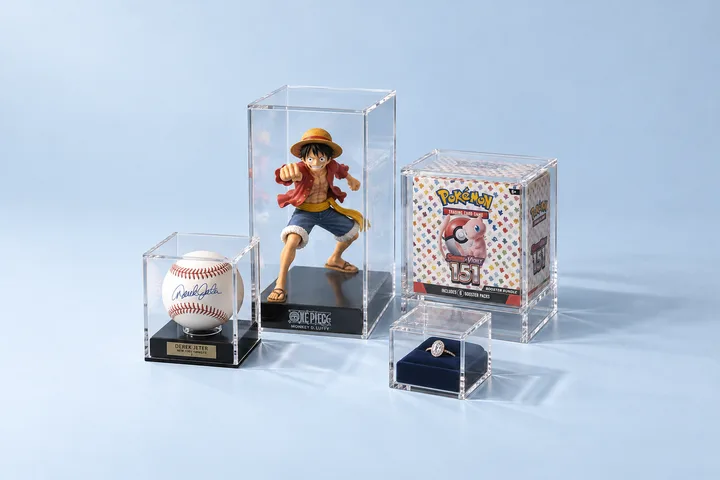
We fabricate iridescent acrylic into finished displays, boxes, trays and signage, made to order from 100 pieces per design; we cut it to size or fabricate finished pieces; we do not sell stock sheet. The finish pays off in three contexts: brand-statement architectural elements that people walk past, feature walls under directional lighting, and luxury product displays viewed from changing angles. It under-performs head-on under flat retail lighting, on high-touch counters and in dim hospitality lighting, where metallic or pearlescent acrylic usually does the job better.
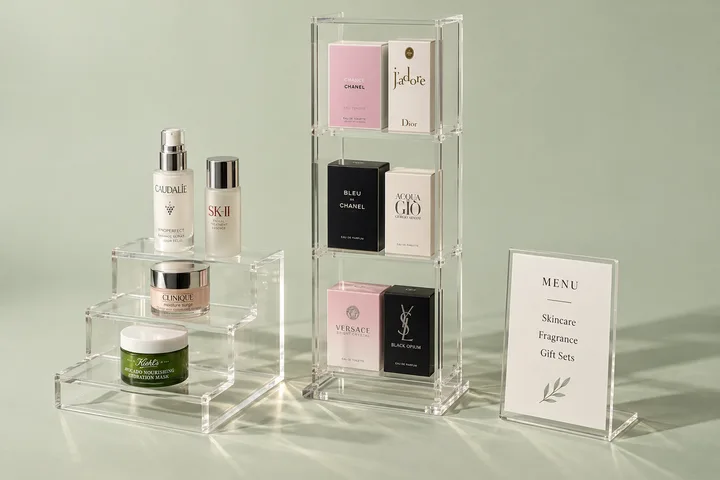
Beauty brands buy these finishes most often. Our cosmetics and perfume displays combine clear, mirrored, pearlescent and metallic acrylic on risers, trays and wall units, and the pearlescent lipstick wall display is a delivered order in this finish family. Brand creative directors bring us iridescent concept renders about 3–4 times a quarter. The sections below cover what each finish does, what it costs, how well it holds a Pantone across reorders, and the spec choices that decide whether the project reads as deliberate brand work or as a plastic gimmick.
Iridescent vs metallic vs pearlescent vs dichroic
Four specialty finishes look similar in marketing imagery but produce different optical behaviors.
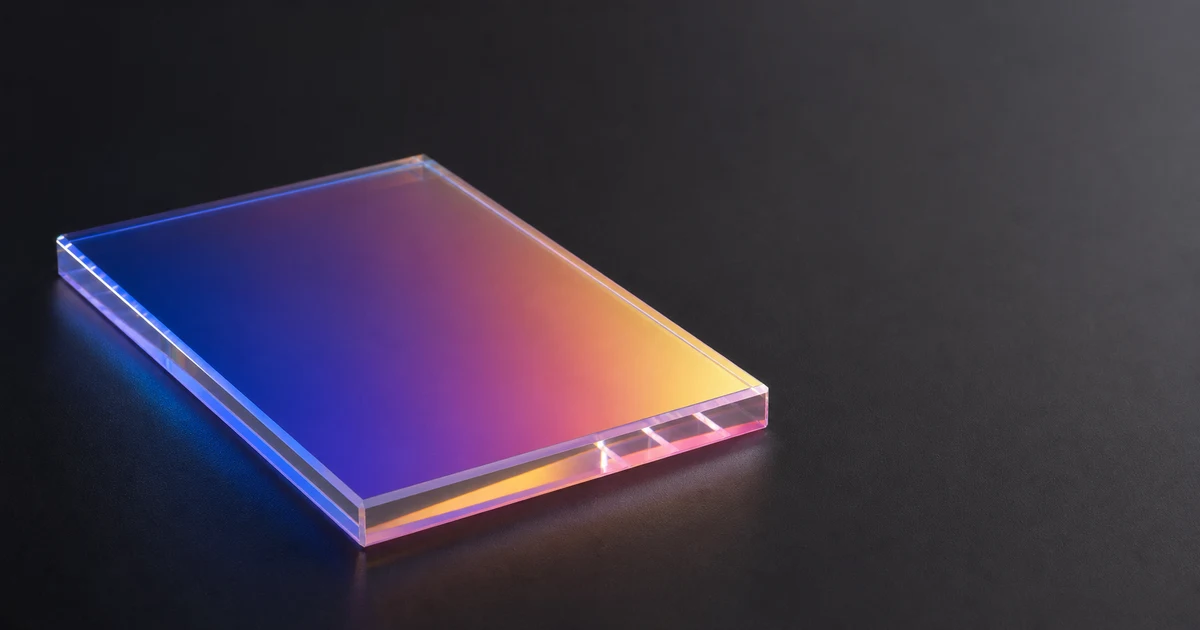
Iridescent. Thin-film optical interference produces color-shift reflection. Visible effect: rainbow-like color change with viewing angle. Most viewing-angle-sensitive. Best for: rotational-viewing applications.
Metallic. Metal-particle additives (typically aluminum or pearlescent flakes) in the substrate or surface coating produce continuous reflective sheen. Visible effect: like brushed metal, with consistent appearance across viewing angles. Best for: consistent brand-statement surfaces under any lighting.
Pearlescent. Mica particles in the substrate produce soft pearl-like luster. Subtle color shift much less aggressive than iridescent. Best for: refined high-end applications where iridescent would be too dramatic.
Dichroic. Multi-layer optical coatings produce hard angle-dependent color transitions. Visible effect: rainbow stripes that shift between color zones rather than continuously. Best for: dramatic feature applications where the hard color transitions are the design intent.
The four are not interchangeable. A brand whose concept render shows iridescent will look meaningfully different in metallic, pearlescent, or dichroic. We typically send substrate samples in all 4 finishes during the early-stage design conversation so the brand team can see the actual optical behavior.
Metallic, pearlescent and two-tone: production specs
Metallic and pearlescent acrylic are pigment finishes, so their risks are cost and color drift rather than viewing angle. The table compares the formats we run for premium displays, awards and branded boxes.
| Finish | Cost premium | Pantone behavior | Volume before re-cast or drift | Typical lead time |
|---|---|---|---|---|
| Metallic gold, solid-cast | 35–60% over plain colored | Tight at pilot; can drift past the visible line between 100 and 1,000 units without per-batch QC | about 2,000 units | 22–28 days |
| Metallic, printed on clear | 15–25% over plain colored | Tighter batch to batch (pre-dispersed ink); edge shows clear PMMA | n/a | Standard |
| Pearlescent, solid-cast | 40–70% over plain colored | Highest batch-to-batch variance; needs a master swatch per batch | about 1,500 units | 25–32 days |
| Two-tone, bonded | 25–45% over base sheet | Each color holds its own Pantone; stays under the visible line at 1,000+ units | 5,000+ units | 18–24 days |
| Two-tone, solid-cast | 50–80% over plain colored | Drifts with each batch as the two pigments interact | about 800 units | 28–35 days |
Solid-cast metallic carries the sheen through to the cut edge and survives flame polishing and thermoforming. Printed metallic is a 50–150 µm ink layer that cannot be flame polished or formed above 80°C, so visible edges need mechanical polishing or a frame. Pearlescent is the hardest to keep consistent because its mica platelets work by interference, like iridescent, and small changes in platelet orientation shift the hue, usually toward yellow-green. The metallic gold printed box program shows the printed route on a multi-SKU order.
Pantone tolerance at 100 vs 1,000 units
A 100-piece pilot almost always hits the target color because it comes from one pigment lot, one cast cell and one cure cycle. A 1,000-piece reorder months later uses a fresh lot and a new cycle, and that is where metallic and pearlescent programs drift. Color difference is measured as delta-E per ASTM D2244;1 below about 1 is invisible, and from roughly 2.5 to 3 buyers see the change side by side.2 A run that reads spot-on at 100 pieces can pass that line on the reorder.
The fix is procedural, not a better pigment: pull a master swatch per batch, check each batch with a spectrometer against the buyer-approved sample, and write the delta-E tolerance on the PO. That QC usually adds a single-digit percentage to the finish premium. We run it by default on metallic gold, pearlescent and bonded two-tone work.
Cost spread: where the finish pays off
A specialty finish earns its premium only on surfaces shoppers see. Split each part into three zones: the primary visual surface (front face, top crown), usually 20–30% of the area, gets the finish; secondary surfaces, another 20–30%, depend on viewing geometry; structural and hidden parts, 40–50%, stay in plain colored or clear acrylic. Plain colored PMMA costs about 30–40% of solid-cast metallic and looks the same on a backer or bracket. Zoning a display this way delivers the same shelf look at roughly 50–65% of the all-metallic cost. The base finish under the pigment is its own decision; the clear vs frosted vs colored acrylic guide covers it, including mirror.
Viewing-angle math — why iridescent under-performs at head-on retail
The iridescent effect depends on viewing angle relative to light source. At head-on viewing under overhead lighting (most retail-floor configurations), the angle relationship produces minimal dichroic shift. Three viewing scenarios:
Head-on under overhead lighting (typical retail floor). Viewer angle perpendicular to surface; light source angle near-perpendicular. Dichroic shift: minimal. The iridescent surface reads similar to ordinary acrylic with slight reflection.
Off-axis under directional lighting (architectural feature with spot lighting). Viewer angle 30-60° from surface normal; light source angle 30-60° from opposite side. Dichroic shift: strong, with visible rainbow color transitions across the surface. This is the design intent for iridescent.
Rotational viewing under any lighting (lobby wall as viewer walks past). Viewer angle continuously changing from acute to perpendicular to obtuse. Dichroic shift: continuous, producing a “moving rainbow” effect as the viewer moves. This is the design intent for many iridescent feature walls.
For brand designers spec’ing iridescent, the critical question is the viewing context. If viewers will see the surface mostly head-on under flat lighting, the iridescent investment doesn’t pay back. If viewers will engage with the surface from changing angles or under directional lighting, iridescent delivers the design intent.
Lighting + finish — diffused soft vs spotlight
Lighting type interacts with finish choice. Two common configurations:
Diffused soft ambient (museum, hospitality). Light comes from broad sources at multiple angles. Iridescent dichroic shift is muted because the multi-angle light sources average out the angle-dependent reflection. Pearlescent and metallic finishes work well in diffused ambient because their effects don’t depend on angle relationships.
Spot lighting (luxury retail, gallery feature). Light comes from concentrated sources at specific angles. Iridescent dichroic shift is dramatic and visible. Spot-lit configuration is what produces the marketing-render effect that brand teams typically want from iridescent.
Flat overhead (mass retail, supermarket). Light comes from continuous overhead source. Iridescent dichroic shift is essentially absent. Metallic finish reads as clean reflective surface; pearlescent reads as soft sheen; iridescent reads as ordinary acrylic.
The implication for design briefs: spec the lighting environment alongside the finish. A “iridescent display under standard retail lighting” almost always under-delivers. A “iridescent feature wall under designed directional lighting” almost always works.
Substrate construction — bulk-iridescent cast vs surface-coated panels
Iridescent acrylic comes in two construction types and the choice matters for both cost and durability.
Bulk-iridescent cast PMMA. The thin-film interference layer is integrated into the cast polymer matrix during sheet manufacture3. The iridescent effect is present throughout the substrate, not only on the surface. Pros: edge cuts on this material reveal the iridescent effect at the cut edge as well as the face — useful for laser-cut signage and edge-lit applications. Surface scratches buff out without disturbing the iridescent finish because the next layer down is the same material. Cons: cost premium ~3-4× over standard clear cast at typical retail sheet sizes (1220 × 2440 mm). Lead time runs 14-21 days for sheet supply rather than 3-5 days for standard cast.
Surface-coated iridescent panels. A thin-film optical coating is applied to a standard cast PMMA substrate after the substrate is manufactured. The iridescent effect is on one face of the panel only. Pros: cost premium ~50-80% over standard cast (much lower than bulk-iridescent). Lead time matches standard cast sheet supply. Substrate behaves like standard cast on the uncoated face — easy to bond, drill, and finish. Cons: the coating is thin and operationally fragile. Surface scratches reveal the underlying clear substrate, which reads as a defect. Cleaning requires soft-cloth-only — abrasive contact damages the coating. Cut edges show plain clear cast, not iridescent, which limits laser-cut and edge-lit applications.
For lobby walls and architectural feature applications where the surface is touch-protected and edge cuts don’t need to read iridescent, surface-coated is usually the right call on cost grounds. For laser-cut signage, edge-lit display, or any context where the cut edge or scratches will be visible, bulk-iridescent is the right call despite the premium.
I generally recommend surface-coated for projects above 50 sqm of finished surface and bulk-iridescent for projects below 20 sqm where the cost premium is absorbed in lower piece counts. Between 20-50 sqm the call depends on the specific application — laser cutting and edge-lit applications push toward bulk; touch-protected feature walls push toward surface-coated.
Edge finish — diamond polished vs flame polished impact on iridescent edge glow
For iridescent acrylic specifically, edge finish affects the edge-glow effect that contributes to the visual statement.
Diamond-polished edges on iridescent. Optical-grade edge that catches light cleanly. The iridescent surface’s edge glow reads premium, with visible dichroic shift at the edge as well as the face. Production-grade default for any iridescent feature application.
Flame-polished edges on iridescent. Faster than diamond polishing but introduces thermal stress at the cut surface. On iridescent substrate, the thermal stress can produce visible micro-pattern variation at the edge that disrupts the iridescent surface continuity. The edge reads as inconsistent and reduces the perceived quality of the iridescent surface.
Saw-cut edges on iridescent. Visible saw marks scatter light irregularly at the edge. On iridescent substrate, the saw-mark scatter produces visible glare and edge-light leak that reads as a finishing defect. Saw-cut edges are not acceptable for iridescent feature applications.
For iridescent feature work, diamond-polished edges are non-negotiable. The cost premium (~$0.50-$0.80 per linear meter) is small relative to the iridescent substrate premium and protects the surface’s overall optical quality.
Lifespan, maintenance, and what fades
Iridescent finishes are not maintenance-free — and the maintenance differs between bulk-iridescent and surface-coated construction.
Bulk-iridescent cast PMMA. The iridescent effect is stable across 8-10 years of typical indoor display conditions because the thin-film interference layer is embedded in the polymer matrix and protected from atmospheric contact. The substrate itself yellows like any PMMA — about 1.5-2.5% reduction in luminous transmittance over 10 years per ASTM D1003 testing on standard cast.4 On bulk-iridescent the yellowing is essentially invisible because the iridescent shift dominates the visual impression. Maintenance is identical to standard cast: standard PMMA cleaner (no ammonia, no abrasive), microfiber cloth, monthly cleaning cycle for retail surfaces and quarterly for architectural surfaces.
Surface-coated iridescent panels. The optical coating is the lifespan-limiting layer. Typical performance: 3-5 years before the iridescent effect begins to soften under sustained UV exposure or repeated cleaning contact. After that point the coating remains visually iridescent but the dichroic shift becomes muted relative to fresh surface. For surfaces protected from direct UV (interior lobby, away from skylights or south-facing windows) the coating can hold its initial intensity for 5-7 years. For sun-exposed surfaces the rate of intensity decay is roughly 2× faster.
Fingerprint and contact damage. Iridescent surfaces show fingerprints more aggressively than plain acrylic because the oils on skin disturb the thin-film interference layer’s optical clarity. On surface-coated panels, repeated fingerprint contact at the same spot accelerates coating wear at that location and produces visible “wear shadows” within 12-18 months. For high-touch applications, plan on weekly or daily cleaning cycles rather than monthly — or shift to a finish that’s less touch-sensitive (pearlescent, brushed metallic).
For brand teams budgeting iridescent projects across multi-year programs, the maintenance and lifespan profile should be part of the brief — a 5-year program on surface-coated panels at an exposed location will need a refurbishment line item at year 4 that an equivalent metallic or pearlescent program wouldn’t require. Bulk-iridescent for permanent installations; surface-coated for shorter-cycle (3-5 year) brand programs where the coating life matches the program horizon.
When NOT to spec iridescent — high-touch, dim lounge, multi-color brand
Three contexts where iridescent under-performs and an alternate finish is the right call.
High-touch retail (jewelry counter, boutique cases). Daily fingerprint contact leaves visible residue that reads as smudging more aggressively than on plain acrylic. Iridescent finishes are also harder to clean without disturbing the optical coating. For high-touch surfaces, choose pearlescent or metallic — both have less surface sensitivity to fingerprint contact.
Dim lounge or hospitality lighting. Iridescent needs light to produce the dichroic effect. In dim lounge environments (200-400 lux ambient), there isn’t enough light to drive the effect. The iridescent surface reads as ordinary acrylic in dim conditions. For lounge or hospitality applications, choose pearlescent (soft luster works in dim light) or metallic (reflective sheen visible in any lighting).
Multi-color brand context. Iridescent’s dichroic shift competes with brand-specific colors rather than supporting them. A brand whose visual identity uses specific brand colors (sage green, navy, deep red) gets visual interference from the iridescent rainbow shift that distracts from the brand color story. For multi-color brand contexts, choose metallic or pearlescent (both add specialty finish without competing with brand colors).
For brand creative directors and retail VM designers considering iridescent, send the brief over to our team. We can prepare samples in specified iridescent, metallic, pearlescent, or dichroic finishes for review under buyer-defined lighting. For finished pieces in these finishes, see the acrylic displays product hub and the indie beauty pearlescent lipstick wall display project. In that project the buyer approves the named substrate, finish sample, artwork, drawing, and packing before production. Supplier documentation for the base PMMA remains part of the material approval.
Footnotes
-
ASTM D2244 — Standard Practice for Calculation of Color Tolerances and Color Differences from Instrumentally Measured Color Coordinates — the standard practice that formalizes the delta-E color-difference calculation used to quantify batch-to-batch variance on pigmented plastics. ↩
-
What is Delta E? — Konica Minolta Sensing color-measurement guidance — color-measurement guidance on the perceptual delta-E scale (ΔE below 1 imperceptible, ΔE of 3 or more clearly visible). ↩
-
Evonik PLEXIGLAS technical information — PMMA manufacturer technical reference for cast acrylic sheet production, including specialty substrate construction where thin-film interference layers are integrated during the casting process. ↩
-
Acrylic luminous transmittance per ASTM D1003 — Plaskolite OPTIX datasheet — manufacturer datasheet listing OPTIX acrylic total light transmission at 92% (Light Transmission – Total, ASTM D1003), the luminous-transmittance baseline against which standard cast PMMA’s gradual reduction over its service life is measured. ↩
Frequently Asked Questions
What's the difference between iridescent / metallic / pearlescent / dichroic acrylic?
Iridescent uses thin-film interference to produce color-shift reflection (rainbow-like color change with viewing angle). Metallic uses metal-particle additives in the substrate or surface coating to produce a continuous reflective sheen (no angle-dependent color shift). Pearlescent uses mica or similar particles to produce a soft pearl-like luster (subtle color shift, much less aggressive than iridescent). Dichroic uses multi-layer optical coatings to produce hard angle-dependent color transitions (rainbow stripes vs continuous shift). Each finish has a different optical signature — they're not interchangeable substitutes.
Why does iridescent under-perform in some retail contexts?
The iridescent effect requires light interaction at specific viewing-vs-light angles to produce the dichroic shift. At typical retail-floor head-on viewing distance under flat overhead fluorescent or LED lighting, the angle relationship is essentially perpendicular — which produces minimal dichroic shift. The iridescent surface reads similar to ordinary acrylic. To produce the dichroic moment, the viewer needs to move their head relative to the surface (rotational viewing) or the lighting needs to be directional rather than overhead-flat.
When does iridescent actually deliver brand value?
Three retail / display contexts. (1) Brand-statement architectural elements where the viewer naturally moves past the surface (lobby walls, reception backdrops, premium feature columns) — the rotational viewing produces the dichroic moment as the viewer approaches and passes. (2) Premium feature walls under directional designed lighting where spot-light angles are calibrated to produce the dichroic shift at the intended viewing positions. (3) Luxury-positioned product display where the viewer is invited to rotate around the displayed product — the dichroic shift becomes part of the engagement experience.
What goes wrong with iridescent under high-touch retail conditions?
Iridescent finishes are typically thin-film coatings on the substrate's surface. Daily fingerprint contact (typical of high-touch retail surfaces like jewelry-counter glass or boutique cases) leaves visible residue that reads as smudging more aggressively than on plain acrylic. The iridescent surface is also typically harder to clean without disturbing the coating's optical properties. For high-touch retail surfaces, iridescent is operationally fragile.
Do you sell iridescent acrylic sheet?
Not as stock sheet. We cut iridescent, metallic and pearlescent acrylic to your sizes or fabricate it into finished displays, boxes, trays and signage, made to order from 100 pieces per design. Send the sizes or drawing, quantity and lighting condition, and we quote with a paid finish sample; the sample fee is billed separately and is not credited to production.
How much more do metallic and pearlescent acrylic cost than plain colored?
Solid-cast metallic gold runs about 35–60% more per square meter than plain colored cast acrylic, pearlescent cast about 40–70% more, and bonded two-tone adds 25–45% to the base sheet. Printed metallic on clear stock is the lowest premium at 15–25% but cannot be flame polished or thermoformed. Put the finish only on the surfaces shoppers see; plain colored acrylic on hidden parts looks the same and costs less.
Can metallic or pearlescent acrylic hold a Pantone match at 1,000 units?
Yes, with per-batch QC. A 100-piece pilot comes from one pigment lot and one cure cycle, so it usually lands on target. A 1,000-piece reorder uses a fresh lot and a new cycle and can drift past about delta-E 2.5, the point where buyers see the difference side by side. Holding register needs a master swatch pulled per batch, spectrometer checks against the approved sample and a written delta-E tolerance on the PO.
Considering iridescent acrylic for a brand-statement display?
Send the design intent, buyer-defined lighting information, viewing-angle requirement, quantity per design and packing brief. We will reply with production-material sample options and a project-specific quote. The buyer approves the finish under the intended venue lighting; Wetop does not predict brand performance.