



Acrylic Lead Time: Inside a 15-20 Day Run
The 15-20 days on your quote is not a queue you wait in — it is nine overlapping production phases.
Need this made?Custom acrylic fabrication services →
Knowing what happens on which day is how you plan a launch around it.
Key Takeaways
- A 15-20 day acrylic lead time starts when two gates close — deposit received and final artwork approved — and ends when goods are packed at the factory. Shipping is on top, not inside.
- The run is nine overlapping phases, not a queue: scheduling and sheet procurement, cutting, machining, polishing and annealing, printing, bonding, 100% QC, and packing all hand off in a flow.
- The most common day-adders are custom Pantone color matching (about +5 days and a $200-300 one-time charge per color), complex multi-part assembly, custom retail packaging, and artwork revisions after approval.
- Rush means queue priority, not skipped steps: machines re-sequence around your order, but annealing hours, adhesive cure, and piece-by-piece inspection stay — which is why honest rush gains are days, not weeks.
- Plan backward from the in-hand date: ocean freight commonly adds 4-5 weeks door to door versus roughly a week by air, so a fixed launch date sets your order date more than the production run does.
On this page
- What a 15-20 day acrylic lead time actually covers
- The 3-5 days before the clock starts: samples
- Day by day: where the time actually goes
- What adds days — and what it costs
- What “rush” really means
- Counting backward from your deadline
- Keeping your order on schedule
- Frequently asked: order status on multi-variant runs
What a 15-20 day acrylic lead time actually covers
Walk our floor on day 6 of your order and nothing about it says “waiting”: your panels came off the CNC bed this morning, half the batch is queued at the polishing line, and the UV printer two stations down is running someone else’s day-12. A 15-20 day acrylic lead time is that flow — nine overlapping phases between deposit and packed cartons, with shipping on top.
That definition carries three boundaries worth fixing before any calendar math. First, the clock starts when two gates close: your deposit is received and your final artwork or approved sample is signed off. A purchase order alone starts commercial review, not production — a distinction that surprises buyers every season. Second, the 3-5 day sample stage sits before the window, not inside it. Third, the clock stops at the factory door: goods packed and ready under our default FOB Shenzhen term, with ocean or air transit added on top.
The schedule conversations that go wrong are almost never about the 15-20 days themselves — they are about what a buyer assumed was inside that number, a pattern running production lines since 2014 has not once broken. So this guide opens the box: what happens on which day, what genuinely adds time, what “rush” can and cannot do, and how to count backward from a launch date so the acrylic lead time lands where your calendar needs it. If your driving question is deadline strategy for one specific event, our production process page lists the gates to plan around; this guide is the process underneath it.
The 3-5 days before the clock starts: samples
The sample stage runs 3-5 days and sits before the acrylic lead time, not inside it. We cut, finish, and ship one real piece of your design; you approve it or mark it up; and only after sign-off — plus deposit — does the 15-20 day bulk clock start. Skipping this stage saves less time than it appears to and removes the only physical checkpoint in the order.
Mechanically, a sample is a miniature production run. My operators cut it on the same CNC beds, polish it on the same line, and print it with the same files the bulk run will use — which is exactly why it predicts the bulk result so well, and why our QC team later inspects every production piece against it. When we quote 3-5 days, that is fabrication time; add courier transit to your desk, typically 3-5 more days internationally.
Two planning notes from the production side. First, the stage most buyers underestimate is not our 3-5 days — it is their own approval loop. A sample that sits a week in someone’s inbox adds a silent week to the project that no factory can recover. When I plan a tight program backward, I book the buyer’s review window into the calendar as its own phase, because that is what it is. Second, on repeat orders and simple spec changes, a photo-and-measurement approval of the retained golden sample can replace a fresh courier round trip — we keep approved samples on file for reorders, and that shortcut alone can pull a week out of a repeat program’s calendar.
The sample fee is paid separately and is not credited against the production order; your quote states the amount. What matters for the timeline is the sequence: sample days, your review days, then deposit and artwork lock, then — and only then — day zero.
Day by day: where the time actually goes
Inside a standard acrylic lead time, no single phase takes 15 days — the calendar is consumed by eight production phases handing off in an overlapping flow, plus the day-zero gates. Cutting starts before scheduling fully clears, printing starts while polishing finishes, and QC begins on the first assembled pieces while the last are still bonding.
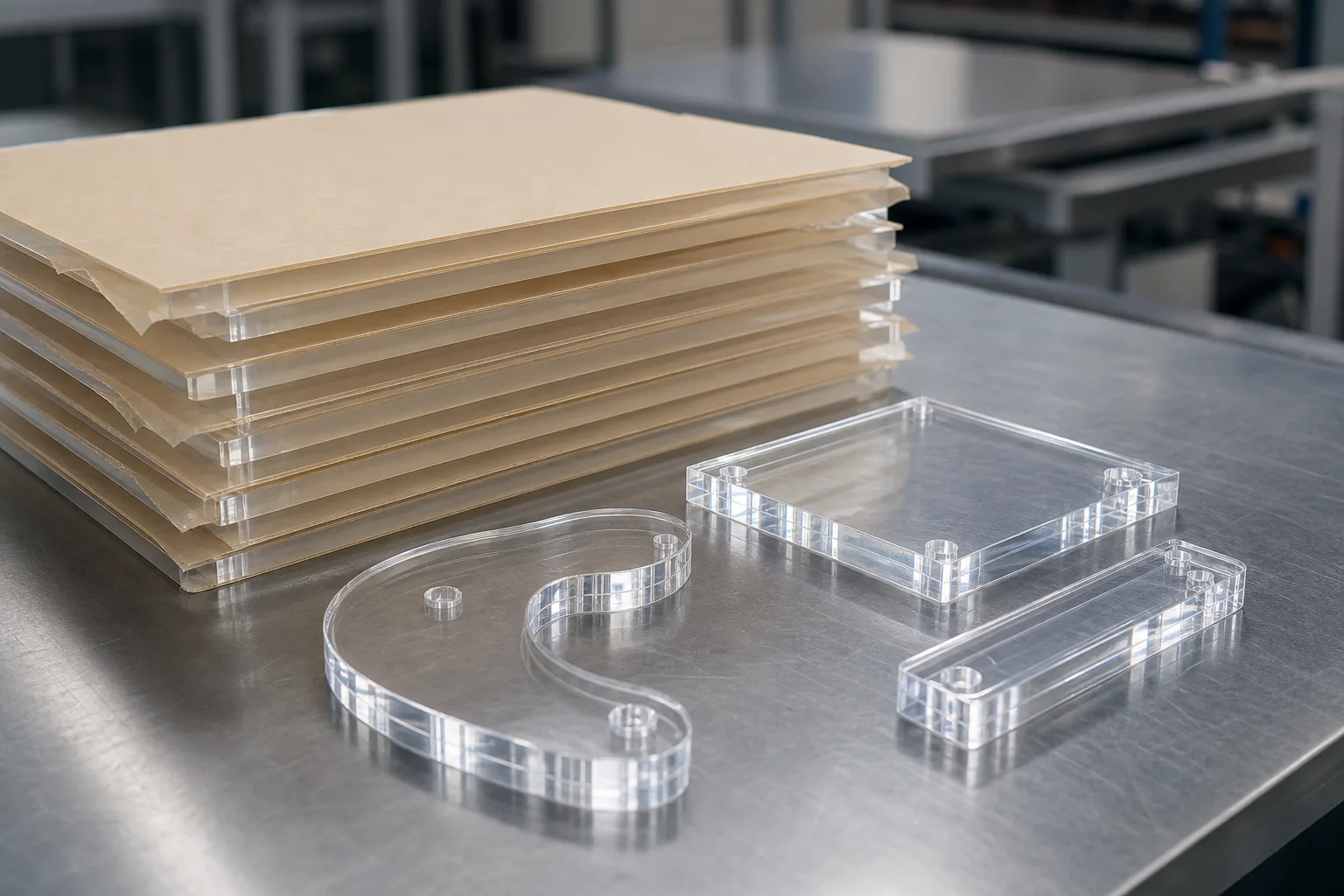
Phase by phase, here is what your order is doing. Days 0-1, gates: deposit confirmed, final files locked, cutting programs written. Days 1-3, scheduling and material: your job slots into the line plan and cast sheet is pulled or purchased — display-grade cast acrylic specified against the ASTM D4802 sheet standard.1 Days 3-6, cutting: laser for profiles and thin gauges, CNC for thick stock and precision work. Days 5-8, machining: holes, slots, hinge recesses, magnet pockets, engraving. Days 7-11, polishing and annealing: diamond or flame polishing brings edges to gloss, then machined parts anneal — hours in an oven around 80 C to relieve internal stress before any adhesive touches them. Days 10-14, printing: UV or silk-screen graphics. Days 12-16, bonding and assembly: panels become boxes, stands, and fixtures in jigs. Days 15-18, QC: piece-by-piece inspection against your approved sample — the 100% check our ISO 9001 process requires. Days 17-20, packing.
Where your order lands inside 15-20 depends on which phases it uses. A batch of plain polished acrylic display stands skips printing and heavy assembly and compresses toward day 15; printed, multi-part acrylic boxes with custom packaging use the full run.
For a practical example of a repeat program moving through controlled production stages, see the automotive showroom countertop display case study.
What adds days — and what it costs
Four order features account for most acrylic lead time extensions: custom color matching, complex assembly, custom retail packaging, and post-approval artwork changes. None of them are surprises when they are on the quote — all of them are surprises when they arrive mid-run.
| Day-adder | Typical impact | Why |
|---|---|---|
| Custom Pantone color match | About +5 days; $200-300 one-time per color | Pigment batch is mixed, cast, and approved before cutting can start |
| Complex multi-part assembly | +2-5 days | More bonding stages, each with jig time and cure time |
| Custom printed retail packaging | +3-7 days (runs partly in parallel) | Box printing and fitting runs alongside, but final pack waits for it |
| Artwork revision after approval | Resets affected phases | A changed file can send parts back to the cutting stage |
| Chinese New Year window | About 2 weeks of factory pause | National holiday shutdown each winter; book January orders early |
The one I flag loudest on quotes is color. A stock clear, frosted, or standard-color sheet is on the rack on day 1. A custom Pantone match is a chemistry project first: the pigment loading is formulated, a plaque is cast, you approve it, and only then does production sheet exist to cut — about five days and a $200-300 one-time charge per color, which then sits in your file for every reorder. The full color-matching workflow, and how it connects to finishes, printing, and the rest of the spec, lives on our custom acrylic fabrication page.
The quiet one is revisions. When a “why is my order late” email lands, the file history usually holds the answer — more often than not there is a revised logo or a dimension change dated day 6. A revision is not a moral failing; it just re-runs physics. Parts already cut to the old drawing are scrap, programs get rewritten, and the affected phases restart. Locking artwork before the deposit gate is the simplest schedule protection available to a buyer.
What “rush” really means
A rush acrylic order gets queue priority, not skipped steps. Your job jumps to the front of each station’s sequence, idle-shift capacity gets assigned to it, and phases overlap as aggressively as the parts allow. What never compresses: annealing hours, adhesive cure time, and piece-by-piece inspection. That is why honest rush gains are measured in days.
It helps to see the two levers separately. Sequencing is ours: on any given week the cutting beds, polishing line, and printer have a queue, and rush re-orders that queue — this is how a standard run compresses toward its floor. Physics is not ours: annealing that needs hours gets hours, a solvent bond that needs cure time before handling gets it, and my operators do not hand a rushed corner to QC any differently than a standard one. A supplier promising to halve a production run without touching quantity or spec is telling you which corner they plan to cut; the usual candidates are the annealing oven and the inspection bench, and both send their bill later.
What rush can change, with every control intact, is the sequence around the standard process. A buyer can approve the 3–5-day paid sample promptly, lock artwork before the 15–20-day production window begins, choose stock material, and use air or split freight after production. The exact dates still belong in the quote; “rush” is not permission to advertise a shorter universal sample-to-bulk promise.
Two more tools belong in the rush conversation. Standard colors and stock finishes keep the +5-day color gate out of your run entirely. And when the deadline is really a first-delivery deadline, splitting the shipment — an air-freight tranche for launch, the balance by sea — often beats compressing production; who books and pays for each freight leg is in our FOB vs DDP guide.
Counting backward from your deadline
Backward planning turns an acrylic lead time into an order date: start at the day you need goods in hand, subtract transit, subtract the production run, subtract sampling and approval, and add buffer at each seam. The production window is usually the smallest number in that chain — freight is the biggest.
Under our default FOB Shenzhen term, we hand your cargo to the carrier at the port and transit becomes your side of the ledger — that split of cost and risk is exactly what the Incoterms rule defines.2 From South China, ocean transit to most US and EU destinations commonly lands door to door in 4-5 weeks once port handling and inland legs are counted, while air freight does it in roughly a week at several times the rate — and ocean pricing itself moves week to week with the market, which is why we quote freight near booking rather than months ahead.3
Here is the chain for a concrete case — a retail program that must be in stores October 15, shipping by sea: customs and inland buffer puts arrival at your warehouse around September 30; 4-5 weeks of ocean transit puts ex-factory at late August; a 15-20 day production run puts the deposit-and-artwork gate in early August; samples (3-5 days) plus your internal approval loop puts the RFQ in mid-July. Three months door to door, of which production is barely three weeks.
The failure pattern I see every autumn is the mirror image: a buyer works forward from “production is only three weeks,” orders in early September, and discovers that no legal amount of production speed recovers five weeks of ocean transit. When the calendar is genuinely short, say so in the first email — the honest answers are air freight, a split shipment, or a scope trim, and all three cost less the earlier they are chosen.
Keeping your order on schedule
Most schedule slip on custom acrylic orders happens at the buyer-supplier handoffs, not on the factory floor — so the highest-leverage protections are yours. Lock artwork before paying the deposit, answer proofs within a day, choose stock colors when the calendar is tight, and name your true in-hand date on the RFQ.
Here is the handoff map. Each of these gates belongs to you, costs nothing to close early, and adds real days when it stays open:
| Buyer-side gate | When it bites | Days at stake |
|---|---|---|
| Final artwork files (vector, outlined fonts) | Before deposit — day zero cannot start without them | 1-10 |
| Sample review and sign-off | Between sample delivery and bulk start | 2-7 |
| Digital proof approval | Before cutting programs are released | 1-3 |
| Deposit transfer | Day zero gate; balance gates shipment later | 1-4 |
| Color decision (stock vs Pantone match) | Before sheet procurement | About 5 |
| Shipping method and destination confirmed | Before packing — cartons are built to the freight mode | 1-3 |
Payment mechanics matter more than buyers expect, because money is a gate on both ends: our standard terms are a 30% deposit before production and the balance before shipment. A deposit that clears Monday instead of Friday starts the run four days sooner — same factory, same acrylic lead time, different calendar. I have watched far more launch dates rescued by fast approvals than by fast machines. On reorders the picture is friendlier still: files, programs, and any color formula are already on record, and since parts are CNC-cut with no tooling fee on most designs there is no mold to re-verify — repeat runs typically land in the lower half of the 15-20 day window. (How deposits, balances, and payment methods work is covered in our ordering and payment FAQ.)
If you are planning a launch now, the useful first message is short: what the product is, quantity, your in-hand date, and whether artwork is final. We respond within 24 hours with the real chain — sample days, production window, the freight options that fit your date — the same planning we have run on 2,000+ custom projects across 25+ countries. Send us your timeline, and we will tell you honestly whether it fits, and what changes if it does not.
Frequently asked: order status on multi-variant runs
Orders with several designs, sizes, or artwork versions generate their own status questions, because each variant moves through the phases above on its own feet. Here is how status and ready dates work on those runs.
How do I know production has actually started?
The unambiguous signal is the gate confirmation: when your deposit clears and final artwork locks, we confirm day zero and the scheduled run window in writing. From there the useful milestones are cutting start, printing if your order has it, assembly, and the 100% QC pass — and on complex programs we send bench photos at the stages worth seeing. If you are ever unsure, ask for the current phase rather than a ship date; “your panels are at polishing” tells you more than a date restated.
Do multiple variants share one ready date?
No — each variant runs its own gates. A printing file still open on variant C does not stop variants A and B from cutting, and we confirm ready dates per line item rather than quoting one date for the whole PO. When one variant falls behind — a late artwork revision, a packaging dependency — the practical options are shipping the finished variants first or holding everything for one consolidated shipment; both are your call, and the freight difference is quoted before you make it.
What updates should I expect on a complex order with moving parts?
Milestone updates at each phase handoff, plus an immediate flag the moment any dependency — packaging, a mating component, an open spec — threatens the schedule, with the recovery options in the same message. What you should never get is silent recalculation: if the ready date moves, you hear it from us with the reason, not from a missed deadline. Orders that include wood, metal, or printed-packaging components from partner shops have those dependencies scheduled as their own line, because they are the usual source of the moving parts.
My customer has a fixed deadline — which date do I plan against?
Plan against the arrival date, not the ex-factory date, and make sure every quote you compare separates the two. A prototype or first-articles run has its own earlier ETA, so if your customer needs proof of progress before the bulk lands, we can schedule a mid-run inspection or photo sign-off instead of making the deadline wait for finished goods. Give us the real in-hand date and the run is planned backward from it, exactly as the backward-planning section above walks through.
Footnotes
-
ASTM D4802 — Standard Specification for Poly(Methyl Methacrylate) Acrylic Plastic Sheet — the specification cast acrylic sheet is purchased against, cited at the material-procurement phase of the production timeline. ↩
-
Incoterms rules — International Chamber of Commerce — the ICC framework defining FOB and the other trade terms, cited for where seller responsibility ends and buyer-side transit begins under FOB Shenzhen. ↩
-
Freightos Baltic Index (FBX) — global container freight index — live ocean container rate index showing week-to-week freight market movement, cited for why freight is quoted near booking rather than months in advance. ↩
Frequently Asked Questions
How long does bulk production take after the sample is approved?
The standard acrylic production run is 15-20 days, and the clock starts when the deposit is in and the final artwork or sample is signed off — not when the PO is sent. The 3-5 day sample stage sits before this window, and shipping sits after it. Sea freight resets the planning math: allow 4-5 weeks of transit on top of production.
What is the current lead time on repeat acrylic orders?
Repeat orders run the same 15-20 day standard but usually land in the lower half of it, because the gates that consume calendar early — artwork approval, proofing, color matching — are already done and your cutting programs are on file. Since parts are CNC-cut rather than molded, there is no tooling to re-verify either. Confirm quantity and any spec changes, and the run schedules immediately.
Can you rush a custom acrylic order?
A rush request can change queue priority, freight method, or the scope of the first shipment, but it does not replace the registered timeline: a paid pre-production sample normally takes 3–5 days, production takes 15–20 days after approval and deposit, and transport is added separately. Tell us the real in-hand date so we can quote the feasible sequence in writing.
What adds time to a standard acrylic lead time?
Four things cause most extensions: custom Pantone color matching (about +5 days and a $200-300 one-time charge per color), complex multi-part assembly, custom printed retail packaging, and artwork revisions after approval — a revised file can send parts back to the cutting stage. Factory holidays matter too: Chinese New Year pauses production for about two weeks each winter, so January orders need buffer.
Does the 15-20 day lead time include shipping?
No. Production lead time ends when goods are packed and ready at the factory — our default term is FOB Shenzhen, where we hand cargo to your carrier at the port. Ocean transit to most US and EU destinations commonly adds 4-5 weeks door to door; air freight cuts that to roughly a week at a higher rate. Landed-date planning is production plus transit plus a customs buffer.
Explore Custom Acrylic Products
Browse product categories to compare formats, materials, and customization options before choosing the closest fit for your project.