
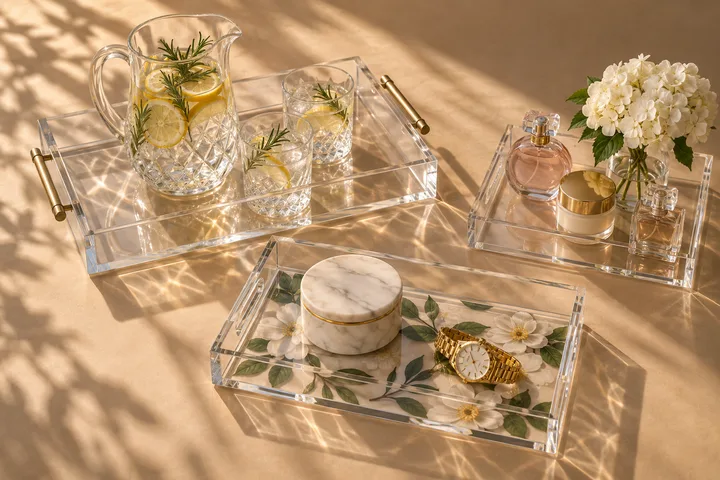
Plexiglass vs Acrylic: PMMA Names Explained
Buyers who ask for plexiglass and buyers who ask for acrylic get quoted the same sheet.
Need this made?Custom acrylic fabrication services →
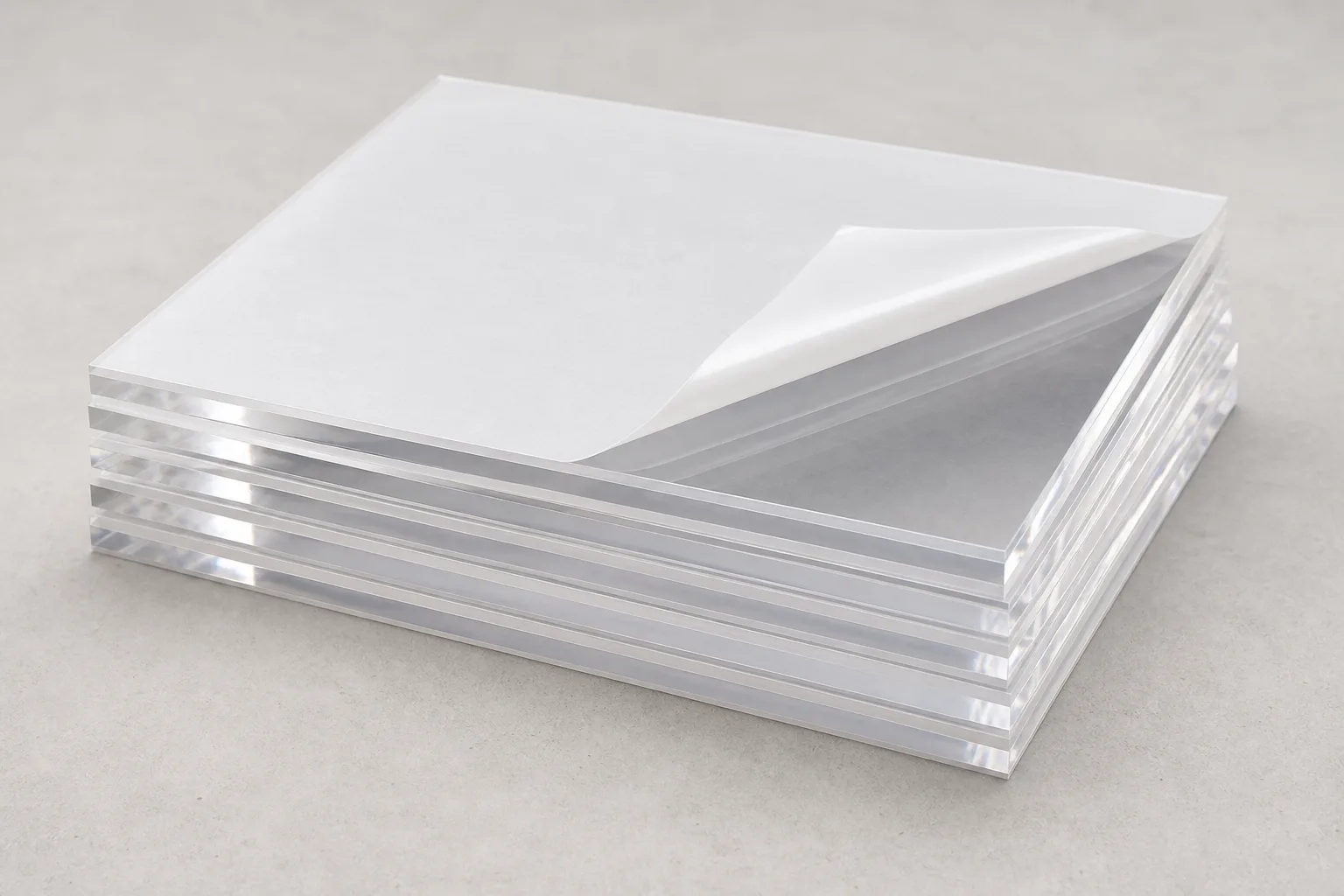
Here's why the words differ, and the one line your spec actually needs.
Key Takeaways
- Plexiglass vs acrylic is a naming question, not a materials question: acrylic is the material — poly(methyl methacrylate), or PMMA — and Plexiglas is a brand name for it, introduced by Rohm & Haas in 1933.
- Perspex (ICI, UK), Lucite (DuPont, US), and Acrylite are other brand names for the same PMMA. Lowercase 'plexiglass' with two s's has become the generic American word for any acrylic sheet.
- The word on an RFQ does not change the quote. What moves price is cast vs extruded sheet, thickness, grade (UV-stabilized, impact-modified), and quantity — not which trade name the buyer typed.
- The one line a spec actually needs: material (cast or extruded acrylic / PMMA), thickness with tolerance, and the governing standard — cast sheet is specified under ASTM D4802, no brand name required.
- Name a specific brand only for a documented reason: color continuity across reorders against a branded swatch, or compliance paperwork that cites a particular manufacturer's datasheet.
On this page
- Is Plexiglass the Same as Acrylic?
- One material, five names: where each word came from
- Plexiglas vs plexiglass: the one-letter difference
- A quick regional dictionary for global buyers
- Does the word on your RFQ change the quote?
- What to write in your spec instead of a brand name
- How this plays out in a real order
Is Plexiglass the Same as Acrylic?
Yes. Plexiglass is acrylic. Both words name the same clear plastic, poly(methyl methacrylate), or PMMA. Plexiglas with one s is a brand registered in 1933; plexiglass with two s’s became the everyday American word for any acrylic sheet. A plexiglass sheet and an acrylic sheet of the same grade and thickness are the same material.
So “plexiglass vs acrylic” is a naming question, not a materials question. Plexiglas, Perspex, Lucite and Acrylite are trade names the same polymer picked up over ninety years of being sold by competing companies. Our production lines have cut, bent, polished, and printed sheet arriving under half a dozen different trade names since I started running them in 2014, and the machines cannot tell the difference, because chemically there isn’t one.
The words matter in one place: the spec. A buyer who writes a brand name on a drawing without meaning to require that brand can pay for sheet the project didn’t need, or stall a quote while the factory asks what was meant. What actually changes a price is cast versus extruded sheet, grade, thickness, finish and quantity, which is how our custom acrylic fabrication quotes are built whatever name the inquiry uses. This guide sorts the names out, then shows the one spec line that makes every factory price the same thing.
One material, five names: where each word came from
Every name in the plexiglass vs acrylic tangle is either the material or a brand of it. Acrylic and PMMA describe the polymer itself. Plexiglas (Rohm & Haas, 1933), Perspex (ICI, UK), Lucite (DuPont, US), and Acrylite are trademarks under which different manufacturers sold that polymer — and two of them drifted into everyday English.
The material was first brought to market in 1933 by the German company Rohm & Haas under the trademark Plexiglas.1 At almost the same time, chemists at Imperial Chemical Industries in Britain developed their own PMMA and registered it as Perspex — which is why buyers in the UK, Australia, and much of the Commonwealth still say perspex the way Americans say plexiglass. DuPont followed in the United States with Lucite. Decades later the names are still trading: Rohm continues to manufacture PMMA sheet under the PLEXIGLAS brand in Europe today,2 while Acrylite marks the same company’s sheet in the Americas.
Here is the whole vocabulary in one table:
| Name | What it is | Origin | Where you’ll hear it |
|---|---|---|---|
| Acrylic | The material (common name) | Chemical shorthand for acrylic polymers | Worldwide; the standard word in manufacturing |
| PMMA | The material (technical name) | Poly(methyl methacrylate) | Datasheets, standards, engineering drawings |
| Plexiglas (one s) | Registered brand | Rohm & Haas, Germany, 1933 | Branded European sheet; trademark still active |
| plexiglass (two s’s) | Generic word | American English, from the brand | US buyers, hardware stores, everyday speech |
| Perspex | Brand, now generic in UK English | ICI, United Kingdom, early 1930s | UK, Australia, NZ, South Africa |
| Lucite | Brand | DuPont, United States | US; now often a luxury-goods cue for thick clear acrylic |
| Acrylite | Brand | Americas sister brand of PLEXIGLAS | Branded North American sheet |
| Acrylic glass | Informal descriptor | Popular usage | Descriptions of acrylic as a glass substitute |
One nuance worth keeping: Lucite today carries a premium-goods connotation — think designer trays and furniture — even though the material is still PMMA. If you’re specifying trays and weighing that word, our lucite tray vs acrylic tray guide covers what the label does and doesn’t buy.
Plexiglas vs plexiglass: the one-letter difference
Plexiglas with one s is a registered trademark; plexiglass with two s’s is a generic English word. The trademark names one manufacturer’s PMMA sheet. The generic word means any acrylic sheet from any producer. It is the same drift that turned Aspirin, Escalator, and Thermos from brands into everyday vocabulary.
This matters more than it looks on a purchase order. Write “Plexiglas” on a drawing and a careful fabricator has to ask whether the order requires Rohm’s branded sheet, which can be sourced at a premium and sometimes with a longer material lead time, or whether the drawing just means clear acrylic. Write “plexiglass” in an email and everyone understands you mean the material. Nine out of ten brand names on incoming drawings are habits, not requirements — and I check which one I am looking at before quoting, because confirming a habit takes one email exchange that didn’t need to happen.
The same reading applies in reverse when we send documents out. Our quotes, drawings, and invoices say “cast acrylic” or “PMMA” with a thickness and a finish — never a trade name — precisely so that nothing in the paperwork implies a brand commitment nobody priced for. In running text, capitalize Plexiglas only when you mean the trademark; generic plexiglass stays lowercase.
A quick regional dictionary for global buyers
Where a buyer is from usually predicts which word lands in our inbox. American buyers say plexiglass or acrylic. British, Australian, and South African buyers say perspex. Design-led US buyers sourcing furniture and trays often say lucite. Engineers everywhere write PMMA. All four groups receive the same quote for the same sheet.
We ship to buyers in 25+ countries, so we treat these words as dialect, not specification. A UK retailer asking for “perspex menu holders,” a US brand asking for “plexiglass sign holders,” and a German engineer asking for “PMMA panels, 3mm” are all describing the same production run on our floor. The only vocabulary that changes anything downstream is the material line on the confirmed drawing — which is why we normalize every order to the same wording at quote stage, whatever word arrived in the first email.
There’s one more phrase worth decoding: “acrylic glass.” It appears in product listings because acrylic is the standard shatter-resistant alternative to glass, but it’s a description, not a different material. If the real question behind your search is acrylic against actual glass — weight, impact resistance, clarity — that’s a materials comparison rather than a naming one, and we’ve written it up separately in our plexiglass vs glass displays guide.
Does the word on your RFQ change the quote?
No. Whether an inquiry says plexiglass, acrylic, perspex, or PMMA, we price the same sheet stock — the trade name does not add or subtract a cent. What actually moves an acrylic quote is the sheet itself: cast or extruded, thickness, grade, color, and how much of it your order consumes.
Those variables are worth naming, because they’re where real price differences hide while buyers worry about vocabulary:
- Cast vs extruded sheet. Cast acrylic machines and polishes cleaner and typically costs about 20% more than extruded sheet in comparable sizes.3 For display work we default to cast. The full trade-off is in our cast vs extruded acrylic guide.
- Thickness. Material is the biggest cost driver in most clear fabrication; doubling thickness roughly doubles sheet cost before our cutting even starts. The acrylic thickness chart shows which sizes are stocked.
- Grade. UV-stabilized, impact-modified, anti-static, and optical grades are all still PMMA — same polymer, upgraded formulation, higher sheet price.
- Branded vs generic sheet. Branded sheet (PLEXIGLAS, Acrylite, Perspex) is priced above equivalent generic cast sheet. The polymer is the same; what you’re paying extra for is the manufacturer’s certification trail and name.
The material properties driving all of this — the roughly 92% light transmission,4 the rigidity, the density that makes acrylic about half the weight of glass — belong to PMMA itself and are identical under every name.5 I have never once seen a quote come back higher because the inquiry said “plexiglass” instead of “acrylic”; I have seen quotes come back higher because “Plexiglas” was read as a brand requirement — and you can avoid that with one clean spec line.
What to write in your spec instead of a brand name
A clean acrylic spec names the material, the process, the thickness, and the governing standard: “cast acrylic (PMMA), 3mm ± tolerance, clear, per ASTM D4802.” Finished-part dimensions then follow our working tolerance standard unless the drawing marks a tighter feature. When a spec arrives on my line with a standard instead of a brand, material purchasing starts the same day. That one line prices identically at any competent fabricator, leaves nothing to interpretation, and never triggers a brand-availability delay.
ASTM D4802 is the specification covering PMMA acrylic plastic sheet — it defines the categories and finish requirements that cast sheet is produced against, which is exactly why it belongs on the drawing in place of a trademark.6 The standard describes what the material must be; a brand name only describes who made it. That same material-first discipline applies to tight-tolerance work — our precision component project shows how we carried the named material, drawing, first article, and inspection method into a buyer-controlled release.
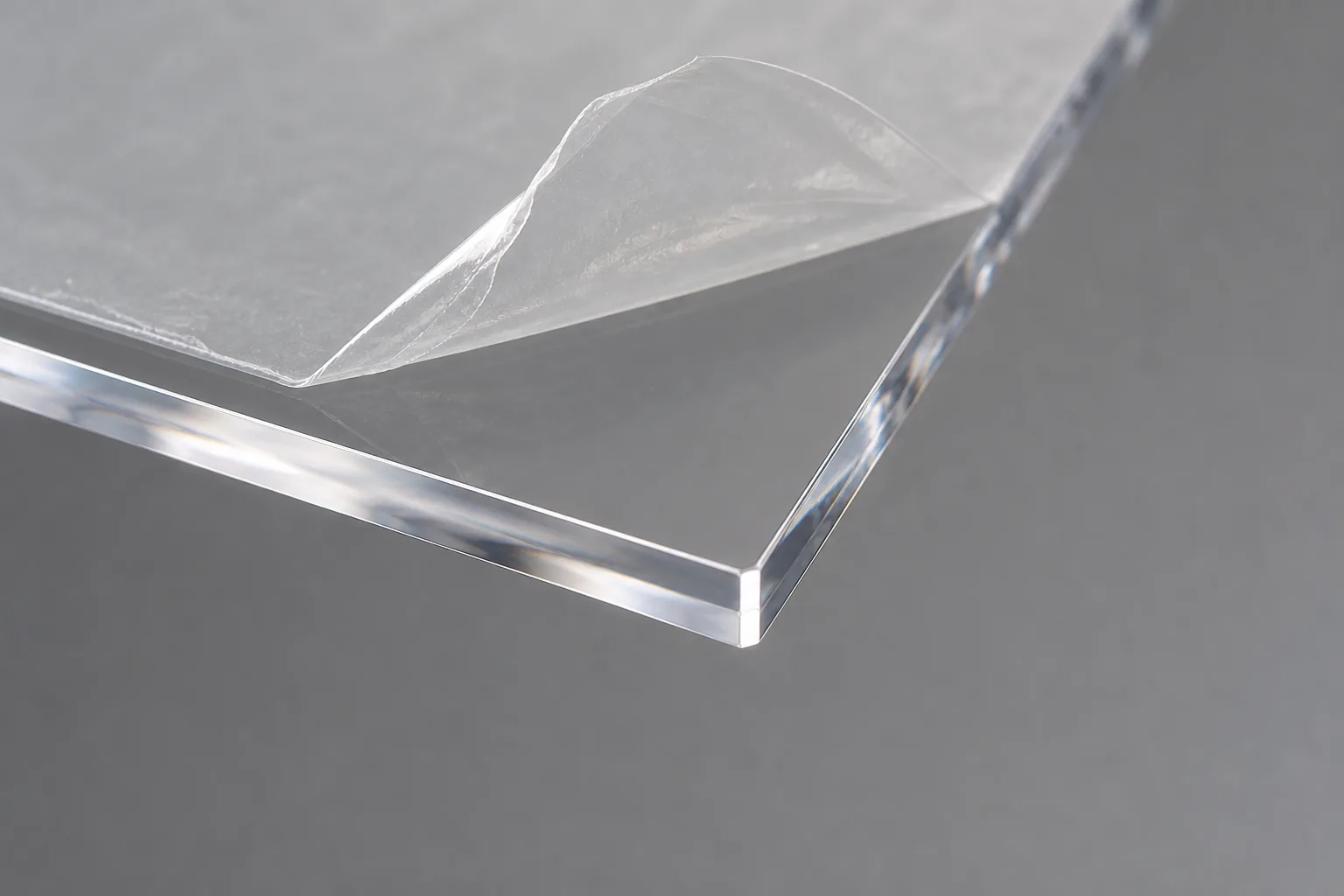
When a brand name does belong in the spec
There are two legitimate reasons to require branded sheet, and both are about paperwork rather than polymer:
- Color continuity across reorders. Colored acrylic batches vary slightly between producers. If your fixture color was matched against one manufacturer’s swatch and your program will reorder for years, locking that producer’s sheet into the spec protects the match. For color-critical programs we usually solve this with a custom Pantone match instead — a $200–300 one-time formulation per color that stays consistent regardless of sheet brand; the Pantone matching acrylic guide explains the route.
- Compliance documentation. Some corporate and institutional buyers need a named manufacturer’s datasheet or certificate in the submittal package. If the end client requires it, write it in — and expect the material premium.
Absent one of those reasons, a brand requirement is cost without benefit. Laser and CNC cutting, bending, diamond polishing, UV printing and engraving behave the same on branded and reputable generic cast sheet.
How this plays out in a real order
In a real quote, the terminology conversation takes one sentence and then disappears. A buyer asks for plexiglass display stands; we confirm the spec back as cast acrylic at a stated thickness; from that point the project runs on numbers, not names. What the order actually turns on is the same set of facts as any custom acrylic job we take: quantity against our 100-piece MOQ, samples in 3–5 days, production in 15–20 days, a 30% deposit with the balance before shipment, FOB Shenzhen shipping terms.
I’ll add the production-floor view: the reason we’re relaxed about the word is that we never buy material by that word. We buy cast PMMA sheet by producer, thickness, grade, and certificate — the trade name on the masking film is the last thing anyone on our floor reads. Buyers can work the same way. Say plexiglass, acrylic, or perspex in the inquiry; put the material and the standard on the drawing; save the brand names for when the paperwork demands one.
If you’re pricing a project, start with our custom acrylic displays; everything we build, from sign holders to furniture, is the same PMMA under whichever name your team uses. Send the spec you have, brand names included, and we’ll confirm the material line back before anything is cut.
Footnotes
-
Poly(methyl methacrylate) — Wikipedia — documents the trade-name lineage: PMMA first brought to market in 1933 by Rohm & Haas under the Plexiglas trademark, ICI’s Perspex registration, and DuPont’s Lucite, the brands behind today’s generic words. ↩
-
PLEXIGLAS — Rohm brand site — Rohm’s official PLEXIGLAS site, confirming the trademark remains an active, protected brand of PMMA sheet in Europe today rather than a generic term. ↩
-
Cast acrylic vs extruded acrylic — Kastlite — acrylic sheet seller’s comparison stating that cast acrylic typically costs about 20% more than extruded acrylic in comparable sizes. ↩
-
Plaskolite OPTIX acrylic sheet product data sheet — manufacturer datasheet listing cast acrylic sheet at 92% total light transmission per ASTM D1003, the optical figure cited here. ↩
-
Polymethylmethacrylate (PMMA, Acrylic) — MakeItFrom — independent material-property data for PMMA, including the density and rigidity figures that apply identically to acrylic sold under any trade name. ↩
-
ASTM D4802 — Standard Specification for Poly(Methyl Methacrylate) Acrylic Plastic Sheet — the specification cast acrylic sheet is produced against; citing it in a spec defines the material without requiring any brand name. ↩
Frequently Asked Questions
Is plexiglass and acrylic the same?
Yes. Plexiglass is a generic American word derived from the brand name Plexiglas, and both refer to acrylic — poly(methyl methacrylate), or PMMA. Plexiglass sheets and acrylic sheets of the same grade and thickness are the same material, so a fabricator quoting 'plexiglass' and one quoting 'acrylic' are pricing the same sheet. The properties, thickness options, and fabrication methods are identical.
Is Plexiglas better quality than generic acrylic?
Not by default. Plexiglas is Rohm's brand of PMMA, and branded sheet is held to that manufacturer's published datasheet — but reputable generic cast acrylic is produced to the same ASTM D4802 specification. Quality differences come from cast vs extruded production and grade (UV-stabilized, impact-modified), not from the trademark on the masking film.
What should I write in a spec — plexiglass, acrylic, or PMMA?
Write the material and the standard, not a brand: 'cast acrylic (PMMA), 3mm, per ASTM D4802' tells any fabricator exactly what to price. 'Plexiglass' works fine in an inquiry email — we quote those every week — but a drawing or purchase order should use the material name so no one substitutes on assumption.
Why is plexiglass sometimes spelled Plexiglas with one s?
Plexiglas with one s is the registered trademark — coined by Rohm & Haas when the material launched in 1933 and still owned by Rohm today. Plexiglass with two s's is the generic English word that grew out of it, the way 'aspirin' outgrew its trademark. One-s Plexiglas means the brand; two-s plexiglass just means acrylic sheet.
Does asking for Perspex or Lucite change the price?
No. Perspex (originally ICI, UK and Commonwealth markets) and Lucite (originally DuPont, US) are trade names for the same PMMA. Unless the order requires branded sheet for documentation or color-continuity reasons, we quote standard cast or extruded acrylic — and the price depends on thickness, grade, and quantity, not the name.
Is acrylic sheet always cast, or can it be extruded?
It can be either. The RFQ should name cast or extruded PMMA because the production route affects thickness behavior, machining, polishing and price even though both sheets are acrylic.
Can a supplier substitute PETG or polycarbonate for plexiglass?
Not without written approval. PETG and polycarbonate are different polymers with different stiffness, optical, forming and scratch behavior, so the approved material line and datasheet should control any substitution.
Which acrylic term should a US or UK buyer use in an RFQ?
Use cast or extruded acrylic (PMMA) as the material line. Plexiglass is common in the US and Perspex in the UK, but the regional word should not replace the grade, thickness, tolerance and required documentation.
Does the brand name determine whether acrylic yellows outdoors?
No. Outdoor performance depends on the exact grade, stabilizer package, thickness and exposure, not on whether the inquiry says acrylic, plexiglass or Perspex. Request the quoted grade's datasheet for the intended environment.
How should thickness and tolerance appear on an acrylic drawing?
State the nominal thickness, permitted thickness range and critical finished-part dimensions separately. Sheet-thickness variation and fabrication tolerance are different controls and should not be collapsed into one number. The acrylic thickness chart lists stocked sheet sizes and inch equivalents.
What documents confirm the acrylic grade on a production order?
Request the material datasheet or declaration tied to the quoted grade, then keep that grade in the approved drawing, purchase order and reorder record. If a named brand is mandatory, state it explicitly and prohibit substitution without approval.
Is plexiglass capitalized?
Only when it is the trademark. Plexiglas, with one s and a capital P, is Rohm's registered brand of PMMA sheet. The generic word plexiglass, with two s's, is a common noun and stays lowercase in running text, the same way acrylic does.
What is the difference between PMMA and acrylic?
There is no material difference. PMMA, poly(methyl methacrylate), is the chemical name; acrylic is the common name for the same plastic. Datasheets and standards such as ASTM D4802 say PMMA, while buyers and product listings usually say acrylic or plexiglass.
Turn the material name into a production spec
Send the part dimensions, material grade, thickness, quantity, finish, artwork and destination. We will return a line-item quote and a paid-sample plan; sample fees are paid separately and are not credited to production.