

Lucite Tray vs Acrylic: Where the Price Goes
The name on the listing changes the price. The material in the carton does not. Here is where the money actually goes.
Need this made?Custom acrylic trays →

Key Takeaways
- Lucite is a trademark for PMMA acrylic, not a different material — a lucite tray and an acrylic tray cut from the same cast sheet are chemically identical.
- The real price gap comes from brand-name sheet stock and finish labor — mitered corners and diamond-polished edges — not from the polymer itself.
- Cast acrylic sheet is the spec to request on premium trays; extruded sheet costs less but polishes less cleanly and offers fewer thick gauges.
- Three quality markers separate finishing tiers without lab gear: corner joints under raking light, edge polish by touch, and optical clarity across the tray floor.
- The made-to-order path runs 100-piece MOQ, samples in 3–5 days, production in 15–20 days — and quotes should be compared on landed cost including freight, not FOB alone.
On this page
- Same polymer, different label
- One polymer, three names — Lucite, Plexiglas, Perspex
- Where the price difference actually comes from
- Cast vs extruded — the spec that matters more than the name
- What “lucite tray” signals in the US market
- Quality markers of a premium tray — what my inspection team checks
- Thickness and weight — substantial without the freight penalty
- Customization that survives the premium test
- Buying wholesale — MOQ, samples, and landed cost
- Early-stage planning checklist — decide these before asking for a quote
Same polymer, different label
Buyers regularly ask us to quote a “genuine lucite tray” against an “acrylic” competitor sample, and the two objects on the bench are always the same material. Lucite is a trademark. Acrylic is the material. A lucite tray and an acrylic tray cut from the same cast PMMA sheet are chemically identical — same clarity, same density, same scratch behavior. What separates a $150 lucite tray from a $30 acrylic tray is the sheet grade, the finish labor, and the retail positioning, not the polymer.
That distinction matters if you buy trays in production quantities, because two listings describing the identical object can sit three price tiers apart. We fabricate both tiers in the same workshop, from the same sheet families, and the honest difference between them is a finishing specification, never a secret material. The rest of this guide breaks the lucite tray premium into its real components: trademark history, cast vs extruded sheet, corner and edge workmanship, weight, decoration, and the made-to-order path, so you can pay for the parts that show up in your hand and skip the parts that only show up in the product title.
One polymer, three names — Lucite, Plexiglas, Perspex
The plexiglass vs acrylic terminology guide covers the naming question for every PMMA trade name; this section keeps to what it means for trays.
All three famous names describe polymethyl methacrylate (PMMA), a thermoplastic commercialized in the 1930s: Röhm trademarked Plexiglas in 1933, ICI registered Perspex, and DuPont brought the same polymer to the American market as Lucite.1 The Lucite name survives today as a sheet-and-resin trademark under Mitsubishi Chemical,2 and decades of mid-century furniture cemented it as shorthand for the clear, sculptural, modern look that premium tray listings still borrow. In our inbox the vocabulary drifts constantly — “lucite clear board,” “plexi trays,” “perspex organizers” — and every one of those requests lands on the same cast PMMA sheet in our cutting queue; we translate the term into a quality expectation rather than correct it. (The same trademark-vs-material confusion plays out at larger scale in our guide to large lucite boxes vs generic cast acrylic.) The equivalence holds for solid formats too: a request for lucite blocks describes the cast PMMA blocks in our acrylic blocks range, where the same material note is set out for that format — the term changes, the polymer does not. One caution from the QC side: the premium word attracts opportunists. I have inspected “genuine Lucite” competitor samples that turned out to be thin extruded sheet with flame-polished edges. The trademark police will not catch that; the inspection checks later in this guide will.
Where the price difference actually comes from
Strip the branding away and the cost of any clear tray reduces to three inputs: sheet stock, machine and labor time, and margin structure. A premium lucite tray spends more in all three, and only the first two put quality in a customer’s hands.
Sheet stock. Branded cast sheet from the big mills costs meaningfully more per kilogram than generic extruded sheet from a commodity line. Part of that gap is genuine: tighter thickness control, better batch-to-batch color consistency, higher molecular weight. Part of it is the mill’s own brand premium. Our approach for tray programs: generic cast sheet from qualified suppliers, which captures most of the physical quality at a lower input cost, unless a client’s spec names a mill brand for their own supply-chain reasons.
Labor. This is the biggest legitimate driver, and the least visible in a product photo. The table below shows where the build choices diverge:
| Build element | Commodity tray | Premium tray |
|---|---|---|
| Sheet grade | Extruded, 2–3 mm | Cast, 5–12 mm |
| Corner joint | Butt joint, fast cement | Mitered 45°, slow-cured seam |
| Edge finish | Flame polish | Diamond-machine polish |
| Inspection | Batch sampling | Piece-by-piece |
| Packing | Bulk with paper | Individual sleeve + foam |
On our lines, finish work on a premium tray takes several times the touch time of a basic one. A commodity tray is laser-cut, flame-polished, and glued square in minutes; a mitered, diamond-polished tray occupies a machine pass per edge plus skilled assembly and cure time. Touch time is what a customer feels when the tray is lifted off the shelf.
Positioning. The remainder is retail markup attached to the word “lucite” in the US home-decor market. It buys nothing physical. Buying factory-direct for production runs removes this layer from landed cost while keeping the two real ones. That arbitrage is what a private-label tray program is built on.
Cast vs extruded — the spec that matters more than the name
One line on a tray RFQ outweighs the lucite-vs-acrylic question entirely: cast acrylic sheet. Cast and extruded PMMA share chemistry but differ in molecular weight, and for trays the difference concentrates in exactly the two places a tray gets judged: edges and thick gauges. Cast sheet’s higher molecular weight lets a diamond-polished edge come off the machine flat and glass-clear; extruded sheet tends to smear and show faint flow lines at the same polish setting. Cast sheet classification is covered by ASTM D4802, the standard specification for PMMA acrylic plastic sheet.3
Gauge availability compounds the edge issue. Extruded lines run efficiently at thin gauges (2 to 5 mm is their sweet spot), while cast production comfortably supplies the 8, 10, and 12 mm stock a substantial tray base wants. When a listing offers a “thick lucite tray” at a suspiciously low price, the base is often two thin extruded layers laminated together, and the bond line announces itself at the edge within a year of daily use.
We keep the full material comparison — thermoforming behavior, chemical resistance, laser response — in our dedicated cast vs extruded acrylic guide. For trays, the short version is enough: cast for anything with a polished edge or a thick base, extruded only when cost beats finish on the priority list. State the choice in writing either way, because “acrylic” alone on a quote leaves the choice to the factory’s margin.
What “lucite tray” signals in the US market
Search behavior tells us what the word sells. “Lucite tray” in US retail almost always points at the premium end of three product families: vanity trays for bathroom counters and dressers, amenity and catch-all trays for hotels and boutiques, and statement serving trays for bar carts and coffee tables. The generic phrase “acrylic tray” covers the same shapes but skews toward office organizers, cafeteria service, and price-first listings.
For a volume buyer this is market intelligence, not semantics. A customer shopping the “lucite” aisle arrives with a mental price anchor set by design magazines and boutique hotels, and the product has to clear a higher bar in hand: the expectations attached to the premium word are real even though the material difference is not. A home-decor brand selling a $120 vanity tray cannot ship the same corner quality as a $25 desk organizer, whatever either object is called on the box.
We build for both segments as a custom acrylic tray manufacturer, and the factory-side difference between them is a finishing specification, not a material substitution. Same cast PMMA sheet; different corner construction, edge treatment, and inspection standard. When a client brief says “lucite quality,” my QC team reads that as a finishing tier, and we price, build, and inspect to that tier. Over 2,000+ custom projects across 25+ countries, that translation has proven more reliable than any terminology debate: ask what the end customer pays at retail, and the finishing tier chooses itself.
Quality markers of a premium tray — what my inspection team checks
A tray tells me its quality tier in about twenty seconds, in three places — a read that ten years of final-QC inspections has only made faster. None of the checks require lab equipment, which means you can run the same checks on any supplier’s sample — and you should, before wiring a production deposit.
Corner joints. Hold the corner up to a strong light at a low angle. On a premium tray with mitered 45-degree joints, the seam should read as a single faint line with no trapped bubbles, no milky cement haze, and no gap your fingernail could catch. Premium tray buyers put it plainly in their briefs: flawlessly joined corners are the make-or-break, and they are right to. The corner is where cost-cutting hides: a butt joint with visible cement squeeze-out is minutes cheaper to make and permanently visible. I have failed entire cartons at final inspection for corner seams that photographed clean but hazed under raking light; that light angle is the first thing my inspectors set up, and it should be the first thing you set up when a sample lands on your desk.
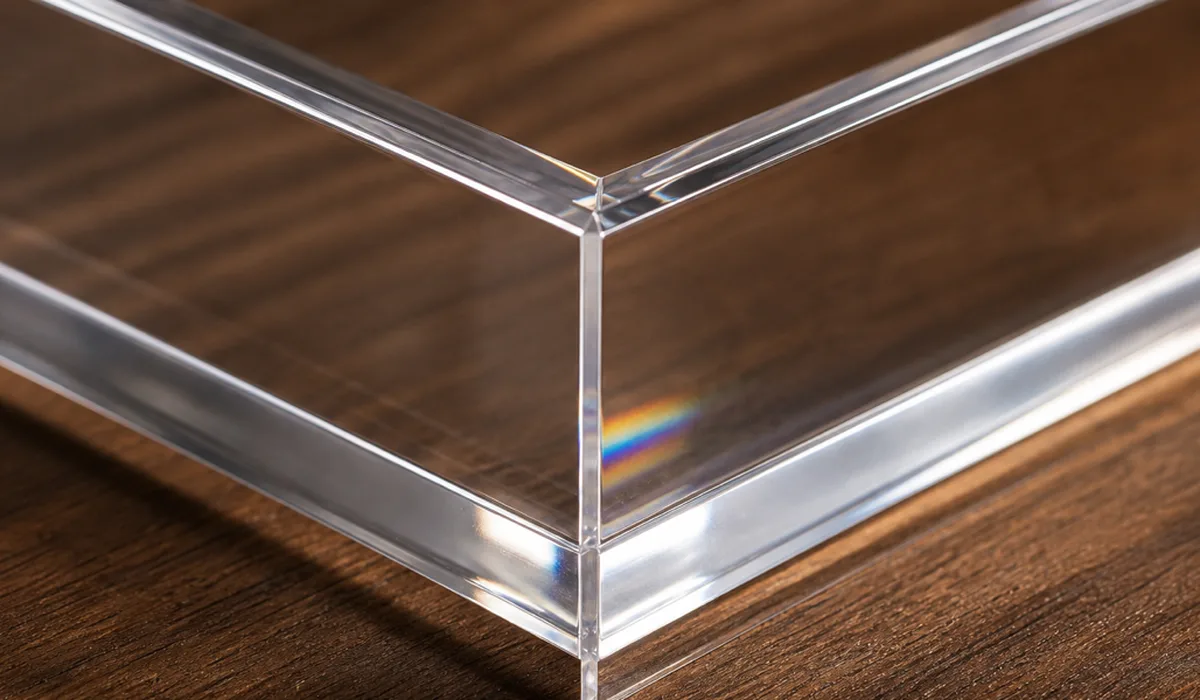
Edge polish. Run your fingernail along every exposed edge. Diamond-polished cast acrylic feels like glass: continuous and slick, with no ripple. Flame-polished extruded edges can look shiny in a photo while carrying a subtle waviness your fingertip finds immediately. Photos flatter edges; touch does not, which is why no tray program should be approved from renders alone. On decorated trays we also check the polish line where it meets any etched area, because a polish pass that burns into an etch is a reject in our book even when the end customer might not notice for months.
Optical clarity. Sight across the tray floor at a shallow angle toward a window. You are looking for flow lines, haze patches, and internal specks. Cast PMMA transmits and refracts light cleanly enough that defects announce themselves at this angle even when the tray looks perfect from above. One tilt reveals everything the product photo hid.
When my inspection team opens a finished tray order for final QC, every piece gets these three checks before packing: 100% inspection, not batch sampling, under our ISO 9001 quality system. Trays earn that rigor more than most products we make, because every surface of a clear tray is a show surface. There is nowhere for a defect to hide, so we give it nowhere to hide from us first.
A note on how we calibrate. When a buyer sends us a benchmark tray they love — or one they rejected — I run it across the same three checks before we quote. If the benchmark passes, I know exactly which finishing tier we are matching; if it fails, I can tell the buyer precisely where, which turns a vague “better quality please” into a spec we can build to and inspect against. That twenty-second routine has settled more quality debates than any contract clause I have seen.
Thickness and weight — substantial without the freight penalty
“Good quality, thick” is how premium tray buyers phrase the brief, and the instinct is sound: mass reads as value the moment the tray is lifted. The engineering question is how much mass, because PMMA’s density of about 1.2 g/cm³ turns thickness decisions directly into weight and freight numbers.4
Run the math on a common 16 x 12 inch (roughly 400 x 300 mm) serving tray. The base panel alone weighs about 144 g per millimeter of thickness, so a 6 mm base contributes roughly 0.86 kg, an 8 mm base about 1.15 kg, and a 12 mm base about 1.73 kg before walls or handles enter the picture. Walls at 50 mm height in 5 mm stock add roughly another 0.4 kg around the perimeter. A tastefully substantial tray lands somewhere between 1.2 and 2 kg finished — heavy enough to sit planted on a counter, light enough to carry loaded with bottles.
Overshoot has a real cost. One premium buyer rejected a sample that weighed in at 4.5 kg — too heavy to carry comfortably, too expensive to ship in case quantities. Nothing about that tray was low quality; the spec simply confused mass with worth. Per-carton freight is priced on weight and dimensional volume, so every unnecessary millimeter of base thickness taxes your whole program, shipment after shipment, reorder after reorder.
Our recommendation pattern for premium trays puts the visual mass where hands and eyes find it: a thick base with a generous polished edge reads far more premium than uniformly heavy walls, and the math above sets your ceiling. Ask your supplier for the per-unit weight and per-carton gross weight with the quote; we include both as standard practice, because any factory that actually fabricates the tray can produce those numbers in the same email. A supplier that cannot is quoting from a catalog, not a workshop. Better to learn that before the deposit than after.
Customization that survives the premium test
Decoration is where a lucite tray program either reinforces the premium read or quietly breaks it. Three techniques dominate our tray orders, and each has a quality gate worth knowing before artwork gets committed.
Second-surface bottom print. Artwork printed on the underside of the tray floor, viewed through the acrylic. The material itself becomes the protective layer, so the print survives washing and daily service, and the glossy depth effect is genuinely hard to replicate in any other material. The gate: the print layer must be sealed watertight and bubble-free, because a single bubble under a clear floor is visible forever. We proof every print job digitally, then on a physical sample, before a production run touches ink.
Etched logos. Laser or CNC etching frosts the surface where it strikes, producing a subtle mark that reads upscale precisely because it refuses to shout. Depth consistency is the gate — an etch that varies across the logo looks worse than no logo at all. Where etching fits against printing and inserts — and how to route your brief — lives in our acrylic tray logo options guide.
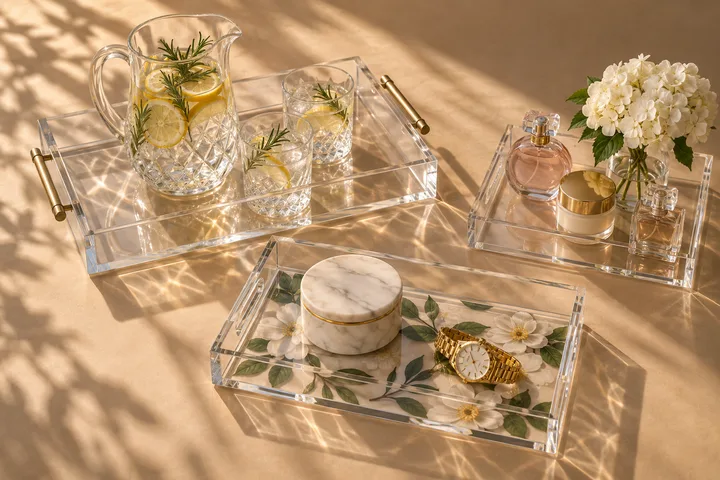
Handles. Integrated cutout handles are machined from the tray walls themselves: nothing to loosen, nothing to corrode, and the cleanest look for bathroom and vanity settings. Metal handles in brushed brass or nickel push the tray toward barware and hospitality; the gates there are hardware quality and consistent screw spacing, since mismatched replacement hardware is one of the most common reorder headaches we untangle for buyers switching suppliers.
All three routes run through our standard custom acrylic fabrication workflow — artwork proof first, then a physical sample, then production — so decoration decisions get locked on a real object rather than a render. The proof stage costs days; a decorated production run with the wrong artwork costs the program.
Buying wholesale — MOQ, samples, and landed cost
The made-to-order path for custom trays is shorter than most first-time buyers expect. Our program terms: 100-piece MOQ per design, so two artwork versions require 100 pieces each; paid samples take 3–5 days and production takes 15–20 days, with every piece individually inspected before packing. A typical first order runs sample approval, then production, inside a month — fast enough to hit a seasonal retail window if the artwork is ready.
The sample stage deserves more respect than it usually gets. From the QC bench, I can say the sample is where programs are saved: it is the one moment a buyer holds the exact corner joint, edge polish, and clarity standard that the production run will be inspected against. The bespoke printed tray project shows how artwork, physical color proof, finish, inspection, and packing were put under that approval route. The pattern generalizes to any decorated tray: sample first, always.
Price the whole journey, not the factory gate. Experienced buyers ask for cost including freight to their door, and that phrasing belongs in your first email. An FOB price that looks 15% lower can invert once carton weight, dimensional volume, and destination charges land, especially on heavy thick-gauge trays — one more reason the per-unit weight math (density 1.2 g/cm³ × acrylic volume) deserves a line in your RFQ. We quote both bases on request; comparing suppliers only works when every quote sits on the same landed basis, so ask each candidate for the same terms and compare like with like.
Two more program-level details worth settling early. First, reorder consistency: if your tray line succeeds, you will reorder, and batch-to-batch color and finish consistency matters more on order three than on order one. Ask how the factory controls sheet sourcing across batches, because a supplier that switches sheet mills between runs will deliver a shelf of trays in two subtly different clears. Second, packing spec: premium trays travel in individual sleeves with foam corners, not bulk-stacked with paper interleave. I have unpacked inbound “premium” competitor cartons where a third of the pieces carried transit scuffs on arrival; the packing line is where that fate is decided, and it costs pennies per unit to decide it correctly.
Early-stage planning checklist — decide these before asking for a quote
Most tray quotes stall on missing basics, not hard questions. I see the same gaps from the inspection end of the process — specs that were never pinned down at quoting come back as disputes at QC, months later and continents apart. Settle these seven points before you write to any factory, and your quote arrives faster, tighter, and comparable across suppliers:
- Dimensions, and which kind. State outside dimensions or inside dimensions explicitly. A “300 mm tray” that must hold 300 mm bottles is a different object than one that measures 300 mm outside.
- Base and wall thickness. On a 400 x 300 mm tray the base weighs about 144 g per millimeter of thickness — state both numbers rather than “thick.”
- Material call. Cast acrylic, written on your RFQ: it polishes to a cleaner edge and supplies the thick gauges extruded sheet cannot.
- Finish tier. Mitered and diamond-polished corners, or standard butt joints — this single line moves your cost more than any other.
- Decoration. Bottom print, etch, handles, or plain — with artwork files in vector format if your logo is involved.
- Quantity and cadence. Against the 100-piece MOQ, and whether you are testing a one-off or building a repeating program.
- Destination. Country and delivery terms, so the quote can include freight from day one.
Seven lines and a reference photo produce a real quote instead of a clarification email. When you are ready, send us your tray spec — samples ship in 3–5 days, and the sample tells you more about a supplier than any product title ever will. Lucite, acrylic, or plexi: the corners never lie.
Footnotes
-
Poly(methyl methacrylate) — Wikipedia — trade-name lineage of PMMA: Röhm’s Plexiglas trademark (1933), ICI’s Perspex, and DuPont’s Lucite, commercialized in the late 1930s. ↩
-
Our History — Lucite (Mitsubishi Chemical Group) — the Lucite brand’s own corporate lineage: formed from the ICI and DuPont acrylics businesses, rebranded Lucite International in 1999, acquired by Mitsubishi Chemical in 2009. ↩
-
ASTM D4802 — Standard Specification for Poly(Methyl Methacrylate) Acrylic Plastic Sheet — the classification standard covering cast PMMA sheet referenced in the cast-vs-extruded section. ↩
-
PMMA (Acrylic) material properties — MakeItFrom — displays the density (1.2 g/cm³) used for the tray weight calculations, plus Rockwell M hardness and tensile figures. ↩
Frequently Asked Questions
Is a lucite tray the same as an acrylic tray?
Chemically, yes. Lucite is a trademarked brand name for polymethyl methacrylate (PMMA) — the same polymer sold generically as acrylic. A lucite tray and an acrylic tray cut from the same cast PMMA sheet are identical. The differences buyers notice come from sheet grade (cast vs extruded) and finish quality, not the name.
Why do lucite trays cost more than acrylic trays?
Three drivers: branded or premium cast sheet stock costs more than generic extruded sheet; finish labor (mitered 45-degree corners, diamond-polished edges) adds machine time and skilled handling; and US retail positioning prices 'lucite' as a premium home-decor term. The polymer is the same — the finishing standard usually is not.
Should a custom tray use cast or extruded acrylic?
Cast acrylic for premium trays. It polishes to a cleaner, glass-like edge, holds up better at cemented corners, and is available in the 8–12 mm gauges thick tray bases need. Extruded sheet is fine for cost-driven programs in 3 mm walls, but its lower molecular weight shows at the polish stage.
What should I inspect on a lucite tray sample?
Three things: hold each corner joint under a strong angled light and look for bubbles or gaps in the seam; run a fingernail along every polished edge to catch saw marks or waviness; and sight across the tray floor at a shallow angle to check for flow lines or haze. A premium tray passes all three.
What do I need to decide before requesting a custom tray quote?
Six things make a quote fast and accurate: outside dimensions (stated as internal or external), wall and base thickness, material call (cast acrylic), decoration (print, etch, handles), quantity against the 100-piece MOQ, and destination for freight. Send those plus a reference photo and a factory can quote without a second email round.
Have specs in hand? Get a quote for your specific project.
Send us your drawings, reference photos, or a description of what you're making. We reply within 24 hours with a material recommendation, thickness, fabrication method, and a per-unit quote.