Custom vs Stock Acrylic Displays: When to Buy Off-the-Shelf
Choosing between custom and stock acrylic displays is a cost and timeline decision — and the wrong call in either direction wastes real money.
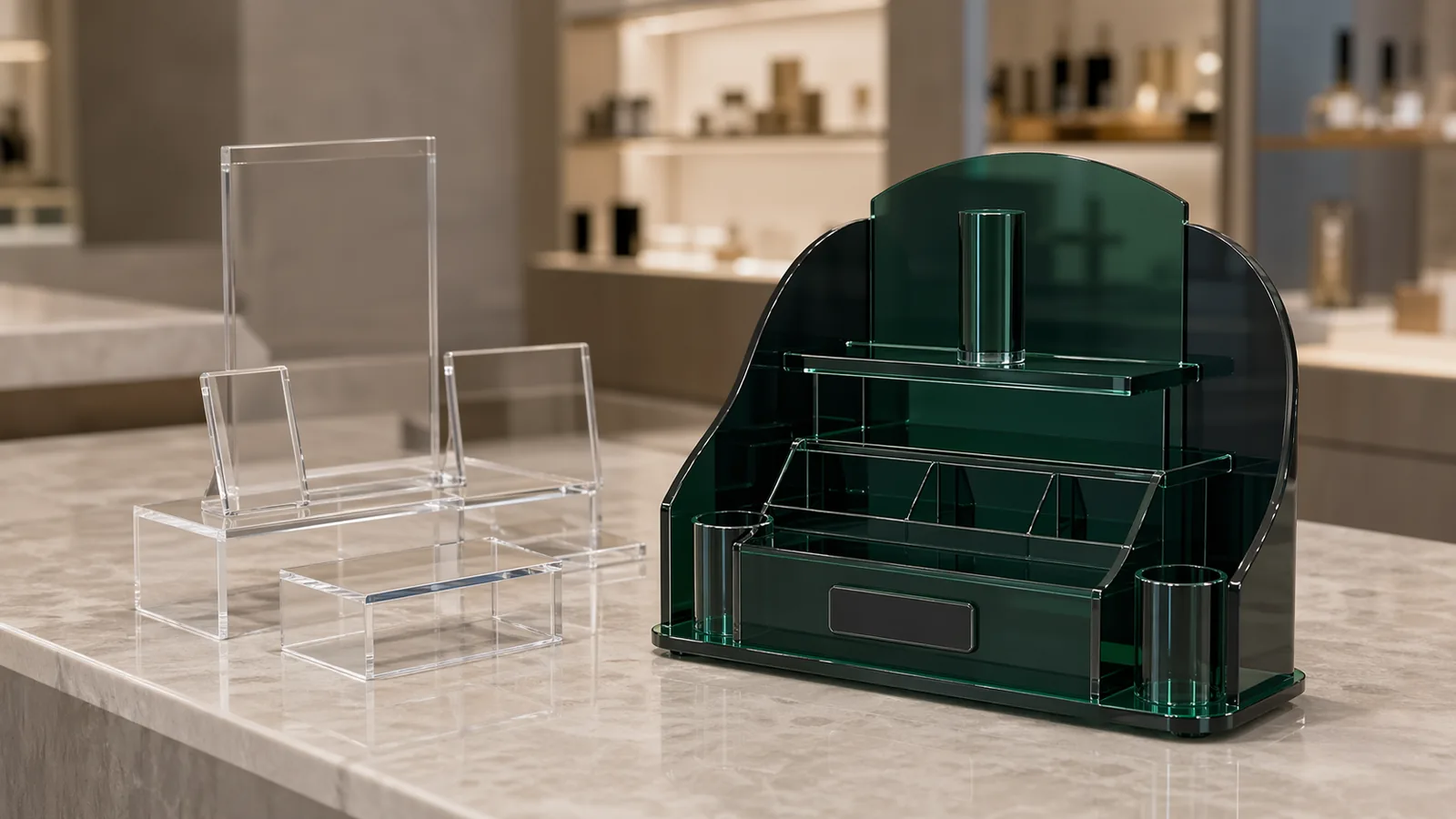
Key Takeaways
- Custom acrylic displays break even versus stock at roughly 200–400 pieces — below that, stock is almost always cheaper per shipped unit once you factor in tooling and setup fees.
- Stock dominates for one-time events, short-run tests, and standard product sizes that fit off-the-shelf dimensions without compromise.
- Custom is non-negotiable when brand color, logo, fixture fit, regulatory marking, or a unique form factor is on the table — generic stock cannot deliver any of these.
- A middle path exists: customized stock (printed or cut-down standard pieces) hits a per-unit cost 15–25% above stock-as-shipped — often the smartest option for brands with 100–200 piece needs.
- Lead time difference is real: stock ships in 1–5 days, custom takes 15–25 days — plan custom orders 4–6 weeks before your in-store or event deadline.
On this page
- The Honest Framework Most Sellers Won’t Give You
- The Real Cost Math
- When Stock Is the Right Answer
- When Custom Is Non-Negotiable
- The Middle Path: Customized Stock
- Lead Time Reality
- Quality Differences That Matter
- Sample and Prototype Protocol
- Red Flags on Both Sides
- Which Is Right for You: A Decision Matrix
- How to Get an Honest Quote on Both Options
The Honest Framework Most Sellers Won’t Give You
Deciding between custom vs stock acrylic displays comes down to two variables: volume and brand requirements. Stock solves roughly 80% of display problems for about 30% less per unit than custom at low volumes. That is the starting point, not a sales pitch for either option. I’ve quoted custom versus stock on the same product for the same buyer twice in a year and recommended stock the first time and custom the second, purely because the volume math changed. The decision isn’t about quality or pride. It’s about whether the economics and requirements justify a tooling investment.
The framework is simple: stock wins on speed and per-unit cost when volumes are low and standard dimensions fit your product. Custom wins when brand fit, fixture compatibility, or volume crosses a threshold where setup costs amortize. Below that threshold, choosing custom out of a vague sense that “custom is better” will cost you real money.
The Real Cost Math
The difference between custom and stock acrylic displays is not just the unit price on the quote — it is the total cost per shipped unit, including tooling, setup, and freight. Getting this number right before deciding is the single most useful thing you can do.
Stock acrylic displays come without tooling fees and without minimum order quantities. A standard clear acrylic riser from a US distributor costs $4–$12 per piece depending on size, ships in 2–5 days, and carries no setup charge. If you need 30 pieces for a trade show, stock is almost always the right answer — the unit cost is predictable and the timeline fits even a tight event schedule.
Custom acrylic displays carry a one-time setup cost, typically $80–$350 depending on design complexity, covering programming, jig fabrication, and first-run testing. That cost is paid regardless of order quantity. At 100 pieces, a $150 setup fee adds $1.50 per unit. At 300 pieces, it adds $0.50. At 1,000 pieces, it adds $0.15 and becomes noise. The following table shows how this plays out across four common order sizes:
Unit cost comparison: stock vs. custom at different volumes
| Order Quantity | Stock (clear, standard size) | Custom (brand color, logo, same footprint) | Custom Setup Amortized | Total Custom Per Unit |
|---|---|---|---|---|
| 100 pcs | $6.00 | $6.20 fabrication | $1.50 ($150 setup) | $7.70 |
| 200 pcs | $6.00 | $5.80 fabrication | $0.75 ($150 setup) | $6.55 |
| 500 pcs | $6.00 | $4.90 fabrication | $0.30 ($150 setup) | $5.20 |
| 2,000 pcs | $5.50 (bulk discount) | $3.80 fabrication | $0.08 ($150 setup) | $3.88 |
Note: Prices are directional estimates for a mid-complexity countertop display riser. Exact pricing varies by dimensions, material thickness, finish, and print method. Request a quote for your specific design.
The crossover point — where custom per-unit cost equals or beats stock — falls between 200 and 400 pieces for most standard display products. Below that range, stock wins on unit economics. Above it, custom frequently wins, especially once you account for the freight cost of shipping heavier, pre-assembled stock pieces versus the more compact packaging of flat-pack custom components. For the quantity-by-quantity price ladder on the custom path — what actually happens to unit cost at 100, 500, and 1,000 pieces — see our acrylic display stand cost guide.
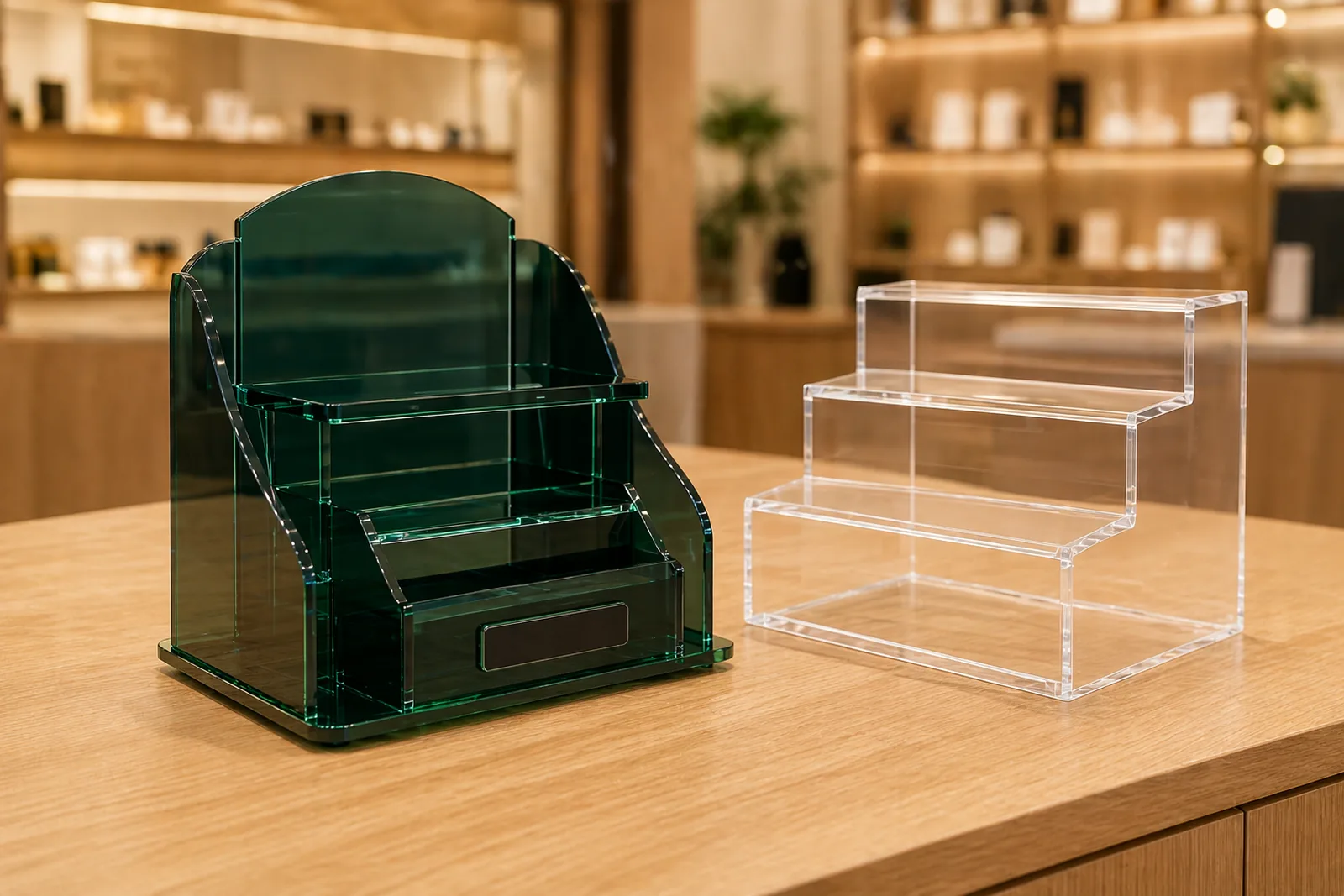
When Stock Is the Right Answer
Stock acrylic displays are the right call in more situations than most custom fabricators will tell you. I tell buyers this directly, because recommending custom when stock fits the job is a short-term sale and a long-term relationship problem.
Stock dominates in four scenarios:
Low quantities with no brand requirement. For quantities under 100 pieces — trade show samples, pop-up events, short seasonal promotions — stock clears the shelf in days and costs a fraction of custom. If clear acrylic works visually and standard sizes fit your product, there is no financial case for custom.
Standard product sizes. If your product fits a shelf, countertop, or case that stock sizing already accommodates — lipstick risers, card holders, box displays for standard retail dimensions — stock pieces require zero design time, zero sampling, and zero lead time risk. They exist precisely because most display needs cluster around a small set of standard footprints.
Urgent timelines. Custom lead time at Wetop is 15–25 days from spec approval. If your event is two weeks out and you don’t have an approved design, custom is not a realistic option. Stock ships. Plan accordingly — and if you find yourself in this situation regularly, it’s a signal to start custom projects earlier rather than default to stock under pressure.
Testing a new product format. Launching a new SKU and not sure yet how you want to display it? Order 20 stock pieces to test the merchandising concept before committing to custom tooling. The stock run costs $200 and takes five days. The custom tooling costs $150 upfront and takes three weeks before you see a sample. Use stock to validate, custom to scale.
When Custom Is Non-Negotiable
Custom acrylic displays move from “nice to have” to mandatory the moment any of these four conditions is true.
Brand color or visual identity. Standard stock comes in clear and a handful of common tints. If your brand requires a specific Pantone, a proprietary frosted finish, or an opaque base color that matches your packaging, stock cannot deliver it. No amount of clever lighting fixes the wrong base color on a display at the point of purchase. Our cosmetics and perfume display page covers this in detail — brand-matched acrylic is one of the top reasons beauty buyers move to custom even at quantities as low as 100 pieces.
Fixture or shelf fit. Retail floor space is engineered to millimeter tolerances. Chain store shelf slots, pegboard grids, and proprietary fixture systems are not built around standard acrylic display sizes — they are built around the chain’s own planogram dimensions. If your display must slot into a Sephora fixture or a Target endcap, you need a custom dimension. Stock pieces approximate; custom pieces fit.
Logo, marking, or regulatory requirement. Some categories — medical devices, electronics accessories, vaping products — require visible compliance markings on the display itself (UL, CE, ASTM, or FDA labeling). Some brands require a logo that must appear on the display, not on a separate card slipped behind it. Neither requirement can be met with unprinted stock. UV printing or laser engraving on a custom piece handles both in one fabrication step.
Volume above 300–500 pieces. At 500 pieces, the custom-versus-stock cost calculation almost always favors custom acrylic displays, and by 1,000 pieces it is rarely close. At volume, you also gain packaging control (custom pieces pack more efficiently), quality consistency (stock from distributors varies by batch), and the ability to iterate the design without changing suppliers. We’ve shipped to 25+ countries and delivered 2,000+ custom projects — see our case studies archive for examples of those long production runs, where the buyers are almost uniformly running custom, not stock.
For collectors-market and trading card display applications, custom is the default rather than the exception — standard dimensions don’t fit sealed card boxes, and brand identity on the display is part of the product appeal. See our trading card display application page for the specifics of that category.
The Middle Path: Customized Stock
There is a third option that most comparison articles skip, and it is often the best answer for buyers in the 100–200 piece range who need brand presence but do not need a new geometry.
Customized stock means taking standard clear acrylic pieces — risers, trays, sign holders, box frames — and adding print, engraving, or a cut-down to a specific dimension. The base form factor stays standard; the differentiation comes from the surface treatment.
Here is what each customization upgrade to stock typically costs and adds:
| Upgrade | Method | Typical Cost Add | Lead Time Add |
|---|---|---|---|
| Logo print (1 color) | Silk-screen on standard riser | +$0.80–$1.50/pc | +3–5 days |
| Full-color panel print | UV printing on standard piece | +$1.50–$3.00/pc | +5–7 days |
| Laser engraving | Logo or text etched into surface | +$1.00–$2.00/pc | +3–5 days |
| Custom cut-down to size | Resize standard stock piece | +$0.50–$1.20/pc | +2–4 days |
| Branded base insert | Printed card behind frosted panel | +$0.30–$0.60/pc | +2–3 days |
At 100 pieces with a logo print, you’re looking at a total cost roughly 15–25% above bare stock. That buys you brand presence on the display without the full tooling investment of a from-scratch custom design. Lead time sits at 7–12 days — faster than full custom, slower than off-the-shelf.
I recommend customized stock to any buyer who asks “can you just make mine look like this Amazon listing?” The answer is yes, with these four catches: the dimensions stay stock standard, print quality depends on surface material (smooth clear polishes best), silk-screen has minimum repeat costs that raise the per-piece rate at very low volumes, and the color gamut on UV print is excellent but is not a Pantone-matched physical color. Within those parameters, customized stock is an undersold option.
Lead Time Reality
Lead time is the most frequent reason buyers make the wrong choice — they underestimate how far out they need to be planning, or they discover a custom order isn’t feasible with two weeks to go.
| Option | Typical Lead Time | Rush Surcharge | Notes |
|---|---|---|---|
| Stock (US distributor) | 1–5 days | None — already stocked | Limited to standard sizes and clear/common colors |
| Stock (from our factory bulk) | 3–7 days | None | Standard clear, limited sizes |
| Customized stock (printed/engraved) | 7–12 days | +15–25% for express | Design needs to be finalized before start |
| Full custom production | 15–25 days | +20–35% for rush | Includes 3–5 days for sample if first order |
| Full custom with new tooling | 20–30 days | Not recommended | First run requires tooling + approval time |
The 15–25 day custom window assumes a complete spec — approved design file, confirmed dimensions, material and finish specified. Missing any of those adds time before the production clock starts. For a first order, also budget 3–5 days for sample approval before production begins. End-to-end, first custom orders frequently run 4–6 weeks from inquiry to delivered goods.
Rush surcharges on custom orders are real and non-trivial — 20–35% above standard pricing for anything that requires compressing the 15–25 day window below 10 days. The math usually favors planning ahead over paying rush fees.
Quality Differences That Matter
Not all acrylic is equal, and the quality difference between stock and custom goes beyond the surface.
Cast versus extruded acrylic. Most stock display pieces are made from extruded PMMA — a cost-efficient material that works well for standard display applications but has slightly lower optical clarity, less uniform thickness, and edges that are harder to polish to a high gloss. Custom fabrication can specify cast PMMA throughout, which offers superior clarity, better edge polishing results, tighter thickness tolerances (±0.2mm vs. ±0.5mm for extruded), and better chemical resistance.1 Cast acrylic costs more per sheet, but the fabricated piece looks and behaves better — especially on premium countertop and jewelry displays where optical quality is visible to the end customer.
Finishing consistency. Stock pieces are manufactured in bulk and QC-checked at the batch level — meaning edge quality, surface condition, and dimensional accuracy vary piece to piece within a shipment. Custom fabrication, particularly from an ISO 9001-certified facility, applies 100% piece inspection against an approved sample. Every piece leaving our factory is measured against your spec — not spot-checked against a batch standard.
Tolerances. Standard stock displays are produced to ±1mm or wider tolerances. Custom CNC-cut pieces hold ±0.25mm; laser-cut parts hold ±0.5mm. If your display must fit a specific slot, nest inside packaging, or accept an insert at a precise dimension, custom tolerances are not a premium — they are a functional requirement.
For display cases and collectible showcase applications where optical quality and dimensional precision are visible to end buyers, custom fabrication consistently produces better results. Our acrylic display cases product page covers the specific formats where this quality gap shows most clearly at the point of purchase, and the broader acrylic displays hub shows the riser, sign holder, and countertop formats where both custom and semi-customized stock paths are viable. And if what you’re actually typing into the RFQ is “custom-made acrylic cases,” our custom-made acrylic cases buyer guide unpacks what that phrase means to a factory quote team and how to spec it without ambiguity.
Sample and Prototype Protocol
Before committing to custom tooling, get a sample. This sounds obvious, but I see buyers skip it regularly to save a week — and regret it when the production run reveals a dimension that didn’t account for packaging, a color that reads differently under store lighting, or an edge finish that doesn’t match their brand reference.
The sample protocol for a first custom order:
- Submit a complete spec: dimensions, material, thickness, finish, print, quantity. A complete spec produces a sample in 3–5 days. An incomplete spec starts a clarification loop. See our acrylic RFQ guide for the nine-field checklist.
- Approve the sample in writing before production begins. Document what was approved — material, finish, dimensions — not just “looks good.” The approved sample becomes the production reference that our QC team checks every piece against.
- Check the sample under your target conditions: store lighting, packaging fit, shelf slot compatibility, branding photo conditions. The most common sample revision I see is color — a Pantone that reads correctly on screen looks different on a physical colored acrylic sheet. Check it where it will actually live.
- Request a revised sample if needed before approving production. One revision adds 3–5 days; catching the issue in production adds weeks and cost.
For stock or customized stock orders, samples are less critical because the base dimensions are already proven. We recommend requesting a print proof (physical or digital) before approving a large silk-screen or UV print run on stock pieces — print registration and color accuracy should be confirmed before committing.
Red Flags on Both Sides
Both stock and custom purchases have common traps. Knowing them saves you from paying more than you should or receiving less than you expected.
Red flags when buying stock:
- “Custom” markup on standard stock. Some US-based acrylic display retailers rebrand standard stock pieces with their own product line name and charge 2–3x the same item’s cost from a direct source. Before paying a premium, confirm whether the dimensions and material are proprietary or standard stock. A standard 4”×4”×2” clear riser is a commodity; if you’re paying $25 for it, you’re paying a brand margin, not a fabrication cost.
- No material specification. Stock listings that don’t state cast vs. extruded PMMA are almost certainly extruded. If optical clarity or edge quality matters for your application, ask before ordering.
- Short return windows on bulk stock. Some distributors enforce strict no-return policies on orders above 50 pieces, even for clear factory defects. Confirm before placing a large stock order.
Red flags when buying custom:
- Quote missing setup or tooling line items. A custom acrylic quote that shows only a unit price with no setup fee is either absorbed into the unit cost (making it hard to evaluate at different volumes) or the supplier is planning to charge it separately on the invoice. Ask explicitly: “What is the one-time setup or tooling fee?”
- No sample offered before production. Any custom fabricator who wants to go straight to production without a sample approval is protecting their timeline, not your quality. Walk away or insist on a sample.
- Vague material spec on the quote. “Clear acrylic” is not a specification. The quote should state cast or extruded PMMA, thickness, and whether the material is sourced from a named supplier (Plaskolite, Evonik, Mitsubishi Chemical) or generic import stock.2 Material sourcing affects quality consistency across reorders.
- Lead times that don’t include sample time. A “15-day lead time” that starts from spec approval — not from inquiry — and doesn’t account for sample iteration can easily become 30 days on a first order. Ask: “Does this lead time include sample approval, or does it start after the sample is approved?”
Which Is Right for You: A Decision Matrix
Use this matrix to land on the right starting point for your situation. It is not a substitute for a quote — it is a starting point for the conversation.
| Your Situation | Recommendation | Why |
|---|---|---|
| Under 100 pcs, standard size fits, clear is OK | Stock | No tooling investment justified; ships in days |
| Under 100 pcs, need logo only, standard size OK | Customized stock | Print on stock keeps cost manageable; 7–12 day lead time |
| Under 100 pcs, specific color required | Customized stock or small custom run | Colored stock is limited; evaluate per-piece cost vs. necessity |
| 100–300 pcs, brand color or logo required | Custom or customized stock | Volume starts to amortize setup; get quotes on both |
| 300–500 pcs, any brand requirement | Custom | Setup amortized; custom beats stock on total delivered cost |
| 500+ pcs, any situation | Custom | Custom almost always wins at scale on price, quality, and consistency |
| Tight deadline (under 2 weeks) | Stock or customized stock | Full custom cannot ship in time at standard lead time |
| Fixture-specific dimension required | Custom | Standard stock won’t fit; custom is not optional |
| Regulated industry requiring markings | Custom with print | Compliance markings require printed custom piece |
| Testing a new product format | Stock first, then custom | Validate the merchandising concept before committing tooling |
For buyers in the jewelry and accessories space, brand-fit and fixture compatibility almost always push toward custom. Our jewelry display application page covers the display formats where standard stock consistently falls short for retail environments that expect coordinated visual presentation.
How to Get an Honest Quote on Both Options
The most useful thing you can do before deciding is ask for quotes on both — stock (or customized stock) and full custom — at the same time. A fabricator who sells both should be willing to give you both numbers and explain where the crossover point is.
When requesting quotes, provide these inputs upfront to avoid clarification delays:
- Finished dimensions (L × W × H in mm or inches)
- Material and finish preference (clear, frosted, specific color, or “recommend”)
- Print or branding requirement (logo, text, none)
- Quantity tiers (e.g., 100 / 300 / 500 pieces)
- Target delivery date
With that information, we can return a quote covering stock-as-shipped, customized stock with print, and full custom — at each quantity tier — in a single response. That comparison is what you actually need to make the decision, and it costs nothing to request.
The ISO 9001 quality management framework3 we operate under at Wetop applies equally to stock-based and custom orders — inspection against spec happens on every piece, regardless of which fabrication path produced it. For a real-world custom-vs-stock decision in action, see how we handled a high-SKU retail rollout in our 50-store retail display rollout case study. Ready to get quotes on both options? Send us your spec and quantity — we’ll return a comparison covering stock, customized stock, and full custom at your target volumes.
Footnotes
-
ASTM D4802 — Standard Specification for Poly(Methyl Methacrylate) Acrylic Plastic Sheet — ASTM standard defining the grades, properties, and tolerance requirements for cast and extruded PMMA acrylic sheet. Grade A (cast) and Grade B (extruded) differ in optical clarity, thickness uniformity, and surface finish suitability. ↩
-
Plaskolite — OPTIX Acrylic Sheet Technical Resources — Plaskolite is one of the largest North American PMMA acrylic sheet manufacturers, supplying fabricators with cast and extruded sheet. Their technical datasheets specify clarity, thickness tolerance, and material compliance — the type of documentation a buyer should request from any custom fabricator as proof of named material sourcing. ↩
-
ISO 9001 — Quality Management Systems — ISO 9001 is the international standard for quality management systems, requiring documented inspection processes and corrective action procedures. Wetop Acrylic has been ISO 9001 certified since 2008 — the certification applies the same inspection standard to every order, stock-based or full custom, regardless of quantity. ↩
Frequently Asked Questions
How much more does custom acrylic cost compared to stock?
At the 100-piece production MOQ, custom acrylic displays usually cost more per unit than comparable stock displays because setup is spread across the first run. At 300–500 pieces, the gap narrows. Above 500 pieces, custom can match or beat stock pricing when fixture fit, branding, and freight are included.
What is the minimum order for custom acrylic displays?
Wetop's MOQ for full custom acrylic displays is 100 pieces per design. Below 100, the economics rarely work — setup costs dominate and per-piece price becomes hard to justify. For quantities of 1–20 pieces, stock is almost always the right call unless the design is truly non-negotiable.
Can I get stock acrylic displays with my logo on them?
Yes — this is the 'customized stock' middle path. We can UV-print or silk-screen your logo onto standard clear acrylic risers, trays, and sign holders from the 100-piece production MOQ. Per-unit cost runs about 15–25% above unprinted stock. Lead time is 7–12 days — faster than full custom, slower than stock-as-is.
How long does custom acrylic take versus stock?
Stock ships within 1–5 days from a distributor or 3–7 days from our bulk clear inventory. Full custom production at Wetop takes 15–25 days from spec approval to dispatch. If you need samples first, add 3–5 days before production begins. Plan for 4–6 weeks end-to-end on a first custom order.
What situations make custom acrylic displays worth the extra cost?
Custom wins when at least one of these applies: your brand color or specific Pantone must match, your display must fit a proprietary fixture or shelf slot, your order volume is 300+ pieces (setup cost amortizes), your industry requires UL or ASTM markings on the product, or your form factor simply does not exist in standard stock sizes.
Stock or custom? We can do both.
Send us your spec and quantity. We'll tell you whether stock fits or custom is better-value at your volume — with sample lead time on either path.