
Case Study · Retail · United States
5,400 Multi-Category Acrylic Displays for a 50-Store US Retail Chain
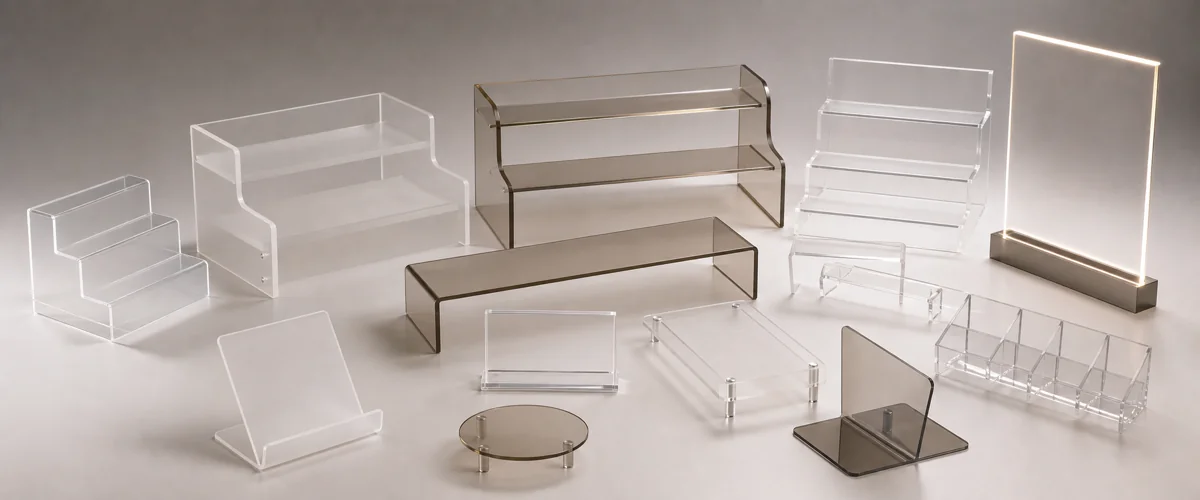
A US national retail chain needed 12 acrylic SKUs across 50 stores to support a Q4 category reset.
We delivered the full rollout in 7 weeks — split shipment, Pantone-matched, packed per-store.
- Units shipped
- 5,400
- US retail stores
- 50
- Brief to first delivery
- 7 weeks
- Display SKUs
- 12
Key Takeaways
- 12-SKU mixed-finish acrylic rollout (clear, frosted, color-matched) shipped to all 50 stores in two waves over 7 weeks.
- Pantone color matching across 4 acrylic variants — verified with delta-E ≤ 1.2 against approved color chip on every batch.
- Air-first / ocean-follow split shipment cut 19 days off store-set deadline vs all-ocean baseline.
- On-site QC sampling at every 500-unit batch pulled cosmetic rejects before shipment, and replacements came from the safety stock shipped with the order.
- Per-store packaging (assembly hardware + planogram card bundled) eliminated store-staff prep time.
The Challenge
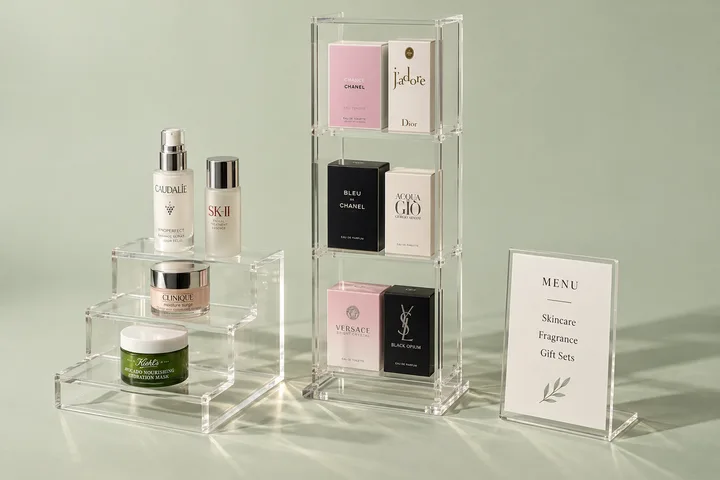
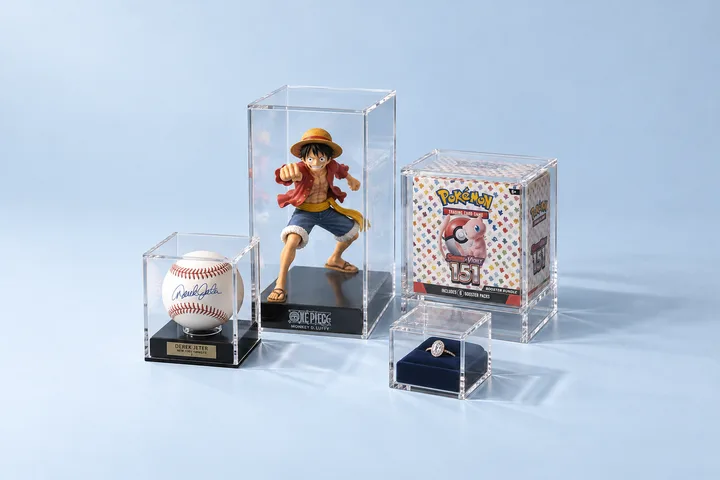
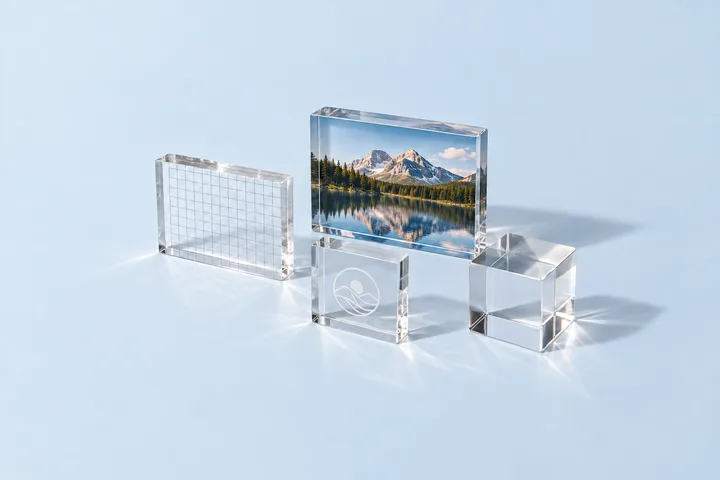
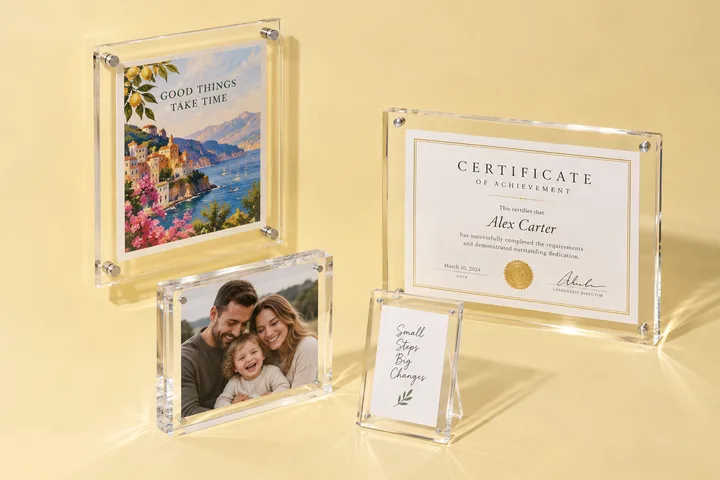
A US national retail chain — 50 stores, mid-market positioning — was launching a Q4 category reset across four product families: cosmetics, accessories, gifting, and seasonal. They needed acrylic display fixtures in all stores by week 7. Twelve SKUs total: countertop risers, tiered shelves, edge-lit panels, sign holders, and slatwall inserts. Mixed finishes — clear, frosted, brand-color-matched, and one Pantone-specified warm gray.
The brief came with three hard constraints:
- All 50 stores stocked by week 7. Missing the category reset window meant a quarter of lost incremental revenue per missed store.
- Pantone color match on the warm gray and brand-color SKUs. Their in-store director had walked a previous vendor's "close enough" gray and rejected it. They wanted ΔE ≤ 1.5 measured against a chip — not "looks good."
- Per-store packaging. No central distribution warehouse — each store unboxes and sets its own planogram. Mixed-SKU loose-pack would have meant store staff sorting through cartons. Unacceptable.
They had 5 weeks until store-set day. They'd already burned 9 days bouncing between two larger US fabricators who quoted but couldn't commit to the color spec. The RFQ landed in our inbox on a Friday.
Our Approach
Step 1 — 48-hour engineering pass
Before quoting, our engineering team spent two days on the BOM. Twelve SKUs across four finish profiles meant 16 distinct production runs. We re-ordered them to share thermoforming jigs where possible (3 SKUs shared one jig), reducing total tooling spend by ~22%. We also flagged two SKUs where the buyer's proposed thickness (3 mm clear, edge-lit panel) would crack under display weight after 60 days — and proposed 5 mm cast acrylic instead. The buyer's product manager approved both spec changes within 4 hours.
Step 2 — Color chip approval before any sheet was cut
We pulled inventory from three different cast acrylic batches in our warm-gray range and shot all three to the buyer with X-Rite spectrophotometer ΔE readings against their Pantone chip. Two batches measured ΔE 0.8 and 1.0 — both passed their ΔE ≤ 1.5 spec. They picked the warmer of the two (ΔE 1.0). We held that batch ID locked for the entire production run so every subsequent sheet matched.
For the brand-color SKUs, we mixed pigment at our supplier and ran a 12-sheet pilot before approving the full sheet order. Same locked-batch protocol.
Step 3 — Sample wave (Day 5-9)
One unit of every SKU in the final approved color, shipped air to the buyer's HQ. They installed the samples on a mock store fixture. Two adjustments came back:
- Edge-lit panel: bevel angle changed from 30° to 45° to bounce more light forward (their merchandising team A/B-tested both bevels in the mock setup).
- Tiered shelf: depth shortened by 8 mm so sign holders cleared the planogram strip mounted above.
Both adjustments were applied to the production CAD on Day 10. No reset of color or material spec was needed — the changes were geometric only.
Step 4 — Production wave (Day 10-32)
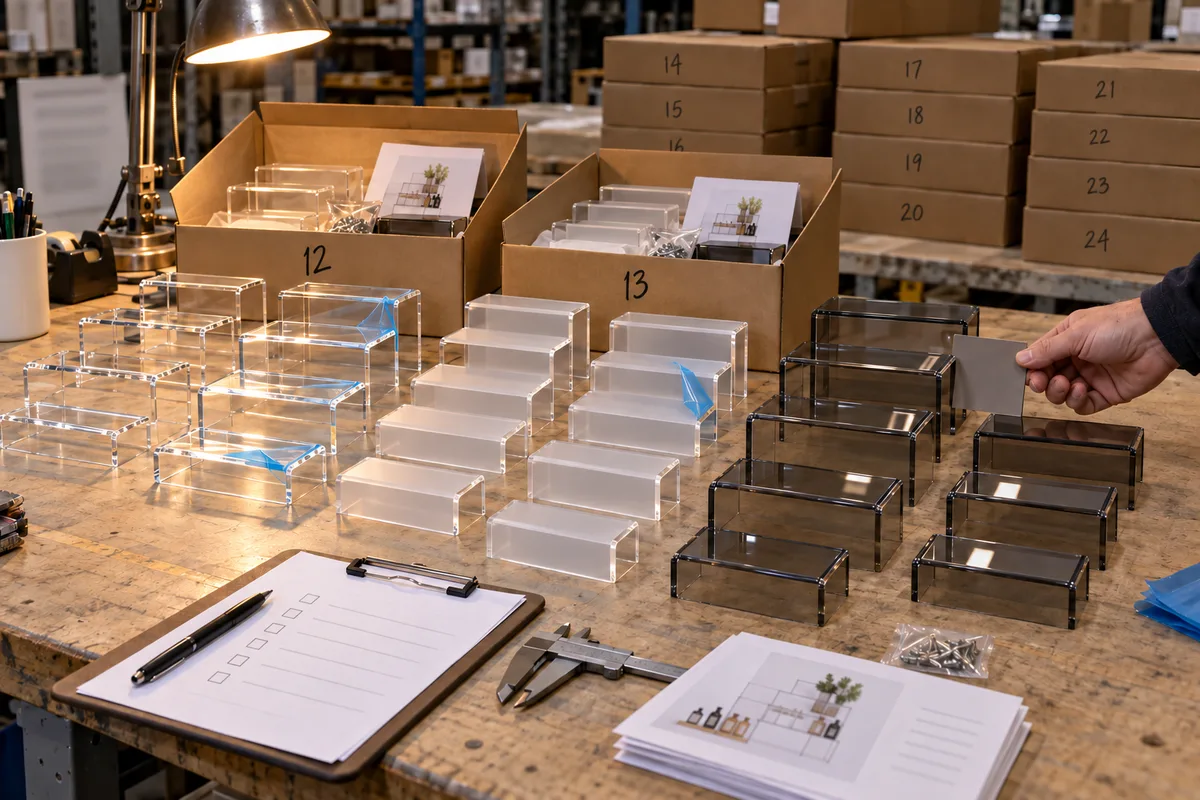
22 days of production. We scheduled the 16 SKU runs across two CNC lines and one thermoforming line, sequenced to keep the highest-quantity SKUs closest to the air freight cutoff. QC sampled every 500-unit batch:
- Color check — X-Rite spectro on 5 random pieces per batch vs locked chip. Tolerance: ΔE ≤ 1.2 (we ran tighter than the buyer's 1.5 spec to leave headroom for transit yellowing risk).
- Edge polish check — 10× loupe inspection on 10 random pieces. Looking for cloudiness, swirl marks, micro-chips. 22 pieces flagged across the run; all replaced before pack.
- Dimension check — calipers on 5 random pieces per SKU. Tolerance ±0.3 mm on all dimensions, ±0.1 mm on slot tolerances where panels join.
Step 5 — Per-store kitting
The chain provided a per-store SKU mix sheet — not every store got every SKU. Some flagship stores got the full 12-SKU set; smaller-format stores got a 7-SKU subset. We built per-store kitting cartons:
- One outer carton per store, labeled with store number and floor manager name
- Inside: each SKU in its own bubble-wrap sleeve
- Assembly hardware (M3 screws, leveling pads) bagged per fixture
- Folded planogram card showing where each SKU sits on the floor
Total: 50 outer cartons, ~108 inner sleeves per store on average. The buyer's logistics team didn't have to re-sort anything at the consolidator.
Step 6 — Split shipment (Day 32-49)
We split the 5,400 units across two shipments:
- Wave 1 (air, 1,200 units) — the 12 highest-priority stores by sales volume. Air freight Shenzhen → Los Angeles → onward truck. 6 days door to store. Day 32 → Day 38.
- Wave 2 (ocean, 4,200 units) — the remaining 38 stores. Ocean FCL Shenzhen → Long Beach → cross-dock → 38 LTL deliveries. 17 days door to store. Day 32 → Day 49.
Splitting the shipment cost 8.4% more than a straight all-ocean run. But it cut the flagship-store stockout window by 19 days against the all-ocean baseline. The buyer's finance team estimated three weeks of additional category revenue from the priority stores covered the freight premium ~3×.
Acceptance gates for a 12-SKU rollout
A mixed-SKU program needs one release matrix that both teams can read. Build a row for each SKU with its CAD revision, approved dimensions and tolerances, finish or color-chip reference, pack quantity, hardware list, store allocation, and shipment wave. Name the buyer who can approve each row. Production should hold a SKU when artwork, color, or fixture fit remains open, while approved rows continue through the schedule.
Before shipment, reconcile finished quantities against the approved BOM and scan a sample of store labels against the latest allocation file. Open one complete kit from each store format, then check the contents in planogram order. The buyer should freeze store numbers, address data, and SKU allocation before carton labels print. This gate prevents a conforming display from reaching the wrong store or arriving without its mounting hardware, two failures that a normal piece-level inspection cannot detect.
The Results
The 5% safety stock we shipped with the rollout covered every cosmetic replacement the stores reported, so no store waited on a reorder.
Color consistency held across all 16 production runs. The ΔE ≤ 1.2 internal tolerance (vs the buyer's ΔE ≤ 1.5 spec) gave us margin to absorb minor sheet-batch drift without failing acceptance.
"Two larger US fabricators couldn't commit to the color spec. Wetop locked the warm-gray batch and held ΔE 1.0 across 16 production runs. All 50 stores stocked on schedule."
What This Means for Your Project
If you're planning a multi-store retail rollout — whether 10 stores or 500 — three decisions will determine whether you hit your set date and your color spec:
- Lock the color batch before production starts, not during.Pulling sheets from one cast batch (with documented batch ID) is the single biggest lever for color consistency across SKUs. We refuse to start production without a locked batch number on file.
- Plan air-first / ocean-follow if your store-set window is tight.For multi-store rollouts where some stores have higher sales volume, the freight premium on a small air wave often pays for itself in earlier in-store revenue. Run the math with your finance team — usually the breakeven is 8-12 days.
- Pay for per-store kitting up-front, not store-staff time on the back end.Loose-pack mixed-SKU cartons look cheaper on the per-unit invoice but cost real money in store-staff sort time on opening day. We've measured this — stores typically save 45-60 minutes per location with proper kitting, which adds up across 50+ locations.
For a request for quote — including BOM, expected per-store SKU mix, color specs, and your store-set deadline — see our RFQ guide or use the contact form below.
Planning a multi-store acrylic rollout?
Send us your store list, brand color spec, BOM by SKU, and your set deadline — we'll come back with a DFM review and a quote.
Sample in 5 days · 22-day production · Air-first / ocean-follow split shipment available