




Delivered project · Consumer Electronics
Phone Display Stand for Carrier Retail
A multi-store carrier retailer needed secure acrylic stands for several phone models.
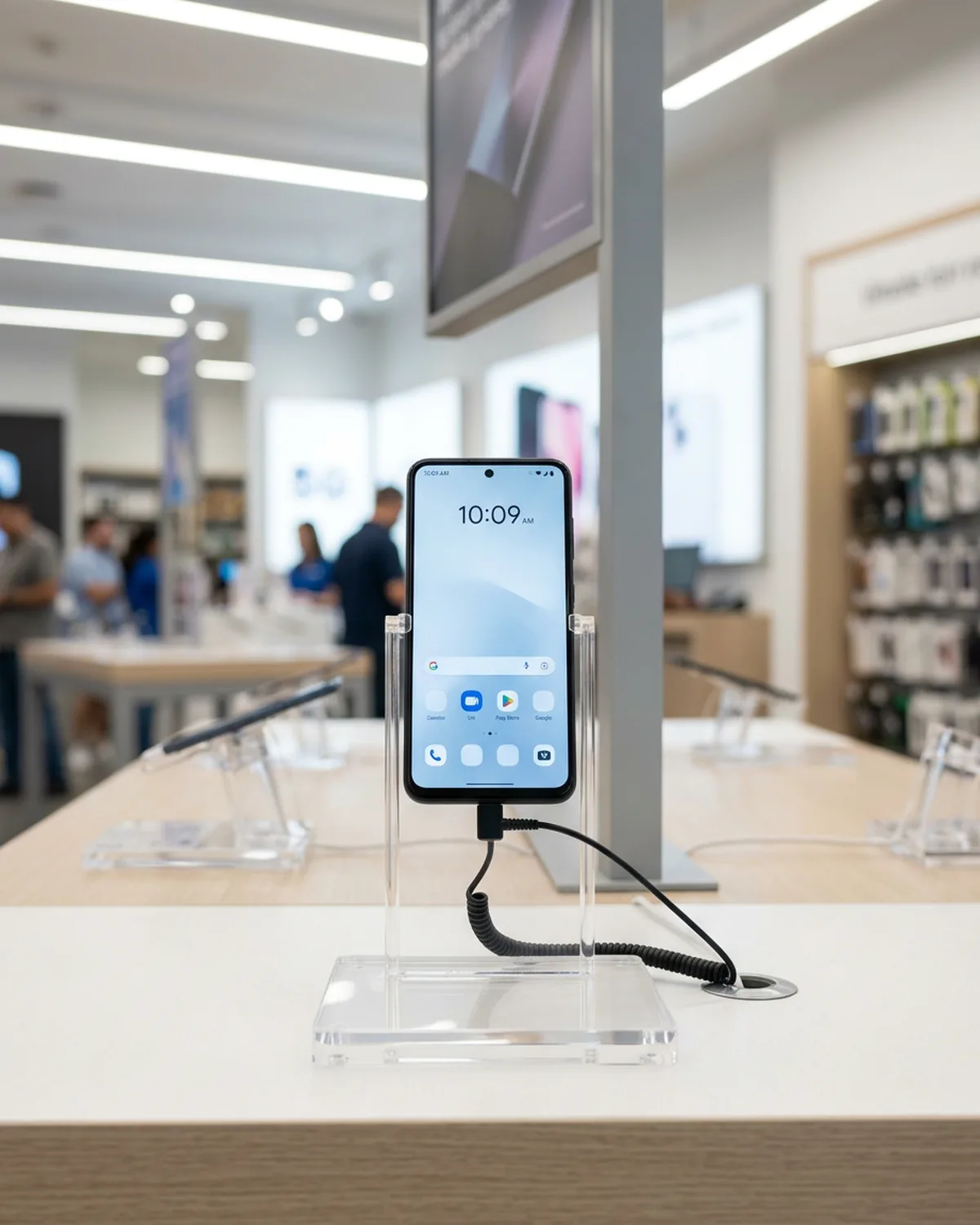
We built one shared base with device inserts, a hidden cable channel and a swappable information card, passed the buyer’s pull test on a paid sample, and produced the stands in 15–20 days, allocated store by store. Delivered: one shared base with buyer-approved device-side inserts, security routing and a passed acceptance test.
Ordering a similar project
MOQ is 100 pieces per design. Paid samples normally take 3–5 days, are paid separately, and are never credited to production. Standard production takes 15–20 days after devices, drawings, security hardware, finish, sample, inspection method, artwork and packing are approved; Wetop responds to a complete brief within 24 hours.
Closest published price: this order was quoted per design. The nearest public reference on the acrylic display manufacturer page is a two-tier countertop stand 250 × 180 × 220 mm, 5 mm clear, one-color UV logo: $28 each at 100 pcs, $16 at 500, $12 at 1,000 (FOB Shenzhen, published reference). Device geometry, security hardware, base construction, finish, artwork, testing, packing, quantity and destination set the final figure.
Key Takeaways
- A multi-store carrier retailer asked us for secure phone stands across several devices; we built one shared base with device-side inserts, each insert on its own drawing.
- The buyer set the security routing, collar, tether hardware and pull-test load, and we passed that test on the production sample.
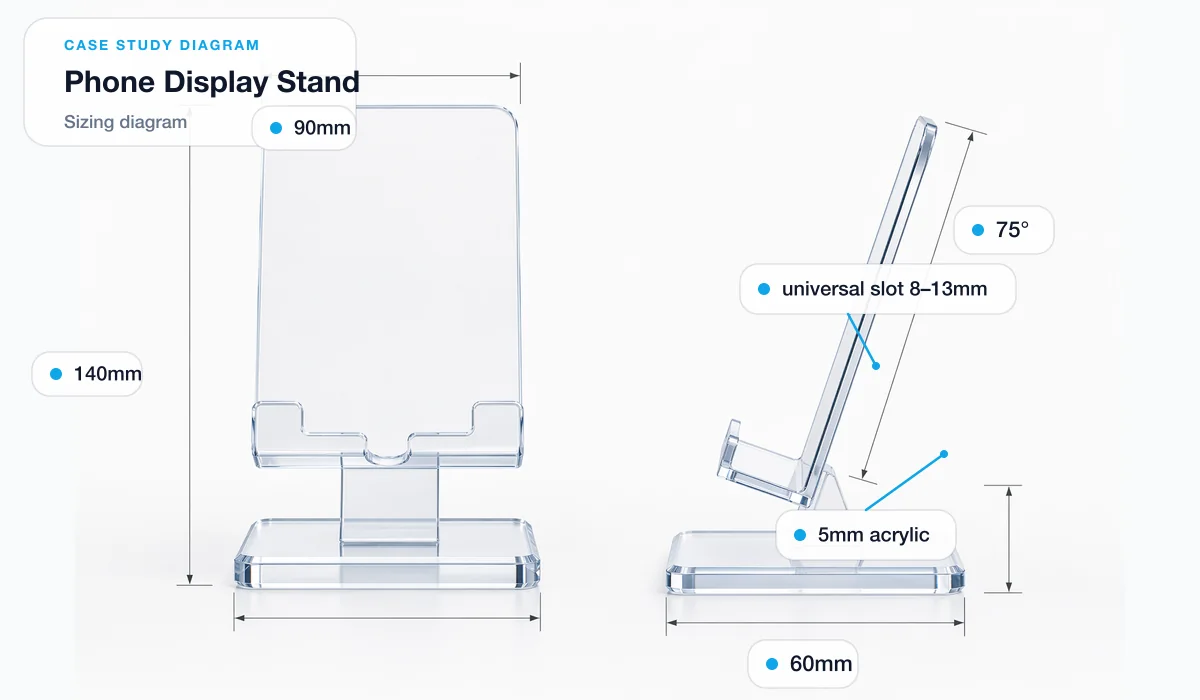
- Viewing angle, device slot and counter footprint came from the actual devices, security hardware and store counters.
- We compared gloss and satin finishes under the buyer's store lighting and cleaning method before release.
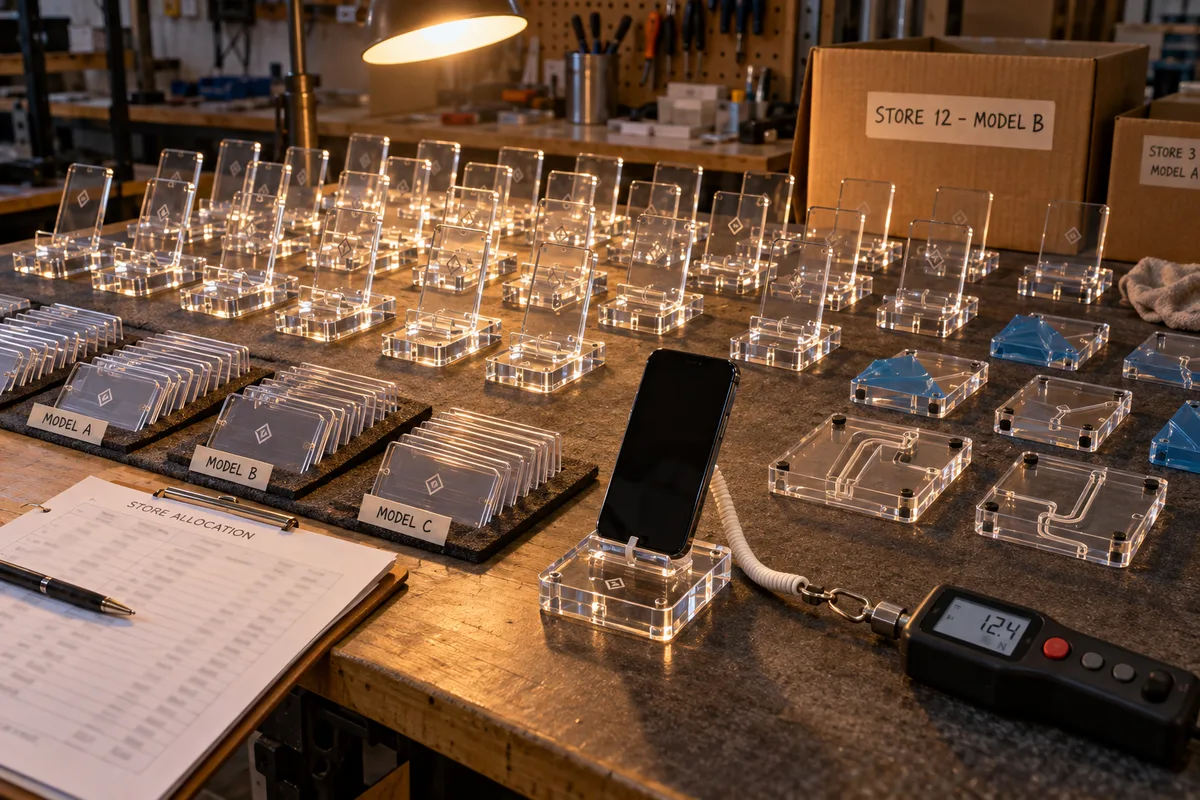
- One device-and-store matrix linked each insert, artwork revision, quantity, destination and carton label.
The Challenge
A multi-store carrier retailer came to us for secure acrylic phone stands. The order covered several phone sizes, local fixture variants, different security systems and artwork that changed by market. Without one controlled device-and-store matrix, a base, insert, information card or cable path could have gone to the wrong store.
We settled on one base with a routed security path, a replaceable information card and a sample-approved finish. Four constraints were fixed before we quoted:
- Several form factors. The buyer supplied each actual device or a controlled 3D file and decided with us whether one insert covered a range or a device needed its own geometry.
- Cable visibility. The buyer named the acceptable cable visibility, the viewing position and the complete tether system for sample review.
- Information cards. The buyer supplied the card stock, dimensions, artwork cadence and the in-store change procedure.
- Multi-store allocation. Finish, artwork revision, device insert, carton label and destination were linked in one release matrix.
Our Approach
We built a modular phone display stand on a shared base, with the device-side insert as the part that changed. Before recommending it we checked that layout against the actual devices, tether, center of mass, card, counter and packing.
One base, buyer-approved device inserts
The drawing kept the base footprint, card location and cable exit common and changed only the insert that holds the device. Base thickness, viewing angle, slot and insert thickness were set on each drawing.
Recessed cable channel for the security path
The anti-theft requirement had two parts: invisible from the front and secure under the buyer’s test. A routed underside channel carried the named cable from the device mount to the counter exit. Channel depth, base thickness, collar, exit and edge clearance followed the released drawing and sample.
Security came from the whole assembly: tether, collar, pass-through, base, counter fixing and cable. The buyer named the test load, duration, fixture and pass/fail criteria. We ran that test on the production sample, recorded it, and carried the same criterion into production inspection. We compared three cable routes:
| Cable strategy | Shopper-side visibility | Outcome on the sample |
|---|---|---|
| Surface-routed cable | Visibility checked from the buyer’s viewing position | Compared, not chosen |
| Cable through base with plastic grommet | Top-surface collar stayed visible on the sample | Collar retention and surface reviewed; not chosen |
| Recessed channel + chamfered steel collar | Visibility checked at the buyer’s eyeline | Chosen; passed the buyer’s load, duration and pass/fail test |
Push-fit spec card slot at the front face
The front face got a slot cut to the buyer’s actual card stock. Card size, thickness, bleed, insertion force, change method and a cycle test were approved on the sample, and the released drawing recorded the slot.
Finish chosen under store light
Gloss and satin behave differently under retail light, touch and cleaning. The buyer compared finish samples under the store lighting with the named cleaner, then approved the outer surfaces and the clearer card window separately. A physical master, named viewing conditions and the buyer’s tolerance went into the inspection record for batch-to-batch checks.
The Results
The paid sample took 3–5 days once devices, drawings and hardware were in hand. On it the buyer used the actual phones, tether hardware, information card, counter fixing and cleaner, and we recorded device removal, cable travel, stand movement, card change, viewing angle, edge condition and finish. Production then ran 15–20 days.
The order shipped with a full release package: device matrix, approved drawings, named security hardware, physical samples, finish reference, card artwork, the buyer’s security test, inspection record, store allocation and packing specification. Every approved insert and artwork revision was tied to a quantity, destination and carton label before release.
For reorders we reuse the released files and the physical finish reference and reconfirm device geometry, security hardware, artwork, quantity, destination and packing. A new phone gets its own insert drawing and paid sample.
Approved on one sample: the buyer signed off device fit, viewing angle, security routing, pull-test criteria, information-card change, finish and packing on the production sample.
If You're Planning Something Similar
Decide early what can be shared: a common base with device inserts cuts duplicated setup only when your devices, security system, counter, card and packing all fit that layout. Design the cable path at the drawing stage, since retrofitted cable management changes both looks and retention. Review finish under your own store lighting with your cleaner, and re-check the matrix whenever a handset, tether, card, counter fixing or destination changes. The custom display stand procurement guide lists the inputs we need, and the acrylic display manufacturer page shows the range.
Need secure phone stands for your stores?
Send us your device list (even photos are fine), your anti-theft spec, and your store count. We will return with a DFM review, a modular base + wedge recommendation, and a quote.