



Delivered Project · Technical / Industrial
Custom Acrylic Precision Component Program
An OEM manufacturer needed two precision acrylic parts for its assembly: a housing panel and a window panel.
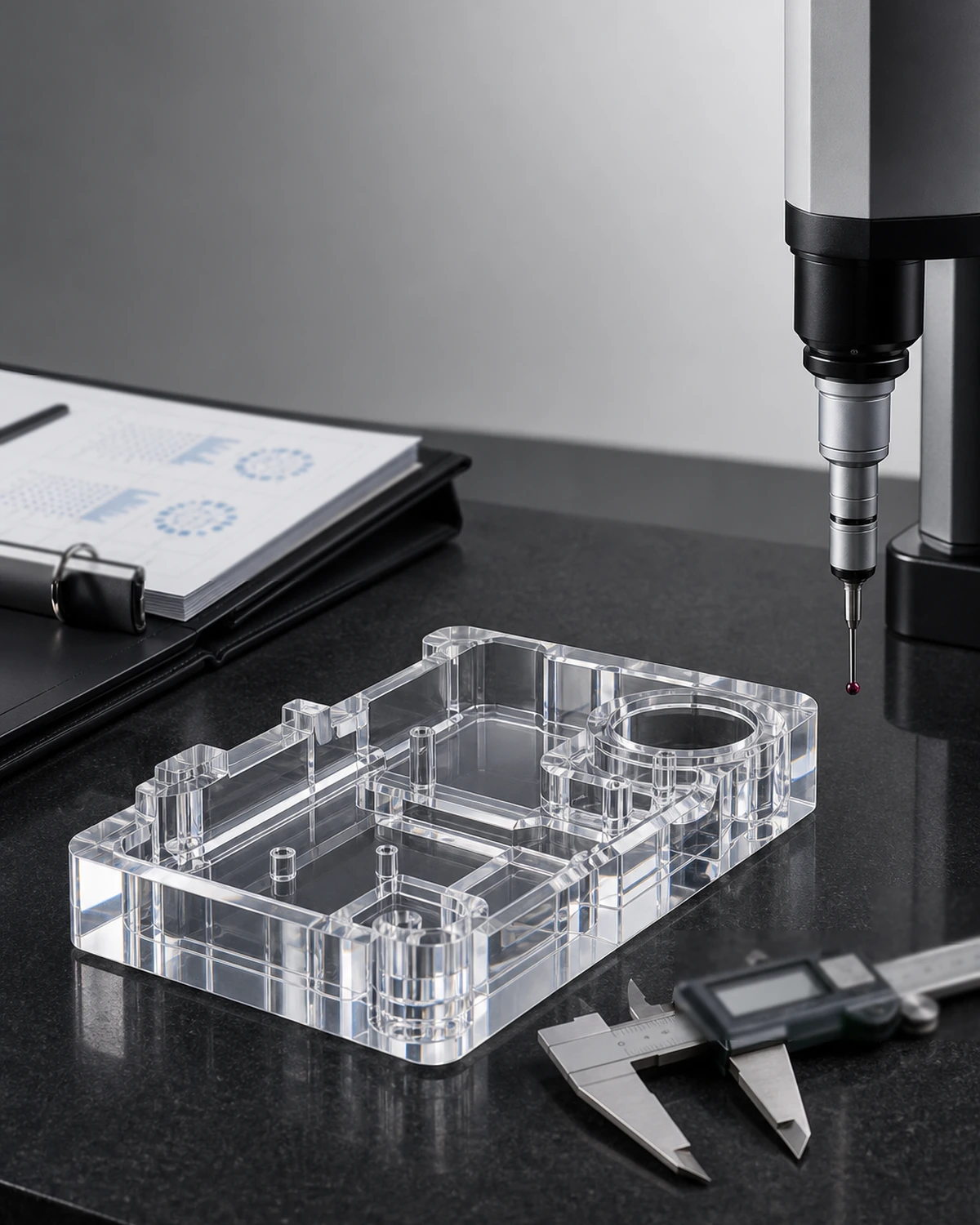
We reviewed its drawings, named material, measurement method, first-article format, finish, packing and inspection plan before we quoted a tolerance, then released bulk production against the approved drawing and physical sample. Delivered: two drawing-controlled parts with buyer-defined acceptance criteria, first-article review, staged inspection and protective packing.
Ordering a similar project
The minimum order is 100 pieces per design. Paid samples normally take 3–5 days; sample fees are paid separately and never credited. Standard production takes 15–20 days after the drawing, material, sample, inspection plan, finish, and packing are approved. Wetop responds to a complete brief within 24 hours.
Closest published price: these parts were quoted from the buyer's drawings. The nearest public reference is on the acrylic cases hub: a 150 × 100 × 100 mm magnetic-lid case in 3 mm clear acrylic at 500 pieces from $6 per unit FOB Shenzhen. Precision parts price from geometry, tolerance, material, fixture, finish, inspection, packing, quantity and destination.
Key Takeaways
- An OEM manufacturer sent us released drawings for two cast-acrylic parts, a housing panel and a window panel, with its own measurement method and first-article report format.
- We did not quote a tolerance until we had reviewed geometry, sheet, fixture route and the sample; the buyer's first-article report then set the method, instrument, sample size, limits and release authority.
- Material grade, fixture, machining sequence, finish, packing and inspection frequency went into one controlled release record, and drawing access stayed restricted.
- After first-article sign-off we moved into bulk production, checking critical dimensions at the agreed frequency with traceable records.
The Brief
An OEM manufacturer came to us with released drawings for two acrylic parts that fit into its own assembly. The package covered end use, material, mating parts, measurement method, inspection format, quantity, packing, destination and revision rules. What we could hold repeatably depended on geometry, unsupported span, thickness, machining sequence, finish and the buyer's assembly, so we set no tolerance before reviewing all of them.
The buyer marked critical dimensions apart from reference dimensions and said where each feature was measured. Where a flatness callout lacked a datum, conditioning state, fixture method, instrument or permitted result, we asked for it before quoting. The buyer supplied its report template and kept authority over supplier qualification. We are ISO 9001 certified; this project did not claim AS9100 or IATF certification.
Our Approach
We built the manufacturing route around the named critical features: incoming material checks, a vacuum-bed fixture, staged machining, a stress-relief step, finishing, first-article measurement and the buyer-approved inspection plan. Each step went in because the drawing and the physical sample showed it was needed.
Fixture strategy followed the actual geometry
Before choosing workholding, we reviewed clamping force, tool access, unsupported areas, heat and the risk of marking visible faces. The material and geometry called for stress relief, so we wrote the process conditions and acceptance method into the sample record and checked them on the sample.
First-article report in the buyer's format
Our first-article package listed the drawing revision, material record, instrument, calibration status, datum scheme, measured sample, results, deviations and reviewer, filled into the buyer's own template. The buyer approved the format and decided whether the first article released bulk production. We kept it as an inspection record for this order, not a certificate under another quality standard.
Staged checks before final inspection
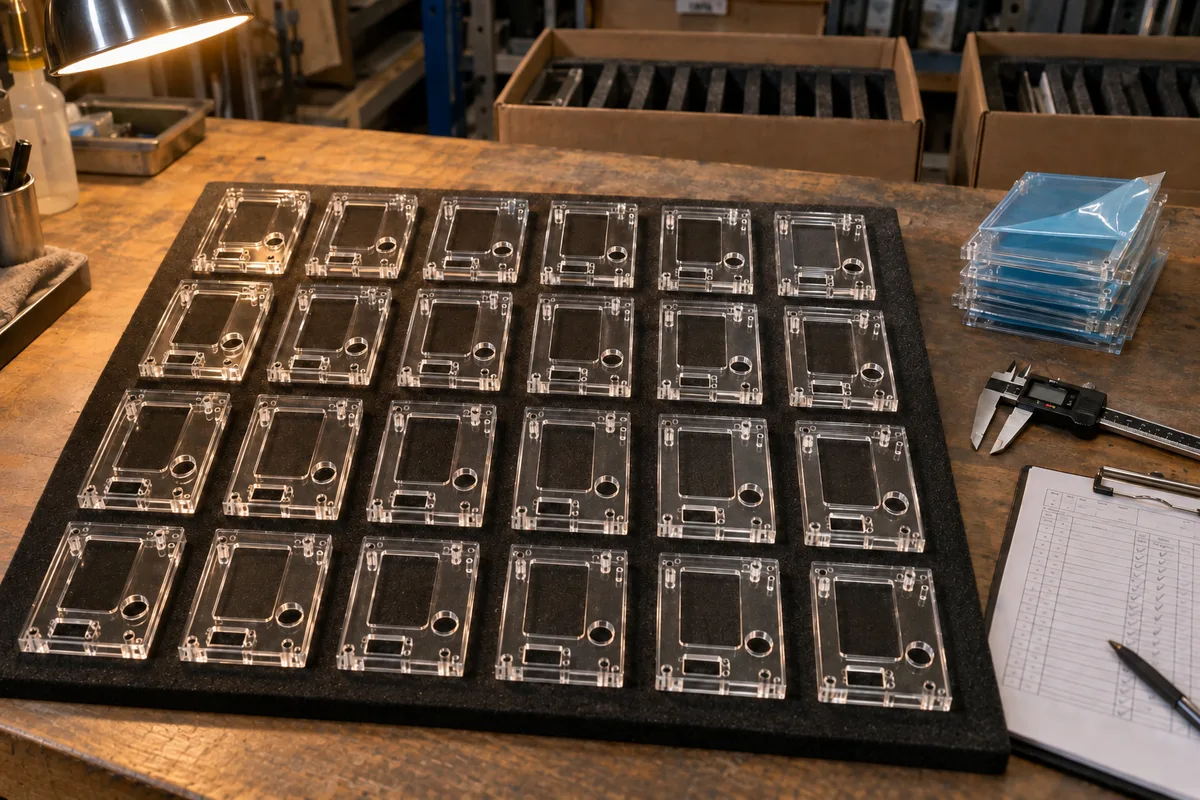
We measured critical features right after the operation that created them instead of waiting for final inspection. Sampling frequency, instrument, permitted result, reaction plan and record retention were agreed with the buyer before release. Cosmetic inspection used a named light, viewing distance, surface class and the approved physical sample.
Spec Breakdown and Production
The two variants shared a material family and documentation structure, with separate drawings and samples. The housing panel had an internal pocket, a polished optical face, a matte rear face, a set edge condition, mating geometry and critical dimensions. The window panel was about visible-face finish, chamfer, clarity and assembly fit. We fixed thickness and tolerance for each after reviewing the named sheet, span, fixture route and sample.
Production ran 15–20 days after the drawing, material, first article, finish, inspection plan and packing were approved. We quoted freight separately, based on mode, destination, carton size and delivery terms.
The release package held the approved drawing revision, material record, first-article report, finish reference, inspection plan, deviation record, carton specification and destination allocation. Bulk production had to match those records. The buyer released each production drawing, and we recorded any accepted deviation before machining the affected quantity.
Repeat-Order and Revision Control
For follow-on runs against unchanged drawings, we kept the approved FAI format, vacuum-bed fixture, stress-relief profile, material source, program, inspection form and packing layout on file. That cut engineering setup and gave the buyer the documents for its own approved-vendor review; qualification stayed the buyer's decision.
Where the buyer named a sheet grade or batch record, our quote identified the supplier document and how the lot was tied to finished parts. We passed supplier documents through as issued, not rewritten as our own test results.
What we settled first: the measurement method and FAI format, against the buyer’s quality system, before bulk parts reached its assembly line.
If You're Planning Something Similar
Bring the drawing revision, a critical-feature list, the measurement method, your first-article format, sampling plan and reaction plan. A repeat order reuses fixtures and programs only when drawing, material, finish, acceptance method, mating assembly and destination are unchanged; a revision goes back to DFM review and may need a new paid sample or first article. The CNC versus laser cutting guide explains how geometry and edge requirements drive the process, and the acrylic CNC machining service page lists the quote inputs. See how we approach precision acrylic manufacturing.
Need a precision acrylic part for your assembly?
Send us the drawing, material requirement, measurement method, first-article format, quantity, packing, and destination. We will return a DFM review, sample plan, inspection outline, and written quote.
Paid sample in 3–5 days, separately paid and never credited.